Hubbry Logo
El VientoEl VientoMain
Open search
El Viento
Community hub
El Viento
logo
7 pages, 0 posts
0 subscribers
Be the first to start a discussion here.
El Viento
El Viento
from Wikipedia
El Viento
Cover art for the Japanese version
DeveloperWolf Team
Publishers
DirectorHiroyuki Kayano
ProducerMasaaki Uno
ProgrammersYukihiko Tani
Hiroshi Izumino
ArtistKazutoshi Yamane
WriterChishio Otsuyama
ComposerMotoi Sakuraba
PlatformGenesis
Release
GenrePlatform
ModeSingle-player

El Viento (エル・ヴィエント, Eru Viento; from Spanish meaning "The Wind") is a 1991 platform game developed and published by Wolf Team for the Sega Genesis. It is the first in a trilogy of games, which includes Earnest Evans and Anett Futatabi, despite taking place after the former.[3]

Gameplay

[edit]

El Viento is a platform game. The player has access to an endless supply of bladed boomerangs and eventually up to five spell attacks. Each level ends in a fight against a stage boss.[4]

Plot

[edit]

The game shares the same fictional universe with Earnest Evans, and happens several years later. It also features many references to H. P. Lovecraft's Cthulhu Mythos. The game takes place in New York City during the late 1920s, when cult leader Henry, the gangster Al Capone (Vincente DeMarcoto in the American localization), and a sorceress named Restiana plot to awaken the ancient and malevolent god Hastur. There are some people that have descended from Hastur's ancient bloodline, one of which is the young Peruvian sorceress, Anett Myer. With some assistance from Earnest Evans, Anett attempts to stop the cult from resurrecting Hastur using the very spells of this bloodline.

Reception

[edit]

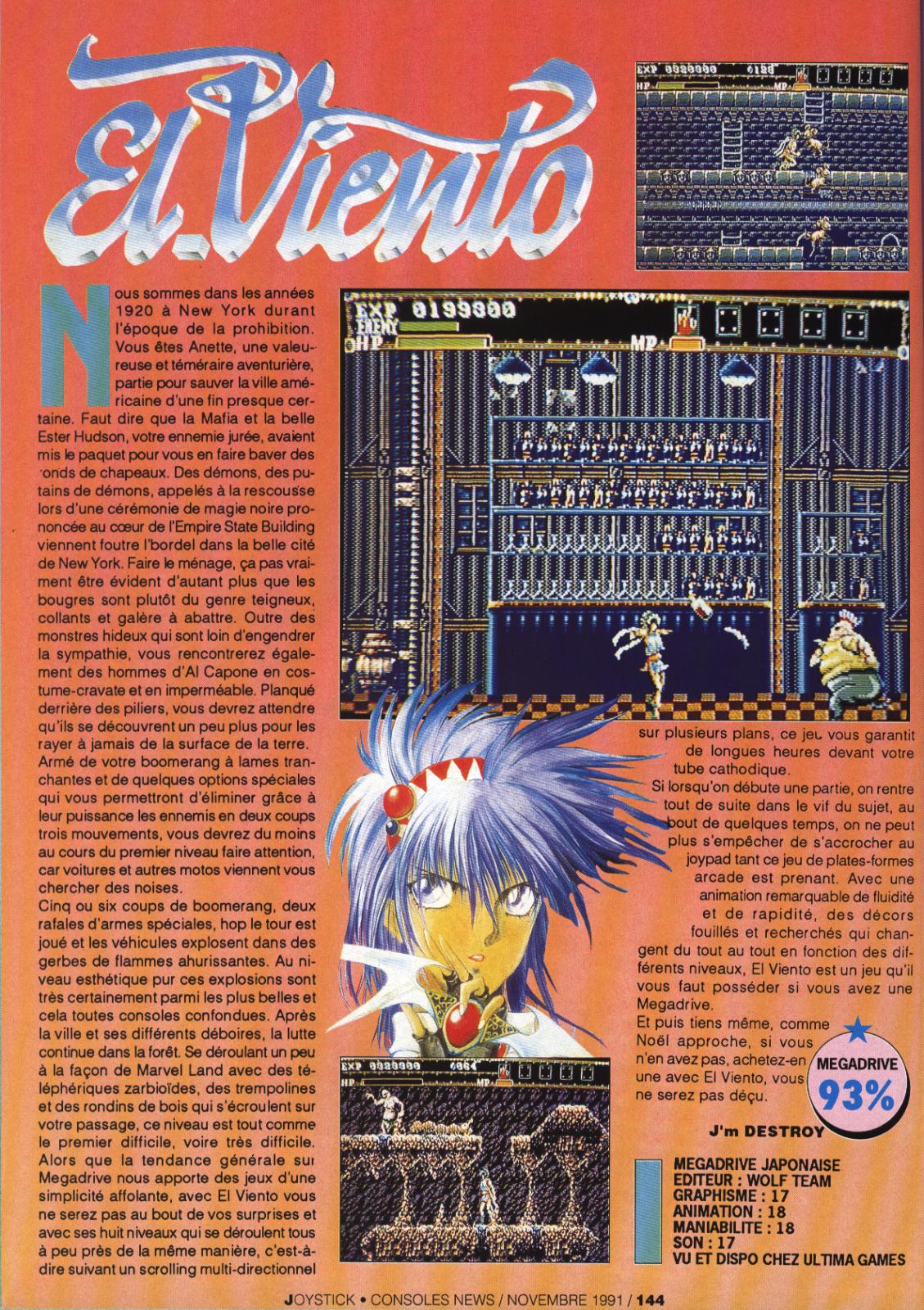
El Viento was given mixed but mostly positive reviews, including being rated 93% by Joystick in France,[5] 66% by Super Play,[6] and 68% by Video Games[7] in Germany. Damian Butt from Sega Pro gave it a score of 89%: "With super fast graphics and brutal gameplay, El Viento will take your breath away."[4] On the other hand, Entertainment Weekly gave it a D−, opining that "only the game's amusing historical anachronisms-like denim-clad blond bikers wielding scimitars-save it from rating as a total failure."[8] MegaTech gave a score of 80% summarizing: "A tough 'n' challenging platform which doesn’t look particularly hot, but is surprisingly addictive and keeps you playing for ages."[9]

Retrospectively, Rodger Swan from Sega-16 gave this "great and challenging action game" an 8 out of 10 in spite of being at times "far too difficult," stating: "It may not have as pretty graphics or music as the Valis titles, but it has some really fast game play that gets players in the mood for action. This is a game that I encourage all action fans to pick up, and fans of Valis will appreciate the sense of speed!"[10] According to Kurt Kalata of Hardcore Gaming 101, "overall, it's a bit of a sloppy game, with haphazard action and iffy level design, but the fast pace and overall craziness make this worth looking into, especially since it's one of Wolf Team's better titles."[3]

References

[edit]
[edit]
Revisions and contributorsEdit on WikipediaRead on Wikipedia
from Grokipedia
El Viento is a 1991 action-platform video game developed and published by Wolf Team for the Sega Mega Drive (known as the Sega Genesis in North America). Set in 1920s New York City, the game follows Annet Myer, a Peruvian sorceress descended from the cursed bloodline of the ancient wind god Hastur, as she uses her mystical boomerang named El Viento and elemental magic to thwart a cult's ritual to resurrect their dark master atop the unfinished Empire State Building. The title, meaning "The Wind" in Spanish, draws inspiration from H.P. Lovecraftian horror elements, featuring grotesque monsters and occult themes throughout its side-scrolling levels. Players control Annet through six stages, including sewers, haunted caves, and urban rooftops, battling enemies and bosses with a combination of attacks, throwable boomerangs, and limited-use spells tied to , , and other elements. The emphasizes precise platforming and , with health and magic meters that deplete during combat and can be replenished by collecting items scattered across the environments. Originally released in in September 1991 and in in November 1991 by Products, it received a planned but canceled European launch, though saw an official distribution; minor localization changes included renaming the gangster antagonist from to Vincent DeMarco to avoid historical sensitivities. El Viento serves as the first entry in a loose trilogy sharing a fictional universe, followed by Earnest Evans (1991, a prequel adventure game) and Anett Futatabi (1993, a direct sequel for the Sega CD). The game has garnered a cult following among retro gaming enthusiasts for its atmospheric storytelling, anime-inspired animation by Studio Madhouse, and challenging difficulty, earning average critical scores around 73% and player ratings of 3.5 out of 5. In recent years, it has seen renewed availability through re-releases, including the Evercade Renovation Collection 1 in 2022, a limited Collector's Edition cartridge by Retro-Bit in January 2024 marking its first official European physical release with 3,400 units produced worldwide to support game preservation efforts, and the Earnest Evans Collection digital release on December 25, 2025, for Nintendo Switch, PlayStation 4, and PlayStation 5 in Japan.

Development

Production Team

Wolf Team served as both the developer and publisher of El Viento for the Sega Genesis in 1991, drawing on their growing expertise with the platform that year through concurrent projects like Arcus Odyssey and Dino Land . Masaaki Uno acted as producer, managing the project's budget, timeline, and coordination with Wolf Team to ensure timely completion. Masahiro Akishino served as executive producer, overseeing broader production aspects. Hiroyuki Kayano directed the game, providing oversight on the overall creative vision and the integration of its elements. The programming was led by Yukihiko Tani (credited as Small Tarō), who handled the core engine development, alongside assistant programmer Hiroshi Izumino, with their efforts focusing on the platforming physics and spell-casting systems. Kazutoshi Yamane designed the main characters, sprites, backgrounds, and boss visuals, contributing to the game's distinctive aesthetic and supernatural motifs. Chishio Ōtsuyama handled planning and story writing, scripting the narrative elements inspired by the to weave themes into the action-platformer framework. Motoi Sakuraba composed the original soundtrack, featuring atmospheric pieces such as the Stage 1 theme and intense boss tracks like the Stage 1/2/3 Boss theme, which enhanced the game's eerie tone and dynamic action sequences.

Design Influences

The design of El Viento prominently incorporates elements from H.P. Lovecraft's , with the ancient entity serving as the central worshipped by a seeking to unleash chaos upon the world. This influence manifests in the game's supernatural threats, including eldritch abominations that embody cosmic horror, drawing directly from Lovecraft's tales of otherworldly beings and . The developers at Wolf Team integrated these motifs to infuse the with a layer of dread, where players confront not just physical foes but incomprehensible forces, as seen in the final confrontation with itself. The game's settings across America, including and , evoke the Prohibition-era aesthetics of urban grit, speakeasies, and , reflecting the period's social decay and shadowy underworld. Initial stages set amid Chicago's criminal hideouts, expanding to other American landmarks such as rain-slicked streets, haunted caverns beneath , and urban sewers to heighten the atmospheric immersion. This historical backdrop, combined with Lovecraftian elements, creates a unique fusion of real-world Americana and supernatural peril, emphasizing themes of hidden cults operating amid societal upheaval. El Viento's mechanics draw inspiration from contemporaries like the series, adapting linear exploration and combat into a faster-paced action experience tailored to the hardware. Rather than a traditional whip-based arsenal, protagonist Annet Myer employs a as her core weapon, enabling rapid, returning projectiles that encourage aggressive playstyles, while collectible spells add mystical variety akin to sub-weapons in similar titles. This twist aligns with Annet's Peruvian heritage as a sorceress, grounding her abilities in cultural and wind-based lore tied to her lineage. Boss encounters further blend action-platforming with horror, modeling massive eldritch horrors that warp the screen and demand precise timing to evade otherworldly attacks. Examples include amorphous, tentacled entities that evoke Lovecraft's indescribable monsters, shifting the tone from gangster shootouts to visceral confrontations with the unknown, thereby distinguishing El Viento's hybrid genre appeal.

Gameplay

Core Mechanics

El Viento is a 2D side-scrolling where players control Annet , navigating linear stages filled with enemies, obstacles, and environmental hazards through precise movement and combat. The core mechanics revolve around a combination of agile platforming and versatile offensive options, emphasizing quick reflexes and strategic resource use to progress. Annet's abilities are designed for fast-paced action, allowing her to traverse 1920s-inspired American settings while combating cultists and eldritch creatures. The primary weapon is an endless supply of bladed boomerangs, thrown horizontally with the A button and capable of multiple simultaneous uses. These boomerangs seek out nearby targets during flight and inflict additional damage to enemies and destructibles upon return, with throw angles varying based on Annet's stance—such as crouching for lower arcs or jumping for elevated trajectories. This homing return mechanic encourages positioning to maximize hits, breaking enemy defenses before follow-up attacks. Complementing the boomerang, Annet can equip up to five spell attacks, unlocked progressively via spell book pickups throughout the game, with selection and charging handled via the C button for versatile combat. Spells consume mana from a depletable bar that regenerates when not in use, and their power scales with charge time; examples include the starting Fireball for horizontal projectile shots, Water Current for a protective ground-based water stream that pushes foes, Wind Cutter for sweeping gusts covering tall areas, for area-denying blasts, and Seeker Charges for automatic homing orbs that defend against incoming threats. Upgrades to mana capacity occur via score-based thresholds, enabling sustained spell use in intense sequences. Platforming fundamentals include directional movement with the , jumping via the B button for height and distance, a crouching dash (down + directional + B) for sliding under obstacles or crossing gaps at high speed, and climbing on certain walls or ledges by holding upward while in contact. These controls facilitate 2D navigation across multi-section stages, demanding momentum-based maneuvers to avoid pitfalls and reach hidden items. Health management ties into a bar that depletes from enemy contact or hazards, restored partially by pickups scattered in levels or fully at starts, with continues available from the title screen upon death. is minimal, focusing on immediate pickups like restoratives and spell books, while spell slots are chosen implicitly through progression without mid-level reconfiguration. Boss encounters at ends demand —dodging telegraphed attacks like projectiles or summons—while switching to specific spells exploits vulnerabilities, such as using explosions against clustered minions or seekers for defensive coverage during aggressive phases. These mechanics integrate seamlessly with level designs that test traversal and timing, though detailed applications vary.

Level Structure

El Viento features eight main stages, set across 1920s America including urban streets in and , secret caverns under , sewers, grand museums, and foreboding cult lairs culminating at the unfinished . These stages immerse players in the era's atmosphere while escalating the platforming challenges through location-specific hazards; for instance, street levels involve combat against gangsters and navigation of urban obstacles, speakeasies and warehouses feature close-quarters fights, museums require maneuvering around exhibits and security, caverns and sewers present pitfalls and environmental dangers, and cult lairs teem with ritualistic traps spawning enemy swarms of fanatical thugs and eldritch minions. The game's progression follows a strictly linear path, preventing and guiding the Annet through a forward-only journey that builds tension without interruption. Each stage culminates in a boss encounter—ranging from mob enforcers to summoners—that serves primarily as a checkpoint rather than a major narrative pivot, ensuring the story unfolds through inter-stage cutscenes instead. This structure emphasizes relentless momentum, with boomerangs occasionally aiding navigation across wide gaps or ricocheting off walls in tight corridors. Difficulty scales progressively across the stages, beginning with foundational platforming in the initial streets and speakeasies that hone basic jumping and timing against sporadic foes. Later stages, such as the caverns, museums, and lairs, introduce layered complexity through environmental puzzles—like aligning ancient artifacts to unlock paths or manipulating currents with spells—and demand precise combo spell usage to counter denser enemy patterns and timed hazards, fostering mastery of Annet's expanding arsenal without overwhelming novices early on. Hidden secret areas punctuate the stages, offering opportunities for extra lives or temporary power-ups such as enhanced range or spell potency boosts; these are concealed behind destructible walls in speakeasy basements or require pixel-perfect jumps to access elevated ledges, rewarding without derailing the core path. The endgame converges in a climactic multi-phase final boss arena within the deepest atop the , where escalating phases shift from direct confrontations to arena-wide environmental manipulations, testing the culmination of platforming and magical skills acquired throughout.

Story and Characters

Plot Synopsis

In the late 1920s, the story of El Viento unfolds in , where the young Peruvian sorceress Annet Myer arrives to thwart a dangerous cult's plan to awaken the ancient god . Annet, descended from 's bloodline, wields inherited magical spells to combat the threat posed by cult leader Henry, who has forged an alliance with gangster Vincent DeMarco—a stand-in for —and the deceived sorceress Restiana, Annet's distant relative and fellow descendant. As Annet infiltrates DeMarco's criminal operations, she battles through the shadowy of speakeasies and streets overrun by mobsters and emerging creatures spawned by the cult's rituals. Her path leads to repeated confrontations with Restiana, who believes Henry's promises of power but is unknowingly marked for sacrifice in the summoning ceremony. Throughout these encounters, Annet forms an alliance with the adventurer , who provides crucial guidance via brief cutscenes, aiding her pursuit across American locales from urban sewers to remote caverns. The narrative escalates as Annet uncovers ancient artifacts tied to during infiltrations of cult sites, including hidden underground complexes beneath major cities where forbidden rituals invoke eldritch energies. These discoveries reveal the extent of Henry's scheme, blending mafia enforcement with practices to channel power toward the incomplete , designated as the focal point for Hastur's revival. In the climax, Annet storms the shrine, facing off against Henry and a partial manifestation of amid chaotic otherworldly forces. Restiana's transformation into a monstrous form serves as the penultimate challenge, underscoring the 's corrupting influence. Annet ultimately defeats the antagonists, disrupting the and banishing Hastur's emerging presence, though subtle hints of lingering threats from the bloodline and cult remnants foreshadow broader dangers.

Key Characters

Anett Myer serves as the central protagonist of El Viento, portrayed as a young Peruvian sorceress with a deep familial connection to ancient mystical forces. Driven by her heritage as a descendant of those who once sealed away the eldritch entity , Anett embarks on a quest in America to thwart a cult's , leveraging her innate magical affinity inherited through her bloodline. Her character embodies resilience and determination, shaped by a legacy of safeguarding the world from cosmic horrors, making her the only individual capable of confronting directly due to their shared lineage. Earnest Evans appears as Anett's key ally and mentor, an adventurous explorer who provides crucial support during pivotal moments in the story. As a rugged, Indiana Jones-inspired figure, he aids Anett in joint confrontations against cult forces, drawing on his experience from prior exploits to offer tactical guidance and physical assistance in high-stakes scenes. His role underscores themes of camaraderie, having previously rescued a young Anett from peril in Peruvian ruins, which forges their ongoing partnership against supernatural threats. Henry emerges as the primary , a charismatic yet deranged leader orchestrating the summoning of through insidious rituals in 1920s New York. Manipulative and steeped in forbidden knowledge, he employs dark magic to deceive followers and advance his apocalyptic agenda, viewing the as a path to ultimate power. His tactics involve psychological coercion and arcane ceremonies, positioning him as a formidable foe whose fanaticism drives the narrative conflict. Among the secondary antagonists, Vincent DeMarco—known as Al Capone in the Japanese version—functions as a ruthless gangster allied with Henry's , supplying armed enforcers and resources to eliminate threats like Anett. Operating from Chicago's underworld, he represents the intersection of Prohibition-era crime and supernatural conspiracy, using his criminal empire to protect the cult's operations. Restiana, another rival figure, is a seductive sorceress aligned with the , who seeks to harness Hastur's power for her own ambitions but ultimately serves as a sacrificial pawn in their ritual atop the nascent . Deceived by promises of godlike abilities, her betrayal highlights the cult's exploitative nature. Minor characters include the cultists, fanatical devotees who populate the story as disposable enforcers wielding rudimentary dark incantations, originating from a secretive revived in the to revive their dormant deity. Mythical entities, such as lesser manifestations of Hastur's influence like shadowy minions and ancient guardians, act as spectral enemies drawn from Cthulhu-inspired lore, embodying the game's blend of cosmic horror and .

Release

Publication History

El Viento was initially released in Japan on September 20, 1991, for the Mega Drive, developed and published by Wolf Team. A North American version followed in November 1991 for the , published by Products under the same title. There was no official European launch at the time beyond , where the game was officially distributed with an extra translated manual, though it circulated via imports among enthusiasts elsewhere. The Japanese packaging featured striking box art depicting the protagonist Annet wielding her boomerang against the looming figure of in the background, emphasizing the game's themes. The included instruction manual was a comprehensive 24-page booklet in Japanese, rich with lore detailing the 1920s setting, character backstories, and mythological elements drawn from the , complete with full-color illustrations and concept art. Commercially, El Viento saw modest performance in , overshadowed by more mainstream titles and appealing primarily to fans of action-platformers with horror influences, establishing it as an under-the-radar gem rather than a blockbuster. No precise figures are available, but its status has since driven collector prices well above ¥20,000 for complete copies. The release aligned with Wolf Team's active Genesis portfolio that year, including titles like Sol-Deace, which shared promotional channels within 's import and domestic gaming press.

Localization and Ports

El Viento received an official English localization for its North American release on the in November 1991, published by Products, with in-game text fully translated into English while retaining the original Japanese audio and sound effects. Minor adaptations were made, such as renaming the gangster character from to Vincent DeMarco to avoid potential legal issues with real historical figures. A European release was planned for November 1991 by at a price of £44.99 but was ultimately cancelled for unknown reasons, limiting official availability in and forcing interested players to import the or Japanese versions during the 1990s. However, it was officially distributed in with an extra translated manual. These imports posed significant challenges for Western players outside , including high costs—often exceeding $100 due to rarity and shipping—and language barriers for the Japanese edition, which featured untranslated text. The game has no official ports to other hardware beyond its original /Mega Drive format, but it has seen several re-releases that enhance accessibility through emulation or hardware compatibility. In 2022, El Viento was included in the Evercade's Renovation Collection 1, a cartridge-based compilation of 12 Renovation-published titles, where it runs via emulation with added features like save states and rewind functionality to aid modern playthroughs, though no graphical or content updates were applied. Physical reprint editions for original Genesis hardware followed, including Retro-Bit's 2024 release with a newly reproduced English manual and improved packaging, and Columbus Circle's 2024 Japanese reprint compatible with all regions. Digitally, it became available in via D4 Enterprise's Project Egg service starting in 2006, offering the original version without modifications. Most recently, the Collection—bundling El Viento with its trilogy sequels—was announced for release on December 25, 2025, for , , and in , marking the first official modern console port and providing broader Western access pending localization details. These re-releases have preserved the game's original presentation, focusing on compatibility rather than overhauls, while increasing its availability beyond the high prices of original cartridges, which can exceed $200 on secondary markets. Fan-driven efforts have supplemented official options since the early 2000s, particularly through emulation communities. The 2010 "El Viento Enhancement" patch by Jon Najar, applied to the ROM, refines with better sprite scaling, enhanced music playback, support, and reduced slowdown, making it more suitable for modern displays without altering core content. Additional fan translations, such as a complete Spanish version based on the enhancement, have been released via sites, addressing gaps in non-English regions. These modifications, distributed freely through communities like Romhacking.net, have enabled global play via emulators long before recent re-releases, though they require technical setup.

Reception

Initial Reviews

Upon its release in Japan in September 1991, El Viento received solid but not exceptional scores from domestic publications, averaging around 60-70%. awarded it 22 out of 40 (equivalent to 55%), praising the atmospheric integration of elements like Cthulhu-inspired bosses while noting occasional difficulty spikes in platforming sections that could frustrate players. Similarly, Beep! Mega Drive gave an average of 65% across four reviewers in its October 1991 issue, highlighting innovative spell mechanics such as wind-based attacks for their creativity in combat, though critics pointed out uneven pacing and short overall length as drawbacks. Mega Drive Fan scored it 67% in December 1991, appreciating the boss fights' spectacle but criticizing unfair enemy placements in later levels. In Western markets, the game saw an official US release in November 1991 by Products, though with limited localization including Japanese text, leading to mixed reception reflecting challenges with accessibility and exposure. French magazines were particularly enthusiastic; and Joypad both rated it 93% in November 1991, lauding the visuals' dynamic scrolling and the immersive 1920s cult storyline blended with eldritch themes, though they acknowledged control issues during precise jumps. UK import coverage varied: Sega Pro gave 89% in November 1991, emphasizing the "super fast graphics and brutal gameplay" that created a breathless atmosphere, while Mega Tech scored 80% for its strong pacing in early stages but deducted points for repetitive platforming frustrations. Lower marks included ACE's 52% in November 1991, which slammed the drab color palette and unresponsive controls, and Super Play's 66% in early 1992, criticizing clunky mechanics despite praising the eerie boss designs. German Video Games magazine assigned 67% in 1991, commending the atmospheric horror but faulting the short length and sudden difficulty jumps. In the US, delivered a high 92% in February 1992 for its engaging lore and varied level structures, but issued a harsh D− grade, calling it overly frustrating due to unfair platforming and poor hit detection. Overall, contemporary feedback positioned El Viento as a favorite among import enthusiasts, valued for its unique horror-action fusion and memorable bosses, yet hampered by technical rough edges and brevity that limited broader appeal in the West.

Modern Assessments

In a 2007 retrospective, Sega-16 awarded El Viento an 8/10 rating, commending its fast-paced action gameplay—highlighted by the Annet's dashing abilities and responsive controls—as a standout feature that elevates the experience beyond typical platformers of the era. The also praised the game's deep integration of lore, centering on a attempting to resurrect the Hastur, with Annet's magical powers tied to this eldritch heritage adding narrative intrigue. However, it critiqued the dated graphics, noting their lack of color and animation fluidity compared to contemporaries like the Valis series. A 2017 retrospective by Hardcore Gaming 101 placed El Viento within the context of the trilogy, emphasizing its role as the first entry where Annet Myer combats supernatural threats, setting up connections to sequels like and Anett Futatabi. The analysis highlighted composer Motoi Sakuraba's involvement, describing the as an early, if unremarkable, effort from the artist who later gained acclaim for intricate scores in titles such as and , underscoring its underrated position in his oeuvre. Despite uneven level design and haphazard action, the piece appreciated the game's frenetic pace and chaotic energy as redeeming qualities. Feedback on the 2024 Retro-Bit Collector's Edition re-release for /Mega Drive has been largely positive as of 2024, with reviewers appreciating the physical reproduction and preservation effort that makes the game accessible on original hardware. Nonetheless, the absence of English localization persists as a significant drawback, forcing reliance on community patches to access the story. Emulation communities on sites like Romhacking.net view El Viento's high difficulty—manifest in precise jumps, relentless enemies, and punishing bosses—as a deliberate design choice that amplifies its atmospheric horror, evoking dread through unforgiving encounters with . Fan mods, including English text translations, have been essential in broadening access, allowing players to fully engage with the narrative without Japanese proficiency barriers. Overall, modern reappraisals position El Viento as a pioneering console adaptation of the , blending action-platforming with eldritch themes in a way that was ahead of its time.

Legacy

The Trilogy

El Viento is the first game in release order but the second in story chronology of a trilogy developed by Wolf Team, known collectively as the series in Western markets. The release order begins with El Viento for the , launched in on September 20, 1991, and in in November 1991. This is followed by Earnest Evans for the , released in on December 6, 1991, and in in April 1992. The trilogy concludes with Anett Futatabi for the , released exclusively in on March 30, 1993. Chronologically, the events of El Viento occur after those in , shifting the focus to Annet Myer's independent quest against supernatural forces in 1928 New York. [Earnest Evans](/page/Earnest Evans) establishes the backstory, detailing adventurer ' initial encounters with ancient perils in , where he allies with Annet. El Viento then depicts Annet's solo journey to thwart the resurrection of the entity , building directly on the prior game's lore without Earnest as a playable character. The narrative arc culminates in Anett Futatabi, set two years after El Viento, where Annet confronts lingering threats from the series' mythos. The trilogy shares core elements that unify its supernatural adventure theme, including recurring protagonists Annet Myer, a Peruvian wind sorceress, and , who appears in supporting roles across titles. Consistent antagonists draw from H.P. Lovecraft-inspired mythos, with serving as the central eldritch threat threatening global domination. Annet's magical abilities evolve progressively: basic wind-based spells in Earnest Evans, expanded boomerang and elemental attacks in El Viento, and enhanced combo-oriented magic in Anett Futatabi's format. All three games were developed by Wolf Team, a Telenet Japan subsidiary known for action titles on Sega hardware, ensuring stylistic continuity in fast-paced combat and cinematic cutscenes. Composer Motoi Sakuraba provided the soundtrack for the entire series, blending orchestral motifs with rock influences to underscore the 1920s pulp adventure tone. The series concluded its original run with Anett Futatabi, resolving the central conflict against the mythos entities without subsequent new entries from Wolf Team. No additional original games were produced after 1993, marking the end of Annet and Earnest's saga. However, the trilogy has seen renewed interest through re-releases, including a 2023 digital version, a limited Collector's Edition cartridge by Retro-Bit in January 2024, and the Earnest Evans Collection, announced in November 2024 and scheduled for launch on December 25, 2025, in Japan for PlayStation 5, PlayStation 4, and Nintendo Switch. The collection includes all three titles with planned English localizations, marking the first official English release for Anett Futatabi and supporting preservation efforts.

Cultural References

El Viento stands out for its early integration of elements into video games, prominently featuring the entity as the antagonist in a release that predates more widely recognized titles such as from 1992. This incorporation of into a platforming framework helped pioneer the blending of cosmic dread with action gameplay in the medium. Fan works have extended the game's legacy through modifications, including ROM hacks like the Invincible Enhanced God Mode Edition, which enhances gameplay accessibility while preserving its Lovecraftian themes, and occasional inclusions in community-driven anthologies of retro horror titles. The soundtrack, composed by , showcases his early work on the sound hardware and has been highlighted in analyses of his career for its energetic, wind-themed motifs that complement the game's supernatural action. Original El Viento cartridges command high value in the retro gaming market due to their limited production run, with loose copies typically selling for over $80 and complete-in-box versions exceeding $250 as of 2025, reflecting sustained collector interest despite re-releases. In histories of horror gaming, El Viento is cited for innovatively merging fast-paced platforming with eldritch abomination encounters, influencing niche discussions on how 16-bit era titles adapted Lovecraftian motifs to interactive formats.

References

Add your contribution
Related Hubs
User Avatar
No comments yet.