Hubbry Logo
Elizabeth LongfordElizabeth LongfordMain
Open search
Elizabeth Longford
Community hub
Elizabeth Longford
logo
8 pages, 0 posts
0 subscribers
Be the first to start a discussion here.
Elizabeth Longford
Elizabeth Longford
from Wikipedia

Elizabeth Pakenham, Countess of Longford (née Harman; 30 August 1906 – 23 October 2002), better known as Elizabeth Longford, was an English historian. She was a member of the Royal Society of Literature and was on the board of trustees of the National Portrait Gallery in London. She is best known as a historian, especially for her biographies of 19th-century figures including Queen Victoria (1964), Lord Byron (1976) and the Duke of Wellington (1969).

Key Information

Early life

[edit]

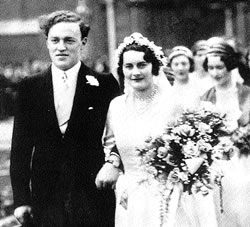
Elizabeth Harman was born on 30 August 1906 at 108 Harley Street in Marylebone, London.[1] The daughter of eye specialist Nathaniel Bishop Harman, she was educated at Francis Holland School and Headington School, and was an undergraduate at Lady Margaret Hall, Oxford. "Able, articulate and beautiful", in the words of The New York Times, she was "the Zuleika Dobson of her day, with undergraduates and even dons tumbling over one another to fall in love with her".[2] A few years after her graduation, on 3 November 1931, she married Frank Pakenham,[3] later 7th Earl of Longford, who died in August 2001. Her obituary by the BBC said the marriage was "famously harmonious". The New York Times, in its review of The Pebbled Shore, called Lady Longford "easily the best writer in what is predominantly a literary family".[2]

She and her husband were both devout Roman Catholic converts, Lady Longford having been raised a Unitarian, and avid social reformers. The Longfords had eight children:

  1. Lady Antonia Margaret Caroline Pakenham (27 August 1932)
  2. Thomas Francis Dermot Pakenham, 8th Earl of Longford (14 August 1933)
  3. The Honourable Patrick Maurice Pakenham (17 April 1937 – 8 June 2005)
  4. Lady Judith Elizabeth Pakenham (14 August 1940 – 18 September 2018)
  5. Lady Rachel Mary Pakenham (11 May 1942)
  6. The Honourable Michael Aidan Pakenham (3 November 1943)
  7. Lady Catherine Rose Pakenham (28 February 1946 – 11 August 1969)
  8. The Honourable John Toussaint Pakenham (1 November 1947)


Daughters Lady Antonia Fraser, Lady Rachel Billington, Judith Kazantzis are all writers, and Thomas Pakenham succeeded his father as Earl of Longford. Her brother, John B. Harman, was a physician; his daughter is Labour politician Harriet Harman. Lady Longford was a great-niece of the politician Joseph Chamberlain and a first cousin once removed of the British prime minister Neville Chamberlain.[2]

Political career

[edit]

She made several unsuccessful attempts to win election to the House of Commons as a Labour MP. In 1935 she contested Cheltenham, which was a safely Conservative seat, and in 1950 she was defeated by Quintin Hogg at Oxford. Through the war she had sought selection at Birmingham King's Norton until she felt compelled to cease her candidacy upon her sixth pregnancy in 1944; the seat was a Labour gain in 1945 by 12,000 votes.[4]

Death

[edit]

Longford died on 23 October 2002, aged 96, at Bernhurst in Hurst Green, East Sussex.[4]

Publications

[edit]

References

[edit]
[edit]
Revisions and contributorsEdit on WikipediaRead on Wikipedia
from Grokipedia
Elizabeth Pakenham, Countess of Longford, CBE (née Harman; 30 August 1906 – 23 October 2002), was a British historian and biographer renowned for her detailed and accessible accounts of historical figures, particularly her two-volume biography of the Duke of Wellington and her life of . Born in to medical parents, she studied at Oxford University, where she developed an interest in politics, eventually aligning with the Labour Party and lecturing for the on subjects including politics, economics, and literature. In 1931, she married Frank Pakenham, who later became the 7th ; the couple converted to Roman Catholicism and raised eight children, several of whom, such as , pursued successful careers in writing. Longford stood unsuccessfully for three times as a Labour candidate and influenced her husband's shift toward socialist views, though her biographical works often focused on conservative icons like and the British monarchy, earning her awards including the for her Wellington biography. A fellow of the Royal Society of Literature, she authored over twenty books, blending scholarly rigor with narrative flair, and later published her memoir The Pebbled Shore in 1986.

Early life and education

Family background and childhood

Elizabeth Harman was born on 30 August 1906 at 108 in , , the eldest of five children born to Nathaniel Bishop Harman, a prominent ophthalmologist practicing on , and Katharine Chamberlain, who held an MB BS from the but never practiced medicine. Her father, born in 1877, had trained at and specialized in eye diseases, contributing to medical advancements in . Her mother, daughter of industrialist Arthur Chamberlain of Moor Green Hall, Birmingham, and niece of the imperialist statesman , brought connections to political and manufacturing circles, though the family emphasized professional merit over inherited status. The Harmans were Unitarians, reflecting a rationalist, non-conformist that shaped their household with a degree of austerity despite the affluence of their medical milieu. Both parents, originating from families of notable achievement—her father's from modest roots and her mother's from Birmingham's elite—instilled values of intellectual discipline and public service, with the home serving as a hub for professional consultations and family discussions. Elizabeth grew up alongside her siblings in this environment, where domestic life blended Edwardian formality with progressive ideals, including early exposure to literature and debate fostered by her parents' interests. Her childhood exemplified a privileged yet structured London upbringing, supervised by nannies in the residence, amid the backdrop of pre-World War I urban prosperity and her parents' commitment to ethical medicine over ostentatious wealth. This setting provided stability and cultural enrichment, though tempered by the family's Unitarian restraint, preparing her for later academic pursuits without undue indulgence.

University years and initial political involvement

Elizabeth Harman entered Lady Margaret Hall at the in , where she pursued undergraduate studies amid a vibrant intellectual and social scene. Academically accomplished, she associated with prominent figures including , her tutor, and formed close friendships with and , while attracting attention from undergraduates such as . Described as aligning with the "aesthetes" rather than the "hearties," her university experience emphasized literary and cultural pursuits over overt athleticism. During her Oxford years, Harman began shifting from the conservative political leanings of her family—descended from figures like —toward more liberal views, particularly under the influence of Gaitskell, a fellow student who later became Labour leader. This ideological evolution laid groundwork for her future engagements, though no records indicate formal political roles within university societies like the during this period. She also encountered Frank Pakenham, her future husband, at a New College ball, whose socialist convictions would further shape her outlook. Upon graduating in the late 1920s, Harman's initial political involvement materialized through practical activism. She joined the , lecturing in to promote among working-class audiences, an effort aligned with Labour's outreach goals. This preceded her first parliamentary candidacy for the Labour Party in in 1935, marking her entry into electoral politics shortly after her 1931 marriage to Pakenham. Her early commitments reflected a commitment to socialist principles, contrasting her upbringing, and involved campaigning in constituencies like Birmingham King's Norton before family responsibilities intensified.

Marriage and family

Courtship and marriage to Frank Pakenham

Elizabeth Harman met Francis Aungier Pakenham at the in 1927, where she was an undergraduate at Lady Margaret Hall and he was a member of the . She later described her first impression of him as that of a "," noting his striking appearance in formal attire during a college chapel event. Their courtship involved navigating political divergences, as Pakenham initially adhered to Conservative views while Harman, from a politically engaged family, leaned toward emerging Labour sympathies. These differences were eventually reconciled, with Harman exerting significant influence on Pakenham's shift to Labour politics over time. On 3 November 1931, Harman and Pakenham married at . The union, which lasted nearly 70 years until Pakenham's death in 2001, bridged their respective social backgrounds—Harman's affluent but untitled family and Pakenham's Anglo-Irish aristocracy—and drew commentary from contemporaries like , who snidely remarked on the mismatch in status. Family accounts note an amusing mishap where Pakenham initially arrived at nearby by mistake before proceeding to the correct venue.

Raising children and domestic life

Elizabeth Longford and her husband, Frank Pakenham (later 7th ), had eight children—five daughters and three sons—born in the years following their 1931 marriage, including the writers , Thomas Pakenham, Rachel Billington, and the poet Judith Kazantzis. The couple raised their children as Roman Catholics after their own conversions in the , instilling religious values amid a household marked by political activism and social reform efforts. Longford prioritized family responsibilities over her nascent political ambitions, effectively pausing her career to manage the household during Pakenham's rise in Labour politics, including his appointments as a minister. Domestic duties held limited appeal for Longford, who delegated routine childcare tasks such as diapering to staff, with family members recalling that she never changed a nappy herself—a reflection of her privileged upbringing and focus on intellectual and public pursuits. Despite this detachment from everyday chores, she derived profound fulfillment from her children's development, viewing them as a central source of personal achievement and engaging them through stimulating conversations rather than conventional nurturing. The family's life blended domestic stability with frequent relocations tied to Pakenham's governmental roles, yet Longford maintained a supportive home environment that encouraged intellectual independence, contributing to several offspring pursuing distinguished literary careers. A profound tragedy struck in 1961 when their 23-year-old son Kevin died suddenly, an event Longford later described as the deepest sorrow of her life, underscoring the emotional intensity of her maternal bonds despite her non-traditional approach to parenting. This loss did not derail the family's resilience; Longford continued balancing maternal oversight with her evolving biographical work, often drawing on family dynamics for inspiration while ensuring the children's Catholic education and exposure to progressive ideals persisted.

Religious conversion

Path to Catholicism

Elizabeth Longford, née Harman, was raised in a Baptist family, reflecting a non-conformist Protestant background that emphasized personal faith and moral rigor over institutional hierarchy. Her husband, Frank Pakenham, underwent a profound spiritual shift during a period of personal and national turmoil in the late , converting to Roman Catholicism in after instruction from Jesuit priests at Farm Street Church in . This decision, made secretly without prior consultation, initially horrified Longford, who viewed it as a disruptive departure from their shared Anglican-influenced life and potentially divisive for their family amid . Despite her resistance, Longford gradually engaged with Catholic teachings, influenced by Pakenham's deepening conviction and their mutual commitment to social justice, which aligned with Catholic social doctrine's emphasis on the poor and reform. She began formal instruction in 1946 and was received into the Catholic Church that same year, six years after her husband's conversion. This path marked a reconciliation of her Baptist roots' moral intensity with Catholicism's sacramental framework, though she later reflected in her 1986 memoir The Pebbled Shore on the emotional strain of the transition, including family baptisms and the faith's demands on conscience. Her conversion solidified a lifelong partnership in faith, evidenced by her editing of Catholic Approaches in 1955, a collection exploring contemporary Catholic thought.

Impact on personal and public views

Elizabeth Longford converted to Roman Catholicism on March 25, 1946, six years after her husband Frank Pakenham's conversion in 1940, marking a significant evolution in her personal beliefs from her Baptist upbringing to a faith that emphasized and intellectual engagement with Catholic thought, including the works of . Initially dismayed by Frank's decision, which she viewed with horror due to her secular leanings and family background, Longford's eventual embrace of Catholicism reconciled her emotional affinity for the —formed through early socialist influences—with a religious framework that portrayed as a divine imperative, thereby deepening rather than supplanting her preexisting political convictions. This personal transformation fostered greater marital harmony, as shared faith became a of their partnership, guiding the Catholic upbringing of their eight children and infusing domestic life with moral discipline amid frequent relocations and public commitments. Publicly, Longford's conversion amplified her commitment to ethical realism in historical biography and social commentary, prompting her to foreground moral dimensions in works like her Victoria RI (1964), where Catholic perspectives on providence and human agency informed analyses of royal character and societal reform. It reinforced her Labour-aligned advocacy for penal and welfare reforms, aligning faith-driven compassion with empirical critiques of inequality, though she maintained independence from doctrinal rigidity by prioritizing causal evidence in political discourse. Her candid public articulation of Catholic tenets, such as insisting during a BBC Brains Trust appearance that life ought to be oriented ad majorem Dei gloriam, resulted in her dismissal from the program, highlighting tensions between her religious views and secular broadcasting norms. Overall, the conversion did not alter her anti-appeasement stance or literary rigor but provided a unifying lens for viewing personal resilience and public duty as interconnected through transcendent purpose.

Political engagement

Transition to Labour politics and anti-appeasement stance

Longford, born into a prosperous Conservative-leaning , underwent a decisive shift toward in 1930 during her involvement with the University (WEA) summer school, where she tutored workers and resided in a North Staffordshire amid the . This immersion provided her with firsthand exposure to economic hardship, which she later recounted in her as a "blinding flash" illuminating the fundamentals of class-based politics and inequality. Her commitment materialized soon after; in May 1931, shortly before her marriage to Frank Pakenham, she campaigned for Labour candidates in , marking her initial foray into partisan activity. Following the couple's relocation to in 1934—prompted by Pakenham's appointment as a lecturer at Christ Church—she formally joined the Cowley branch of the Labour Party and intensified her grassroots efforts, including constituency nursing and . This transition culminated in her selection as Labour's parliamentary candidate for Cheltenham in the November 1935 general election, where she narrowed the Conservative majority from over 17,000 votes in 1931 to approximately 11,000, despite the national tide favoring the National Government. She was also adopted as candidate for Stone in Staffordshire earlier in the decade and later for Birmingham's King's Norton around 1936, though she resigned the latter in 1944 amid party scrutiny of her family size. Amid rising European threats, Longford adopted a staunch anti-appeasement position, aligning with Labour's critique of Neville Chamberlain's concessions to . A member of the Socialist League—a Labour-affiliated group advocating and opposition to —she publicly denounced government policy at a Birmingham rally, questioning, “What sort of is this that cannot say Boo to the Goosestep?” Her views reflected causal concerns over emboldening aggression, as evidenced by her support for the Spanish Republic against Franco's Nationalists starting in 1936 and her broader rejection of Munich-era diplomacy in 1938.

Postwar campaigns and affiliations

Following the conclusion of , Elizabeth Longford maintained her longstanding affiliation with the Labour Party, actively participating in its local branches such as the Cowley Labour Party. In 1950, she stood as the Labour candidate for in the general election, her third parliamentary bid and the first postwar, conducted mere months after the birth of her eighth child. Supported by party leaders including and , she campaigned on socialist principles but lost the seat. This effort underscored her dedication to Labour's social reform agenda, though direct electoral involvement ceased thereafter amid growing family and literary commitments. Longford remained a committed socialist throughout her life, aligning with the party's postwar emphasis on expansion and egalitarian policies, while her husband's ministerial roles in Attlee and Wilson governments reinforced her proximity to political circles without further personal candidacies.

Critiques and controversies in political positions

Elizabeth Longford's political aspirations within the Labour Party encountered practical critiques centered on her family commitments, reflecting broader tensions regarding women's roles in mid-20th-century British politics. In 1935, she stood as the Labour candidate for , marking her entry into electoral politics after shifting from her family's conservative leanings to during her years and involvement with the . Her subsequent nursing of Birmingham King's Norton until 1944 was interrupted when, amid her sixth pregnancy, local party factions expressed dismay, pressuring her to resign the candidacy in favor of family priorities; Longford later described this as prioritizing her "addiction to motherhood" without regret, though it effectively sidelined her Westminster ambitions. This episode drew implicit criticism from party handlers, who viewed her expanding family—eventually eight children—as incompatible with the demands of parliamentary life, forcing her withdrawal from a winnable contest. Longford stood again in in , reportedly the only mother of eight to contest a , ostensibly to settle a political , but her prospects were similarly constrained by domestic responsibilities. These experiences highlighted a party not of her ideological commitment—rooted in anti-appeasement activism and Gaitskellite moderation—but of her personal circumstances, underscoring how motherhood was perceived as a liability for female candidates in Labour circles at the time. Longford's enduring loyalty to Labour persisted despite these setbacks, as evidenced by her family's continued alignment, including niece Harriet Harman's parliamentary career, yet her later biographical works on monarchical and imperial figures like and the Duke of Wellington prompted observations of ideological tension. Commentators noted a "strange journey" from socialist campaigning in industrial seats to championing the , potentially reconciling her left-wing roots with an appreciation for constitutional stability, though no formal party censure arose. Her Catholic conversion in the 1940s, shared with husband Frank Pakenham, further shaped her social reformism—defending underdogs amid economic depression—but drew no documented political backlash beyond personal adjustments to papal stances on contraception. Overall, critiques focused less on doctrinal disputes than on pragmatic barriers to her advancement, allowing her to redirect energies toward literary pursuits without alienating her Labour affiliations.

Literary career

Development as a biographer

Longford's writing career initially focused on domestic topics, prompted by frequent journalistic inquiries about child-rearing after her large family and political activities. In the 1950s, this led to a column in the Sunday Express commissioned by Beaverbrook, which evolved into her first , Points for Parents (1954), a collection of advice on family life. She followed with Catholic Approaches (1955), reflecting her recent conversion, though neither achieved significant commercial success. Encouraged by her husband Frank Pakenham to pursue book-length projects beyond , Longford shifted toward historical subjects in her mid-50s, marking the onset of her biographical development. Her initial foray targeted her great-uncle , but restricted access to family papers limited the scope to Jameson's Raid (1960), a focused account of the 1895–1896 event precipitating the Second Boer War. This work, praised as A.J.P. Taylor's of the year, demonstrated her emerging skill in archival research and narrative synthesis, establishing a foundation for fuller biographies. Building on this, Longford secured access to royal archives, enabling Victoria R.I. (1964), a single-volume life of that became a and won the . At age 58, she honed a method emphasizing empathetic yet critical portrayal, informed by extensive primary sources and on-site visits, such as to battlefields for later works. This success propelled her to ambitious multi-volume projects, including the two-part Duke of Wellington biography (The Years of the Sword, 1969; Pillar of State, 1972), solidifying her reputation through rigorous, context-rich analysis over . Her approach influenced family members, including daughter , toward biographical writing, underscoring Longford's self-directed evolution from occasional contributor to dedicated historian.

Key publications and biographical methods

Longford's inaugural major historical work, Jameson's Raid: A Prelude to the Boer War, published in 1960, examined the events leading to the Second Boer War through archival documents and contemporary accounts. Her breakthrough biography, Victoria R.I. (1964), offered a comprehensive life of , drawing on extensive access to royal correspondence and diaries to portray the monarch's personal and political dimensions; it earned the for its scholarly depth and narrative clarity. The two-volume biography of the Duke of Wellington followed: Wellington: Years of the Sword (1969) covered his military career up to , and Wellington: Pillar of State (1972) addressed his postwar political role, both utilizing unique access to the Wellington family archives at for primary materials including letters and dispatches. Subsequent works included Byron's (1976), which intertwined the poet's life with Greek independence struggles; A Pilgrimage of Passion: The Life of (1980), profiling the diplomat and poet via his extensive diaries; Eminent Victorian Women (1983), a collective study highlighting overlooked female figures; and (1983), a biography of researched in the Royal Archives at . Her autobiography, (1986), provided reflections on her authorial process alongside personal history. Longford's biographical methods emphasized meticulous , prioritizing primary sources such as family papers, royal documents, and unpublished correspondence to construct evidence-based narratives over secondary interpretations. She conducted fieldwork in key repositories, including the Royal Archives and private estates, ensuring comprehensive sourcing while critically evaluating biases in historical records. Her style balanced scholarly rigor with accessibility, presenting dense research "worn lightly" through graceful prose, chronological structure, and vivid characterization that appealed to both academic and general audiences without sacrificing factual precision. This approach avoided psychoanalytic speculation, favoring grounded in documented actions and contexts, as evidenced in her rehabilitation of Victoria's image through verifiable domestic and imperial evidence rather than conjecture.

Reception, awards, and scholarly impact

Longford's biographies were praised for combining meticulous research with accessible prose, appealing to both scholars and general readers. Her seminal work Victoria R.I. (1964), a comprehensive account of Queen Victoria's life spanning from the Peterloo massacres to the , garnered critical approval for its scholarly depth and narrative vitality. The book won the for Biography in 1964, recognizing its authoritative treatment of Victorian history. Subsequent publications, including Wellington: The Years of the Sword (1969), which detailed the Duke of 's military career up to 1815, similarly received acclaim for their factual rigor and broad appeal, though later assessments noted it had been partially superseded by more recent accounts. Longford's approach emphasized primary sources and balanced judgment, influencing the standards for historical by prioritizing readability without sacrificing evidential foundation. Her scholarly impact endures through the establishment of the Elizabeth Longford Prize for Historical Biography in 2003, funded in her memory to honor works that mirror her method of integrating scholarship with narrative drive; the annual £5,000 award has recognized numerous biographies since, underscoring her role in elevating the genre's prestige. Longford's election as a Fellow of the Royal Society of Literature further affirmed her contributions to literary .

Later years and honors

Elevation to peerage and continued influence

In 1961, upon the death of her brother-in-law , 6th , Elizabeth Pakenham's husband succeeded to the earldom, elevating her status from Baroness Pakenham to Countess of Longford. This transition coincided with her husband's continued prominence in the Labour government under , where he served as Leader of the from 1964 to 1968, amplifying her indirect influence in political and social reform circles. Following this elevation, Longford sustained her literary productivity, publishing major works including the single-volume biography Victoria R.I. in 1964, which earned the for biography, and the two-volume : The Years of the Sword (1969) and : Pillar of State (1972). She received the Commander of the (CBE) for services to literature, recognizing her contributions to historical scholarship. Longford also served on the board of trustees of the National Portrait Gallery, contributing to cultural preservation efforts, and was elected a Fellow of the Royal Society of Literature. Her influence extended through familial and advisory roles, as the matriarch of a prolific literary dynasty whose children, including and Thomas Pakenham, followed her into historical writing and biography. Longford supported her husband's campaigns on penal reform and moral legislation in the , maintaining a commitment to Labour causes without resuming active candidacy after her earlier parliamentary attempts. Later publications, such as her The Pebbled Shore (1986) and Darling Loosy (1991), along with revisions to her earlier biographies up to 2002, underscored her enduring scholarly engagement.

Final works and death

In her later years, Elizabeth Longford continued her biographical pursuits, publishing Elizabeth R: A Biography in 1983, a work drawing on research in the Royal Archives focused on Queen Elizabeth II. She released her memoirs, The Pebbled Shore, in 1986, recounting her life up to 1969 with emphasis on her Oxford education, marriage, and early political involvement. This autobiography provided personal insights into her family dynamics and intellectual development, though it concluded before her major biographical successes. Longford's final publication was a concise biography, , issued in 1999, which distilled her earlier comprehensive study of the monarch for a broader audience. These late efforts reflected her enduring interest in royal history, even as she approached her mid-90s, though they were shorter in scope compared to her mid-century magnum opuses like the two-volume Wellington biography. Following the death of her husband, Frank Pakenham, 7th Earl of Longford, in August 2001 at age 95, Longford resided at their family home, Bernhurst, in Hurst Green, . She died peacefully in her sleep on 23 October 2002, at the age of 96. Her passing marked the end of a prolific career that spanned , motherhood to eight children, and over a dozen historical biographies.

Legacy

Contributions to historical biography

Elizabeth Longford advanced historical biography by producing authoritative, research-driven narratives that balanced scholarly rigor with narrative accessibility, focusing primarily on 19th-century British figures whose lives intersected , political, and royal spheres. Her seminal work, Victoria R.I. (1964), offered a comprehensive portrait of spanning her 63-year reign, drawing on extensive primary sources including the monarch's journals to illuminate personal motivations alongside constitutional developments; this biography has endured as the most readable and balanced account amid subsequent scholarship. In Wellington: The Years of the Sword (1969), Longford detailed the of 's military campaigns from to Waterloo, emphasizing tactical innovations, logistical challenges, and the interplay of personality with geopolitical forces; the two-volume study, exceeding 800 pages, revealed the "subtlety and full variety" of 's strategic mind while contextualizing early 19th-century European conflicts, earning praise for its factual depth without romanticization. This approach exemplified her method of integrating archival evidence—such as dispatches and correspondence—with broader of leadership efficacy, contributing to renewed academic interest in Napoleonic-era command structures. Longford's later biographies, including Byron (1976), extended this framework to literary figures, employing psychological insight derived from letters and contemporaries to trace creative output against personal turmoil, thereby modeling how biographers could link individual agency to cultural shifts without unsubstantiated speculation. Her oeuvre influenced the genre by prioritizing empirical sourcing over interpretive overlay, fostering biographies that prioritized verifiable causation—such as Victoria's influence on imperial policy or Wellington's adaptive command—over hagiographic tendencies prevalent in earlier works; this evidentiary emphasis, grounded in her access to restricted archives, elevated standards for narrative-driven history. Through these efforts, Longford demonstrated that historical could serve as a vehicle for causal realism, dissecting how personal decisions propelled systemic outcomes, as in her analysis of 's Peninsula War maneuvers countering French expansionism via superior supply chains and alliances. Her contributions thus bridged academic and public audiences, with works like the Wellington biography cited in military histories for their precise reconstructions of operational decisions.

Establishment of the Elizabeth Longford Prize

The Elizabeth Longford Prize for Historical Biography was established in 2003 by Flora Fraser, Longford's granddaughter and a biographer in her own right, alongside her husband Peter Soros, in commemoration of Longford's contributions to the genre following her death on 3 October 2002. The prize's purpose is to recognize annually an outstanding historical biography that integrates scholarly depth with engaging narrative prose, emulating Longford's approach in works such as her two-volume biography of and her life of the Duke of Wellington. Administered initially by the Society of Authors from 2003 to 2021, the award carries a monetary prize of £5,000, presented alongside a bound copy of Longford's , The Pebbled Shore. Antonia Fraser, Longford's daughter and a prominent biographer, served as the founding chair of the judging panel in 2003, ensuring continuity with Longford's intellectual lineage. The first recipient was selected that year, marking the prize's debut in sustaining the tradition of accessible yet evidence-based historical lives.

References

Add your contribution
Related Hubs
User Avatar
No comments yet.