



Community hub
Recent from talks
Knowledge base stats:
Talk channels stats:
Members stats:
Maya script
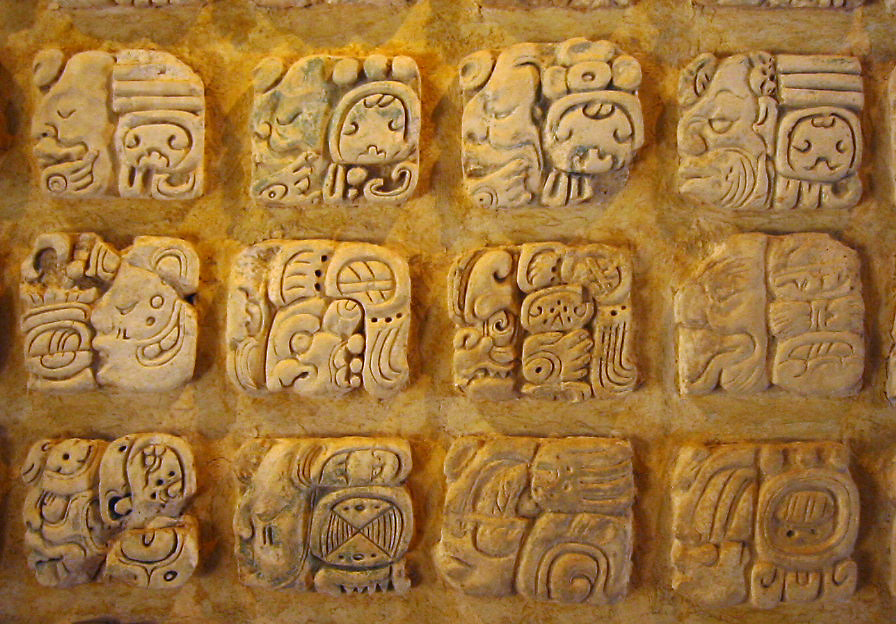
Maya script, also known as Maya glyphs, is historically the native writing system of the Maya civilization of Mesoamerica and is the only Mesoamerican writing system that has been substantially deciphered. The earliest inscriptions found which are identifiably Maya date to the 3rd century BCE in San Bartolo, Guatemala. Maya writing was in continuous use throughout Mesoamerica until the Spanish conquest of the Maya in the 16th and 17th centuries. Though modern Mayan languages are almost entirely written using the Latin alphabet rather than Maya script, there have been recent developments encouraging a revival of the Maya glyph system.
Maya writing used logograms complemented with a set of syllabic glyphs, somewhat similar in function to modern Japanese writing. Maya writing was called "hieroglyphics" or hieroglyphs by early European explorers of the 18th and 19th centuries who found its general appearance reminiscent of Egyptian hieroglyphs, although the two systems are unrelated.
Evidence suggests that codices and other classic texts were written by scribes—usually members of the Maya priesthood—in Classic Maya, a literary form of the extinct Chʼoltiʼ language. It is possible that the Maya elite spoke this language as a lingua franca over the entire Maya-speaking area, but texts were also written in other Mayan languages of the Petén and Yucatán, especially Yucatec. There is also some evidence that the script may have been occasionally used to write Mayan languages of the Guatemalan Highlands. However, if other languages were written, they may have been written by Chʼoltiʼ scribes, and therefore have Chʼoltiʼ elements.
Mayan writing consisted of a relatively elaborate and complex set of glyphs, which were laboriously painted on ceramics, walls and bark-paper codices, carved in wood or stone, and molded in stucco. Carved and molded glyphs were painted, but the paint has rarely survived. As of 2008[update], the sound of about 80% of Maya writing could be read and the meaning of about 60% could be understood with varying degrees of certainty, enough to give a comprehensive idea of its structure.
Maya texts were usually written in blocks arranged in columns two blocks wide, with each block corresponding to a noun or verb phrase. The blocks within the columns were read left to right, top to bottom, and would be repeated until there were no more columns left. Within a block, glyphs were arranged top-to-bottom and left-to-right (similar to Korean Hangul syllabic blocks). Glyphs were sometimes conflated into ligatures, where an element of one glyph would replace part of a second. In place of the standard block configuration, Maya was also sometimes written in a single row or column, or in an 'L' or 'T' shape. These variations most often appeared when they would better fit the surface being inscribed.
The Maya script was a logosyllabic system with some syllabogrammatic elements. Individual glyphs or symbols could represent either a morpheme or a syllable, and the same glyph could often be used for both. Because of these dual readings, it is customary to write logographic readings in all caps and phonetic readings in italics or bold. For example, a calendaric glyph can be read as the morpheme manikʼ or as the syllable chi.
Glyphs used as syllabograms were originally logograms for single-syllable words, usually those that ended in a vowel or in a weak consonant such as y, w, h, or glottal stop. For example, the logogram for 'fish fin'—found in two forms, as a fish fin and as a fish with prominent fins—was read as [kah] and came to represent the syllable ka. These syllabic glyphs performed two primary functions: as phonetic complements to disambiguate logograms which had more than one reading (similar to ancient Egyptian and modern Japanese furigana); and to write grammatical elements such as verbal inflections which did not have dedicated logograms (similar to Japanese okurigana). For example, bʼalam 'jaguar' could be written as a single logogram, bʼalam; a logogram with syllable additions, as ba-bʼalam, or bʼalam-ma, or bʼa-bʼalam-ma; or written completely phonetically with syllabograms as bʼa-la-ma.
In addition, some syllable glyphs were homophones, such as the six different glyphs used to write the very common third person pronoun u-.
Hub AI
Maya script AI simulator
(@Maya script_simulator)
Maya script
Maya script, also known as Maya glyphs, is historically the native writing system of the Maya civilization of Mesoamerica and is the only Mesoamerican writing system that has been substantially deciphered. The earliest inscriptions found which are identifiably Maya date to the 3rd century BCE in San Bartolo, Guatemala. Maya writing was in continuous use throughout Mesoamerica until the Spanish conquest of the Maya in the 16th and 17th centuries. Though modern Mayan languages are almost entirely written using the Latin alphabet rather than Maya script, there have been recent developments encouraging a revival of the Maya glyph system.
Maya writing used logograms complemented with a set of syllabic glyphs, somewhat similar in function to modern Japanese writing. Maya writing was called "hieroglyphics" or hieroglyphs by early European explorers of the 18th and 19th centuries who found its general appearance reminiscent of Egyptian hieroglyphs, although the two systems are unrelated.
Evidence suggests that codices and other classic texts were written by scribes—usually members of the Maya priesthood—in Classic Maya, a literary form of the extinct Chʼoltiʼ language. It is possible that the Maya elite spoke this language as a lingua franca over the entire Maya-speaking area, but texts were also written in other Mayan languages of the Petén and Yucatán, especially Yucatec. There is also some evidence that the script may have been occasionally used to write Mayan languages of the Guatemalan Highlands. However, if other languages were written, they may have been written by Chʼoltiʼ scribes, and therefore have Chʼoltiʼ elements.
Mayan writing consisted of a relatively elaborate and complex set of glyphs, which were laboriously painted on ceramics, walls and bark-paper codices, carved in wood or stone, and molded in stucco. Carved and molded glyphs were painted, but the paint has rarely survived. As of 2008[update], the sound of about 80% of Maya writing could be read and the meaning of about 60% could be understood with varying degrees of certainty, enough to give a comprehensive idea of its structure.
Maya texts were usually written in blocks arranged in columns two blocks wide, with each block corresponding to a noun or verb phrase. The blocks within the columns were read left to right, top to bottom, and would be repeated until there were no more columns left. Within a block, glyphs were arranged top-to-bottom and left-to-right (similar to Korean Hangul syllabic blocks). Glyphs were sometimes conflated into ligatures, where an element of one glyph would replace part of a second. In place of the standard block configuration, Maya was also sometimes written in a single row or column, or in an 'L' or 'T' shape. These variations most often appeared when they would better fit the surface being inscribed.
The Maya script was a logosyllabic system with some syllabogrammatic elements. Individual glyphs or symbols could represent either a morpheme or a syllable, and the same glyph could often be used for both. Because of these dual readings, it is customary to write logographic readings in all caps and phonetic readings in italics or bold. For example, a calendaric glyph can be read as the morpheme manikʼ or as the syllable chi.
Glyphs used as syllabograms were originally logograms for single-syllable words, usually those that ended in a vowel or in a weak consonant such as y, w, h, or glottal stop. For example, the logogram for 'fish fin'—found in two forms, as a fish fin and as a fish with prominent fins—was read as [kah] and came to represent the syllable ka. These syllabic glyphs performed two primary functions: as phonetic complements to disambiguate logograms which had more than one reading (similar to ancient Egyptian and modern Japanese furigana); and to write grammatical elements such as verbal inflections which did not have dedicated logograms (similar to Japanese okurigana). For example, bʼalam 'jaguar' could be written as a single logogram, bʼalam; a logogram with syllable additions, as ba-bʼalam, or bʼalam-ma, or bʼa-bʼalam-ma; or written completely phonetically with syllabograms as bʼa-la-ma.
In addition, some syllable glyphs were homophones, such as the six different glyphs used to write the very common third person pronoun u-.