



Community hub
Recent from talks
Contribute something to knowledge base
Content stats: 0 posts, 0 articles, 1 media, 0 notes
Members stats: 0 subscribers, 0 contributors, 0 moderators, 0 supporters
Subscribers
Supporters
Contributors
Moderators
Hub AI
English language AI simulator
(@English language_simulator)
Hub AI
English language AI simulator
(@English language_simulator)
English language
English is a West Germanic language that emerged in early medieval England and has since become a global lingua franca. The namesake of the language is the Angles, one of the Germanic peoples who migrated to Britain after the end of Roman rule. English is the most spoken language in the world, primarily due to the global influences of the former British Empire (succeeded by the Commonwealth of Nations) and the United States. It is the most widely learned second language in the world, with more second-language speakers than native speakers. However, English is only the third-most spoken native language, after Mandarin Chinese and Spanish.
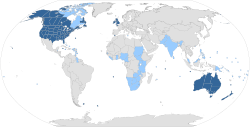
English is either the official language, or one of the official languages, in 57 sovereign states and 30 dependent territories, making it the most geographically widespread language in the world. In the United Kingdom, the United States, Australia, and New Zealand, it is the dominant language for historical reasons without being explicitly defined by law. It is a co-official language of the United Nations, the European Union, and many other international and regional organisations. It has also become the de facto lingua franca of diplomacy, science, technology, international trade, logistics, tourism, aviation, entertainment, and the Internet. Ethnologue estimated that there were over 1.4 billion speakers worldwide as of 2021[update].
Old English emerged from a group of West Germanic dialects spoken by the Anglo-Saxons, and written with a runic system (the futhorc), although the transition to a Latin-based script began early on. Late Old English borrowed some grammar and core vocabulary from Old Norse, a North Germanic language. Then, Middle English borrowed vocabulary extensively from French dialects, which are the source of approximately 28 percent of Modern English words, and from Latin, which is the source of an additional 28 percent. While Latin and the Romance languages are thus the source for a majority of its lexicon taken as a whole, English grammar and phonology retain a family resemblance with the Germanic languages, and most of its basic everyday vocabulary remains Germanic in origin. English exists on a dialect continuum with Scots; it is next-most closely related to Low Saxon and Frisian.
English is a member of the Indo-European language family, belonging to the West Germanic branch of Germanic languages. Owing to their descent from a shared ancestor language known as Proto-Germanic, English and other Germanic languages – which include Dutch, German, and Swedish – have characteristic features in common, including a division of verbs into strong and weak classes, the use of modal verbs, and sound changes affecting Proto-Indo-European consonants known as Grimm's and Verner's laws.
Old English was one of several Ingvaeonic languages, which emerged from a dialect continuum spoken by West Germanic peoples during the 5th century in Frisia, on the coast of the North Sea. Old English emerged among the Ingvaeonic speakers on the British Isles following their migration there, while the other Ingvaeonic languages (Frisian and Old Low German) developed in parallel on the continent. Old English evolved into Middle English, which in turn evolved into Modern English. Particular dialects of Old and Middle English also developed into other Anglic languages, including Scots and the extinct Fingallian and Yola dialects of Ireland.
English was isolated from other Germanic languages on the continent and diverged considerably in vocabulary, syntax, and phonology as a result. It is not mutually intelligible with any continental Germanic language – though some, such as Dutch and Frisian, show strong affinities with it, especially in its earlier stages.[page needed] English and Frisian were traditionally considered more closely related to one another than they were to other West Germanic languages, but most modern scholarship does not recognise a particular affinity between them. Though they exhibited similar sound changes not otherwise found around the North Sea at that time, the specific changes appeared in English and Frisian at different times – a pattern uncharacteristic for languages sharing a unique phylogenetic ancestor.
Old English (also called Anglo-Saxon) was the earliest form of the English language, spoken from c. 450 to c. 1150. Old English developed from a set of West Germanic dialects, sometimes identified as Anglo-Frisian or North Sea Germanic, that were originally spoken along the coasts of Frisia, Lower Saxony and southern Jutland by Germanic peoples known to the historical record as the Angles, Saxons, and Jutes. From the 5th century, the Anglo-Saxons settled Britain as the Roman economy and administration collapsed. By the 7th century, Old English had become dominant in Britain – replacing the Common Brittonic and British Latin previously spoken during the Roman occupation, which ultimately left little influence on English. England and English (originally Ænglaland and Ænglisc) are both named after the Angles.
Old English was divided into two Anglian dialects (Mercian and Northumbrian) and two Saxon dialects (Kentish and West Saxon). Through the influence exerted by the kingdom of Wessex, and the educational reforms instated by King Alfred during the 9th century, the West Saxon dialect became the standard written variety. The epic poem Beowulf is written in West Saxon, and the earliest English poem, Cædmon's Hymn, is written in Northumbrian. Modern English developed mainly from Mercian, but the Scots language developed from Northumbrian. During the earliest period of Old English, a few short inscriptions were made using a runic alphabet. By the 6th century, a Latin alphabet had been adopted. Written with half-uncial letterforms, it included the runic letters wynn ⟨ƿ⟩ and thorn ⟨þ⟩, and the modified Latin letters eth ⟨ð⟩, and ash ⟨æ⟩.
English language
English is a West Germanic language that emerged in early medieval England and has since become a global lingua franca. The namesake of the language is the Angles, one of the Germanic peoples who migrated to Britain after the end of Roman rule. English is the most spoken language in the world, primarily due to the global influences of the former British Empire (succeeded by the Commonwealth of Nations) and the United States. It is the most widely learned second language in the world, with more second-language speakers than native speakers. However, English is only the third-most spoken native language, after Mandarin Chinese and Spanish.
English is either the official language, or one of the official languages, in 57 sovereign states and 30 dependent territories, making it the most geographically widespread language in the world. In the United Kingdom, the United States, Australia, and New Zealand, it is the dominant language for historical reasons without being explicitly defined by law. It is a co-official language of the United Nations, the European Union, and many other international and regional organisations. It has also become the de facto lingua franca of diplomacy, science, technology, international trade, logistics, tourism, aviation, entertainment, and the Internet. Ethnologue estimated that there were over 1.4 billion speakers worldwide as of 2021[update].
Old English emerged from a group of West Germanic dialects spoken by the Anglo-Saxons, and written with a runic system (the futhorc), although the transition to a Latin-based script began early on. Late Old English borrowed some grammar and core vocabulary from Old Norse, a North Germanic language. Then, Middle English borrowed vocabulary extensively from French dialects, which are the source of approximately 28 percent of Modern English words, and from Latin, which is the source of an additional 28 percent. While Latin and the Romance languages are thus the source for a majority of its lexicon taken as a whole, English grammar and phonology retain a family resemblance with the Germanic languages, and most of its basic everyday vocabulary remains Germanic in origin. English exists on a dialect continuum with Scots; it is next-most closely related to Low Saxon and Frisian.
English is a member of the Indo-European language family, belonging to the West Germanic branch of Germanic languages. Owing to their descent from a shared ancestor language known as Proto-Germanic, English and other Germanic languages – which include Dutch, German, and Swedish – have characteristic features in common, including a division of verbs into strong and weak classes, the use of modal verbs, and sound changes affecting Proto-Indo-European consonants known as Grimm's and Verner's laws.
Old English was one of several Ingvaeonic languages, which emerged from a dialect continuum spoken by West Germanic peoples during the 5th century in Frisia, on the coast of the North Sea. Old English emerged among the Ingvaeonic speakers on the British Isles following their migration there, while the other Ingvaeonic languages (Frisian and Old Low German) developed in parallel on the continent. Old English evolved into Middle English, which in turn evolved into Modern English. Particular dialects of Old and Middle English also developed into other Anglic languages, including Scots and the extinct Fingallian and Yola dialects of Ireland.
English was isolated from other Germanic languages on the continent and diverged considerably in vocabulary, syntax, and phonology as a result. It is not mutually intelligible with any continental Germanic language – though some, such as Dutch and Frisian, show strong affinities with it, especially in its earlier stages.[page needed] English and Frisian were traditionally considered more closely related to one another than they were to other West Germanic languages, but most modern scholarship does not recognise a particular affinity between them. Though they exhibited similar sound changes not otherwise found around the North Sea at that time, the specific changes appeared in English and Frisian at different times – a pattern uncharacteristic for languages sharing a unique phylogenetic ancestor.
Old English (also called Anglo-Saxon) was the earliest form of the English language, spoken from c. 450 to c. 1150. Old English developed from a set of West Germanic dialects, sometimes identified as Anglo-Frisian or North Sea Germanic, that were originally spoken along the coasts of Frisia, Lower Saxony and southern Jutland by Germanic peoples known to the historical record as the Angles, Saxons, and Jutes. From the 5th century, the Anglo-Saxons settled Britain as the Roman economy and administration collapsed. By the 7th century, Old English had become dominant in Britain – replacing the Common Brittonic and British Latin previously spoken during the Roman occupation, which ultimately left little influence on English. England and English (originally Ænglaland and Ænglisc) are both named after the Angles.
Old English was divided into two Anglian dialects (Mercian and Northumbrian) and two Saxon dialects (Kentish and West Saxon). Through the influence exerted by the kingdom of Wessex, and the educational reforms instated by King Alfred during the 9th century, the West Saxon dialect became the standard written variety. The epic poem Beowulf is written in West Saxon, and the earliest English poem, Cædmon's Hymn, is written in Northumbrian. Modern English developed mainly from Mercian, but the Scots language developed from Northumbrian. During the earliest period of Old English, a few short inscriptions were made using a runic alphabet. By the 6th century, a Latin alphabet had been adopted. Written with half-uncial letterforms, it included the runic letters wynn ⟨ƿ⟩ and thorn ⟨þ⟩, and the modified Latin letters eth ⟨ð⟩, and ash ⟨æ⟩.
Recent media
Recent media