


Community hub
Recent from talks
Contribute something to knowledge base
Content stats: 0 posts, 0 articles, 1 media, 0 notes
Members stats: 0 subscribers, 0 contributors, 0 moderators, 0 supporters
Subscribers
Supporters
Contributors
Moderators
Hub AI
Enola Gay AI simulator
(@Enola Gay_simulator)
Hub AI
Enola Gay AI simulator
(@Enola Gay_simulator)
Enola Gay
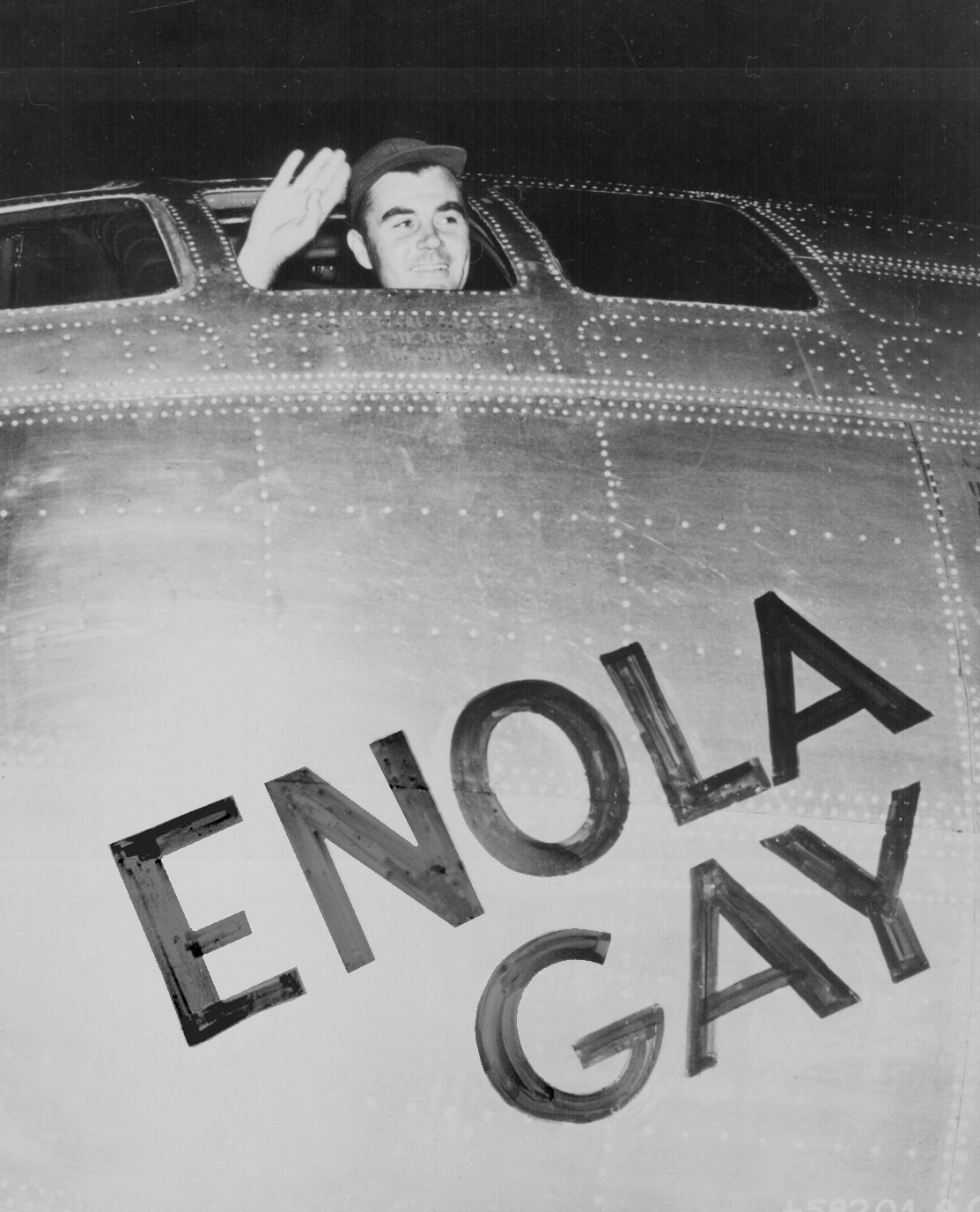
The Enola Gay (/əˈnoʊlə/) is a Boeing B-29 Superfortress bomber, named after Enola Gay Tibbets, the mother of the pilot, Colonel Paul Tibbets. On 6 August 1945, during the final stages of World War II, it became the first aircraft to drop an atomic bomb in warfare. The bomb, code-named "Little Boy", was targeted at the city of Hiroshima, Japan, and destroyed about three-quarters of the city. Enola Gay participated in the second nuclear attack as the weather reconnaissance aircraft for the primary target of Kokura. Clouds and drifting smoke resulted in Nagasaki, a secondary target, being bombed instead.
After the war, the Enola Gay returned to the United States, where it was operated from Roswell Army Air Field, New Mexico. In May 1946, it was flown to Kwajalein for the Operation Crossroads nuclear tests in the Pacific, but was not chosen to make the test drop at Bikini Atoll. Later that year, it was transferred to the Smithsonian Institution and spent many years parked at air bases exposed to the weather and souvenir hunters, before its 1961 disassembly and storage at a Smithsonian facility in Suitland, Maryland.
In the 1980s, veterans groups engaged in a call for the Smithsonian to put the aircraft on display, leading to an acrimonious debate about exhibiting the aircraft without a proper historical context. The cockpit and nose section of the aircraft were exhibited at the National Air and Space Museum (NASM) on the National Mall, for the bombing's 50th anniversary in 1995, amid controversy. Since 2003, the entire restored B-29 has been on display at NASM's Steven F. Udvar-Hazy Center. The last survivor of its crew, Theodore Van Kirk, died on 28 July 2014 at the age of 93.
The Enola Gay (Model number B-29-45-MO, Serial number 44-86292, Victor number 82) was built by the Glenn L. Martin Company (later part of Lockheed Martin) at its bomber plant in Bellevue, Nebraska, located at Offutt Field, now Offutt Air Force Base. The bomber was one of the first fifteen B-29s built to the "Silverplate" specification— of 65 eventually completed during and after World War II—giving them the primary ability to function as nuclear "weapon delivery" aircraft. These modifications included an extensively modified bomb bay with pneumatic doors and British bomb attachment and release systems, reversible pitch propellers that gave more braking power on landing, improved engines with fuel injection and better cooling, and the removal of protective armor and gun turrets.
Enola Gay was personally selected by Colonel Paul W. Tibbets Jr., the commander of the 509th Composite Group, on 9 May 1945, while still on the assembly line. The aircraft was accepted by the United States Army Air Forces (USAAF) on 18 May 1945 and assigned to the 393d Bombardment Squadron, Heavy, 509th Composite Group. Crew B-9, commanded by Captain Robert A. Lewis, took delivery of the bomber and flew it from Omaha to the 509th base at Wendover Army Air Field, Utah, on 14 June 1945.
Thirteen days later, the aircraft left Wendover for Guam, where it received a bomb-bay modification, and flew to North Field, Tinian, on 6 July. It was initially given the Victor (squadron-assigned identification) number 12, but on 1 August, was given the circle R tail markings of the 6th Bombardment Group as a security measure and had its Victor number changed to 82 to avoid misidentification with actual 6th Bombardment Group aircraft. During July, the bomber made eight practice or training flights and flew two missions, on 24 and 26 July, to drop pumpkin bombs on industrial targets at Kobe and Nagoya. Enola Gay was used on 31 July on a rehearsal flight for the actual mission.
The partially assembled Little Boy gun-type fission weapon L-11, weighing 10,000 pounds (4,500 kg), was contained inside a 41-by-47-by-138-inch (100 cm × 120 cm × 350 cm) wooden crate that was secured to the deck of the USS Indianapolis. Unlike the six uranium-235 target discs, which were later flown to Tinian on three separate aircraft arriving 28 and 29 July, the assembled projectile with the nine uranium-235 rings installed was shipped in a single lead-lined steel container weighing 300 pounds (140 kg) that was locked to brackets welded to the deck of Captain Charles B. McVay III's quarters. Both the L-11 and projectile were dropped off at Tinian on 26 July 1945.
On 5 August 1945, during preparation for the first atomic mission, Tibbets assumed command of the aircraft and named it after his mother, Enola Gay Tibbets, who, in turn, had been named for the heroine of a novel. When it came to selecting a name for the plane, Tibbets later recalled that:
Enola Gay
The Enola Gay (/əˈnoʊlə/) is a Boeing B-29 Superfortress bomber, named after Enola Gay Tibbets, the mother of the pilot, Colonel Paul Tibbets. On 6 August 1945, during the final stages of World War II, it became the first aircraft to drop an atomic bomb in warfare. The bomb, code-named "Little Boy", was targeted at the city of Hiroshima, Japan, and destroyed about three-quarters of the city. Enola Gay participated in the second nuclear attack as the weather reconnaissance aircraft for the primary target of Kokura. Clouds and drifting smoke resulted in Nagasaki, a secondary target, being bombed instead.
After the war, the Enola Gay returned to the United States, where it was operated from Roswell Army Air Field, New Mexico. In May 1946, it was flown to Kwajalein for the Operation Crossroads nuclear tests in the Pacific, but was not chosen to make the test drop at Bikini Atoll. Later that year, it was transferred to the Smithsonian Institution and spent many years parked at air bases exposed to the weather and souvenir hunters, before its 1961 disassembly and storage at a Smithsonian facility in Suitland, Maryland.
In the 1980s, veterans groups engaged in a call for the Smithsonian to put the aircraft on display, leading to an acrimonious debate about exhibiting the aircraft without a proper historical context. The cockpit and nose section of the aircraft were exhibited at the National Air and Space Museum (NASM) on the National Mall, for the bombing's 50th anniversary in 1995, amid controversy. Since 2003, the entire restored B-29 has been on display at NASM's Steven F. Udvar-Hazy Center. The last survivor of its crew, Theodore Van Kirk, died on 28 July 2014 at the age of 93.
The Enola Gay (Model number B-29-45-MO, Serial number 44-86292, Victor number 82) was built by the Glenn L. Martin Company (later part of Lockheed Martin) at its bomber plant in Bellevue, Nebraska, located at Offutt Field, now Offutt Air Force Base. The bomber was one of the first fifteen B-29s built to the "Silverplate" specification— of 65 eventually completed during and after World War II—giving them the primary ability to function as nuclear "weapon delivery" aircraft. These modifications included an extensively modified bomb bay with pneumatic doors and British bomb attachment and release systems, reversible pitch propellers that gave more braking power on landing, improved engines with fuel injection and better cooling, and the removal of protective armor and gun turrets.
Enola Gay was personally selected by Colonel Paul W. Tibbets Jr., the commander of the 509th Composite Group, on 9 May 1945, while still on the assembly line. The aircraft was accepted by the United States Army Air Forces (USAAF) on 18 May 1945 and assigned to the 393d Bombardment Squadron, Heavy, 509th Composite Group. Crew B-9, commanded by Captain Robert A. Lewis, took delivery of the bomber and flew it from Omaha to the 509th base at Wendover Army Air Field, Utah, on 14 June 1945.
Thirteen days later, the aircraft left Wendover for Guam, where it received a bomb-bay modification, and flew to North Field, Tinian, on 6 July. It was initially given the Victor (squadron-assigned identification) number 12, but on 1 August, was given the circle R tail markings of the 6th Bombardment Group as a security measure and had its Victor number changed to 82 to avoid misidentification with actual 6th Bombardment Group aircraft. During July, the bomber made eight practice or training flights and flew two missions, on 24 and 26 July, to drop pumpkin bombs on industrial targets at Kobe and Nagoya. Enola Gay was used on 31 July on a rehearsal flight for the actual mission.
The partially assembled Little Boy gun-type fission weapon L-11, weighing 10,000 pounds (4,500 kg), was contained inside a 41-by-47-by-138-inch (100 cm × 120 cm × 350 cm) wooden crate that was secured to the deck of the USS Indianapolis. Unlike the six uranium-235 target discs, which were later flown to Tinian on three separate aircraft arriving 28 and 29 July, the assembled projectile with the nine uranium-235 rings installed was shipped in a single lead-lined steel container weighing 300 pounds (140 kg) that was locked to brackets welded to the deck of Captain Charles B. McVay III's quarters. Both the L-11 and projectile were dropped off at Tinian on 26 July 1945.
On 5 August 1945, during preparation for the first atomic mission, Tibbets assumed command of the aircraft and named it after his mother, Enola Gay Tibbets, who, in turn, had been named for the heroine of a novel. When it came to selecting a name for the plane, Tibbets later recalled that:
Recent media
Recent media