Hubbry Logo
Gun-type fission weaponGun-type fission weaponMain
Open search
Gun-type fission weapon
Community hub
Gun-type fission weapon
logo
8 pages, 0 posts
0 subscribers
Be the first to start a discussion here.
Gun-type fission weapon
from Wikipedia
The "gun" assembly method

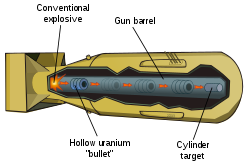
Gun-type fission weapons are fission-based nuclear weapons whose design assembles their fissile material into a supercritical mass by the use of the "gun" method: shooting one piece of sub-critical material into another. Although this is sometimes pictured as two sub-critical hemispheres driven together to make a supercritical sphere, typically a hollow projectile is shot onto a cylindrical spike, which fills the hole in its center. Its name is a reference to the fact that it is shooting the material through an artillery barrel as if it were a projectile. Developed and deployed by the Manhattan Project, gun-type designs were quickly replaced by the more efficient implosion-type weapons.

All known gun-type fission weapons have used highly enriched uranium (HEU). The high spontaneous fission rates of plutonium isotopes make it very impractical for use in gun-type designs, as in the abandoned Thin Man design. Additionally, the efficiency is low, increasing the amount of HEU required and weapon weight. The main reason for this is the fissile material does not undergo compression (and resulting density increase) as does the implosion design. Instead, gun-type bombs assemble the supercritical mass by amassing such a large quantity of uranium that the overall distance through which daughter neutrons must travel has so many mean free paths it becomes very probable most neutrons will find uranium nuclei to collide with, before escaping the supercritical mass. HEU could be more efficiently used by the composite cores of early implosion-type weapons.

The first time gun-type fission weapons were discussed was as part of the British Tube Alloys nuclear bomb development program, the world's first nuclear bomb development program.[1] The British MAUD Report[2] of 1941 laid out how "an effective uranium bomb which, containing some 25 lb of active material, would be equivalent as regards destructive effect to 1,800 tons of T.N.T".[3] The bomb would use the gun-type design "to bring the two halves together at high velocity and it is proposed to do this by firing them together with charges of ordinary explosive in a form of double gun".[4]

The method was applied in four known US programs. First, the "Little Boy" weapon which was detonated over Hiroshima and several additional units of the same design prepared after World War II, in 40 Mark 8 bombs, and their replacement, 40 Mark 11 bombs. Both the Mark 8 and Mark 11 designs were intended for use as earth-penetrating bombs (see nuclear bunker buster), for which the gun-type method was preferred for a time by designers who were less than certain that early implosion-type weapons would successfully detonate following an impact. The second program was a family of 11-inch (280 mm) nuclear artillery shells, the W9 and its derivative W19, plus a repackaged W19 in a 16-inch (406 mm) shell for US Navy battleships, the W23. The third family was an 8-inch (203 mm) artillery shell, the W33.

South Africa also developed six nuclear bombs based on the gun-type principle, and was working on missile warheads using the same basic design – See South Africa and weapons of mass destruction.

There are currently no known gun-type weapons in service: advanced nuclear weapon states tended to abandon the design in favor of the implosion-type weapons, which were also used to create boosted fission weapons and thermonuclear weapons. All known gun-type nuclear weapons previously built worldwide have been dismantled.

Little Boy

[edit]
The interior of the Little Boy weapon used against Hiroshima. The uranium-235 is indicated in red.

The "gun" method is roughly how the Little Boy weapon, which was detonated over Hiroshima, worked, using uranium-235 as its fissile material. In the Little Boy design, the U-235 "bullet" had a mass of around 86 pounds (39 kg), and it was 7 inches (17.8 cm) long, with a diameter of 6.25 inches (15.9 cm). The hollow cylindrical shape made it subcritical. It was powered by a cordite charge. The uranium target spike was about 57.3 pounds (26 kg). Both the bullet and the target consisted of multiple rings stacked together.

The use of "rings" had two advantages: it allowed the larger bullet to confidently remain subcritical (the hollow column served to keep the material from having too much contact with other material), and it allowed sub-critical assemblies to be tested using the same bullet but with just one ring.

The barrel had an inside diameter of 6.5 inches (16.5 cm). Its length was 70.8 inches (1.8 m), which allowed the bullet to accelerate to its final speed of about 1,000 feet per second (300 m/s)[5] before coming into contact with the target.

When the bullet is at a distance of 9.8 inches (25 cm), the combination becomes critical. This means that some free neutrons may cause the chain reaction to take place before the material could be fully joined (see nuclear chain reaction).

Typically the chain reaction takes less than 1 μs (100 shakes), during which time the bullet travels only 0.3 mm (185 inch). Although the chain reaction is slower when the supercriticality is low, it still happens in a time so brief that the bullet hardly moves in that time.

This could cause a fizzle, a predetonation which would blow the material apart before creating much of an explosion. Thus, it is important that the frequency at which free neutrons occur is kept low, compared with the assembly time from this point. This also means that the speed of the projectile must be sufficiently high; its speed can be increased but this requires a longer and heavier barrel, or a higher pressure of the propellant gas for greater acceleration of the bullet subcritical mass.

In the case of Little Boy, the 20% 238U in the uranium had 70 spontaneous fissions per second. With the fissionable material in a supercritical state, each gave a large probability of detonation: each fission creates on average 2.52 neutrons, which each have a probability of more than 1:2.52 of creating another fission. During the 1.35 ms of supercriticality prior to full assembly, there was a 10% probability of a fission, with somewhat less probability of pre-detonation.

In July 1944 the laboratory abandoned the plutonium gun-type bomb ("Thin Man", shown above) and focused almost entirely around the problem of implosion.
Weapon effects – Hiroshima in ruins after the Little Boy atomic bomb exploded

Initially the Manhattan Project gun-type effort was directed at making a gun weapon that used plutonium as its source of fissile material, known as the "Thin Man" because of its extreme length. It was thought that if a plutonium gun-type bomb could be created, then the uranium gun-type bomb would be very easy to make by comparison. However, it was discovered in April 1944 that reactor-bred plutonium (Pu-239) is contaminated with another isotope of plutonium, Pu-240, which increases the material's spontaneous neutron-release rate, making pre-detonation inevitable. For this reason, a gun-type bomb is thought to only be usable with enriched uranium fuel. It is unknown though possible to make a composite design using high grade plutonium in the bullet only.

After it was discovered that the "Thin Man" program would not be successful, Los Alamos redirected its efforts into creating the implosion-type plutonium weapon: "Fat Man". The gun program switched completely over to developing a uranium bomb.

Although in Little Boy 132 pounds (60 kg) of 80%-grade 235U was used (hence 106 pounds or 48 kilograms), the minimum is about 44 to 55 pounds (20 to 25 kg), versus 33 pounds (15 kg) for the implosion method.

Little Boy's target subcritical mass was enclosed in a neutron reflector made of tungsten carbide (WC). The presence of a neutron reflector reduced neutron losses during the chain reaction, and so reduced the quantity of uranium fuel needed. A more effective reflector material would be metallic beryllium, but this was not known until the postwar years when Ted Taylor developed an implosion design known as "Scorpion".

The scientists who designed the "Little Boy" weapon were confident enough of its success that they did not field-test a design before using it in war (though scientists such as Louis Slotin did perform non-destructive tests with sub-critical assemblies, dangerous experiments nicknamed "tickling the dragon's tail"). In any event, it could not be tested before being deployed, as there was only sufficient U-235 available for one device. Even though the design was never proof-tested, there was thought to be no risk of the device being captured by an enemy if it malfunctioned. Even a "fizzle" would have completely disintegrated the device, while the multiple redundancies built into the "Little Boy" design meant there was negligible, if any, potential for the device to strike the ground without detonating at all.

For a quick start of the chain reaction at the right moment a neutron trigger/initiator is used. An initiator is not strictly necessary for an effective gun design,[6][5] as long as the design uses "target capture" (in essence, ensuring that the two subcritical masses, once fired together, cannot come apart until they explode). Considering the 70 spontaneous fissions per second, this only causes a delay of a few times 1/70 second, which in this case does not matter. Initiators were only added to Little Boy late in its design.

Proliferation and terrorism

[edit]

With regard to the risk of proliferation and use by terrorists, the relatively simple design is a concern, as it does not require as much fine engineering or manufacturing as other methods. With enough highly enriched uranium, nations or groups with relatively low levels of technological sophistication could create an inefficient—though still quite powerful—gun-type nuclear weapon.

Comparison with the implosion method

[edit]
Schematic of the gun-type method (above) and the implosion-type method (below).

For technologically advanced states the gun-type method is now essentially obsolete, for reasons of efficiency and safety (discussed below). The gun type method was largely abandoned by the United States as soon as the implosion technique was perfected, though it was retained in the specialised role of nuclear artillery for a time. Other nuclear powers, such as the United Kingdom and Soviet Union, never built an example of this type of weapon. Besides requiring the use of highly enriched U-235, the technique has other severe limitations. The implosion technique is much better suited to the various methods employed to reduce the mass of the weapon and increase the proportion of material which fissions. Apartheid South Africa built around five gun-type weapons, and no implosion-type weapons. They later abandoned their nuclear weapon program altogether. They were unique in their abandonment of nuclear weapons, and probably also by building gun-type weapons rather than implosion-type weapons.

There are also safety problems with gun-type weapons. For example, it is inherently dangerous to have a weapon containing a quantity and shape of fissile material that can form a critical mass through a relatively simple accident. Furthermore, if the weapon is dropped from an aircraft into the sea, then the moderating effect of the seawater can also cause a criticality accident without the weapon even being physically damaged. Neither can happen with an implosion-type weapon, since there is normally insufficient fissile material to form a critical mass without the correct detonation of the explosive lenses.

US nuclear artillery

[edit]
Upshot–Knothole Grable, a 1953 test of a nuclear artillery projectile at Nevada Test Site (photo depicts 280 mm gun and explosion), used a gun-type shell.

The gun method has also been applied for nuclear artillery shells, since the simpler design can be more easily engineered to withstand the rapid acceleration and g-forces imparted by an artillery gun, and since the smaller diameter of the gun-type design can be relatively easily fitted to projectiles that can be fired from existing artillery.

A US gun-type nuclear artillery weapon, the W9, was tested on May 25, 1953, at the Nevada Test Site. Fired as part of Operation Upshot–Knothole and codenamed Shot GRABLE, a 280 mm (11 in) shell was fired 10,000 m (33,000 ft) and detonated 160 m (520 ft) above the ground with an estimated yield of 15 kilotons. This is approximately the same yield as Little Boy, although the W9 had less than 110 of Little Boy's weight (365 kg vs. 4,000 kg, or 805 lbs vs. 8,819 lbs). The shell was 1,384 mm (54.5 in) long.

This was the only nuclear artillery shell ever actually fired (from an artillery gun) in the US test program. It was fired from a specially built artillery piece, nicknamed Atomic Annie. Eighty shells were produced from 1952 to 1953. It was retired in 1957.

The W19 was also a 280 mm gun-type nuclear shell, a longer version of the W-9. Eighty warheads were produced and the system was retired in 1963.

The W33 was a smaller, 8 inch (203 mm) gun-type nuclear artillery shell, which was produced starting in 1957 and in service until 1992. Two were test fired (detonated, not fired from an artillery gun), one hung under a balloon in the open air, and one in a tunnel.[7]

Later versions were based on the implosion design.

List of US gun-type weapons

[edit]

Bombs

[edit]

Artillery

[edit]
  • W9, 1952–1957
  • W19, 1955–1963
  • W23, 1956–1962
  • W33, 1957–1992

Others

[edit]

Tests

[edit]

Gun-type weapons have only been tested three times, excluding the Mark 1 used in the attack on Hiroshima.

Operation Shot[note 1] Date time (UT) Local time zone[note 2][8] Location[note 3] Elevation + height[note 4] Delivery[note 5]

Purpose[note 6]

Device[note 7] Yield[note 8] Fallout[note 9] References Notes
Upshot–Knothole Grable May 25, 1953 15:30:00.3 PST (-8 hrs) Launch from NTS Areas 5, 11, Frenchman Flat: 5

36°42′15″N 115°58′26″W / 36.70428°N 115.97387°W / 36.70428; -115.97387 (Launch_Grable), elv: 950 + 5 m (3,117 + 16 ft);

Detonation over NTS 36°47′35″N 115°54′56″W / 36.793°N 115.9156°W / 36.793; -115.9156 (Grable)

960 m (3,150 ft)

+ 160 m (520 ft)

gun deployed,

weapon effect

W9 AFAP "Gun" 15 kt I-131 detected, 2.1 MCi (78 PBq) Fired from the M65 Atomic Cannon "Atomic Annie" 11 km (6.8 mi) downrange. 280mm shell, 365 kg (805 lb). Detonation at 200 feet (61 m) SW of target. Desert Rock V military exercise in nuclear battlefield conditions. Major effects test.
Plumbbob Laplace September 8, 1957 12:59:59.8 PST (-8 hrs) NTS Area B7b ~ 37°05′12″N 116°01′28″W / 37.0866°N 116.0245°W / 37.0866; -116.0245 (Laplace) 1,282 m (4,206 ft) + 230 m (750 ft) balloon,

weapons development

XW-33 "Fleegle" 1 kt I-131 venting detected, 140 kCi (5,200 TBq) For nuclear artillery shell.
Nougat Aardvark May 12, 1962 19:00:00.1 PST (-8 hrs) NTS Area U3am(s) 37°03′54″N 116°01′51″W / 37.06512°N 116.03092°W / 37.06512; -116.03092 (Aardvark) 1,214 m (3,983 ft) - 434.04 m (1,424.0 ft) underground shaft,

weapons development

TX-33Y2 AFAP[9] 40 kt Venting detected on site, less than 10 Ci (370 GBq) For nuclear artillery shell, likely boosted fission weapon.

Notes

[edit]

References

[edit]
[edit]
Revisions and contributorsEdit on WikipediaRead on Wikipedia
from Grokipedia
A is a nuclear that achieves a supercritical mass of by propelling one subcritical component into a complementary subcritical target using the force of a conventional high-explosive , thereby initiating an exponential of . This assembly method, conceived during the , exploits the linear acceleration akin to a to combine highly enriched masses rapidly enough to outpace neutron-induced predetonation. The design's inherent simplicity—requiring no precise synchronization of multiple detonators—distinguishes it from the more complex implosion-type weapons, though it demands larger quantities of scarce and yields lower efficiency due to incomplete fission before disassembly by the expanding core. The prototypical gun-type weapon, , incorporated approximately 64 kilograms of and was delivered by B-29 bomber to detonate over , , on August 6, 1945, producing a yield of about 15 kilotons of from the fission of roughly 0.9 kilograms of its uranium payload. Unlike , which undergoes at rates incompatible with the gun method's assembly time of milliseconds, uranium's lower background enabled this straightforward approach without full-scale prior testing, as component validations sufficed for deployment confidence. Postwar assessments revealed Little Boy's inefficiencies, including only 1-2% fission fraction and vulnerability to fizzle yields from imperfect propellant performance, prompting the U.S. to favor implosion designs for subsequent weapons despite their greater technical hurdles. While no other gun-type weapons saw combat use, the design's relative ease of fabrication—eschewing the implosion's need for shaped charges and tamper compression—has sustained interest in proliferation analyses, as it permits crude supercriticality with modest enrichment levels, though modern variants remain constrained by material purity and hydrodynamic instabilities during firing. Empirical data from declassified simulations underscore the gun method's causal limitations: assembly velocities must exceed 300 meters per second to minimize leakage, yet barrel and residue introduce uncertainties absent in symmetric implosions.

Design Principles

Basic Mechanism of Operation

The gun-type fission weapon operates by rapidly assembling two subcritical masses of into a single supercritical mass to initiate an exponential . This design relies on the principle that a supercritical configuration of , such as highly enriched , sustains neutron multiplication exceeding losses, leading to rapid energy release from fission./06:_Nuclear_Weapons-_Fission_and_Fusion/6.04:The_Manhattan_Project-_Critical_Mass_and_Bomb_Construction) The assembly must occur faster than the time scale of potential predetonation events to ensure high efficiency. In the core mechanism, a conventional high-explosive charge accelerates a subcritical "" mass of down a toward a stationary subcritical "target" mass, typically configured as a ring or to receive the . Upon impact, the two masses combine to form the supercritical assembly within microseconds, with velocities on the order of hundreds of meters per second ensuring minimal disassembly before fission propagation. The barrel, often constructed from and lined with materials to minimize absorption, facilitates precise alignment and containment during transit. Simultaneously, a initiator, such as a polonium-beryllium source or equivalent, releases a burst of s precisely when the masses unite, providing the initial s to trigger . Surrounding tamper materials, like , reflect s back into the core and provide inertial confinement to prolong the supercritical state, enhancing economy and yield./06:_Nuclear_Weapons-_Fission_and_Fusion/6.04:The_Manhattan_Project-_Critical_Mass_and_Bomb_Construction) This design's simplicity made it suitable for , where low spontaneous fission rates minimize predetonation risks, unlike which requires more complex implosion methods.

Fissile Material and Supercriticality

Gun-type fission weapons utilize (HEU) as the , with (U-235) enriched to concentrations typically exceeding 80 percent to ensure efficient neutron-induced fission while minimizing parasitic absorption by uranium-238. The low rate of U-235, approximately 0.0007 fissions per kilogram per second, permits the relatively slow mechanical assembly process without risking premature initiation. This contrasts with (Pu-239), where reactor-produced material inevitably includes about 1 percent (Pu-240), an with a rate roughly 80,000 times higher than U-235, generating neutrons that can trigger predetonation during the assembly interval of around 1 millisecond. Early attempts to develop a plutonium-based gun-type design, known as , were abandoned in 1944 upon recognition of this issue, redirecting efforts toward implosion for weapons. Supercriticality in gun-type designs is achieved by accelerating a subcritical mass of U-235 into a complementary subcritical target mass, forming a unified assembly exceeding the threshold. The bare-sphere for pure U-235 is approximately 52 kilograms, but practical bomb configurations incorporate neutron reflectors, such as , and tampers to reduce this to around 15-25 kilograms of contained U-235 by reflecting escaping s back into the core and compressing the material slightly. Upon joining, the effective neutron multiplication factor (k_eff) surpasses 1, where each fission event produces more than one subsequent fission, initiating exponential neutron population growth and rapid energy release via sustained chain reactions. The design's simplicity stems from U-235's fission cross-section of about 580 barns for neutrons, enabling reliable supercritical assembly without precise synchronization, though remains low at roughly 1-2 percent fission of the due to disassembly by the expanding fission products before full utilization. This inefficiency necessitates larger quantities of scarce HEU, with historical examples requiring over 60 kilograms total to yield explosive powers in the 10-20 kiloton range.

Historical Development

Origins in the Manhattan Project

The Manhattan Project, formally initiated in mid-1942 under the direction of the U.S. Army Corps of Engineers, sought to harness nuclear fission for weaponization through parallel efforts in fissile material production and bomb assembly methods. Early theoretical considerations at sites preceding the full-scale Los Alamos Laboratory emphasized rapid assembly of subcritical fissile masses to achieve supercriticality and initiate a chain reaction before extraneous neutron emissions could disrupt the process. The gun-type design emerged as a baseline approach, leveraging conventional high-explosive propellants—typically cordite or similar—to accelerate a "bullet" subcritical mass into a stationary "target" subcritical mass, forming a combined supercritical configuration within milliseconds. This method's mechanical simplicity drew from existing ordnance principles, minimizing risks associated with precise timing in more exotic compression techniques. Initially, the gun-type was slated for both (enriched via and electromagnetic separation at Oak Ridge) and (produced in reactors at , with construction breaking ground in 1943). 's projected availability positioned it as the priority fissile material, leading to the codenamed "" prototype—a 10-foot-long device requiring about 6.2 kilograms of plutonium for criticality. Design work advanced under naval ordnance expertise, including contributions from Captain William S. Parsons, who oversaw ballistics integration to ensure assembly velocities of around 300 meters per second without deforming the fissile components. By early 1943, following the establishment of Los Alamos as the project's central under , gun-type specifications were formalized in Robert Serber's briefing lectures, which outlined the target's ring-shaped uranium or plutonium geometry to optimize neutron economy. Challenges surfaced in mid-1944 when metallurgical tests at Los Alamos and metallurgists' analyses revealed plutonium's isotopic impurities—particularly Pu-240's high rate—would likely cause premature , yielding a fizzle rather than full yield in the gun's relatively slow assembly time of about 1 millisecond. This finding, corroborated by neutron multiplicity measurements, prompted abandonment of by July 1944, redirecting plutonium efforts to the unproven implosion symmetry method proposed by . The gun-type was preserved for , whose lower rate (due to U-235's properties) permitted reliable assembly, with Lieutenant Commander Francis Birch's group refining the design into what became , requiring approximately 64 kilograms of 80% . This pivot underscored the design's material-specific viability, rooted in empirical fission parameter differences rather than universal applicability.

Path to Little Boy

The development of Little Boy, the gun-type uranium-235 fission weapon, originated in the theoretical foundations laid at Los Alamos Laboratory shortly after its establishment in 1943. In April 1943, physicist Robert Serber delivered a series of lectures compiled as the Los Alamos Primer, which outlined the gun assembly principle: firing one subcritical mass of fissile material into another at high velocity using conventional explosives to achieve supercriticality and initiate a chain reaction. This method was selected for uranium-235 owing to its relatively low spontaneous fission rate, which minimized the likelihood of predetonation during assembly. Engineering efforts focused on the Ordnance Division at Los Alamos, where U.S. Navy experts, including Captain William S. Parsons, adapted artillery propulsion systems—employing charges to accelerate a "bullet" through a into a "target" ring assembly. Initial designs drew from 1943 sketches and progressed amid parallel plutonium work; however, in April 1944, metallurgical tests revealed that reactor-produced contained Pu-240 impurities causing high spontaneous s, rendering gun-type designs unreliable for it and necessitating implosion for plutonium while affirming the uranium gun path. By mid-1944, the uranium device, initially conceptualized without a specific name, prioritized simplicity over efficiency, requiring approximately 64 kilograms of highly enriched to compensate for incomplete neutron economy. Fissile material production at Oak Ridge's Y-12 plant, utilizing electromagnetic calutrons operational since November 1943, faced delays from low initial yields but accelerated in 1945, yielding the requisite stockpile—about 80% U-235 purity—by June. The design was frozen in February 1945, enabling fabrication of components like the 28-inch diameter steel casing and tungsten carbide tamper by contractors such as the Kellex Corporation and shipment via cruiser USS Indianapolis to Tinian Island in early July. High confidence in hydrodynamic and ballistic simulations obviated a full-scale nuclear test, with drop and arming mechanism trials conducted using dummy assemblies at Los Alamos and Wendover Field to validate reliability. This path culminated in 's readiness for combat deployment by late July 1945, embodying a straightforward yet material-intensive solution amid wartime constraints.

Deployment and Combat Use

The Hiroshima Bombing

On August 6, 1945, the United States detonated the first gun-type fission weapon in combat over Hiroshima, Japan, marking the operational debut of the Little Boy design developed under the Manhattan Project. The bomb was delivered by the B-29 Superfortress Enola Gay, piloted by Colonel Paul W. Tibbets Jr., which departed Tinian Island in the Mariana Islands at 2:45 a.m. local time and reached the target after a 1,500-mile flight. Little Boy contained approximately 64 kilograms of highly enriched uranium-235, assembled via a gun mechanism that propelled a subcritical "bullet" mass into a subcritical "target" ring to achieve supercriticality and sustain a rapid fission chain reaction. The weapon was released at 8:15 a.m. Hiroshima time from an altitude of 31,000 feet (9,400 meters) and detonated as an airburst at about 1,900 feet (580 meters) above the in the city center, optimizing blast and thermal effects against 's military-industrial targets, including army barracks and port facilities. The explosion released energy equivalent to 15 kilotons of TNT, with less than 2% of the undergoing fission due to the design's inefficiency, yet producing a fireball reaching 7,700 degrees (4,300 degrees ) and generating shockwaves that leveled structures up to 1.6 miles (2.6 kilometers) from ground zero. Immediate effects included a destroying 69% of Hiroshima's buildings across 4.7 square miles (12 square kilometers), with winds exceeding 500 miles per hour (800 kilometers per hour) near the hurling debris and igniting fires that consumed much of the wooden urban core. caused third-degree burns up to 1.2 miles (2 kilometers) away, while and gamma delivered lethal doses within 1,600 feet (500 meters) of the detonation. Postwar U.S. assessments estimated 66,000 to 80,000 immediate fatalities from blast, heat, and acute , with total deaths reaching 90,000 to 166,000 by year-end including subsequent injuries and sickness; Japanese records and survivor accounts align with the lower end of immediate casualty figures, though exact counts remain contested due to incomplete civil registries and the chaos of urban firestorms. The crew observed the rising to 40,000 feet (12,000 meters) and confirmed the detonation's success via , with no by Japanese defenses despite detection of approaching B-29s. This untested deployment validated the gun-type concept's reliability for uranium-based weapons, as the design's simplicity avoided the plutonium implosion complexities that risked predetonation, though its low fission efficiency highlighted inherent limitations in material utilization.

Immediate Postwar Assessments

The , conducted in the months following Japan's surrender on August 15, 1945, evaluated the bombing's effects, determining that the device obliterated over four square miles of the city, with nearly complete destruction within a one-mile radius of ground zero and severe damage extending to two miles. Casualties were estimated at approximately killed, predominantly from blast, heat, and ensuing fires, though initial counts varied due to the chaos and effects complicating body recovery. The survey equated the single bomb's impact to that of about 220 B-29 sorties delivering 1,200 tons of incendiaries and 400 tons of high explosives, highlighting the gun-type weapon's concentrated destructive power from a lone despite its technical simplicity. Scientific teams from the , including Los Alamos physicists, conducted aerial and ground surveys starting in late August 1945 to measure blast gauges, thermal charring, and in debris, yielding an estimated explosive power of 15 kilotons of for , with a 20% uncertainty margin derived from cross-verified methods like shock-wave scaling from canister data (16.6 ± 0.3 kt), gamma-ray dosimetry, and sulfur activation analysis. Luis Alvarez, a key contributor, pioneered airborne pressure measurements during follow-up flights over to refine yield assessments via air-blast hydrodynamics, confirming the gun-type mechanism's success in rapidly assembling a supercritical mass without the predetonation risks that plagued plutonium designs. These evaluations validated the design's reliability—untested in a full nuclear detonation due to scarce —but underscored its inefficiency, as only about 1% of the 64 kilograms of underwent fission to produce the observed energy release. Military assessments emphasized the weapon's psychological shock, with Japanese records captured postwar indicating the unexplained "new bomb" eroded troop morale and civilian resolve more than conventional raids, accelerating Emperor Hirohito's surrender decision on August 10, 1945; however, debates persisted on whether the bombing alone or in combination with Soviet entry into the was decisive. Postwar disassembly of components at Kirkland Base revealed no design flaws in the gun assembly, affirming its robustness for , though the lack of a or tamper limited neutron economy compared to implosion alternatives. These findings informed U.S. , prioritizing production scalability over efficiency for gun-type weapons in the immediate atomic buildup.

Technical Features and Performance

Key Components and Assembly

The gun-type fission weapon assembles a supercritical mass of by propelling one subcritical piece into another using a conventional mechanism. Key components include a gun barrel, a subcritical projectile, a matching subcritical target, a charge, and a tamper encasing the target to reflect neutrons and retard fission product expansion. In the Little Boy design, the fissile core utilized approximately 64 kilograms of highly enriched at 80% enrichment, divided into a target assembly of about 38.5 kilograms and a of roughly 25 kilograms. The target consisted of stacked uranium rings fitted over a tungsten carbide spike, surrounded by tungsten carbide tamper rings approximately 10 centimeters thick for reflection and confinement. The formed a hollow cylinder engineered to slide precisely onto the target spike upon collision, minimizing misalignment risks. The , approximately 2 meters long, directed the 's path. A propellant charge, loaded in four bags, generated gases to accelerate the to about 300 meters per second, completing assembly in roughly 1 millisecond—fast enough to outpace significant neutron-induced predetonation in uranium-235. These elements were housed within the bomb's aerodynamic casing, with the aligned along the longitudinal axis. Arming occurred via and barometric sensors during , triggering an electrical impulse to ignite the only at the predetermined altitude. Unlike implosion designs, no specialized neutron initiator was required, relying instead on neutrons once supercriticality was achieved. The design's ballistic predictability obviated full-scale pretest, conserving scarce .

Yield Efficiency and Material Utilization

The yield efficiency of gun-type fission weapons, measured as the explosive output per unit mass of fissile material or the fraction of fissile isotopes undergoing fission, is inherently low due to the design's reliance on linear assembly without compression. In the device, deployed on August 6, 1945, approximately 64 kilograms of highly —averaging 80% U-235, or about 51 kilograms of the fissile isotope—produced a yield of 15 kilotons TNT equivalent, with only roughly 0.9 kilograms of U-235 fissioning. This equates to a fission efficiency of about 1.7% of the available U-235, or an explosive of 0.23 kilotons per kilogram of fissile material. Several factors limit this efficiency from first principles of neutronics and hydrodynamics. The assembly process involves propelling a subcritical "bullet" of into a target at velocities around 300 meters per second, taking about 0.2 milliseconds to form a supercritical mass; however, neutrons or those induced in U-238 via (n,γ) reactions can initiate predetonation, dispersing the core before fully develops. Without the density increase from implosion, the multiplication factor (k) barely exceeds 1 at assembly, allowing only a few neutron generations—typically 10-20—before expansion velocities exceeding 10 kilometers per second halt further fissions, leaving over 98% of the material inert. The design's tolerance for U-235's low rate (about 0.016 fissions per kilogram per second) enables reliability absent in variants, but this comes at the cost of incomplete burn-up. Material utilization suffers correspondingly, as gun-type weapons require a large supercritical —over 50 kilograms of U-235 for the combined target and —to compensate for unreflected, uncompressed , far exceeding the 6-10 kilograms sufficient for in compressed implosion systems. In , the active components totaled about 38 kilograms of HEU ( and target), with the remainder as tamper and inactive enrichments, yet post-detonation analyses confirmed negligible fission in the dispersed remnants. This inefficiency drove resource demands, consuming nearly two-thirds of wartime U-235 production for a single device, underscoring the design's unsuitability for proliferation without abundant fissile stocks.

Comparison with Implosion Designs

Engineering Simplicity and Reliability

The gun-type fission weapon achieves engineering simplicity through a linear assembly process, in which conventional or propels a subcritical "bullet" of highly enriched down a into a matching subcritical "target" ring, rapidly forming a supercritical mass. This mechanism requires no intricate explosive lenses, multiple synchronized detonators, or high-precision timing circuits essential to implosion designs, minimizing components and fabrication tolerances. engineers at Los Alamos favored the gun-type for due to its straightforward mechanics, which avoided the developmental uncertainties of implosion. Reliability derives from the design's inherent robustness against predetonation, as uranium-235's low rate—approximately 0.0008 neutrons per fission event per second—produces negligible neutron background during the brief assembly transit of about 1 , preventing premature chain reactions. Unlike , which exhibits spontaneous fission rates orders of magnitude higher, uranium enables the slower gun assembly without fizzle risks. scientists expressed such confidence in the gun-type bomb's performance that no full-yield nuclear test was conducted; validation relied instead on subscale ballistic tests using tungsten-carbide surrogates and structural drop tests from . This approach succeeded, as evidenced by the weapon's detonation over on August 6, 1945, yielding approximately 15 kilotons without malfunction. The absence of complex pyrotechnics reduces sensitivity to environmental factors like or , enhancing storability and deployability in early aerial bombs. However, the design's ballistic nature imposes length constraints, limiting miniaturization compared to compact implosion systems. Overall, these attributes made gun-type weapons preferable for initial deployment where scarcity prioritized assured function over efficiency.

Efficiency Trade-offs and Limitations

The gun-type fission weapon's is constrained by its mechanical assembly method, which achieves supercriticality through linear collision without compression, leading to rapid hydrodynamic disassembly that limits the fission . In the bomb, approximately 64 s of enriched to an average of 80% U-235 was used, but only about 1.3% of the —roughly 0.8 s—underwent fission, yielding 15 kilotons of explosive power. This equates to a specific yield of 0.23 kilotons per of , far below theoretical maxima. Key limitations stem from dynamics: the must reach velocities of around 300 meters per second over a barrel length of several meters, resulting in an insertion time of about 1.35 milliseconds during which predetonation neutrons can initiate a suboptimal reaction. Without compression, the core remains near bare-metal values, reducing neutron economy and fission probability compared to implosion designs, which can achieve densities two to three times higher and efficiencies of 16-20% or more. Trade-offs favor engineering simplicity and reliability over material thrift: gun-type weapons require no precision lens explosives or testing for basic functionality, as the physics of one-dimensional assembly is predictable, but demand 40-50 kilograms of highly for yields exceeding 10 kilotons—three to four times the needed for equivalent implosion devices using . This inefficiency exacerbated wartime uranium scarcity, as enrichment via or calutrons was resource-intensive. Further constraints include incompatibility with , whose rate (about 60 neutrons per kilogram per second versus under 1 for U-235) risks fizzling during the extended assembly phase, necessitating implosion for plutonium cores. The design's bulk—exemplified by Little Boy's 4,500-kilogram weight and elongated form—also restricts deployment to large aerial platforms, rendering it less versatile for or missiles.

Variants and Military Applications

US Aerial and Artillery Weapons

The United States developed the Little Boy as its primary aerial gun-type fission weapon during World War II. This uranium-235-based bomb, weighing approximately 9,700 pounds (4,400 kg) and measuring 10 feet (3.0 m) in length, utilized a gun assembly mechanism to propel one subcritical mass of highly enriched uranium into another, achieving supercriticality. Dropped from a B-29 Superfortress bomber named Enola Gay on August 6, 1945, over Hiroshima, Japan, it detonated at an altitude of about 1,900 feet (580 m), producing a yield of approximately 15 kilotons of TNT equivalent. Little Boy incorporated around 64 kg of highly enriched uranium, with only about 1% fissioned due to the design's inefficiencies, yet it marked the first combat use of a nuclear weapon. No further aerial gun-type weapons entered US service postwar, as implosion designs offered superior efficiency for plutonium and reduced material requirements. For artillery applications, the produced the W9 (also designated Mk 9) nuclear shell, a gun-type fission weapon adapted for the 280 mm T1 cannon, later deployed as the M65 "Atomic Annie" atomic cannon. This shell, measuring 11 inches (280 mm) in diameter, 54.4 inches (1.38 m) long, and weighing 803 pounds (365 kg), contained highly and relied on a similar gun-propelled assembly to achieve criticality upon firing. It was tested on May 25, 1953, during Operation Upshot-Knothole at the , with the "Grable" shot fired from a distance of 20 miles (32 km) and detonating at 1,370 feet (420 m) altitude, yielding 15 kilotons. Approximately 80 W9 shells and 15-20 M65 cannons were manufactured between 1952 and 1953, entering limited Army service for tactical battlefield use against armored formations or fortifications, though their 800-pound weight and the cannon's 85-ton mass limited mobility. The W9 was retired by 1957, supplanted by lighter implosion-based warheads that enabled smaller delivery systems like howitzers. No other US gun-type shells achieved operational deployment, as miniaturization challenges and efficiency gains from implosion favored alternative designs for subsequent tactical nuclear weapons.

Non-US Developments and Attempts

The concept of the gun-type fission weapon originated in theoretical discussions within the British program, the world's first organized nuclear weapons effort, launched in 1941 amid . British physicists, including Otto Frisch and , contributed early insights into chain reactions that informed assembly methods, though practical design work shifted to the after the 1943 integrated into the . The did not independently pursue or deploy gun-type weapons postwar, opting instead for plutonium implosion designs in its first test, , on October 3, 1952. South Africa represents the only confirmed non-US state to successfully manufacture and assemble operational gun-type fission weapons, leveraging domestically enriched highly enriched (HEU). In the 1970s and 1980s, under the apartheid regime's secret program, South Africa produced six air-deliverable gun-type devices, each weighing approximately 1,000 kg and designed without a initiator for simplicity, relying instead on the uranium projectile's compression to achieve supercriticality. These were intended for delivery via aircraft like the bomber or missile warheads, with yields estimated in the 10-20 kiloton range based on HEU mass of 50-60 kg per device. The program halted in 1989 amid international pressure, and all six weapons were dismantled by 1991 before South Africa's accession to the Nuclear Non-Proliferation Treaty. North Korea has pursued gun-type designs as part of its HEU-based nuclear arsenal, capitalizing on the method's relative simplicity for weapons amid limited testing infrastructure. Since enriching weapons-grade at facilities like Yongbyon, North Korea is assessed to have developed or tested components for gun-type HEU devices, potentially supporting 20-30 warheads from accumulated material by 2015 estimates. Facilities such as Yongdok-tong have been linked to high-explosive testing that could validate gun assembly without full-yield nuclear tests, aligning with North Korea's doctrine emphasizing bombs for boosted yields or . Other states, including the , evaluated gun-type feasibility but abandoned it for implosion due to predetonation risks with and efficiency losses with ; Soviet (1949) copied the implosion design exclusively. Iraq's pre-1991 program similarly focused on implosion for HEU, forgoing gun-type amid technical ambitions.

Testing and Validation

Pre-Combat Testing Efforts

Due to the scarcity of highly enriched and high confidence in the gun-type design's straightforward physics—relying on rapid mechanical assembly of subcritical masses into a supercritical configuration without complex compression—project leaders opted against conducting a full-scale nuclear yield test of the weapon before its deployment. This contrasted with the implosion-type device, which required the test on July 16, 1945, to validate its novel symmetric compression amid uncertainties in performance and initiator timing. The gun method's predicted low risk of predetonation, stemming from 's longer emission compared to , supported this decision, as laboratory-scale criticality experiments had already confirmed the fissile material's behavior under assembled conditions. Testing efforts instead emphasized non-nuclear verification of the weapon's mechanical components, particularly the , breech, and system, to ensure reliable high-velocity union of the projectile and target rings. At Los Alamos Laboratory's V-Site and dedicated Site facilities, engineers conducted repeated ballistic firings using charges to propel surrogate "bullets" of steel or partial masses down a 17-foot rifled barrel at speeds exceeding 1,000 feet per second, confirming alignment tolerances under dynamic stresses and minimizing misalignment risks that could yield a fizzle. These tests, performed throughout 1944 and into 1945, incorporated radiographed inspections and to validate tamper integrity and assembly timing, with results indicating near-certain supercriticality upon impact given the design's inherent neutron economy. An early plutonium variant, the Thin Man gun-type bomb, underwent analogous non-nuclear assembly tests in 1943–1944 using surrogate materials to assess longer-barrel dynamics for 's higher background, but concerns over predetonation from Pu-240 impurities—evidenced in reactor-derived samples—halted further development without nuclear validation, redirecting resources to implosion. Overall, these pre-combat efforts prioritized empirical validation of causal mechanics over yield demonstration, reflecting resource constraints and the design's first-principles robustness: predictable hydrodynamic assembly driven by conventional , absent the instabilities plaguing implosion symmetry.

Postwar Tests and Refinements

Following , the conducted limited full-yield tests of gun-type fission weapons, prioritizing implosion designs for their superior efficiency in utilizing and enabling smaller, more versatile warheads. Gun-type assemblies, reliant on highly to avoid predetonation risks inherent to , retained appeal for tactical applications where mechanical simplicity outweighed yield limitations, as no precise timing electronics were required during high-acceleration launches. The principal postwar validation occurred on May 25, 1953, during Operation Upshot-Knothole at the Nevada Proving Ground, with the Grable shot detonating a gun-assembled device at 15 kilotons yield. This test fired the —a 280 mm artillery-fired atomic projectile—from the M65 cannon (dubbed "Atomic Annie"), simulating battlefield delivery over a distance of approximately 11 kilometers (7 miles). The design propelled a subcritical "bullet" into a target ring via conventional explosives, achieving supercriticality without under g-forces exceeding 3,000 times gravity. Grable confirmed the gun-type's reliability for short-range tactical nuclear delivery, prompting limited production of W9 for integration into heavy systems. Refinements focused on minimizing dimensions (length 1.4 meters, weight 365 kilograms) and optimizing charges for extended range, though inefficiencies in utilization—requiring over 50 kilograms of highly enriched material for yields comparable to early implosions—curtailed scalability. No additional full-scale gun-type detonations followed, as advancing implosion technologies and thermonuclear developments rendered the design obsolete for strategic roles by the mid-1950s, with remaining stockpiles retired without combat use.

Strategic and Proliferation Considerations

Military Advantages in Deterrence and Warfare

The reliability of gun-type fission weapons constitutes a primary military advantage in deterrence, as their straightforward mechanical assembly—firing one subcritical mass of into another—avoids the predetonation risks inherent in plutonium-based implosion designs. This design was deemed sufficiently dependable to deploy without prior full-scale testing, as with the bomb used on on August 6, 1945, yielding approximately 15 kilotons and confirming operational certainty. Such predictability enhances deterrence credibility, assuring adversaries of effective retaliation under doctrines like , where doubt in weapon performance could undermine strategic threats. In warfare, gun-type weapons excel in tactical versatility due to their compact form and resilience to high accelerations, enabling integration into systems. The W9 warhead, a gun-type nuclear projectile weighing 365 kg and containing about 50 kg of , was fired from the M65 280 mm cannon during the Grable test on May 25, 1953, detonating at 15 kilotons over a range of 6.2 miles. This capability allowed for rapid delivery against massed enemy forces or fortifications, providing a counter to conventional numerical superiority without the precision timing vulnerabilities of implosion mechanisms during launch stresses. These advantages, rooted in engineering simplicity, supported early postwar nuclear postures by expanding delivery options beyond strategic bombers, though subsequent shifts to implosion for efficiency reduced their proliferation in advanced arsenals.

Barriers to Proliferation and Modern Irrelevance

The gun-type design's reliance on highly enriched (HEU), typically requiring approximately 64 kilograms of material enriched to over 90% U-235 for a yield comparable to the 15-kiloton device, constitutes a primary barrier to proliferation, as uranium enrichment demands sophisticated, detectable facilities such as plants or centrifuges that produce signatures monitorable by international bodies like the IAEA. cannot substitute effectively due to its high spontaneous fission rate from Pu-240 impurities, which causes predetonation during the slow mechanical assembly process, leading to a low-yield fizzle rather than supercriticality; this incompatibility abandoned early gun-type efforts like the U.S. project by 1944. While the mechanical simplicity of gun assembly—merely firing one subcritical mass into another—lowers engineering hurdles compared to implosion, the acquisition remains the dominant technical and logistical obstacle, exacerbated by global non-proliferation regimes including the Nuclear Non-Proliferation Treaty and export controls on enrichment technology. In contemporary nuclear arsenals, gun-type weapons have become irrelevant owing to their inefficiency, consuming far more per kiloton of yield than implosion designs—for instance, utilized about 64 kilograms of HEU for 15 kilotons, whereas implosion-type achieved 21 kilotons with roughly 6 kilograms of . The design's bulk and length, optimized for unhurried assembly velocities exceeding 300 meters per second to minimize predetonation risks with HEU, render it unsuitable for modern miniaturization required in missile warheads, submarine-launched systems, or multiple independently targetable reentry vehicles (MIRVs). Post-World War II advancements, including compatibility via implosion, boosted fission with deuterium-tritium, and multi-stage thermonuclear configurations, have prioritized higher yields from smaller packages, rendering gun-type's material wastefulness and dimensional constraints obsolete; no nuclear-armed state deploys them today, with even early adopters like the U.S. shifting exclusively to implosion after 1945.

Risks from State and Non-State Actors

State actors pose proliferation risks with gun-type designs due to their relative simplicity, requiring highly enriched uranium (HEU) but no complex implosion mechanisms or prior testing for basic functionality, as demonstrated by the untested bomb yielding 15 kilotons in 1945. , operating under international isolation during apartheid, successfully produced six operational gun-type devices using domestically enriched HEU between 1974 and 1989, each weighing approximately 1,000 kg and designed for delivery without neutron initiators, highlighting how resource-constrained states can achieve weaponization with modest industrial capabilities. Iraq's pre-1991 nuclear program under included work on gun-type concepts alongside implosion designs, aiming for rapid assembly if HEU were acquired, though sanctions and inspections disrupted progress; this underscores vulnerabilities in states evading non-proliferation regimes like the Nuclear Non-Proliferation Treaty (NPT). Such designs lower technical barriers for rogue states pursuing break-out capabilities, potentially enabling deployment via ballistic missiles or if 25-50 kg of weapons-grade HEU (93%+ U-235) is obtained through covert enrichment or theft, amplifying regional instability without the need for extensive testing infrastructure. Non-state actors, including terrorist groups, face heightened challenges but could exploit gun-type simplicity for improvised devices if acquiring sufficient HEU, which remains the primary fissile material barrier as plutonium demands implosion expertise prone to fizzle yields. Feasibility analyses indicate that 25 kg of 93% enriched HEU, propelled by conventional explosives to achieve supercriticality, could produce a 10-15 kiloton yield in a crude assembly, though amateur construction risks predetonation or low efficiency (potentially sub-kiloton), compounded by radiological hazards from machining and handling uranium metal. Global HEU stockpiles exceed 1,400 tons, with vulnerabilities in under-secured research reactors in Pakistan, Russia, and former Soviet states, where insider threats or smuggling—facilitated by networks like A.Q. Khan's—could divert material; even 60% enriched uranium might suffice for lower-yield variants, though efficiency drops sharply below 90%. No verified terrorist nuclear detonation has occurred, but the design's minimal physics requirements (one subcritical "bullet" fired into a "target") heighten risks compared to implosion, potentially enabling attacks on urban centers if 50-100 kg is amassed, with consequences rivaling Hiroshima despite technical hurdles like precise alignment and tamper design.

References

Add your contribution
Related Hubs
User Avatar
No comments yet.