
Recent from talks
Epidermal growth factor receptor
Knowledge base stats:
Talk channels stats:
Members stats:
Epidermal growth factor receptor
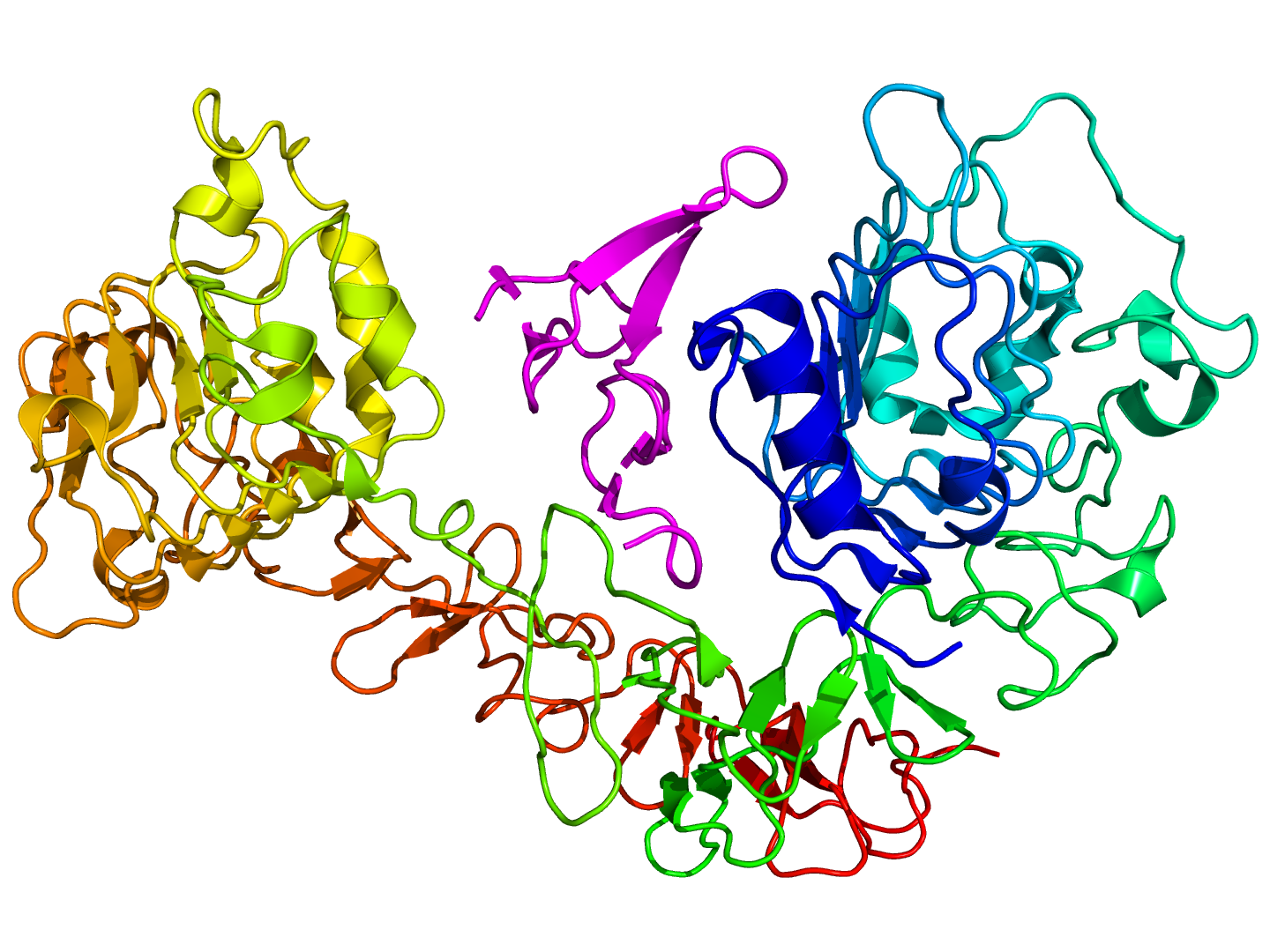
The epidermal growth factor receptor (EGFR; ErbB-1; HER1 in humans) is a transmembrane protein that is a receptor for members of the epidermal growth factor family (EGF family) of extracellular protein ligands.
The epidermal growth factor receptor is a member of the ErbB family of receptors, a subfamily of four closely related receptor tyrosine kinases: EGFR (ErbB-1), HER2/neu (ErbB-2), Her 3 (ErbB-3) and Her 4 (ErbB-4). In many cancer types, mutations affecting EGFR expression or activity could result in cancer.
Epidermal growth factor and its receptor were discovered by Stanley Cohen of Vanderbilt University. Cohen shared the 1986 Nobel Prize in Medicine with Rita Levi-Montalcini for their discovery of growth factors.
Deficient signaling of the EGFR and other receptor tyrosine kinases in humans is associated with diseases such as Alzheimer's, while over-expression is associated with the development of a wide variety of tumors. Interruption of EGFR signalling, either by blocking EGFR binding sites on the extracellular domain of the receptor or by inhibiting intracellular tyrosine kinase activity, can prevent the growth of EGFR-expressing tumours and improve the patient's condition[citation needed].
Epidermal growth factor receptor (EGFR) is a transmembrane protein that is activated by binding of its specific ligands, including epidermal growth factor and transforming growth factor alpha (TGF-α). ErbB2 has no known direct activating ligand, and may be in an activated state constitutively or become active upon heterodimerization with other family members such as EGFR. Upon activation by its growth factor ligands, EGFR undergoes a transition from an inactive monomeric form to an active homodimer. – although there is some evidence that preformed inactive dimers may also exist before ligand binding. In addition to forming homodimers after ligand binding, EGFR may pair with another member of the ErbB receptor family, such as ErbB2/Her2/neu, to create an activated heterodimer. There is also evidence to suggest that clusters of activated EGFRs form, although it remains unclear whether this clustering is important for activation itself or occurs after activation of individual dimers.
EGFR dimerization stimulates its intrinsic intracellular protein-tyrosine kinase activity. As a result, autophosphorylation of several tyrosine (Y) residues in the C-terminal domain of EGFR occurs. These include Y992, Y1045, Y1068, Y1148, and Y1173, as shown in the adjacent diagram. This autophosphorylation elicits downstream activation and signaling by several other proteins that associate with the phosphorylated tyrosines through their own phosphotyrosine-binding SH2 domains. These downstream signaling proteins initiate several signal transduction cascades, principally the MAPK, Akt and JNK pathways, leading to DNA synthesis and cell proliferation. Such proteins modulate phenotypes such as cell migration, adhesion, and proliferation. Activation of the receptor is important for the innate immune response in human skin. Additionally, the kinase domain of the EGFR can cross-phosphorylate the tyrosine residues of other receptors with which it is aggregated and thereby activate itself.
The EGFR is essential for ductal development of the mammary glands, and agonists of the EGFR such as amphiregulin, TGF-α, and heregulin induce both ductal and lobuloalveolar development even in the absence of estrogen and progesterone.
Mutations that lead to EGFR overexpression (known as upregulation or amplification) have been associated with a number of cancers, including adenocarcinoma of the lung (40% of cases), anal cancers, glioblastoma (50%) and epithelian tumors of the head and neck (80–100%). These somatic mutations involving EGFR lead to its constant activation, which produces uncontrolled cell division. In glioblastoma a specific mutation of EGFR, called EGFRvIII, is often observed. Mutations, amplifications or misregulations of EGFR or family members are implicated in about 30% of all epithelial cancers.
Hub AI
Epidermal growth factor receptor AI simulator
(@Epidermal growth factor receptor_simulator)
Epidermal growth factor receptor
The epidermal growth factor receptor (EGFR; ErbB-1; HER1 in humans) is a transmembrane protein that is a receptor for members of the epidermal growth factor family (EGF family) of extracellular protein ligands.
The epidermal growth factor receptor is a member of the ErbB family of receptors, a subfamily of four closely related receptor tyrosine kinases: EGFR (ErbB-1), HER2/neu (ErbB-2), Her 3 (ErbB-3) and Her 4 (ErbB-4). In many cancer types, mutations affecting EGFR expression or activity could result in cancer.
Epidermal growth factor and its receptor were discovered by Stanley Cohen of Vanderbilt University. Cohen shared the 1986 Nobel Prize in Medicine with Rita Levi-Montalcini for their discovery of growth factors.
Deficient signaling of the EGFR and other receptor tyrosine kinases in humans is associated with diseases such as Alzheimer's, while over-expression is associated with the development of a wide variety of tumors. Interruption of EGFR signalling, either by blocking EGFR binding sites on the extracellular domain of the receptor or by inhibiting intracellular tyrosine kinase activity, can prevent the growth of EGFR-expressing tumours and improve the patient's condition[citation needed].
Epidermal growth factor receptor (EGFR) is a transmembrane protein that is activated by binding of its specific ligands, including epidermal growth factor and transforming growth factor alpha (TGF-α). ErbB2 has no known direct activating ligand, and may be in an activated state constitutively or become active upon heterodimerization with other family members such as EGFR. Upon activation by its growth factor ligands, EGFR undergoes a transition from an inactive monomeric form to an active homodimer. – although there is some evidence that preformed inactive dimers may also exist before ligand binding. In addition to forming homodimers after ligand binding, EGFR may pair with another member of the ErbB receptor family, such as ErbB2/Her2/neu, to create an activated heterodimer. There is also evidence to suggest that clusters of activated EGFRs form, although it remains unclear whether this clustering is important for activation itself or occurs after activation of individual dimers.
EGFR dimerization stimulates its intrinsic intracellular protein-tyrosine kinase activity. As a result, autophosphorylation of several tyrosine (Y) residues in the C-terminal domain of EGFR occurs. These include Y992, Y1045, Y1068, Y1148, and Y1173, as shown in the adjacent diagram. This autophosphorylation elicits downstream activation and signaling by several other proteins that associate with the phosphorylated tyrosines through their own phosphotyrosine-binding SH2 domains. These downstream signaling proteins initiate several signal transduction cascades, principally the MAPK, Akt and JNK pathways, leading to DNA synthesis and cell proliferation. Such proteins modulate phenotypes such as cell migration, adhesion, and proliferation. Activation of the receptor is important for the innate immune response in human skin. Additionally, the kinase domain of the EGFR can cross-phosphorylate the tyrosine residues of other receptors with which it is aggregated and thereby activate itself.
The EGFR is essential for ductal development of the mammary glands, and agonists of the EGFR such as amphiregulin, TGF-α, and heregulin induce both ductal and lobuloalveolar development even in the absence of estrogen and progesterone.
Mutations that lead to EGFR overexpression (known as upregulation or amplification) have been associated with a number of cancers, including adenocarcinoma of the lung (40% of cases), anal cancers, glioblastoma (50%) and epithelian tumors of the head and neck (80–100%). These somatic mutations involving EGFR lead to its constant activation, which produces uncontrolled cell division. In glioblastoma a specific mutation of EGFR, called EGFRvIII, is often observed. Mutations, amplifications or misregulations of EGFR or family members are implicated in about 30% of all epithelial cancers.
Recent media