


Community hub
Recent from talks
Knowledge base stats:
Talk channels stats:
Members stats:
Equations of motion
In physics, equations of motion are equations that describe the behavior of a physical system in terms of its motion as a function of time. More specifically, the equations of motion describe the behavior of a physical system as a set of mathematical functions in terms of dynamic variables. These variables are usually spatial coordinates and time, but may include momentum components. The most general choice are generalized coordinates which can be any convenient variables characteristic of the physical system. The functions are defined in a Euclidean space in classical mechanics, but are replaced by curved spaces in relativity. If the dynamics of a system is known, the equations are the solutions for the differential equations describing the motion of the dynamics.
There are two main descriptions of motion: dynamics and kinematics. Dynamics is general, since the momenta, forces and energy of the particles are taken into account. In this instance, sometimes the term dynamics refers to the differential equations that the system satisfies (e.g., Newton's second law or Euler–Lagrange equations), and sometimes to the solutions to those equations.
However, kinematics is simpler. It concerns only variables derived from the positions of objects and time. In circumstances of constant acceleration, these simpler equations of motion are usually referred to as the SUVAT equations, arising from the definitions of kinematic quantities: displacement (s), initial velocity (u), final velocity (v), acceleration (a), and time (t).
A differential equation of motion, usually identified as some physical law (for example, F = ma), and applying definitions of physical quantities, is used to set up an equation to solve a kinematics problem. Solving the differential equation will lead to a general solution with arbitrary constants, the arbitrariness corresponding to a set of solutions. A particular solution can be obtained by setting the initial values, which fixes the values of the constants.
Stated formally, in general, an equation of motion M is a function of the position r of the object, its velocity (the first time derivative of r, v = dr/dt), and its acceleration (the second derivative of r, a = d2r/dt2), and time t. Euclidean vectors in 3D are denoted throughout in bold. This is equivalent to saying an equation of motion in r is a second-order ordinary differential equation (ODE) in r,
![{\displaystyle M\left[\mathbf {r} (t),\mathbf {\dot {r}} (t),\mathbf {\ddot {r}} (t),t\right]=0\,,}](https://wikimedia.org/api/rest_v1/media/math/render/svg/969c32e88d55826a347715bee49544f4ab6bf67a)
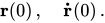
where t is time, and each overdot denotes one time derivative. The initial conditions are given by the constant values at t = 0,
Hub AI
Equations of motion AI simulator
(@Equations of motion_simulator)
Equations of motion
In physics, equations of motion are equations that describe the behavior of a physical system in terms of its motion as a function of time. More specifically, the equations of motion describe the behavior of a physical system as a set of mathematical functions in terms of dynamic variables. These variables are usually spatial coordinates and time, but may include momentum components. The most general choice are generalized coordinates which can be any convenient variables characteristic of the physical system. The functions are defined in a Euclidean space in classical mechanics, but are replaced by curved spaces in relativity. If the dynamics of a system is known, the equations are the solutions for the differential equations describing the motion of the dynamics.
There are two main descriptions of motion: dynamics and kinematics. Dynamics is general, since the momenta, forces and energy of the particles are taken into account. In this instance, sometimes the term dynamics refers to the differential equations that the system satisfies (e.g., Newton's second law or Euler–Lagrange equations), and sometimes to the solutions to those equations.
However, kinematics is simpler. It concerns only variables derived from the positions of objects and time. In circumstances of constant acceleration, these simpler equations of motion are usually referred to as the SUVAT equations, arising from the definitions of kinematic quantities: displacement (s), initial velocity (u), final velocity (v), acceleration (a), and time (t).
A differential equation of motion, usually identified as some physical law (for example, F = ma), and applying definitions of physical quantities, is used to set up an equation to solve a kinematics problem. Solving the differential equation will lead to a general solution with arbitrary constants, the arbitrariness corresponding to a set of solutions. A particular solution can be obtained by setting the initial values, which fixes the values of the constants.
Stated formally, in general, an equation of motion M is a function of the position r of the object, its velocity (the first time derivative of r, v = dr/dt), and its acceleration (the second derivative of r, a = d2r/dt2), and time t. Euclidean vectors in 3D are denoted throughout in bold. This is equivalent to saying an equation of motion in r is a second-order ordinary differential equation (ODE) in r,
where t is time, and each overdot denotes one time derivative. The initial conditions are given by the constant values at t = 0,