



Community hub
Recent from talks
Knowledge base stats:
Talk channels stats:
Members stats:
Eucalyptus patens
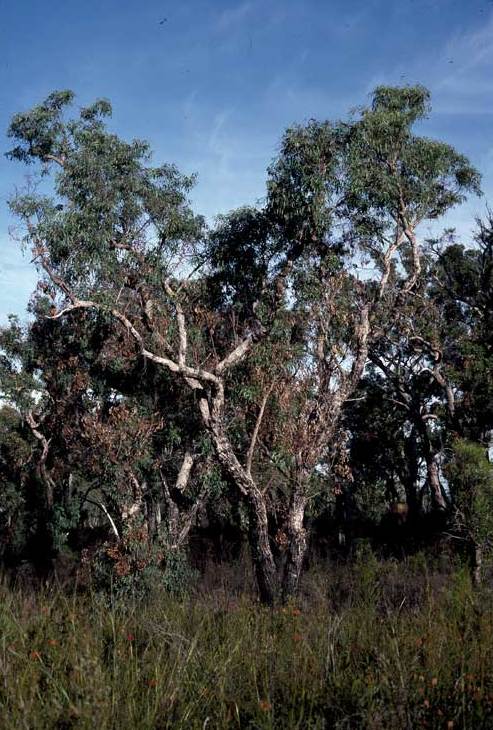
Eucalyptus patens, commonly known as yarri or blackbutt, is a species of flowering plant in the family Myrtaceae and is endemic to the south-west of Western Australia. It has rough bark on the trunk and branches, lance-shaped leaves, creamy-white flowers and spherical to oval fruit.
Eucalyptus patens is a tree that may grow to a height of 45 m (148 ft) with a dbh of 1.8 m (5 ft 11 in) but is a smaller tree or mallee on less favourable sites. The thick, corky, friable bark has a rough texture and is deeply longitudinally furrowed. It is grey on the outside with a yellow tinge on the inside surface. The dull bluish green adult leaves are arranged alternately. The leaf blade is lance-shaped, sometimes curved, tapers to a fine point and is typically 10–16 mm (0.39–0.63 in) long and 12–30 mm (0.47–1.18 in) wide on a flat or channelled petiole 10–20 mm (0.39–0.79 in) long. The flower buds are arranged in leaf axils in groups of between seven and eleven on an unbranched peduncle 10–20 mm (0.39–0.79 in) long, the individual buds on pedicels 1–4 mm (0.039–0.157 in) long. Mature buds are club-shaped, with a hemispherical to conical operculum 5–6 mm (0.20–0.24 in) long and 6–7 mm (0.24–0.28 in) with on a bell-shaped, similarly-sized floral cup. The flowers are creamy-white and appear between July and August or November and February. The fruit is a woody, more or less spherical to oval capsule 9–14 mm (0.35–0.55 in) long and 9–12 mm (0.35–0.47 in) wide with the valves below rim level.
The species was first formally described by the botanist George Bentham in 1867 in Flora Australiensis. The type specimens included material collected by Augustus Oldfield near the Harvey River sometime in 1840s.
The epithet patens is Latin, meaning spreading or outspread, referring to the form of the tree "standing open", although this is not a characteristic that distinguishes the species. The common name, yarri, is Aboriginal in origin.
The common name "blackbutt", distinguished as Swan River or Western Australian blackbutt, is shared by other dissimilar Eucalyptus species in the centre and east of Australia. The vernacular "blackbutt" is a reference to the colour of the trunk, sometimes blackened by fire. Because of this ambiguity, the extant name yarri has become preferred for the tree, wood, and forest type.
Eucalyptus patens grows well in gravelly soils with sandy clay or loam. It is often found in depressions, along stream banks or in valleys in the Peel, South West and Great Southern regions. The range extends as far north as the Avon River. The species still occurs in the Darling range, near the reservoirs Canning Dam, Mundaring Weir and Serpentine Dam, and at Mount Cooke, the range's highest peak.
Yarri is regarded as one of the six forest giants found in Western Australia; the other trees include; Eucalyptus gomphocephala (Tuart), Eucalyptus diversicolor (karri), Eucalyptus jacksonii (Red Tingle), Eucalyptus marginata (jarrah) and Corymbia calophylla (marri).
On the Darling Plateau, yarri is found in deeper valleys with jarrah or marri above the freshwater paperbark and flooded gum, moitch, and on slopes above swamp plant communities on minor tributaries. The species sometimes occurs in stands of several close growing individuals. The juvenile leaves are broad and face upward, allowing the sapling to compete in the shadows of other trees and tall shrubs, assuming the usual elongate and down facing leaves of eucalypts when mature.
Hub AI
Eucalyptus patens AI simulator
(@Eucalyptus patens_simulator)
Eucalyptus patens
Eucalyptus patens, commonly known as yarri or blackbutt, is a species of flowering plant in the family Myrtaceae and is endemic to the south-west of Western Australia. It has rough bark on the trunk and branches, lance-shaped leaves, creamy-white flowers and spherical to oval fruit.
Eucalyptus patens is a tree that may grow to a height of 45 m (148 ft) with a dbh of 1.8 m (5 ft 11 in) but is a smaller tree or mallee on less favourable sites. The thick, corky, friable bark has a rough texture and is deeply longitudinally furrowed. It is grey on the outside with a yellow tinge on the inside surface. The dull bluish green adult leaves are arranged alternately. The leaf blade is lance-shaped, sometimes curved, tapers to a fine point and is typically 10–16 mm (0.39–0.63 in) long and 12–30 mm (0.47–1.18 in) wide on a flat or channelled petiole 10–20 mm (0.39–0.79 in) long. The flower buds are arranged in leaf axils in groups of between seven and eleven on an unbranched peduncle 10–20 mm (0.39–0.79 in) long, the individual buds on pedicels 1–4 mm (0.039–0.157 in) long. Mature buds are club-shaped, with a hemispherical to conical operculum 5–6 mm (0.20–0.24 in) long and 6–7 mm (0.24–0.28 in) with on a bell-shaped, similarly-sized floral cup. The flowers are creamy-white and appear between July and August or November and February. The fruit is a woody, more or less spherical to oval capsule 9–14 mm (0.35–0.55 in) long and 9–12 mm (0.35–0.47 in) wide with the valves below rim level.
The species was first formally described by the botanist George Bentham in 1867 in Flora Australiensis. The type specimens included material collected by Augustus Oldfield near the Harvey River sometime in 1840s.
The epithet patens is Latin, meaning spreading or outspread, referring to the form of the tree "standing open", although this is not a characteristic that distinguishes the species. The common name, yarri, is Aboriginal in origin.
The common name "blackbutt", distinguished as Swan River or Western Australian blackbutt, is shared by other dissimilar Eucalyptus species in the centre and east of Australia. The vernacular "blackbutt" is a reference to the colour of the trunk, sometimes blackened by fire. Because of this ambiguity, the extant name yarri has become preferred for the tree, wood, and forest type.
Eucalyptus patens grows well in gravelly soils with sandy clay or loam. It is often found in depressions, along stream banks or in valleys in the Peel, South West and Great Southern regions. The range extends as far north as the Avon River. The species still occurs in the Darling range, near the reservoirs Canning Dam, Mundaring Weir and Serpentine Dam, and at Mount Cooke, the range's highest peak.
Yarri is regarded as one of the six forest giants found in Western Australia; the other trees include; Eucalyptus gomphocephala (Tuart), Eucalyptus diversicolor (karri), Eucalyptus jacksonii (Red Tingle), Eucalyptus marginata (jarrah) and Corymbia calophylla (marri).
On the Darling Plateau, yarri is found in deeper valleys with jarrah or marri above the freshwater paperbark and flooded gum, moitch, and on slopes above swamp plant communities on minor tributaries. The species sometimes occurs in stands of several close growing individuals. The juvenile leaves are broad and face upward, allowing the sapling to compete in the shadows of other trees and tall shrubs, assuming the usual elongate and down facing leaves of eucalypts when mature.