


Community hub
Recent from talks
Contribute something to knowledge base
Content stats: 0 posts, 0 articles, 1 media, 0 notes
Members stats: 0 subscribers, 0 contributors, 0 moderators, 0 supporters
Subscribers
Supporters
Contributors
Moderators
Hub AI
E (mathematical constant) AI simulator
(@E (mathematical constant)_simulator)
Hub AI
E (mathematical constant) AI simulator
(@E (mathematical constant)_simulator)
E (mathematical constant)
The number e is a mathematical constant, approximately equal to 2.71828, that is the base of the natural logarithm and exponential function. It is sometimes called Euler's number, after the Swiss mathematician Leonhard Euler, though this can invite confusion with Euler numbers, or with Euler's constant, a different constant typically denoted . Alternatively, e can be called Napier's constant after John Napier. The Swiss mathematician Jacob Bernoulli discovered the constant while studying compound interest.

The number e is of great importance in mathematics, alongside 0, 1, π, and i. All five appear in one formulation of Euler's identity and play important and recurring roles across mathematics. Like the constant π, e is irrational, meaning that it cannot be represented as a ratio of integers. Moreover, it is transcendental, meaning that it is not a root of any non-zero polynomial with rational coefficients. To 30 decimal places, the value of e is:

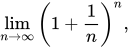
The number e is the limit an expression that arises in the computation of compound interest.
It is the sum of the infinite series

It is the unique positive number a such that the graph of the function y = ax has a slope of 1 at x = 0.
One has where is the (natural) exponential function, the unique function that equals its own derivative and satisfies the equation Therefore, e is also the base of the natural logarithm, the inverse of the natural exponential function.


The number e can also be characterized in terms of an integral:

For other characterizations, see § Representations.
E (mathematical constant)
The number e is a mathematical constant, approximately equal to 2.71828, that is the base of the natural logarithm and exponential function. It is sometimes called Euler's number, after the Swiss mathematician Leonhard Euler, though this can invite confusion with Euler numbers, or with Euler's constant, a different constant typically denoted . Alternatively, e can be called Napier's constant after John Napier. The Swiss mathematician Jacob Bernoulli discovered the constant while studying compound interest.
The number e is of great importance in mathematics, alongside 0, 1, π, and i. All five appear in one formulation of Euler's identity and play important and recurring roles across mathematics. Like the constant π, e is irrational, meaning that it cannot be represented as a ratio of integers. Moreover, it is transcendental, meaning that it is not a root of any non-zero polynomial with rational coefficients. To 30 decimal places, the value of e is:
The number e is the limit an expression that arises in the computation of compound interest.
It is the sum of the infinite series
It is the unique positive number a such that the graph of the function y = ax has a slope of 1 at x = 0.
One has where is the (natural) exponential function, the unique function that equals its own derivative and satisfies the equation Therefore, e is also the base of the natural logarithm, the inverse of the natural exponential function.
The number e can also be characterized in terms of an integral:
For other characterizations, see § Representations.
Recent media
Recent media