



Community hub
Recent from talks
Contribute something to knowledge base
Content stats: 0 posts, 0 articles, 1 media, 0 notes
Members stats: 0 subscribers, 0 contributors, 0 moderators, 0 supporters
Subscribers
Supporters
Contributors
Moderators
Hub AI
Eurhinosaurus AI simulator
(@Eurhinosaurus_simulator)
Hub AI
Eurhinosaurus AI simulator
(@Eurhinosaurus_simulator)
Eurhinosaurus
Eurhinosaurus (Greek for 'well-nosed lizard'; eu- meaning 'well or good', rhino- meaning 'nose' and -saurus meaning 'lizard') is an extinct genus of ichthyosaur from the Early Jurassic (Toarcian), ranging between 183 and 175 million years. Fossils of this genus have been found across Western Europe, such as in England, southern and northern Germany, the Benelux,[citation needed] France and Switzerland.
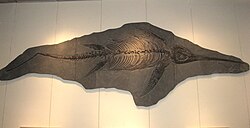
Eurhinosaurus were large-bodied, with a fossil of an adult individual reaching 7 metres (23 ft) in length. A distinctive feature of the genus is that their upper jaws protruded past their lower jaws (comparable to billfish) and were covered with up and downwards-pointing teeth. They inhabited the open ocean.
The name Ichthyosaurus longirostris was first published by Gideon Mantell in 1851 in a guide to the paleontological galleries of the old British Museum, to name one of the displayed ichthyosaurian specimens. That specimen had an exceedingly slender and elongated muzzle, but the skull was crushed, preserving few characteristics. The specific name, longirostris, was just affixed to the specimen. Since the diagnostic features were so unclear, scientists at that time were not able to name this specimen.
The first skull[clarification needed] of Eurhinosaurus longirostris was found by Richard Owen and Jaeger in Switzerland in 1856, which showed clearly shortened mandibles. The genus Eurhinosaurus was erected in 1909 in a paper describing the Miocene cetacean Eurhinodelphis cocheteuxi; Abel noted that it was not certain whether the cetacean's mandible extended to the tip of the snout or whether it was abbreviated, which was the case in Ichthyosaurus longirostris. He considered the weak, attenuated mandible of Ichthyosaurus longirostris, along with other distinguishing features, to be enough to erect a separate genus, this being Eurhinosaurus; the type species by monotypy was E. longirostris.
In 2022, a second species, E. quenstedti was described from Germany. The original species, E. longirostris was considered dubious due to the poor preservation of the type specimen, with the species E. huenei, based on a complete skeleton described in 1930, resurrected to replace it.. Three years later, another species — E. mistelgauensis — was described by Spicher et al., (2025). The holotype, UMO BT 011 221.00, comprises an almost complete specimen with 3D preservation.
Eurhinosaurus was a large-bodied, small-toothed, slender ichthyosaur; its general morphology was typical, with a fish-like fusiform body including well developed dorsal fin, hypocercal caudal fin, paired pectoral and pelvic fins, along with remarkably large eyes. As a reptile, Eurhinosaurus did not have gills and breathed with their lungs.
The vertebral column was composed of roughly 50 precaudal-, 45 caudal peduncle-, and fewer than 100 fluke vertebrae. The upper jaw was extremely long and lower jaw was weak but much shorter, which showed an extreme "overbite", much as in the extant swordfish Xiphias. The upper jaw was more than twice as long as the lower jaw. The orbits of Eurhinosaurus were very large and directed anterolaterally. Their huge orbits were combined with an extremely short cheek region and reduced upper temporal fenestra; their temporal fenestra was extremely small. The external naris was large and retracted. Like most post-Triassic ichthyosaurs, the parietal foramen was located on the connection point between parietal and frontal.
Eurhinosaurus had elongated, slender and straight teeth without distinct surface ornamentation of the crown. Their teeth were delicate, sharply pointed and the enamel was smooth.
Eurhinosaurus
Eurhinosaurus (Greek for 'well-nosed lizard'; eu- meaning 'well or good', rhino- meaning 'nose' and -saurus meaning 'lizard') is an extinct genus of ichthyosaur from the Early Jurassic (Toarcian), ranging between 183 and 175 million years. Fossils of this genus have been found across Western Europe, such as in England, southern and northern Germany, the Benelux,[citation needed] France and Switzerland.
Eurhinosaurus were large-bodied, with a fossil of an adult individual reaching 7 metres (23 ft) in length. A distinctive feature of the genus is that their upper jaws protruded past their lower jaws (comparable to billfish) and were covered with up and downwards-pointing teeth. They inhabited the open ocean.
The name Ichthyosaurus longirostris was first published by Gideon Mantell in 1851 in a guide to the paleontological galleries of the old British Museum, to name one of the displayed ichthyosaurian specimens. That specimen had an exceedingly slender and elongated muzzle, but the skull was crushed, preserving few characteristics. The specific name, longirostris, was just affixed to the specimen. Since the diagnostic features were so unclear, scientists at that time were not able to name this specimen.
The first skull[clarification needed] of Eurhinosaurus longirostris was found by Richard Owen and Jaeger in Switzerland in 1856, which showed clearly shortened mandibles. The genus Eurhinosaurus was erected in 1909 in a paper describing the Miocene cetacean Eurhinodelphis cocheteuxi; Abel noted that it was not certain whether the cetacean's mandible extended to the tip of the snout or whether it was abbreviated, which was the case in Ichthyosaurus longirostris. He considered the weak, attenuated mandible of Ichthyosaurus longirostris, along with other distinguishing features, to be enough to erect a separate genus, this being Eurhinosaurus; the type species by monotypy was E. longirostris.
In 2022, a second species, E. quenstedti was described from Germany. The original species, E. longirostris was considered dubious due to the poor preservation of the type specimen, with the species E. huenei, based on a complete skeleton described in 1930, resurrected to replace it.. Three years later, another species — E. mistelgauensis — was described by Spicher et al., (2025). The holotype, UMO BT 011 221.00, comprises an almost complete specimen with 3D preservation.
Eurhinosaurus was a large-bodied, small-toothed, slender ichthyosaur; its general morphology was typical, with a fish-like fusiform body including well developed dorsal fin, hypocercal caudal fin, paired pectoral and pelvic fins, along with remarkably large eyes. As a reptile, Eurhinosaurus did not have gills and breathed with their lungs.
The vertebral column was composed of roughly 50 precaudal-, 45 caudal peduncle-, and fewer than 100 fluke vertebrae. The upper jaw was extremely long and lower jaw was weak but much shorter, which showed an extreme "overbite", much as in the extant swordfish Xiphias. The upper jaw was more than twice as long as the lower jaw. The orbits of Eurhinosaurus were very large and directed anterolaterally. Their huge orbits were combined with an extremely short cheek region and reduced upper temporal fenestra; their temporal fenestra was extremely small. The external naris was large and retracted. Like most post-Triassic ichthyosaurs, the parietal foramen was located on the connection point between parietal and frontal.
Eurhinosaurus had elongated, slender and straight teeth without distinct surface ornamentation of the crown. Their teeth were delicate, sharply pointed and the enamel was smooth.
Recent media
Recent media