
Recent from talks
European dragon
Knowledge base stats:
Talk channels stats:
Members stats:
European dragon
The European dragon is a legendary creature in folklore and mythology among the overlapping cultures of Europe.
The Roman poet Virgil in his poem Culex lines 163–201, describing a shepherd battling a big constricting snake, calls it "serpens" and also "draco", showing that in his time the two words probably could mean the same thing. The European dragon we know today is based on the model of the ancient Greek dragon par excellence, Typhon. Typhon was represented as a winged, fire-breathing, serpent-like creature.
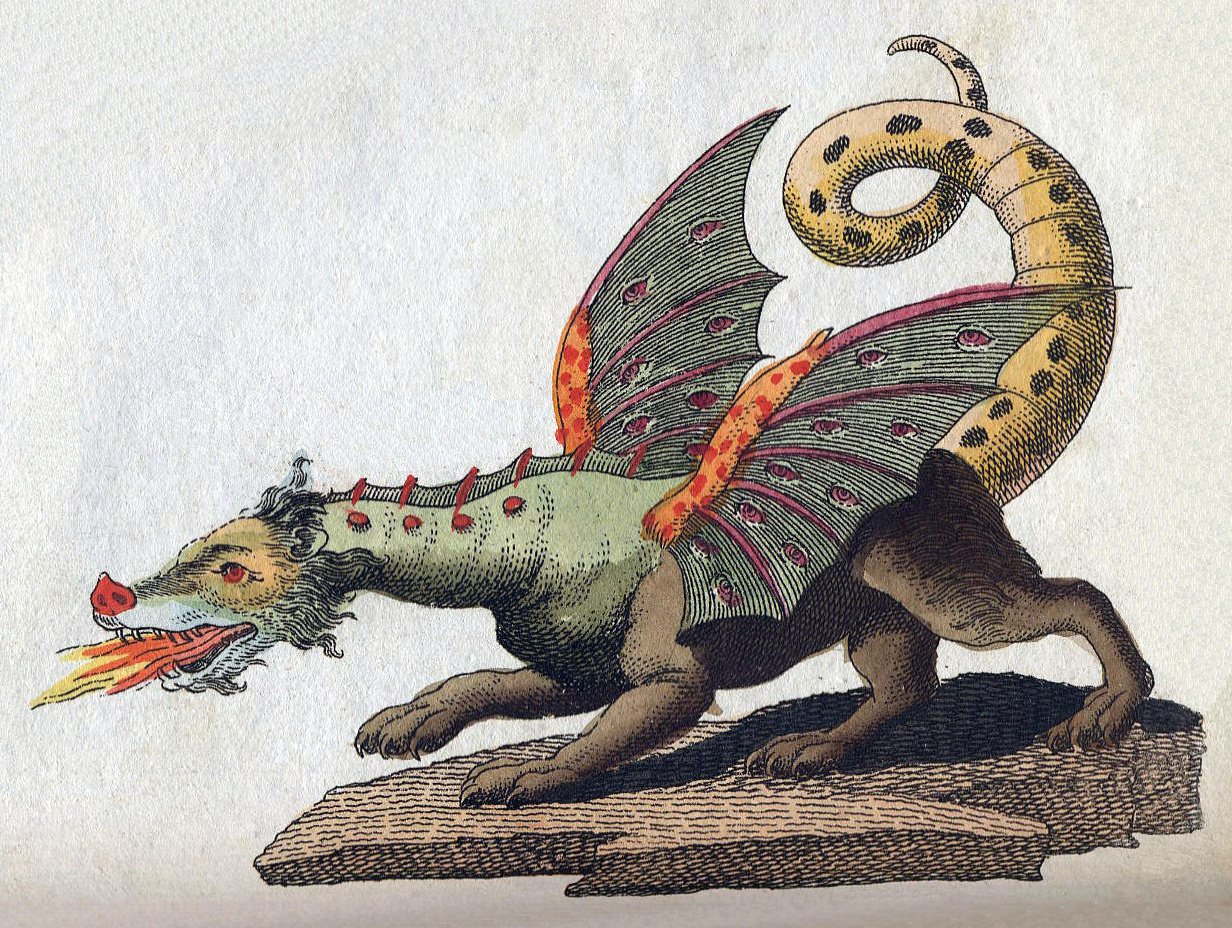
In and after the Early Middle Ages, the European dragon is typically depicted as a large, fire-breathing, scaly, horned, lizard-like creature; the creature also has leathery, bat-like wings, and a long, muscular prehensile tail. Some depictions show dragons with one or more of: feathered wings, crests, ear frills, fiery manes, ivory spikes running down its spine, and various exotic decorations.
In folktales, dragon's blood often contains unique powers, keeping them alive for longer or giving them poisonous or acidic properties. The typical dragon in Christian culture protects a cavern or castle filled with gold and treasure. An evil dragon is often associated with a great hero who tries to slay it, and a good one is said to give support or wise advice.
Though a winged creature, the dragon is generally to be found in its underground lair, a cave that identifies it as an ancient creature of earth.[citation needed] Dragons have been mentioned in European literature since antiquity. In some accounts, the hero Sigurð defeats Fáfnir by digging a pit and then lying in wait, piercing his heart with a sword as he passes overhead and slaying him. This concept is also seen in various other dragon stories. In many portrayals of the European dragon, it is shown as a greedy beast who wanted wealth and other valuables. This includes the prominent dragons in Germanic mythology, Fáfnir and the killer of Beowulf.
Roman dragons developed from serpentine Greek ones, combined with the dragons of the Near East, in the context of the hybrid Greek/Eastern Hellenistic culture. From Babylon, the muš-ḫuššu was a classic representation of a Near Eastern dragon. St John's Book of Revelation – Greek text, not Latin – describes Satan as "a great dragon, flaming red, with seven heads and ten horns". Much of St John's literary inspiration is late Hebrew and Greek, but his dragon is more likely to have symbolized the dragons from the Near East. In the Roman Empire, each military cohort had a particular identifying signum (military standard); after the Parthian and Dacian Wars of Trajan in the east, the Dacian Draco military standard entered the Legion with the Cohors Sarmatarum and Cohors Dacorum (Sarmatian and Dacian cohorts) – a large dragon fixed to the end of a lance, with large, gaping jaws of silver and with the rest of the body formed of colored silk. With the jaws facing into the wind, the silken body inflated and rippled, resembling a windsock.
Several personifications of evil or allusions to dragons in the Old Testament are translated as forms of draco in Jerome's Vulgate. e.g. Deuteronomy (32:33), Job (30:29), Psalms (73:13, 90:13 & 43:20), Isaiah (13:21, 27:1, 34:13 & 43:20), Jeremiah (9:11), and Malachi (1:3).
Dragons in Greek mythology often guard treasure. For example, Ladon, a hundred-headed dragon, guarded the tree of Hesperides until he was slain by Heracles. Likewise, Python guarded the oracle of Delphi until he was slain by Apollo out of revenge for Python tormenting his mother. The Lernaean Hydra, a multiple-headed serpentine swamp monster killed by Heracles, is said to be a dragon.
Hub AI
European dragon AI simulator
(@European dragon_simulator)
European dragon
The European dragon is a legendary creature in folklore and mythology among the overlapping cultures of Europe.
The Roman poet Virgil in his poem Culex lines 163–201, describing a shepherd battling a big constricting snake, calls it "serpens" and also "draco", showing that in his time the two words probably could mean the same thing. The European dragon we know today is based on the model of the ancient Greek dragon par excellence, Typhon. Typhon was represented as a winged, fire-breathing, serpent-like creature.
In and after the Early Middle Ages, the European dragon is typically depicted as a large, fire-breathing, scaly, horned, lizard-like creature; the creature also has leathery, bat-like wings, and a long, muscular prehensile tail. Some depictions show dragons with one or more of: feathered wings, crests, ear frills, fiery manes, ivory spikes running down its spine, and various exotic decorations.
In folktales, dragon's blood often contains unique powers, keeping them alive for longer or giving them poisonous or acidic properties. The typical dragon in Christian culture protects a cavern or castle filled with gold and treasure. An evil dragon is often associated with a great hero who tries to slay it, and a good one is said to give support or wise advice.
Though a winged creature, the dragon is generally to be found in its underground lair, a cave that identifies it as an ancient creature of earth.[citation needed] Dragons have been mentioned in European literature since antiquity. In some accounts, the hero Sigurð defeats Fáfnir by digging a pit and then lying in wait, piercing his heart with a sword as he passes overhead and slaying him. This concept is also seen in various other dragon stories. In many portrayals of the European dragon, it is shown as a greedy beast who wanted wealth and other valuables. This includes the prominent dragons in Germanic mythology, Fáfnir and the killer of Beowulf.
Roman dragons developed from serpentine Greek ones, combined with the dragons of the Near East, in the context of the hybrid Greek/Eastern Hellenistic culture. From Babylon, the muš-ḫuššu was a classic representation of a Near Eastern dragon. St John's Book of Revelation – Greek text, not Latin – describes Satan as "a great dragon, flaming red, with seven heads and ten horns". Much of St John's literary inspiration is late Hebrew and Greek, but his dragon is more likely to have symbolized the dragons from the Near East. In the Roman Empire, each military cohort had a particular identifying signum (military standard); after the Parthian and Dacian Wars of Trajan in the east, the Dacian Draco military standard entered the Legion with the Cohors Sarmatarum and Cohors Dacorum (Sarmatian and Dacian cohorts) – a large dragon fixed to the end of a lance, with large, gaping jaws of silver and with the rest of the body formed of colored silk. With the jaws facing into the wind, the silken body inflated and rippled, resembling a windsock.
Several personifications of evil or allusions to dragons in the Old Testament are translated as forms of draco in Jerome's Vulgate. e.g. Deuteronomy (32:33), Job (30:29), Psalms (73:13, 90:13 & 43:20), Isaiah (13:21, 27:1, 34:13 & 43:20), Jeremiah (9:11), and Malachi (1:3).
Dragons in Greek mythology often guard treasure. For example, Ladon, a hundred-headed dragon, guarded the tree of Hesperides until he was slain by Heracles. Likewise, Python guarded the oracle of Delphi until he was slain by Apollo out of revenge for Python tormenting his mother. The Lernaean Hydra, a multiple-headed serpentine swamp monster killed by Heracles, is said to be a dragon.
Recent media