



Community hub
Recent from talks
Contribute something to knowledge base
Content stats: 0 posts, 0 articles, 1 media, 0 notes
Members stats: 0 subscribers, 0 contributors, 0 moderators, 0 supporters
Subscribers
Supporters
Contributors
Moderators
Hub AI
European hedgehog AI simulator
(@European hedgehog_simulator)
Hub AI
European hedgehog AI simulator
(@European hedgehog_simulator)
European hedgehog
The European hedgehog (Erinaceus europaeus), also known as the West European hedgehog or common hedgehog, is a hedgehog species native to Europe from Iberia and Italy northwards into Scandinavia and westwards into Ireland. It is a generally common and widely distributed species that can survive across a wide range of habitat types. It is a well-known species, and a favourite in European gardens, both for its endearing appearance and its preference for eating a range of garden pests. While populations are currently stable across much of its range, it is declining severely in Great Britain, where it is now Red Listed, meaning that it is considered to be at risk of local extinction. Outside its native range the species was introduced to New Zealand during the late nineteenth and early twentieth centuries.
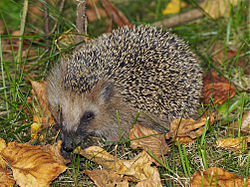
The European hedgehog has a generalised body structure with unspecialised limb girdles. It appears brownish with most of its body covered by up to 6000 brown and white spines. The length of head and body is ~160 mm (6 in) at weaning, increasing to 260 mm (10 in) or more in large adults. It has an extremely short tail as an almost vestigial feature, typically 20 to 30 mm (0.8 to 1.2 in). Weight increases from around 120 g (4 oz) at weaning to > 1100 g (40 oz) in adulthood. The maximum recorded weight is 2000 g (70 oz), though few wild specimens exceed 1600 g (55 oz) even in autumn. Adult summer weight is typically somewhat less than in autumn, with an average of around 800 g (28 oz) and adult weights commonly as low as 500 g (18 oz). Males tend to be slightly larger than females, but sex differences in body weight are overshadowed by enormous seasonal variation.
The European hedgehog is unlike any other creature across most of its range. Where it coexists with the northern white-breasted hedgehog (Erinaceus roumanicus), the two species are difficult to distinguish in the field, the latter having a white spot on its chest. It is probably the largest hedgehog species and is possibly the heaviest member of the order Erinaceomorpha.
Leucistic or 'blonde' hedgehogs occasionally occur. Such specimens are believed to have a pair of rare recessive genes, giving rise to their black eyes and creamy-coloured spines; however they are not strictly speaking albino. They are extremely rare, except on North Ronaldsay and the Channel Island of Alderney, where around 25% of the population is thought to be blonde. True albino morphs of the hedgehog occur infrequently.
The European hedgehog is largely nocturnal. It has a hesitant gait, frequently stopping to smell the air. Unlike the smaller, warmer-climate species, the European hedgehog may hibernate in the winter. However most wake at least once to move their nests.
The European hedgehog is an insectivore. Its diet consists largely of earthworms, as well as snails and slugs, beetles, ants, bees and wasps, earwigs, cockroaches, crickets and grasshoppers, butterflies and moths, and caterpillars and other insect larvae. Eggs of ground-nesting birds are also taken and carcasses may be foraged on. Hedgehogs may also eat lizards, snakes, frogs and small rodents. Plant matter appears to make up only a negligible part of the hedgehog's diet.
The breeding season commences after hibernation. Pregnancies peak between May and July, though they have been recorded as late as September. Gestation is 31 to 35 days. The female alone raises the litter, which typically numbers between four and six, though the range is from two to ten. Studies have indicated that litter size may increase in more northern climes. The young are born blind with a covering of small spines. By the time they are 36 hours old the second, outer coat of spines begins to sprout. By 11 days they can roll into a ball. Weaning occurs at around six weeks of age.
European hedgehogs may live to more than ten years of age, although the average life expectancy is three years. Starvation is the most common cause of death, usually occurring during hibernation. If alarmed, the animal will roll into a ball to protect itself. Many potential predators are repelled by its spines, but predation does occur. Remains of hedgehogs have been found in the stomachs of red foxes (Vulpes vulpes), European badgers (Meles meles) and pine martens (Martes martes). A large portion of these may be from hedgehog carcasses, especially roadkill. However hedgehogs tend to be absent from areas where badgers are numerous.
European hedgehog
The European hedgehog (Erinaceus europaeus), also known as the West European hedgehog or common hedgehog, is a hedgehog species native to Europe from Iberia and Italy northwards into Scandinavia and westwards into Ireland. It is a generally common and widely distributed species that can survive across a wide range of habitat types. It is a well-known species, and a favourite in European gardens, both for its endearing appearance and its preference for eating a range of garden pests. While populations are currently stable across much of its range, it is declining severely in Great Britain, where it is now Red Listed, meaning that it is considered to be at risk of local extinction. Outside its native range the species was introduced to New Zealand during the late nineteenth and early twentieth centuries.
The European hedgehog has a generalised body structure with unspecialised limb girdles. It appears brownish with most of its body covered by up to 6000 brown and white spines. The length of head and body is ~160 mm (6 in) at weaning, increasing to 260 mm (10 in) or more in large adults. It has an extremely short tail as an almost vestigial feature, typically 20 to 30 mm (0.8 to 1.2 in). Weight increases from around 120 g (4 oz) at weaning to > 1100 g (40 oz) in adulthood. The maximum recorded weight is 2000 g (70 oz), though few wild specimens exceed 1600 g (55 oz) even in autumn. Adult summer weight is typically somewhat less than in autumn, with an average of around 800 g (28 oz) and adult weights commonly as low as 500 g (18 oz). Males tend to be slightly larger than females, but sex differences in body weight are overshadowed by enormous seasonal variation.
The European hedgehog is unlike any other creature across most of its range. Where it coexists with the northern white-breasted hedgehog (Erinaceus roumanicus), the two species are difficult to distinguish in the field, the latter having a white spot on its chest. It is probably the largest hedgehog species and is possibly the heaviest member of the order Erinaceomorpha.
Leucistic or 'blonde' hedgehogs occasionally occur. Such specimens are believed to have a pair of rare recessive genes, giving rise to their black eyes and creamy-coloured spines; however they are not strictly speaking albino. They are extremely rare, except on North Ronaldsay and the Channel Island of Alderney, where around 25% of the population is thought to be blonde. True albino morphs of the hedgehog occur infrequently.
The European hedgehog is largely nocturnal. It has a hesitant gait, frequently stopping to smell the air. Unlike the smaller, warmer-climate species, the European hedgehog may hibernate in the winter. However most wake at least once to move their nests.
The European hedgehog is an insectivore. Its diet consists largely of earthworms, as well as snails and slugs, beetles, ants, bees and wasps, earwigs, cockroaches, crickets and grasshoppers, butterflies and moths, and caterpillars and other insect larvae. Eggs of ground-nesting birds are also taken and carcasses may be foraged on. Hedgehogs may also eat lizards, snakes, frogs and small rodents. Plant matter appears to make up only a negligible part of the hedgehog's diet.
The breeding season commences after hibernation. Pregnancies peak between May and July, though they have been recorded as late as September. Gestation is 31 to 35 days. The female alone raises the litter, which typically numbers between four and six, though the range is from two to ten. Studies have indicated that litter size may increase in more northern climes. The young are born blind with a covering of small spines. By the time they are 36 hours old the second, outer coat of spines begins to sprout. By 11 days they can roll into a ball. Weaning occurs at around six weeks of age.
European hedgehogs may live to more than ten years of age, although the average life expectancy is three years. Starvation is the most common cause of death, usually occurring during hibernation. If alarmed, the animal will roll into a ball to protect itself. Many potential predators are repelled by its spines, but predation does occur. Remains of hedgehogs have been found in the stomachs of red foxes (Vulpes vulpes), European badgers (Meles meles) and pine martens (Martes martes). A large portion of these may be from hedgehog carcasses, especially roadkill. However hedgehogs tend to be absent from areas where badgers are numerous.
Recent media
Recent media