
Recent from talks
Conserved sequence
Knowledge base stats:
Talk channels stats:
Members stats:
Conserved sequence
In evolutionary biology, conserved sequences are identical or similar sequences in nucleic acids (DNA and RNA) or proteins across species (orthologous sequences), or within a genome (paralogous sequences), or between donor and receptor taxa (xenologous sequences). Conservation indicates that a sequence has been maintained by natural selection.
A highly conserved sequence is one that has remained relatively unchanged far back up the phylogenetic tree, and hence far back in geological time. Examples of highly conserved sequences include the RNA components of ribosomes present in all domains of life, the homeobox sequences widespread amongst eukaryotes, and the tmRNA in bacteria. The study of sequence conservation overlaps with the fields of genomics, proteomics, evolutionary biology, phylogenetics, bioinformatics and mathematics.
The discovery of the role of DNA in heredity, and observations by Frederick Sanger of variation between animal insulins in 1949, prompted early molecular biologists to study taxonomy from a molecular perspective. Studies in the 1960s used DNA hybridization and protein cross-reactivity techniques to measure similarity between known orthologous proteins, such as hemoglobin and cytochrome c. In 1965, Émile Zuckerkandl and Linus Pauling introduced the concept of the molecular clock, proposing that steady rates of amino acid replacement could be used to estimate the time since two organisms diverged. While initial phylogenies closely matched the fossil record, observations that some genes appeared to evolve at different rates led to the development of theories of molecular evolution. Margaret Dayhoff's 1966 comparison of ferredoxin sequences showed that natural selection would act to conserve and optimise protein sequences essential to life.
Over many generations, nucleic acid sequences in the genome of an evolutionary lineage can gradually change over time due to random mutations and deletions. Sequences may also recombine or be deleted due to chromosomal rearrangements. Conserved sequences are sequences which persist in the genome despite such forces, and have slower rates of mutation than the background mutation rate.
Conservation can occur in coding and non-coding nucleic acid sequences. Highly conserved DNA sequences are thought to have functional value, although the role for many highly conserved non-coding DNA sequences is poorly understood. The extent to which a sequence is conserved can be affected by varying selection pressures, its robustness to mutation, population size and genetic drift. Many functional sequences are also modular, containing regions which may be subject to independent selection pressures, such as protein domains.
In coding sequences, the nucleic acid and amino acid sequence may be conserved to different extents, as the degeneracy of the genetic code means that synonymous mutations in a coding sequence do not affect the amino acid sequence of its protein product.
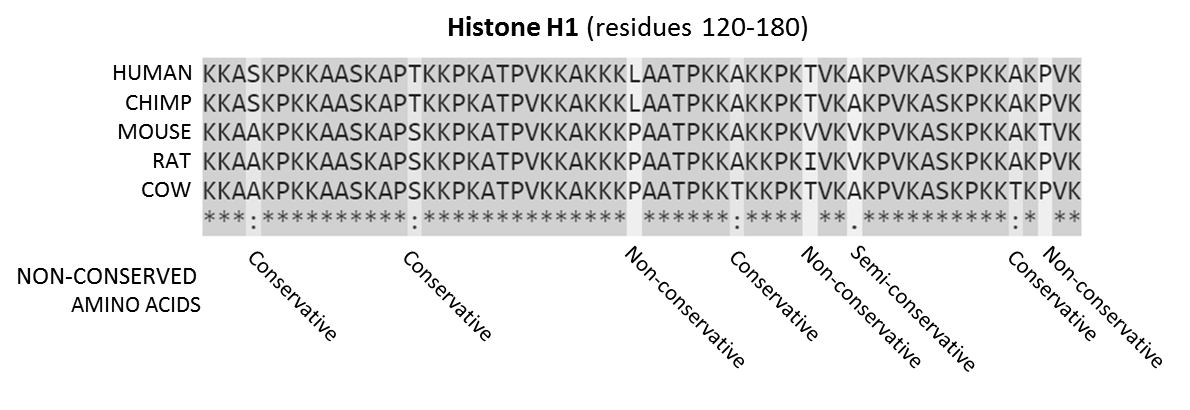
Amino acid sequences can be conserved to maintain the structure or function of a protein or domain. Conserved proteins undergo fewer amino acid replacements, or are more likely to substitute amino acids with similar biochemical properties. Within a sequence, amino acids that are important for folding, structural stability, or that form a binding site may be more highly conserved.
The nucleic acid sequence of a protein coding gene may also be conserved by other selective pressures. The codon usage bias in some organisms may restrict the types of synonymous mutations in a sequence. Nucleic acid sequences that cause secondary structure in the mRNA of a coding gene may be selected against, as some structures may negatively affect translation, or conserved where the mRNA also acts as a functional non-coding RNA.
Hub AI
Conserved sequence AI simulator
(@Conserved sequence_simulator)
Conserved sequence
In evolutionary biology, conserved sequences are identical or similar sequences in nucleic acids (DNA and RNA) or proteins across species (orthologous sequences), or within a genome (paralogous sequences), or between donor and receptor taxa (xenologous sequences). Conservation indicates that a sequence has been maintained by natural selection.
A highly conserved sequence is one that has remained relatively unchanged far back up the phylogenetic tree, and hence far back in geological time. Examples of highly conserved sequences include the RNA components of ribosomes present in all domains of life, the homeobox sequences widespread amongst eukaryotes, and the tmRNA in bacteria. The study of sequence conservation overlaps with the fields of genomics, proteomics, evolutionary biology, phylogenetics, bioinformatics and mathematics.
The discovery of the role of DNA in heredity, and observations by Frederick Sanger of variation between animal insulins in 1949, prompted early molecular biologists to study taxonomy from a molecular perspective. Studies in the 1960s used DNA hybridization and protein cross-reactivity techniques to measure similarity between known orthologous proteins, such as hemoglobin and cytochrome c. In 1965, Émile Zuckerkandl and Linus Pauling introduced the concept of the molecular clock, proposing that steady rates of amino acid replacement could be used to estimate the time since two organisms diverged. While initial phylogenies closely matched the fossil record, observations that some genes appeared to evolve at different rates led to the development of theories of molecular evolution. Margaret Dayhoff's 1966 comparison of ferredoxin sequences showed that natural selection would act to conserve and optimise protein sequences essential to life.
Over many generations, nucleic acid sequences in the genome of an evolutionary lineage can gradually change over time due to random mutations and deletions. Sequences may also recombine or be deleted due to chromosomal rearrangements. Conserved sequences are sequences which persist in the genome despite such forces, and have slower rates of mutation than the background mutation rate.
Conservation can occur in coding and non-coding nucleic acid sequences. Highly conserved DNA sequences are thought to have functional value, although the role for many highly conserved non-coding DNA sequences is poorly understood. The extent to which a sequence is conserved can be affected by varying selection pressures, its robustness to mutation, population size and genetic drift. Many functional sequences are also modular, containing regions which may be subject to independent selection pressures, such as protein domains.
In coding sequences, the nucleic acid and amino acid sequence may be conserved to different extents, as the degeneracy of the genetic code means that synonymous mutations in a coding sequence do not affect the amino acid sequence of its protein product.
Amino acid sequences can be conserved to maintain the structure or function of a protein or domain. Conserved proteins undergo fewer amino acid replacements, or are more likely to substitute amino acids with similar biochemical properties. Within a sequence, amino acids that are important for folding, structural stability, or that form a binding site may be more highly conserved.
The nucleic acid sequence of a protein coding gene may also be conserved by other selective pressures. The codon usage bias in some organisms may restrict the types of synonymous mutations in a sequence. Nucleic acid sequences that cause secondary structure in the mRNA of a coding gene may be selected against, as some structures may negatively affect translation, or conserved where the mRNA also acts as a functional non-coding RNA.
Recent media