Hubbry Logo
search
logo

Expenditure function

logo
Community Hub0 Subscribers
Read side by side
from Wikipedia

In microeconomics, the expenditure function represents the minimum amount of expenditure needed to achieve a given level of utility, given a utility function and the prices of goods.

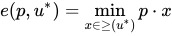
Formally, if there is a utility function that describes preferences over n goods, the expenditure function is defined as:

where is the price vector is the desired utility level, is the set of providing at least utility .

Expressed equivalently, the individual minimizes expenditure subject to the minimal utility constraint that giving optimal quantities to consume of the various goods as as function of and the prices; then the expenditure function is


Properties

[edit]

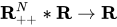
Suppose is a continuous utility function representing a locally non-satiated preference relation on . Then is

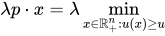
  1. Homogeneous of degree one in p: for all and ,
  2. Continuous in and
  3. Nondecreasing in and strictly increasing in provided
  4. Concave in
  5. If the utility function is strictly quasi-concave, there is Shephard's lemma

Proofs

[edit]

(1) As in the above proposition, note that
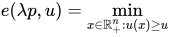
(2) Continue on the domain :

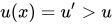
(3) Let and suppose . Then , and . It follows immediately that .

For the second statement, suppose to the contrary that for some , Than, for some , , which contradicts the "no excess utility" conclusion of the previous proposition


(4) Let and suppose . Then, and , so .

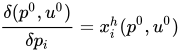
(5)
Expenditure and indirect utility

[edit]

The expenditure function is the inverse of the indirect utility function when the prices are kept constant. I.e, for every price vector and income level :[1]: 106 

There is a duality relationship between the expenditure function and the utility function. If given a specific regular quasi-concave utility function, the corresponding price is homogeneous, and the utility is monotonically increasing expenditure function, conversely, the given price is homogeneous, and the utility is monotonically increasing expenditure function will generate the regular quasi-concave utility function. In addition to the property that prices are once homogeneous and utility is monotonically increasing, the expenditure function usually assumes

  1. Is a non-negative function, i.e.,
  2. For P, it is non-decreasing, i.e., ;
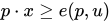
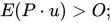
  3. E(Pu) is a concave function. That is,

Expenditure function is an important theoretical method to study consumer behavior. Expenditure function is very similar to cost function in production theory. Dual to the utility maximization problem is the cost minimization problem [2][3]

Example

[edit]

Suppose the utility function is the Cobb-Douglas function which generates the demand functions[4]

where is the consumer's income. One way to find the expenditure function is to first find the indirect utility function and then invert it. The indirect utility function is found by replacing the quantities in the utility function with the demand functions thus:


where Then since when the consumer optimizes, we can invert the indirect utility function to find the expenditure function:


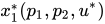
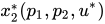
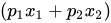
Alternatively, the expenditure function can be found by solving the problem of minimizing subject to the constraint This yields conditional demand functions and and the expenditure function is then

See also

[edit]

References

[edit]

Further reading

[edit]
Revisions and contributorsEdit on WikipediaRead on Wikipedia
from Grokipedia
The expenditure function in microeconomics represents the minimum amount of expenditure required for a consumer to achieve a given level of utility, subject to prevailing prices of goods and services. It is formally defined as $ e(\mathbf{p}, u) = \min_{\mathbf{x}} {\mathbf{p} \cdot \mathbf{x} \mid u(\mathbf{x}) \geq u } $, where p\mathbf{p} denotes the vector of prices, x\mathbf{x} is the vector of quantities consumed, u(x)u(\mathbf{x}) is the utility function, and uu is the target utility level. This function arises from the dual problem to utility maximization, framing consumer choice as cost minimization while maintaining a fixed utility constraint.[1] Key properties of the expenditure function include homogeneity of degree one in prices, implying that scaling all prices by a positive factor λ\lambda results in $ e(\lambda \mathbf{p}, u) = \lambda e(\mathbf{p}, u) $; concavity in prices, ensuring the function is a concave curve that reflects efficient budgeting; and non-decreasing behavior in both prices and the utility level, as higher costs or desired utility necessitate greater spending. These properties stem from the underlying assumptions of consumer preferences, such as continuity, monotonicity, and convexity. By Shephard's lemma, the partial derivative of the expenditure function with respect to the price of good ii, $ \frac{\partial e(\mathbf{p}, u)}{\partial p_i} $, yields the Hicksian (compensated) demand for that good, $ h_i(\mathbf{p}, u) $, which holds utility constant unlike Marshallian demands.[2] As the inverse of the indirect utility function—which maps prices and income to maximum attainable utility—the expenditure function facilitates duality in consumer theory, allowing economists to recover utility representations from observable demand data. It plays a central role in welfare economics, particularly in calculating measures like compensating variation (the expenditure adjustment needed to restore original utility after a price change) and equivalent variation (the expenditure equivalent of a policy's utility impact). For instance, in analyzing a gasoline price increase, the compensating variation is given by $ e(\mathbf{p}', u_0) - e(\mathbf{p}, u_0) $, where p\mathbf{p}' are new prices and u0u_0 is baseline utility. These applications extend to policy evaluation, such as assessing the cost of environmental regulations or trade reforms on consumer welfare.[1][2]

Fundamentals

Definition

The expenditure function, denoted $ e(\mathbf{p}, u) $, represents the minimum cost required for a consumer to attain a specified utility level $ u $ given a vector of prices $ \mathbf{p} $. It is formally defined as the solution to the expenditure minimization problem:
e(p,u)=minx0{px | u(x)u}, e(\mathbf{p}, u) = \min_{\mathbf{x} \geq \mathbf{0}} \left\{ \mathbf{p} \cdot \mathbf{x} \ \middle|\ u(\mathbf{x}) \geq u \right\},
where $ \mathbf{p} > \mathbf{0} $ is the price vector for goods, $ u $ is the target utility level, and $ \mathbf{x} \geq \mathbf{0} $ is the consumption bundle.[3] This formulation arises in the context of the expenditure minimization problem (EMP), which serves as the dual to the utility maximization problem in consumer theory.[4] The existence of a solution to the EMP requires that the utility function $ u(\mathbf{x}) $ is continuous and that there exists some $ \mathbf{x} $ achieving at least utility $ u $, with prices strictly positive. Additionally, local non-satiation ensures the consumer exhausts the budget at the optimum.[5] For uniqueness of the minimizing bundle, $ u(\mathbf{x}) $ must be strictly increasing and strictly quasi-concave.[6] Under these assumptions, the Hicksian (compensated) demand corresponds to the argument that minimizes the EMP.[7]

Economic Interpretation

The expenditure function represents the minimum expenditure required by a consumer to achieve a given level of utility $ u $ at prices $ p $. This interpretation positions it as the solution to the expenditure minimization problem, where the consumer selects the cheapest bundle that delivers at least the target utility, thereby revealing the true resource cost associated with maintaining a specific welfare standard. In contrast, Marshallian (uncompensated) demand derives from utility maximization under a fixed budget constraint, focusing on affordable choices rather than the lowest cost for a fixed welfare outcome; the expenditure function thus provides a dual perspective that emphasizes efficiency in spending for welfare preservation. Within welfare economics, the expenditure function serves as a foundational tool for quantifying welfare impacts, particularly through measures like compensating variation—the difference in minimum expenditures needed to sustain the initial utility level before and after a price change—which enables precise assessments of policy effects such as taxation or price reforms on living costs. It also informs cost-of-living adjustments by underpinning the construction of theoretically sound price indexes that track changes in the minimum cost to maintain utility. The modern formulation of the expenditure function in consumer theory was suggested by Paul Samuelson in 1947.[8] The associated Hicksian demand represents the cost-minimizing consumption bundle that achieves this utility level.

Mathematical Properties

Core Properties

The expenditure function e(p,u)e(p, u), defined as the solution to the expenditure minimization problem (EMP), exhibits several fundamental mathematical properties that stem directly from its optimization origins under standard assumptions such as local nonsatiation and continuity of the utility function.[9] These properties ensure the function's role as a dual to the utility maximization problem and facilitate its use in welfare analysis and demand derivation. One key property is that e(p,u)e(p, u) is non-decreasing in the utility level uu: for uuu' \geq u, e(p,u)e(p,u)e(p, u') \geq e(p, u). To see this, let xx' be the cost-minimizing bundle achieving utility uu', so px=e(p,u)p \cdot x' = e(p, u') and u(x)uuu(x') \geq u'\geq u. This bundle xx' is feasible for the EMP at utility uu, implying that the minimum cost at uu satisfies e(p,u)px=e(p,u)e(p, u) \leq p \cdot x' = e(p, u'). Under strict monotonicity of preferences, the inequality is strict for u>uu' > u.[9][10] The function is also homogeneous of degree one in prices: for any λ>0\lambda > 0, e(λp,u)=λe(p,u)e(\lambda p, u) = \lambda e(p, u). This follows directly from the EMP, as scaling prices by λ\lambda scales the objective function pxp \cdot x to λpx\lambda p \cdot x while leaving the constraint u(x)uu(x) \geq u unchanged; thus, the minimizing bundle xx^* remains optimal, and the minimum value scales by λ\lambda.[9] Additionally, e(p,u)e(p, u) is continuous in pp and strictly increasing in each component of pp under the assumption of local nonsatiation, reflecting that higher prices necessitate greater expenditure to maintain utility.[10] Concavity in prices is another core trait: e(p,u)e(p, u) is concave in pp. This arises because the expenditure function is the pointwise infimum of the family of linear functions {pxxR+n,u(x)u}\{p \cdot x \mid x \in \mathbb{R}^n_+, u(x) \geq u\}, and the infimum of linear functions is concave. Alternatively, by the envelope theorem applied to the EMP Lagrangian L(x,λ;p,u)=px+λ(u(x)u)\mathcal{L}(x, \lambda; p, u) = p \cdot x + \lambda (u(x) - u), the second derivative with respect to pp confirms negative semidefiniteness, yielding concavity.[9][10] Assuming the utility function is strictly quasi-concave, the EMP has a unique solution x(p,u)x^*(p, u), as the upper contour set {xu(x)u}\{x \mid u(x) \geq u\} is strictly convex, ensuring a unique minimizer on the convex budget hyperplane. This uniqueness extends the above properties, such as strict monotonicity, and can be verified via the strict quasi-concavity of the Lagrangian's objective under interior solutions.[9] Finally, e(p,u)0e(p, u) \geq 0 for all p0p \gg 0 and uu, with equality holding if and only if uu(0)u \leq u(0), where u(0)u(0) is the utility from the zero bundle. This boundary condition follows from non-negativity of prices and quantities in the EMP, as any feasible x0x \geq 0 yields non-negative cost, and the zero bundle achieves utility at most u(0)u(0).[9] These properties collectively underpin the expenditure function's differentiability, linking it via Shephard's lemma to Hicksian demands as partial derivatives.[10]

Shephard's Lemma

Shephard's Lemma states that the partial derivative of the expenditure function e(p,u)e(\mathbf{p}, u) with respect to the price pip_i of good ii equals the Hicksian demand hi(p,u)h_i(\mathbf{p}, u) for that good:
e(p,u)pi=hi(p,u). \frac{\partial e(\mathbf{p}, u)}{\partial p_i} = h_i(\mathbf{p}, u).
This result provides a direct link between the expenditure function and the compensated demands derived from the expenditure minimization problem (EMP).[11][12] The lemma is named after Ronald Shephard, who formalized it in his 1953 book Cost and Production Functions, extending earlier work by Harold Hotelling on envelope conditions in optimization problems.[13][14] To derive this, consider the EMP: minimize px\mathbf{p} \cdot \mathbf{x} subject to u(x)uu(\mathbf{x}) \geq u. The associated Lagrangian is $ \mathcal{L}(\mathbf{x}, \lambda; \mathbf{p}, u) = \mathbf{p} \cdot \mathbf{x} - \lambda (u(\mathbf{x}) - u) $, where λ>0\lambda > 0 is the multiplier. At the optimum x=h(p,u)\mathbf{x}^* = \mathbf{h}(\mathbf{p}, u), the envelope theorem applies to the value function e(p,u)=minxpxe(\mathbf{p}, u) = \min_{\mathbf{x}} \mathbf{p} \cdot \mathbf{x} subject to the constraint. The partial derivative with respect to pip_i is
epi=Lpix,λ=xi, \frac{\partial e}{\partial p_i} = \frac{\partial \mathcal{L}}{\partial p_i} \bigg|_{\mathbf{x}^*, \lambda^*} = x_i^*,
since the indirect effects through the optimization variables x\mathbf{x} and λ\lambda vanish by the first-order conditions, leaving only the direct effect on the objective. This holds without needing to re-solve the full constraint, as the envelope theorem isolates the parameter's marginal impact.[11][12] The implications of Shephard's Lemma are significant for demand analysis. Since prices pi>0p_i > 0 and the expenditure function is increasing in prices, the resulting Hicksian demands hi(p,u)0h_i(\mathbf{p}, u) \geq 0 for all ii, ensuring non-negativity consistent with economic feasibility. Under interior solutions where demands are positive, the expenditure function is differentiable in p\mathbf{p}, allowing the lemma to yield smooth compensated demand functions.[11][12]

Derivation and Duality

Derivation from Constrained Optimization

The expenditure minimization problem (EMP) is formulated as minimizing the inner product of prices and quantities, minx0px\min_{x \geq 0} p \cdot x, subject to the constraint that utility reaches at least a target level, u(x)uu(x) \geq u.[15] This setup assumes the consumer's preferences are represented by a continuous, quasi-concave utility function ensuring the constraint set is convex.[1] To solve the EMP, the Lagrangian is constructed as L=px+λ(uu(x))L = p \cdot x + \lambda (u - u(x)), where λ\lambda is the Lagrange multiplier associated with the utility constraint.[15] The first-order conditions with respect to each quantity xix_i are derived by setting the partial derivatives to zero: Lxi=piλuxi=0\frac{\partial L}{\partial x_i} = p_i - \lambda \frac{\partial u}{\partial x_i} = 0 for all ii, along with the binding constraint u(x)=uu(x) = u.[15] These conditions imply that the marginal utility per dollar, u/xipi=1λ\frac{\partial u / \partial x_i}{p_i} = \frac{1}{\lambda}, is equalized across all goods, reflecting the tangency between the price hyperplane and the indifference surface at the optimum.[15] The solution to the EMP yields the Hicksian demands h(p,u)h(p, u), which satisfy the first-order conditions and the utility constraint; the expenditure function is then given by e(p,u)=ph(p,u)e(p, u) = p \cdot h(p, u), representing the minimum cost to achieve utility uu at prices pp.[15] This indirect form arises through the duality inherent in the optimization, where the value function of the EMP directly provides e(p,u)e(p, u).[1] The EMP serves as the dual to the utility maximization problem (UMP), which maximizes u(x)u(x) subject to pxmp \cdot x \leq m; under regularity conditions such as strict quasi-concavity of uu and positive prices, both problems yield the same optimal bundle at the corresponding income level that achieves utility uu.[1]

Relationship to Indirect Utility Function

The expenditure function e(p,u)e(\mathbf{p}, u) and the indirect utility function v(p,m)v(\mathbf{p}, m), defined as the solution to the utility maximization problem maxxu(x)\max_{\mathbf{x}} u(\mathbf{x}) subject to pxm\mathbf{p} \cdot \mathbf{x} \leq m, are dual representations of consumer preferences in microeconomic theory.[16] This duality manifests through inversion theorems that link the two functions: e(p,v(p,m))=me(\mathbf{p}, v(\mathbf{p}, m)) = m and v(p,e(p,u))=uv(\mathbf{p}, e(\mathbf{p}, u)) = u.[17] These relations imply that the minimum expenditure required to achieve the maximum utility attainable from income mm at prices p\mathbf{p} exactly equals mm, and conversely, the maximum utility from the minimum expenditure to reach utility level uu equals uu.[3] Recovery of one function from the other is possible through these inversions. For instance, the utility level uu can be recovered from the expenditure function by solving u=v(p,e(p,u))u = v(\mathbf{p}, e(\mathbf{p}, u)), which inverts the expenditure to obtain the indirect utility and then extracts uu.[16] In linear cases, such as those exhibiting the Gorman polar form, the expenditure function takes the structure e(p,u)=a(p)+ub(p)e(\mathbf{p}, u) = a(\mathbf{p}) + u \cdot b(\mathbf{p}), where a(p)a(\mathbf{p}) and b(p)b(\mathbf{p}) are homogeneous of degree 1 in prices; this directly yields the indirect utility as v(p,m)=ma(p)b(p)v(\mathbf{p}, m) = \frac{m - a(\mathbf{p})}{b(\mathbf{p})}.[16] Such forms facilitate explicit recovery and are particularly useful in demand system estimation.[17] The duality endows both functions with shared properties under standard assumptions of continuous and locally nonsatiated preferences. Specifically, both e(p,u)e(\mathbf{p}, u) and v(p,m)v(\mathbf{p}, m) are continuous in their arguments, with the expenditure function serving as the "inverse" to the indirect utility in the income dimension, reflecting the reciprocal nature of cost minimization and utility maximization.[17] The expenditure function is concave and homogeneous of degree 1 in p\mathbf{p}, while the indirect utility is quasiconvex and homogeneous of degree 0 in (p,m)(\mathbf{p}, m).[16] A proof outline for the duality theorems proceeds by substituting the solutions from one optimization problem into the other. For e(p,v(p,m))=me(\mathbf{p}, v(\mathbf{p}, m)) = m, let x\mathbf{x}^* solve the utility maximization problem at prices p\mathbf{p} and income mm, so v(p,m)=u(x)v(\mathbf{p}, m) = u(\mathbf{x}^*) and px=m\mathbf{p} \cdot \mathbf{x}^* = m. If x\mathbf{x}^* did not solve the expenditure minimization problem for utility u(x)u(\mathbf{x}^*), there would exist x0\mathbf{x}^0 with u(x0)u(x)u(\mathbf{x}^0) \geq u(\mathbf{x}^*) and px0<m\mathbf{p} \cdot \mathbf{x}^0 < m, implying by local nonsatiation a bundle exceeding u(x)u(\mathbf{x}^*) within budget mm, contradicting optimality of x\mathbf{x}^*. Thus, e(p,v(p,m))=px=me(\mathbf{p}, v(\mathbf{p}, m)) = \mathbf{p} \cdot \mathbf{x}^* = m.[3] Symmetrically, for v(p,e(p,u))=uv(\mathbf{p}, e(\mathbf{p}, u)) = u, let y\mathbf{y}^* solve the expenditure minimization at p\mathbf{p} and uu, so e(p,u)=pye(\mathbf{p}, u) = \mathbf{p} \cdot \mathbf{y}^* and u(y)=uu(\mathbf{y}^*) = u. If y\mathbf{y}^* did not solve utility maximization at income py\mathbf{p} \cdot \mathbf{y}^*, there would exist y0\mathbf{y}^0 with py0py\mathbf{p} \cdot \mathbf{y}^0 \leq \mathbf{p} \cdot \mathbf{y}^* and u(y0)>uu(\mathbf{y}^0) > u, contradicting optimality of y\mathbf{y}^* in expenditure minimization. Continuity ensures u(y)=uu(\mathbf{y}^*) = u, so v(p,e(p,u))=uv(\mathbf{p}, e(\mathbf{p}, u)) = u.[3]

Applications and Examples

Theoretical Applications

The expenditure function plays a central role in measuring welfare changes due to price or income variations. The compensating variation (CV) quantifies the amount of income adjustment required at new prices $ p' $ to maintain the original utility level $ u $, given by $ CV = e(p', u) - e(p, u) $, where $ e(p, u) $ is the minimum expenditure needed to achieve utility $ u $ at prices $ p $.[18] This measure captures the Hicksian welfare loss from a price increase, as it reflects the cost difference between the original and compensated bundles.[19] In contrast, the equivalent variation (EV) assesses the income change at original prices that would make the consumer as well off as after the price change, expressed as $ EV = e(p, v(p', m)) - m $, where $ v(p', m) $ is the indirect utility at new prices and initial income $ m $.[18] These path-independent measures provide exact welfare evaluations, unlike approximate consumer surplus, and are derived from the duality between expenditure and utility functions.[20] In the construction of cost-of-living indexes, the expenditure function defines the true cost-of-living index as the ratio $ e(p^t, u)/e(p^0, u) $, where $ p^t $ and $ p^0 $ are prices at time $ t $ and base period 0, respectively, holding utility constant at a reference level $ u $.[21] This Konüs index represents the exact proportional cost change needed to sustain the same living standard, serving as an upper bound for the Laspeyres index (which uses base-period quantities) and a lower bound for the Paasche index (using current-period quantities).[21] Empirical approximations often rely on these observable indexes due to the unobservability of the true utility reference, but the expenditure-based framework ensures theoretical consistency in welfare comparisons across periods.[22] Aggregation of individual expenditure functions into a representative one requires specific preference structures, notably under the Gorman conditions where all consumers share identical preferences or exhibit linear Engel curves with a common price-dependent term.[23] These conditions, formalized in the Gorman polar form of the indirect utility function, imply that aggregate demand behaves as if generated by a single representative agent with total income, enabling macroeconomic analysis without individual heterogeneity.[23] When preferences are homothetic and identical, the aggregate expenditure function simplifies further, facilitating equilibrium computations in general equilibrium models.[16] In revealed preference theory, the expenditure function aids nonparametric tests of integrability conditions, ensuring observed choices are consistent with utility maximization. By checking whether expenditure data satisfy generalized Afriat inequalities—such as concavity and monotonicity in prices—these tests validate the recoverability of underlying preferences without parametric assumptions. Nonparametric estimation often incorporates Engel curve restrictions derived from the expenditure function to improve efficiency and test symmetry in Slutsky matrices, enhancing empirical demand analysis.[24]

Illustrative Example

Consider the Cobb-Douglas utility function u(x1,x2)=x1αx21αu(x_1, x_2) = x_1^\alpha x_2^{1-\alpha}, where 0<α<10 < \alpha < 1. The corresponding Hicksian demands are h1(p,u)=α1α(1α)α1up1α1p21αh_1(p, u) = \alpha^{1-\alpha} (1-\alpha)^{\alpha-1} u \, p_1^{\alpha-1} p_2^{1-\alpha} and h2(p,u)=(1α)1ααα1up2αp1αh_2(p, u) = (1-\alpha)^{1-\alpha} \alpha^{\alpha-1} u \, p_2^{-\alpha} p_1^{\alpha}. The expenditure function is e(p,u)=u(p1α)α(p21α)1αe(p, u) = u \left( \frac{p_1}{\alpha} \right)^\alpha \left( \frac{p_2}{1-\alpha} \right)^{1-\alpha}. For a concrete computation, take α=0.5\alpha = 0.5, p=(1,1)p = (1, 1), and u=1u = 1. Then e(1,1,1)=1(2)0.5(2)0.5=2e(1, 1, 1) = 1 \cdot (2)^{0.5} \cdot (2)^{0.5} = 2. The Hicksian demands are h1(1,1,1)=1h_1(1, 1, 1) = 1 and h2(1,1,1)=1h_2(1, 1, 1) = 1. To verify homogeneity of degree one in prices, scale to p=(2,2)p' = (2, 2). Then e(2,2,1)=1(4)0.5(4)0.5=4=2e(1,1,1)e(2, 2, 1) = 1 \cdot (4)^{0.5} \cdot (4)^{0.5} = 4 = 2 \cdot e(1, 1, 1). The Hicksian demands are h1(2,2,1)=1h_1(2, 2, 1) = 1 and h2(2,2,1)=1h_2(2, 2, 1) = 1. Now contrast with Marshallian demands to illustrate compensated versus uncompensated effects. With the price of good 1 rising to 2 while p2=1p_2 = 1 and u=1u = 1, the required expenditure is e(2,1,1)=1(4)0.5(2)0.5=222.828e(2, 1, 1) = 1 \cdot (4)^{0.5} \cdot (2)^{0.5} = 2\sqrt{2} \approx 2.828. The compensated Hicksian demand is h1(2,1,1)0.707h_1(2, 1, 1) \approx 0.707. Holding initial income fixed at m=2m = 2, the uncompensated Marshallian demand is x1M(2,1,2)=0.52/2=0.5x_1^M(2, 1, 2) = 0.5 \cdot 2 / 2 = 0.5. The total uncompensated change in demand for good 1 (from 1 to 0.5, a decrease of 0.5) combines substitution and income effects, whereas the compensated change (to 0.707, a decrease of approximately 0.293) isolates the substitution effect. Shephard's lemma confirms the Hicksian demands, as hi(p,u)=e(p,u)pih_i(p, u) = \frac{\partial e(p, u)}{\partial p_i}.
User Avatar
No comments yet.