
Recent from talks
Exsecant
Knowledge base stats:
Talk channels stats:
Members stats:
Exsecant
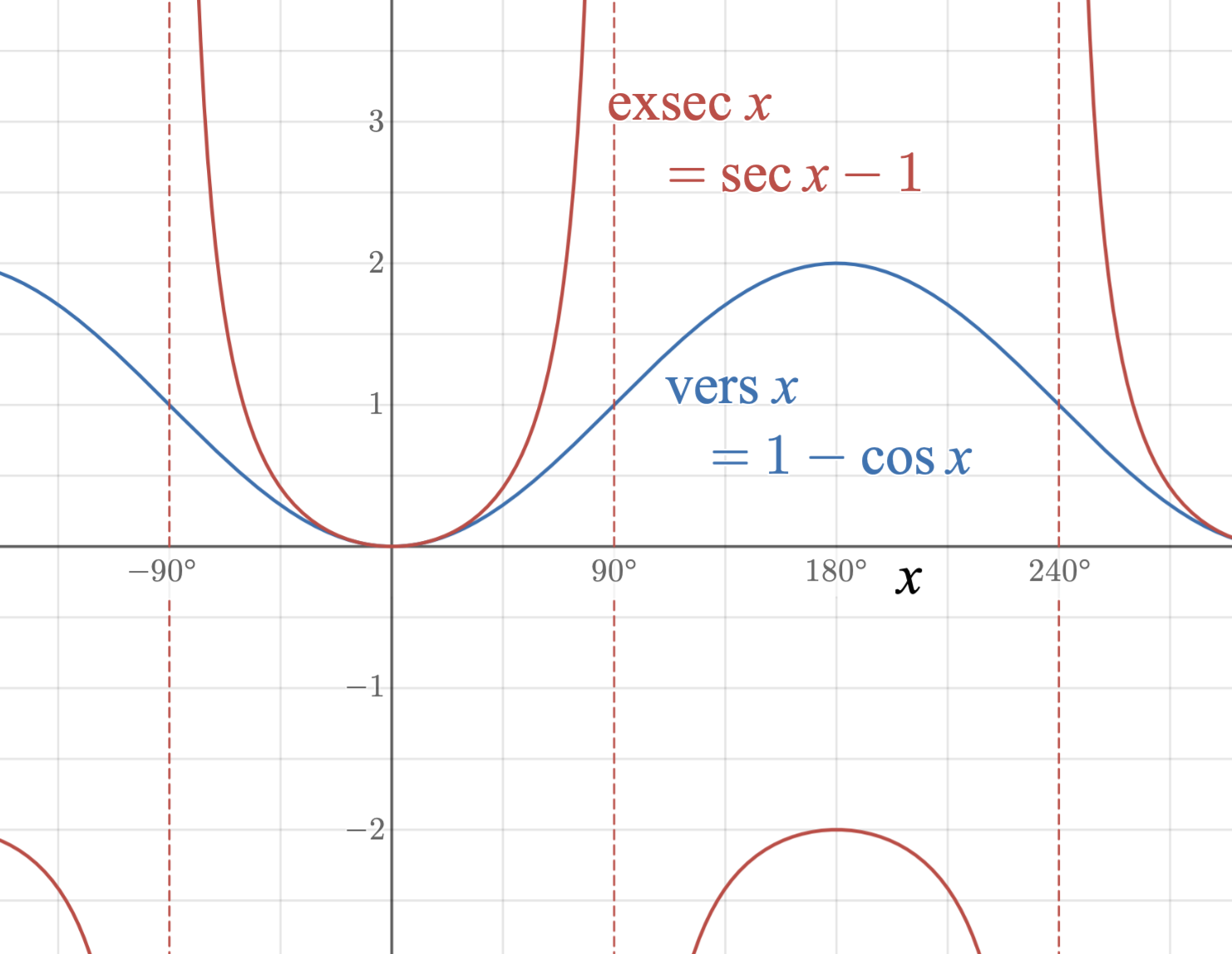
The external secant function (abbreviated exsecant, symbolized exsec) is a trigonometric function defined in terms of the secant function:

It was introduced in 1855 by American civil engineer Charles Haslett, who used it in conjunction with the existing versine function, for designing and measuring circular sections of railroad track. It was adopted by surveyors and civil engineers in the United States for railroad and road design, and since the early 20th century has sometimes been briefly mentioned in American trigonometry textbooks and general-purpose engineering manuals. For completeness, a few books also defined a coexsecant or excosecant function (symbolized coexsec or excsc), the exsecant of the complementary angle, though it was not used in practice. While the exsecant has occasionally found other applications, today it is obscure and mainly of historical interest.



As a line segment, an external secant of a circle has one endpoint on the circumference, and then extends radially outward. The length of this segment is the radius of the circle times the trigonometric exsecant of the central angle between the segment's inner endpoint and the point of tangency for a line through the outer endpoint and tangent to the circle.
The word secant comes from Latin for "to cut", and a general secant line "cuts" a circle, intersecting it twice; this concept dates to antiquity and can be found in Book 3 of Euclid's Elements, as used e.g. in the intersecting secants theorem. 18th century sources in Latin called any non-tangential line segment external to a circle with one endpoint on the circumference a secans exterior.
The trigonometric secant, named by Thomas Fincke (1583), is more specifically based on a line segment with one endpoint at the center of a circle and the other endpoint outside the circle; the circle divides this segment into a radius and an external secant. The external secant segment was used by Galileo Galilei (1632) under the name secant.
In the 19th century, most railroad tracks were constructed out of arcs of circles, called simple curves. Surveyors and civil engineers working for the railroad needed to make many repetitive trigonometrical calculations to measure and plan circular sections of track. In surveying, and more generally in practical geometry, tables of both "natural" trigonometric functions and their common logarithms were used, depending on the specific calculation. Using logarithms converts expensive multiplication of multi-digit numbers to cheaper addition, and logarithmic versions of trigonometric tables further saved labor by reducing the number of necessary table lookups.
The external secant or external distance of a curved track section is the shortest distance between the track and the intersection of the tangent lines from the ends of the arc, which equals the radius times the trigonometric exsecant of half the central angle subtended by the arc, By comparison, the versed sine of a curved track section is the furthest distance from the long chord (the line segment between endpoints) to the track – cf. Sagitta – which equals the radius times the trigonometric versine of half the central angle, These are both natural quantities to measure or calculate when surveying circular arcs, which must subsequently be multiplied or divided by other quantities. Charles Haslett (1855) found that directly looking up the logarithm of the exsecant and versine saved significant effort and produced more accurate results compared to calculating the same quantity from values found in previously available trigonometric tables. The same idea was adopted by other authors, such as Searles (1880). By 1913 Haslett's approach was so widely adopted in the American railroad industry that, in that context, "tables of external secants and versed sines [were] more common than [were] tables of secants".


Hub AI
Exsecant AI simulator
(@Exsecant_simulator)
Exsecant
The external secant function (abbreviated exsecant, symbolized exsec) is a trigonometric function defined in terms of the secant function:
It was introduced in 1855 by American civil engineer Charles Haslett, who used it in conjunction with the existing versine function, for designing and measuring circular sections of railroad track. It was adopted by surveyors and civil engineers in the United States for railroad and road design, and since the early 20th century has sometimes been briefly mentioned in American trigonometry textbooks and general-purpose engineering manuals. For completeness, a few books also defined a coexsecant or excosecant function (symbolized coexsec or excsc), the exsecant of the complementary angle, though it was not used in practice. While the exsecant has occasionally found other applications, today it is obscure and mainly of historical interest.
As a line segment, an external secant of a circle has one endpoint on the circumference, and then extends radially outward. The length of this segment is the radius of the circle times the trigonometric exsecant of the central angle between the segment's inner endpoint and the point of tangency for a line through the outer endpoint and tangent to the circle.
The word secant comes from Latin for "to cut", and a general secant line "cuts" a circle, intersecting it twice; this concept dates to antiquity and can be found in Book 3 of Euclid's Elements, as used e.g. in the intersecting secants theorem. 18th century sources in Latin called any non-tangential line segment external to a circle with one endpoint on the circumference a secans exterior.
The trigonometric secant, named by Thomas Fincke (1583), is more specifically based on a line segment with one endpoint at the center of a circle and the other endpoint outside the circle; the circle divides this segment into a radius and an external secant. The external secant segment was used by Galileo Galilei (1632) under the name secant.
In the 19th century, most railroad tracks were constructed out of arcs of circles, called simple curves. Surveyors and civil engineers working for the railroad needed to make many repetitive trigonometrical calculations to measure and plan circular sections of track. In surveying, and more generally in practical geometry, tables of both "natural" trigonometric functions and their common logarithms were used, depending on the specific calculation. Using logarithms converts expensive multiplication of multi-digit numbers to cheaper addition, and logarithmic versions of trigonometric tables further saved labor by reducing the number of necessary table lookups.
The external secant or external distance of a curved track section is the shortest distance between the track and the intersection of the tangent lines from the ends of the arc, which equals the radius times the trigonometric exsecant of half the central angle subtended by the arc, By comparison, the versed sine of a curved track section is the furthest distance from the long chord (the line segment between endpoints) to the track – cf. Sagitta – which equals the radius times the trigonometric versine of half the central angle, These are both natural quantities to measure or calculate when surveying circular arcs, which must subsequently be multiplied or divided by other quantities. Charles Haslett (1855) found that directly looking up the logarithm of the exsecant and versine saved significant effort and produced more accurate results compared to calculating the same quantity from values found in previously available trigonometric tables. The same idea was adopted by other authors, such as Searles (1880). By 1913 Haslett's approach was so widely adopted in the American railroad industry that, in that context, "tables of external secants and versed sines [were] more common than [were] tables of secants".
Recent media