


Community hub
Recent from talks
Contribute something
Nothing was collected or created yet.
Restriction (mathematics)
View on Wikipedia


| Function |
|---|
| x ↦ f (x) |
| History of the function concept |
| Types by domain and codomain |
| Classes/properties |
| Constructions |
| Generalizations |
| List of specific functions |
In mathematics, the restriction of a function is a new function, denoted or obtained by choosing a smaller domain for the original function The function is then said to extend


Formal definition
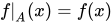
[edit]Let be a function from a set to a set If a set is a subset of then the restriction of to is the function[1] given by for Informally, the restriction of to is the same function as but is only defined on .




If the function is thought of as a relation on the Cartesian product then the restriction of to can be represented by its graph,


where the pairs represent ordered pairs in the graph

Extensions
[edit]A function is said to be an extension of another function if whenever is in the domain of then is also in the domain of and That is, if and


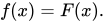

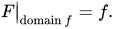
A linear extension (respectively, continuous extension, etc.) of a function is an extension of that is also a linear map (respectively, a continuous map, etc.).
Examples
[edit]- The restriction of the non-injective function to the domain is the injection
- The factorial function is the restriction of the gamma function to the positive integers, with the argument shifted by one:




Properties of restrictions
[edit]- Restricting a function to its entire domain gives back the original function, that is,
- Restricting a function twice is the same as restricting it once, that is, if then
- The restriction of the identity function on a set to a subset of is just the inclusion map from into [2]
- The restriction of a continuous function is continuous.[3][4]




Applications
[edit]Inverse functions
[edit]For a function to have an inverse, it must be one-to-one. If a function is not one-to-one, it may be possible to define a partial inverse of by restricting the domain. For example, the function defined on the whole of is not one-to-one since for any However, the function becomes one-to-one if we restrict to the domain in which case


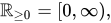
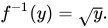
(If we instead restrict to the domain then the inverse is the negative of the square root of ) Alternatively, there is no need to restrict the domain if we allow the inverse to be a multivalued function.
![{\displaystyle (-\infty ,0],}](https://wikimedia.org/api/rest_v1/media/math/render/svg/e272055483b65ca10ef4c030f1b292b8eca41506)

Selection operators
[edit]In relational algebra, a selection (sometimes called a restriction to avoid confusion with SQL's use of SELECT) is a unary operation written as or where:


- and are attribute names,
- is a binary operation in the set
- is a value constant,
- is a relation.





The selection selects all those tuples in for which holds between the and the attribute.
The selection selects all those tuples in for which holds between the attribute and the value

Thus, the selection operator restricts to a subset of the entire database.
The pasting lemma
[edit]The pasting lemma is a result in topology that relates the continuity of a function with the continuity of its restrictions to subsets.
Let be two closed subsets (or two open subsets) of a topological space such that and let also be a topological space. If is continuous when restricted to both and then is continuous.


This result allows one to take two continuous functions defined on closed (or open) subsets of a topological space and create a new one.
Sheaves
[edit]Sheaves provide a way of generalizing restrictions to objects besides functions.
In sheaf theory, one assigns an object in a category to each open set of a topological space, and requires that the objects satisfy certain conditions. The most important condition is that there are restriction morphisms between every pair of objects associated to nested open sets; that is, if then there is a morphism satisfying the following properties, which are designed to mimic the restriction of a function:


- For every open set of the restriction morphism is the identity morphism on
- If we have three open sets then the composite
- (Locality) If is an open covering of an open set and if are such that for each set of the covering, then ; and
- (Gluing) If is an open covering of an open set and if for each a section is given such that for each pair of the covering sets the restrictions of and agree on the overlaps: then there is a section such that for each







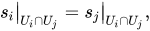


The collection of all such objects is called a sheaf. If only the first two properties are satisfied, it is a pre-sheaf.
Left- and right-restriction
[edit]More generally, the restriction (or domain restriction or left-restriction) of a binary relation between and may be defined as a relation having domain codomain and graph Similarly, one can define a right-restriction or range restriction Indeed, one could define a restriction to -ary relations, as well as to subsets understood as relations, such as ones of the Cartesian product for binary relations. These cases do not fit into the scheme of sheaves.[clarification needed]





Anti-restriction
[edit]The domain anti-restriction (or domain subtraction) of a function or binary relation (with domain and codomain ) by a set may be defined as ; it removes all elements of from the domain It is sometimes denoted ⩤ [5] Similarly, the range anti-restriction (or range subtraction) of a function or binary relation by a set is defined as ; it removes all elements of from the codomain It is sometimes denoted ⩥


See also
[edit]- Constraint – Condition of an optimization problem which the solution must satisfy
- Deformation retract – Continuous, position-preserving mapping from a topological space into a subspace
- Local property
- Function (mathematics) § Restriction and extension
- Binary relation § Restriction
- Relational algebra § Selection (σ)
References
[edit]- ^ Stoll, Robert (1974). Sets, Logic and Axiomatic Theories (2nd ed.). San Francisco: W. H. Freeman and Company. pp. [36]. ISBN 0-7167-0457-9.
- ^ Halmos, Paul (1960). Naive Set Theory. Princeton, NJ: D. Van Nostrand. Reprinted by Springer-Verlag, New York, 1974. ISBN 0-387-90092-6 (Springer-Verlag edition). Reprinted by Martino Fine Books, 2011. ISBN 978-1-61427-131-4 (Paperback edition).
- ^ Munkres, James R. (2000). Topology (2nd ed.). Upper Saddle River: Prentice Hall. ISBN 0-13-181629-2.
- ^ Adams, Colin Conrad; Franzosa, Robert David (2008). Introduction to Topology: Pure and Applied. Pearson Prentice Hall. ISBN 978-0-13-184869-6.
- ^ Dunne, S. and Stoddart, Bill Unifying Theories of Programming: First International Symposium, UTP 2006, Walworth Castle, County Durham, UK, February 5–7, 2006, Revised Selected ... Computer Science and General Issues). Springer (2006)
Restriction (mathematics)
View on GrokipediaRestriction of Functions
Formal Definition
In mathematics, the restriction of a function is a fundamental operation that limits the domain of the function to a specified subset while preserving its values on that subset. Formally, given sets and , and a function that is total on (meaning it assigns a unique output in to every element of ), the restriction of to a subset is the function defined by for all .[2][3][4] The notation for restriction commonly employs the vertical bar subscript, as in , though alternatives such as or are also used in some texts; regardless of the symbol, the codomain of the restricted function remains unless explicitly modified.[2][3] This construction assumes that and are arbitrary sets and that is well-defined on the entire domain , ensuring the restriction is itself a total function on .[4]Examples
A classic example of function restriction is the squaring function , originally defined on the domain with codomain . This function is neither injective nor surjective over , as and negative values are missed in the image. Restricting the domain to the non-negative reals yields , which is now bijective, as it is strictly increasing and onto its image.[5] In analytic contexts, the factorial function on positive integers arises as a restriction of the gamma function , defined for complex with positive real part via the integral . Specifically, for , providing a continuous interpolation of the discrete factorial values.[6] For trigonometric functions, consider the sine function on , which is periodic and thus not injective. Restricting the domain to produces , a bijective mapping essential for defining the principal branch of the inverse sine.[7] In general, selecting appropriate domain subsets via restriction can transform a function's properties, such as rendering it monotonic where it was not originally; for instance, the squaring function gains strict monotonicity on despite decreasing on .[5]Properties
The restriction operation satisfies certain identity and transitivity properties. Specifically, for a function , the restriction to the entire domain yields the original function, i.e., .[5] Furthermore, successive restrictions are equivalent to a single restriction: if , then .[2] Restriction preserves several key algebraic and analytic properties of functions. If is injective, then its restriction to any subset is also injective, since distinct elements in map to distinct elements in by the original injectivity.[8] Similarly, if is continuous (in the topological sense), the restriction to a subspace is continuous relative to the subspace topology on .[9] For real-valued functions, if is differentiable on an open set , then is differentiable at interior points of , with the derivative matching that of .[10] Monotonicity is also preserved: if is monotone on , its restriction to remains monotone on .[11] However, surjectivity is not generally preserved under restriction. While is surjective onto its image , it may fail to be surjective onto the full codomain unless .[5] Regarding composition, the restriction of a composite function aligns with the composition of restrictions under compatible domains. For functions and with , the restriction satisfies .[2]Extensions of Functions
Definition
In mathematics, particularly in set theory and topology, an extension of a function is a function defined on a superset such that the restriction of to coincides with , i.e., .[12] This operation serves as the inverse process to restricting a function's domain, enlarging it while preserving the original mapping on the initial domain.[13] Such extensions are not unique in general, since the values of on may be defined arbitrarily within the codomain , subject only to the consistency requirement on .[12] However, uniqueness or existence can hold under additional conditions; for instance, in topology, the Tietze extension theorem guarantees the existence of a continuous extension for a continuous , where is a closed subspace of a normal topological space .[13] This theorem extends to bounded real-valued functions with range preserved in a closed interval .[12] Partial extensions refer to cases where the enlargement of the domain maintains specific properties of the original function, such as continuity or differentiability.[13] For continuous functions on closed subsets of normal spaces, the Tietze theorem ensures such a continuous partial extension exists to the entire space.[12]Relation to Restrictions
In the theory of function extensions, compatibility with restrictions is fundamental. Every restriction of a function to a subset of its domain admits trivial extensions to a larger domain; for instance, one can define the function to take a constant value on the complement of the subset while agreeing with the original on the subset.[14] Such extensions always exist for arbitrary functions, as the values on the complement can be chosen freely without additional constraints. However, non-trivial extensions that preserve properties like continuity depend on the extendability of the restricted function. For continuous functions on closed subsets of normal topological spaces, the Tietze extension theorem ensures the existence of a continuous extension to the entire space.[15] The relation between extensions and restrictions also appears in iterative processes, where successive restrictions to subsets followed by extensions can recover the original function under suitable conditions. For example, for any function , there exists a c-dense set such that the restriction is separately continuous, and this restriction admits an extension to that is quasi-continuous and agrees with on a set containing , thereby approximating or recovering key behaviors of the original .[16] This iterative interplay highlights how restrictions can be used to simplify analysis while extensions allow reconstruction, provided the function satisfies properties like separate continuity on dense subsets. A illustrative example of the challenges in extending restrictions while preserving functional properties is the square root function defined on . There is no real-valued continuous extension to that satisfies for all , since for , no real number squares to a negative value.[17] However, piecewise definitions enable extensions that agree with on but define different behaviors on , such as setting for , yielding a continuous (though non-injective) function on . Historically, the ideas of restricting and extending functions emerged in 18th-century analysis, particularly in addressing partial differential equations, where mathematicians like Euler broadened the notion of functions to include piecewise twice-differentiable forms to solve equations such as the wave equation .[18] This allowed extensions of solutions from initial or boundary data to larger domains, facilitating developments in heat conduction and vibration problems by Fourier and others in the 19th century.Applications of Function Restrictions
Inverse Functions
In mathematics, restricting the domain of a non-injective function can yield an injective restriction, facilitating the definition of an inverse function. Consider a function that fails to be injective over its full domain . A subset can be selected such that the restriction is injective. To construct the inverse, the codomain is adjusted to the image , rendering bijective. The inverse then exists as , satisfying for all . This approach is essential for defining inverses in contexts where the original function maps multiple domain elements to the same codomain element.[19] A representative example is the squaring function , which is not injective because for . Restricting the domain to the non-negative reals gives , which is bijective since it is strictly increasing on this interval. The inverse is the principal square root function, defined by satisfying for and for . This restriction preserves the function's essential behavior while enabling invertibility.[19] For the inverse to be bijective, the restricted codomain must be precisely the image , ensuring surjectivity: every element in is hit exactly once from . The domain of the inverse is , with range , guaranteeing the identity mappings hold: Without this codomain adjustment, the restriction might be injective but not surjective onto , precluding a full inverse. This setup aligns the domain and range appropriately for composition properties.[19] In general settings, maximal injective restrictions address the challenge of selecting optimal subsets , where is inclusion-maximal among all subsets of on which is injective—no proper superset of admits an injective restriction of . Such maximal subsets exist under the axiom of choice: consider the partially ordered set of all pairs where and is injective, ordered by extension (i.e., if and ). Every chain in this poset has an upper bound (the union), so Zorn's lemma yields a maximal element, providing a maximal domain for injectivity and thus a corresponding inverse on the image. These maximal restrictions maximize the scope of the inverse but may lack the symmetry or simplicity of ad hoc choices like principal branches in calculus.[20]Pasting Lemma
The pasting lemma, a key result in general topology concerning the restriction and extension of continuous functions, asserts that continuous functions defined on the pieces of an open cover of a topological space can be glued together to form a continuous function on the entire space, provided they agree on the overlaps. Specifically, let be a topological space and an open cover of , where is an index set. Suppose is another topological space, and for each , there is a continuous function . If and agree on for all , then there exists a unique continuous function such that for each . This function is defined by for any . A proof sketch relies on the definition of continuity in terms of preimages of open sets. To show is continuous, let be open. Then . For each , is open in by continuity of , and since is open in , is open in . The union of open sets is open, so is open in . The pasting lemma appears in mid-20th century topology texts as a standard tool for constructing continuous maps, with early presentations in works like John L. Kelley's General Topology (1955). A variant addresses pasting over closed sets: if is a finite collection of closed subsets covering , and continuous functions (for topological space ) agree on pairwise intersections, then the glued function is continuous. For infinite closed covers, additional conditions such as the space being normal are required to ensure the result holds in general.Sheaves
In sheaf theory, a branch of mathematics central to algebraic geometry and topology, restriction maps form the backbone of the structure that coordinates local information across open subsets of a topological space into a cohesive global object. Introduced by Jean Leray during his internment as a prisoner of war in the early 1940s and formalized in subsequent works, a sheaf of sets (or more generally, of abelian groups or modules) on a topological space assigns to each open subset a set , called the sections over , together with restriction maps for every open . These maps satisfy the sheaf axioms: locality, which states that two sections over that restrict to the same section on every member of an open cover of must be equal, and gluing, which asserts that compatible sections over the members of an open cover (agreeing on pairwise intersections) can be uniquely glued to a global section over the union.[21][22] Unlike simple domain restrictions of functions, the restriction maps in sheaves function as morphisms in a presheaf category, preserving the algebraic or topological structure of the sections while enforcing consistency across the space. This setup ensures that the sheaf captures "local-to-global" behavior, where data defined patch-wise must cohere under restrictions, making sheaves ideal for studying phenomena like cohomology groups that vanish locally but not globally. The gluing axiom extends classical results such as the pasting lemma for continuous functions, providing an axiomatic framework for such compatibilities in more abstract settings.[22][23] A concrete illustration is the constant sheaf associated to a discrete set on , where sections over an open consist of locally constant functions from to ; the restriction maps act pointwise, projecting the function values while maintaining local constancy. For instance, on a connected open set, sections are genuine constant functions to , but on disconnected components, they allow varying constants that agree under restrictions to smaller opens. This example highlights how restrictions enforce the sheaf's coherence, ensuring that local variations remain trivial in the constant case.[23] Since the 1960s, restriction maps within sheaf theory have underpinned modern developments like étale cohomology, pioneered by Alexander Grothendieck to equip algebraic varieties with a Weil cohomology theory via the étale topology, where restrictions respect finite étale covers rather than just opens.[24]Restriction of Relations
Left and Right Restrictions
In the context of binary relations, the left restriction (also known as domain restriction) of a relation to a subset is defined as the relation .[2][25] This operation retains only those pairs in where the first component lies in , effectively narrowing the domain while preserving the full codomain . Similarly, the right restriction (or range restriction) to a subset is , which limits the codomain to while keeping the original domain .[2][25] These definitions parallel the domain and codomain restrictions for functions but apply to arbitrary relations, allowing pairs where the second component may not be uniquely determined by the first.[2] The notation is commonly employed for left restrictions, with the subscript indicating the restricting subset, while right restrictions may use a prefixed subscript or analogous symbols such as in some texts.[2] For example, consider the relation ; the left restriction to yields , and the right restriction to gives .[25] For n-ary relations, restrictions extend naturally by applying the binary case to individual coordinates, often via projections to that coordinate. For an n-ary relation , the restriction to a subset in the k-th position is , which can be computed iteratively by projecting onto the relevant binary slices if needed.[2] This approach allows sequential restrictions across multiple coordinates, maintaining the structure of the original relation. Left and right restrictions preserve key properties of the original relation, particularly for partial orders. If is reflexive, then is reflexive on ; likewise, transitivity is preserved, as chains within the restricted domain remain valid under the original relation. For a partial order on a set, the left restriction to a subset induces a partial order on that subset, retaining reflexivity, antisymmetry, and transitivity. The same holds for right restrictions when the relation is homogeneous (domain equals codomain).Anti-Restrictions
In the context of binary relations, anti-restrictions provide a means to subtract specified subsets from the domain or codomain, effectively excluding certain pairs while preserving the remainder of the relation. For a binary relation , the domain anti-restriction to a subset is defined as , which removes all pairs whose first component lies in . This operation yields a new relation whose domain is contained in the complement of . Similarly, the range anti-restriction to is , resulting in a relation that excludes pairs with second components in . These definitions appear in formal specification frameworks, where they facilitate precise manipulation of relational structures by exclusion rather than inclusion.[26] Notation for anti-restrictions varies but commonly employs set difference or specialized symbols to distinguish from standard restrictions. The explicit set subtraction highlights the removal process, as in the definitions above. In Z notation, a standard formal language for specifying mathematical structures, domain anti-restriction is denoted , equivalent to , and range anti-restriction as , or , where and denote the domain and range of the relation. These notations emphasize the antithetical nature to restriction operators like (domain restriction) and (range restriction), which intersect with subsets rather than subtract. For instance, in an equivalence relation on a set of data records, an anti-restriction might remove pairs involving deprecated records (e.g., as invalid keys), yielding a reduced relation that excludes obsolete equivalences without altering surviving pairs.[26] Unlike standard restrictions, which generally preserve relational properties such as reflexivity, symmetry, and transitivity when the restricting set aligns with the relation's structure, anti-restrictions can disrupt these properties by asymmetrically removing pairs. Consider a symmetric relation on a set , where implies . Applying a domain anti-restriction with removes all pairs , but if some with remains, the resulting relation loses symmetry since the converse pair is absent. This disruption arises because anti-restriction targets one side of the Cartesian product without guaranteeing balanced removal, contrasting with the preservative behavior of intersection-based restrictions. In the case of transitivity, removing domain elements may sever chains of related pairs, breaking the property even if the original relation was transitive. Such effects are noted in analyses of relational operations, where anti-restrictions are used judiciously to avoid unintended structural changes.[26] Anti-restrictions extend naturally to multi-relations, where elements in the domain may relate to multiple codomain elements, by applying the subtraction uniformly to all affected pairs. For example, given a multi-relation representing possible transitions in a state machine (with multiple outputs per input), a domain anti-restriction to exclude faulty states removes all outgoing transitions from those states, preserving the multi-valued nature for remaining states while simplifying the model. This operation connects to quotient constructions in relation theory, where anti-restriction can eliminate pairs involving representatives of equivalence classes to induce a well-defined relation on the quotient set; for instance, in modular equivalence, anti-restricting by residue classes modulo aids in projecting the relation onto the quotient space , ensuring compatibility with the partition. These applications underscore anti-restrictions' role in refining relations for modular or reduced structures without introducing extraneous pairs.[26]Selection Operators
In relational algebra, the selection operator restricts a relation to the subset of tuples that satisfy a specified predicate , effectively filtering rows based on logical conditions.[27] This operation parallels conditional domain restriction by selecting only those elements meeting the criterion, preserving the relation's schema while reducing its cardinality.[27] The predicate can involve comparisons, logical connectives, or arithmetic on attributes, enabling precise data subsetting.[27] The notation for the selection operator typically places the predicate as a subscript, such as , which yields all tuples from the Employees relation where the age attribute exceeds 30.[27] Formally, its semantics are defined as , ensuring the output remains a valid relation with the same attributes as the input.[27] This syntax originated in the evolution of relational algebra following Edgar F. Codd's 1970 introduction of restriction operations in his relational model, where selections were initially generalized using auxiliary relations for pattern matching.[28] Key properties of the selection operator include its commutativity with the projection operator , provided the predicate depends solely on the projected attributes: for attribute set .[27] It also exhibits closure under composition, as , allowing multiple filters to combine into a single, equivalent selection for query optimization.[27] These algebraic laws facilitate efficient query rewriting in database systems.[27] In modern implementations, the selection operator corresponds directly to the WHERE clause in SQL, which applies predicates to filter rows during query execution.[29] For instance, the SQL querySELECT * FROM Employees WHERE age > 30 translates to in relational algebra.[29] This integration, rooted in Codd's foundational work, underpins the declarative nature of SQL queries in relational database management systems.[28]References
- https://proofwiki.org/wiki/Restriction_of_Monotone_Function_is_Monotone