


Community hub
Recent from talks
Contribute something
Nothing was collected or created yet.
External sorting
View on Wikipedia
External sorting is a class of sorting algorithms that can handle massive amounts of data. External sorting is required when the data being sorted do not fit into the main memory of a computing device (usually RAM) and instead they must reside in the slower external memory, usually a disk drive. Thus, external sorting algorithms are external memory algorithms and thus applicable in the external memory model of computation.
External sorting algorithms generally fall into two types, distribution sorting, which resembles quicksort, and external merge sort, which resembles merge sort. External merge sort typically uses a hybrid sort-merge strategy. In the sorting phase, chunks of data small enough to fit in main memory are read, sorted, and written out to a temporary file. In the merge phase, the sorted subfiles are combined into a single larger file.
Model
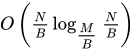
[edit]External sorting algorithms can be analyzed in the external memory model. In this model, a cache or internal memory of size M and an unbounded external memory are divided into blocks of size B, and the running time of an algorithm is determined by the number of memory transfers between internal and external memory. Like their cache-oblivious counterparts, asymptotically optimal external sorting algorithms achieve a running time (in Big O notation) of .
External merge sort
[edit]One example of external sorting is the external merge sort algorithm, which uses a K-way merge algorithm. It sorts chunks that each fit in RAM, then merges the sorted chunks together.[1][2]
The algorithm first sorts M items at a time and puts the sorted lists back into external memory. It does a -way merge on those sorted lists, recursing if there is not enough main memory to merge efficiently in one pass. During a merge pass, B elements from each sorted list are in internal memory, and the minimum is repeatedly outputted.

For example, for sorting 900 megabytes of data using only 100 megabytes of RAM:
- Read 100 MB of the data in main memory and sort by some conventional method, like quicksort.
- Write the sorted data to disk.
- Repeat steps 1 and 2 until all of the data is in sorted 100 MB chunks (there are 900MB / 100MB = 9 chunks), which now need to be merged into one single output file.
- Read the first 10 MB (= 100MB / (9 chunks + 1)) of each sorted chunk into input buffers in main memory and allocate the remaining 10 MB for an output buffer. (In practice, it might provide better performance to make the output buffer larger and the input buffers slightly smaller.)
- Perform a 9-way merge and store the result in the output buffer. Whenever the output buffer fills, write it to the final sorted file and empty it. Whenever any of the 9 input buffers empties, fill it with the next 10 MB of its associated 100 MB sorted chunk until no more data from the chunk is available.
The merge pass is key to making external merge sort work externally. The merge algorithm only makes one pass through each chunk, so chunks do not have to be loaded all at once; rather, sequential parts of the chunk are loaded as needed. And as long as the blocks read are relatively large (like the 10 MB in this example), the reads can be relatively efficient even on media with low random-read performance, like hard drives.
Historically, instead of a sort, sometimes a replacement-selection algorithm[3] was used to perform the initial distribution, to produce on average half as many output chunks of double the length.
Additional passes
[edit]The previous example is a two-pass sort: first sort, then merge. The sort ends with a single k-way merge, rather than a series of two-way merge passes as in a typical in-memory merge sort. This is because each merge pass reads and writes every value from and to disk, so reducing the number of passes more than compensates for the additional cost of a k-way merge.
The limitation to single-pass merging is that as the number of chunks increases, memory will be divided into more buffers, so each buffer is smaller. Eventually, the reads become so small that more time is spent on disk seeks than data transfer. A typical magnetic hard disk drive might have a 10 ms access time and 100 MB/s data transfer rate, so each seek takes as much time as transferring 1 MB of data.
Thus, for sorting, say, 50 GB in 100 MB of RAM, using a single 500-way merge pass isn't efficient: we can only read 100 MB / 501 ≈ 200 KB from each chunk at once, so 5/6 of the disk's time is spent seeking. Using two merge passes solves the problem. Then the sorting process might look like this:
- Run the initial chunk-sorting pass as before to create 500×100 MB sorted chunks.
- Run a first merge pass combining 25×100 MB chunks at a time, resulting in 20×2.5 GB sorted chunks.
- Run a second merge pass to merge the 20×2.5 GB sorted chunks into a single 50 GB sorted result
Although this requires an additional pass over the data, each read is now 4 MB long, so only 1/5 of the disk's time is spent seeking. The improvement in data transfer efficiency during the merge passes (16.6% to 80% is almost a 5× improvement) more than makes up for the doubled number of merge passes.
Variations include using an intermediate medium like solid-state disk for some stages; the fast temporary storage needn't be big enough to hold the whole dataset, just substantially larger than available main memory. Repeating the example above with 1 GB of temporary SSD storage, the first pass could merge 10×100 MB sorted chunks read from that temporary space to write 50x1 GB sorted chunks to HDD. The high bandwidth and random-read throughput of SSDs help speed the first pass, and the HDD reads for the second pass can then be 2 MB, large enough that seeks will not take up most of the read time. SSDs can also be used as read buffers in a merge phase, allowing fewer larger reads (20MB reads in this example) from HDD storage. Given the lower cost of SSD capacity relative to RAM, SSDs can be an economical tool for sorting large inputs with very limited memory.
Like in-memory sorts, efficient external sorts require O(n log n) time: exponentially growing datasets require linearly increasing numbers of passes that each take O(n) time.[4] Under reasonable assumptions at least 500 GB of data stored on a hard drive can be sorted using 1 GB of main memory before a third pass becomes advantageous, and many times that much data can be sorted before a fourth pass becomes useful.[5]
Main memory size is important. Doubling memory dedicated to sorting halves the number of chunks and the number of reads per chunk, reducing the number of seeks required by about three-quarters. The ratio of RAM to disk storage on servers often makes it convenient to do huge sorts on a cluster of machines[6] rather than on one machine with multiple passes. Media with high random-read performance like solid-state drives (SSDs) also increase the amount that can be sorted before additional passes improve performance.
External distribution sort
[edit]External distribution sort is analogous to quicksort. The algorithm finds approximately pivots and uses them to divide the N elements into approximately equally sized subarrays, each of whose elements are all smaller than the next, and then recurse until the sizes of the subarrays are less than the block size. When the subarrays are less than the block size, sorting can be done quickly because all reads and writes are done in the cache, and in the external memory model requires operations.

However, finding exactly pivots would not be fast enough to make the external distribution sort asymptotically optimal. Instead, we find slightly fewer pivots. To find these pivots, the algorithm splits the N input elements into chunks, and takes every elements, and recursively uses the median of medians algorithm to find pivots.[7]


There is a duality, or fundamental similarity, between merge- and distribution-based algorithms.[8]
Performance
[edit]The Sort Benchmark, created by computer scientist Jim Gray, compares external sorting algorithms implemented using finely tuned hardware and software. Winning implementations use several techniques:
- Using parallelism
- Multiple disk drives can be used in parallel in order to improve sequential read and write speed. This can be a very cost-efficient improvement: a Sort Benchmark winner in the cost-centric Penny Sort category uses six hard drives in an otherwise midrange machine.[9]
- Sorting software can use multiple threads, to speed up the process on modern multicore computers.
- Software can use asynchronous I/O so that one run of data can be sorted or merged while other runs are being read from or written to disk.
- Multiple machines connected by fast network links can each sort part of a huge dataset in parallel.[10]
- Increasing hardware speed
- Using more RAM for sorting can reduce the number of disk seeks and avoid the need for more passes.
- Fast external memory like solid-state drives can speed sorts, either if the data is small enough to fit entirely on SSDs or, more rarely, to accelerate sorting SSD-sized chunks in a three-pass sort.
- Many other factors can affect hardware's maximum sorting speed: CPU speed and number of cores, RAM access latency, input/output bandwidth, disk read/write speed, disk seek time, and others. "Balancing" the hardware to minimize bottlenecks is an important part of designing an efficient sorting system.
- Cost-efficiency as well as absolute speed can be critical, especially in cluster environments where lower node costs allow purchasing more nodes.
- Increasing software speed
- Some Sort Benchmark entrants use a variation on radix sort for the first phase of sorting: they separate data into one of many "bins" based on the beginning of its value. Sort Benchmark data is random and especially well-suited to this optimization.
- Compacting the input, intermediate files, and output can reduce time spent on I/O, but is not allowed in the Sort Benchmark.
- Because the Sort Benchmark sorts long (100-byte) records using short (10-byte) keys, sorting software sometimes rearranges the keys separately from the values to reduce memory I/O volume.
See also
[edit]References
[edit]- ^ Donald Knuth, The Art of Computer Programming, Volume 3: Sorting and Searching, Second Edition. Addison-Wesley, 1998, ISBN 0-201-89685-0, Section 5.4: External Sorting, pp.248–379.
- ^ Ellis Horowitz and Sartaj Sahni, Fundamentals of Data Structures, H. Freeman & Co., ISBN 0-7167-8042-9.
- ^ Donald Knuth, The Art of Computer Programming, Volume 3: Sorting and Searching, Second Edition. Addison-Wesley, 1998, ISBN 0-201-89685-0, Section 5.4: External Sorting, pp.254–ff.
- ^ One way to see this is that given a fixed amount of memory (say, 1GB) and a minimum read size (say, 2MB), each merge pass can merge a certain number of runs (such as 500) into one, creating a divide-and-conquer situation similar to in-memory merge sort. The size of each main-memory sort and number of ways in each merge have a constant upper bound, so they don't contribute to the big-O.
- ^ For an example, assume 500 GB of data to sort, 1 GB of buffer memory, and a single disk with 200 MB/s transfer rate and 20 ms seek time. A single 500-way merging phase will use buffers of 2 MB each, and need to do 250 K seeks while reading then writing 500 GB. It will spend 5,000 seconds seeking and 5,000 s transferring. Doing two merge passes as described above would nearly eliminate the seek time but add an additional 5,000 s of data transfer time, so this is approximately the break-even point between a two-pass and three-pass sort.
- ^ Chris Nyberg, Mehul Shah, Sort Benchmark Home Page (links to examples of parallel sorts)
- ^ Aggarwal, Alok; Vitter, Jeffrey (1988). "The input/output complexity of sorting and related problems" (PDF). Communications of the ACM. 31 (9): 1116–1127. doi:10.1145/48529.48535.
- ^ J. S. Vitter, Algorithms and Data Structures for External Memory, Series on Foundations and Trends in Theoretical Computer Science, now Publishers, Hanover, MA, 2008, ISBN 978-1-60198-106-6.
- ^ Nikolas Askitis, OzSort 2.0: Sorting up to 252GB for a Penny
- ^ Rasmussen et al., TritonSort
External links
[edit]External sorting
View on GrokipediaBackground
Definition and Motivation
External sorting encompasses a class of algorithms engineered to organize datasets that surpass the limits of primary memory, leveraging secondary storage media such as magnetic tapes or hard disk drives to manage data input and output operations. These methods emerged as essential tools for processing voluminous records that cannot reside entirely in random-access memory (RAM), thereby bridging the gap between computational speed and storage constraints.[6] The historical roots of external sorting trace back to the 1950s, when magnetic tape units became standard for data storage in early computers like the IBM 701, enabling the sorting of large payroll and census datasets through multi-tape merge processes. Donald Knuth provided a seminal analysis in his 1973 treatise, formalizing external merge techniques and replacement selection for tape-based systems, which laid the groundwork for subsequent developments in disk-oriented environments. This evolution reflects the shift from tape-driven batch processing in the mid-20th century to modern disk-based systems supporting relational databases and distributed computing.[7][6] The motivation for external sorting stems from the exigencies of big data management in domains like databases, file systems, and search engines, where datasets routinely exceed available RAM—projected to reach 181 zettabytes globally by 2025.[8] Internal sorting algorithms falter under such scales due to memory exhaustion, rendering external approaches indispensable for efficient data organization in resource-constrained environments. Key challenges include the disparity in access times, where external I/O latencies can be orders of magnitude slower than CPU operations, thus demanding strategies to curtail disk seeks and optimize transfer volumes. For example, sorting a 1-terabyte file on a machine equipped with 64 gigabytes of RAM exemplifies the need for external methods to partition and merge data without overwhelming main memory.[9]Comparison to Internal Sorting
Internal sorting algorithms, such as quicksort and heapsort, process entire datasets that fit within main memory (RAM), leveraging fast random access to achieve optimal time complexities of O(n log n) for both average and worst cases in comparison-based methods, with I/O costs being negligible due to the absence of secondary storage involvement.[10] These algorithms prioritize computational efficiency and simplicity, as data elements can be freely rearranged without the overhead of disk transfers.[11] In contrast, external sorting algorithms address datasets exceeding RAM capacity by emphasizing I/O minimization as the primary performance bottleneck, since disk access latencies are significantly higher—often by factors of 10^5 to 10^6—than memory operations.[12] While internal sorting assumes uniform low-cost access patterns, external methods must account for sequential I/O patterns and buffering strategies to reduce seek times and transfers, potentially sacrificing some CPU efficiency for overall throughput gains.[13] This shift in focus leads to more complex implementations in external sorting, where the goal is not just comparisons but optimizing data movement between tiers of the memory hierarchy. Internal sorting suits applications with datasets smaller than available RAM, providing rapid execution and minimal hardware dependencies beyond memory allocation, whereas external sorting is essential for massive-scale data processing, introducing trade-offs like reduced simplicity and heightened sensitivity to storage hardware characteristics such as disk speed and buffer sizes.[12] For instance, empirical comparisons in virtual memory environments show internal quicksort outperforming external mergesort only for files under 1000 records, with external methods gaining substantial advantages as data size increases due to superior I/O overlap.[13] Historically, internal sorting prevailed in early computing due to modest data volumes that readily fit in primary memory, but the post-2000s data explosion—driven by sources like the internet and sensors, with global data volumes projected to reach 181 zettabytes by 2025—has rendered external sorting indispensable, as memory capacities fail to scale proportionally.[8] Seminal analyses, such as those in Knuth's work, underscore this evolution by contrasting the flexibility of internal methods with the stringent I/O constraints of external ones, marking a transition from memory-bound to storage-bound paradigms in sorting.[14]Memory and I/O Models
External Memory Model
The external memory model provides an abstract framework for analyzing algorithms that process data too large to fit entirely in main memory, emphasizing the cost of data transfers between internal and external storage. Introduced by Aggarwal and Vitter, this model abstracts the memory hierarchy into two levels: a fast internal memory of size elements and a slower external memory holding elements where , with data transferred in blocks of elements per I/O operation.[15] The model assumes that computation within internal memory is free in terms of time, while the primary cost arises from I/O operations, making it suitable for evaluating external sorting efficiency.[16] Key assumptions in the model highlight the differences between sequential and random I/O accesses. Sequential I/O, which transfers contiguous blocks, is significantly cheaper due to reduced overhead from disk seeks and rotational latency, often by a factor of 100 or more compared to random accesses.[17] External storage is modeled as linear, with transfers occurring in fixed-size blocks to mimic real hardware constraints like disk sectors or tape records, ensuring that algorithms optimize for block-aligned operations to minimize I/O volume.[16] Variants of the model account for different storage technologies. The disk access model, central to Aggarwal and Vitter's work, permits random access to any block but incorporates latency penalties for non-sequential reads, reflecting modern hard disk drives with multiple platters allowing parallel transfers.[15] In contrast, the tape model, prevalent in early computing systems, restricts access to sequential only, without random seeks, as tapes unwind linearly and rewinding incurs substantial time costs; this variant influenced initial external sorting designs before disk dominance.[18][15] These model components and assumptions directly shape algorithm design prerequisites, particularly in external sorting. The ratio determines available buffer slots in internal memory, enabling strategies like buffering multiple input runs to overlap reads and writes, thus reducing total I/O passes.[16] Similarly, the large (number of external blocks) necessitates multi-pass approaches, where each pass scans a fraction of the data, with the number of passes influenced by how effectively internal memory partitions the workload to balance sequential access patterns.[15]I/O Cost Measures
In the external memory model, the primary metric for evaluating the efficiency of external sorting algorithms is the number of I/O operations, which counts the reads and writes of fixed-size blocks between internal memory and secondary storage.[19] This measure captures the dominant bottleneck in processing large datasets that exceed available main memory, as each I/O transfers B records at a time.[20] A basic scanning operation, such as reading or writing the entire dataset once, requires O(N/B) I/O operations, where N denotes the total number of records.[19] For sorting, the established upper bound is O\left( \frac{N}{B} \log_{\frac{M}{B}} \frac{N}{B} \right) I/O operations, where M is the size of internal memory; this bound arises from multiway merge strategies and is tight under standard assumptions.[19] The logarithmic term reflects the number of merging phases needed, with each phase involving scans of the data. Secondary costs include CPU time, which is typically linear in N and not the focus of I/O analysis, and seek time for disk accesses, modeled as a constant overhead per random I/O operation.[20] Larger block sizes B reduce the total I/O count by minimizing the number of transfers but may increase latency per operation due to rotational delays.[20] Similarly, increasing internal memory M lowers the base of the logarithm in the sorting bound, reducing overall I/Os, though diminishing returns apply as M approaches N.[20] Buffering introduces trade-offs by allocating portions of M to stage data and overlap I/O with computation, potentially cutting effective I/Os through techniques like double buffering in merging, but at the expense of reduced space for active sorting runs.[20] Optimal buffer sizing balances these factors, as excessive buffering can underutilize memory for algorithmic progress while insufficient buffering amplifies I/O volume.[20]Merge-Based Algorithms
External Merge Sort Procedure
The external merge sort algorithm divides the sorting process into two main phases: run formation and multiway merging. In the first phase, the input file, assumed to contain N elements divided into n = N/B disk pages where B is the number of elements per page, is processed to create initial sorted runs. Each run is formed by reading approximately M elements (where M is the available main memory in elements, with M < N) into memory, sorting them using an internal sorting algorithm such as heapsort or quicksort, and writing the sorted run back to disk. This process repeats until the entire input is consumed, yielding approximately N/M initial runs, with the last run potentially shorter. An alternative to full internal sorting for run formation is replacement selection, which exploits any existing order in the input to produce longer initial runs on average by selecting the next output element as the smallest that is at least as large as the previously output element.[21] In the second phase, the initial runs are iteratively merged using a k-way merge, where k is chosen as approximately (M/B) - 1 to fully utilize available memory (with k input buffers of size B each and one output buffer of size B). Each merge pass reads k runs into the input buffers, merges them by repeatedly selecting the smallest element from the buffer heads using a min-heap or tournament method, and writes the merged output as a new run to disk. If the number of runs exceeds k, multiple passes are required, halving (or reducing by factor k) the number of runs per pass until only one sorted run remains; the total number of passes is roughly 1 + log_k (N/M). This procedure assumes the external memory model, where I/O costs dominate due to limited memory and block-based disk access.[22][21] The following pseudocode outlines the basic external merge sort procedure: Initial Run Formation:for i = 1 to ceil(N/M) do
Read min(M, remaining elements) from input file into memory
Sort the M elements internally
Write the sorted run to output file as run i
end
Set current_runs = ceil(N/M)
for i = 1 to ceil(N/M) do
    Read min(M, remaining elements) from input file into memory
    Sort the M elements internally
    Write the sorted run to output file as run i
end
Set current_runs = ceil(N/M)
while current_runs > 1 do
    k = min(floor((M - B)/B) + 1, current_runs)  // Number of runs to merge per group
    for j = 1 to ceil(current_runs / k) do
        Allocate k input buffers and 1 output buffer
        Read first B elements of each of k runs into input buffers
        while any input buffer not empty do
            Find smallest element among buffer heads (e.g., via heap)
            Write it to output buffer
            Advance the corresponding input buffer
            If an input buffer empties, refill from its run
            If output buffer full, write to disk and reset
        end
        Write any remaining output buffer to disk as new run
    end
    current_runs = ceil(current_runs / k)
end
while current_runs > 1 do
    k = min(floor((M - B)/B) + 1, current_runs)  // Number of runs to merge per group
    for j = 1 to ceil(current_runs / k) do
        Allocate k input buffers and 1 output buffer
        Read first B elements of each of k runs into input buffers
        while any input buffer not empty do
            Find smallest element among buffer heads (e.g., via heap)
            Write it to output buffer
            Advance the corresponding input buffer
            If an input buffer empties, refill from its run
            If output buffer full, write to disk and reset
        end
        Write any remaining output buffer to disk as new run
    end
    current_runs = ceil(current_runs / k)
end
Optimizations for Merge Sort
Replacement selection is a key optimization for the initial run formation phase of external merge sort, where records are continuously read into a buffer of size M and the largest available record is selected and written to the output run, with the buffer maintained as a heap to facilitate efficient selection. This approach, introduced by Goetz in 1963, produces longer initial runs than simple load-sort-store methods by overlapping input, selection, and output operations, achieving an average run length approximately twice that of the buffer size for randomly distributed data.[24] Bottom-up merging variants, such as polyphase or balanced merging, introduce additional passes to balance run lengths and minimize the total number of merging phases, particularly beneficial for sequential storage devices like tapes where rewinding and repositioning are costly. These methods distribute initial runs unevenly across multiple tapes during the first pass and merge them in a way that equalizes run sizes over subsequent passes, reducing the overall I/O volume by avoiding excessive tape traversals. Multiway merging extends the standard two-way merge by combining k sorted runs simultaneously, where k is bounded by the memory limit (k ≈ M/B - 1), employing a min-heap (priority queue) to track the smallest unmerged element from each run, allowing efficient selection with O(log k) time per extraction. This heap-based approach reduces the number of merging passes from O(log (N/M)) to O(log_k (N/M)), thereby decreasing total I/O operations, especially when buffer space permits larger k values.[22] For sequential devices like tapes, adaptations such as odd-even tape merging in balanced merge variants enable efficient distribution and merging without random access, minimizing head movements by processing runs on odd and even numbered tapes alternately during merges. This technique suits tape-based systems by facilitating balanced distribution and merging in a linear access manner, contrasting with disk-oriented random I/O optimizations. In practice, these optimizations significantly reduce I/O costs compared to basic external merge sort, with replacement selection alone doubling run lengths and multiway merging further compressing pass counts, as demonstrated in cache-conscious implementations on modern storage.[3][25]Distribution-Based Algorithms
External Radix Sort
External radix sort is a distribution-based sorting algorithm adapted for external memory environments, where the dataset exceeds main memory capacity and must be processed using disk storage. Unlike comparison-based methods, it partitions data into buckets based on individual digits of the keys, starting from the most significant digit (MSD) in a recursive manner. This approach is particularly effective for fixed-length keys, such as integers or strings of uniform length, as it enables linear-time processing per digit position with minimal I/O overhead. The procedure follows the MSD radix sort paradigm, modified for external storage. In each pass, the input file is read sequentially, and records are distributed into buckets corresponding to the possible values of the current digit (e.g., 0-255 for base-256). Only non-empty buckets are written to separate external files or disk partitions, and the process recurses on each bucket for the next digit position until the keys are fully sorted. Small buckets that fit in main memory can be sorted internally using an in-memory radix sort or other efficient method to reduce disk accesses. This recursive distribution ensures that the sorting tree has depth equal to the number of digits, with each level requiring a single full scan of the data. Bucket management in external radix sort relies on creating temporary files or allocated disk areas for each bucket during distribution. To optimize I/O, buffers of size approximately equal to the main memory capacity are used to accumulate records before writing full blocks to disk, ensuring sequential access patterns. For multiple disks, buckets can be striped or cycled across devices to balance load and improve parallelism. If a bucket is small enough to fit in memory after distribution, it is sorted internally and collected back without further external passes, avoiding unnecessary disk operations. Stable partitioning is maintained by preserving the relative order of records with equal digits, typically achieved through counting or linked-list mechanisms adapted for external use. A key advantage of external radix sort over merge-based algorithms is the reduced number of passes for fixed-length keys, as the number of digit positions is constant and independent of data size. In ideal cases with sufficient memory for buffers, it achieves O(N) total I/O volume across all passes, making it highly efficient for large uniform-key datasets like integer arrays. For instance, sorting a collection of 32-bit integers using base 256 requires at most 4 passes—one per byte—each scanning the entire dataset once for distribution. This contrasts with merge sort's logarithmic number of passes, which grows with N. Despite its efficiencies, external radix sort has limitations, particularly with variable-length keys where the MSD recursion depth varies, leading to unbalanced buckets and potentially more I/O than fixed-length cases. It also requires stable partitioning to ensure correctness across digits, which adds complexity in external implementations due to the need for auxiliary storage or careful buffering to maintain order during disk writes. Additionally, performance can degrade if the base is poorly chosen relative to memory size, as too many buckets may exceed available disk space or buffer capacity.Other Distribution Methods
External quicksort hybrids extend the partitioning strategy of internal quicksort to external environments by using multiple external buckets to store records less than, equal to, or greater than a selected pivot, with recursive partitioning applied to each resulting subfile until the data fits in main memory for internal sorting. This method leverages buffer space efficiently to reduce I/O operations during pivot selection and data redistribution, often achieving performance competitive with merge sort in practice when disk access patterns are favorable.[20][26] Hash-based distribution scatters input records across a set of output files by applying a hash function to the sort keys, promoting balanced partitioning without relying on key comparisons; each resulting file, typically small enough for internal sorting, is then sorted in memory, followed by a multiway merge of the sorted files to obtain the final order. Randomized variants employ multiple hash functions over successive distribution passes to mitigate skew from poor initial hashing and ensure uniform load across files.[20] These alternatives to radix sort prove useful when sort keys defy radix assumptions, such as fixed-length digits or uniform base representation, particularly for non-numeric or variable-length data like strings where comparison-based or hash partitioning avoids the need for digit-by-digit processing. For example, hash-based sorting of strings distributes records by hashing the full string key to files for initial scattering; collisions within a file are managed through subsequent internal sorting of that group before merging all sorted files.[20]Performance Evaluation
Complexity Analysis
The theoretical analysis of external sorting algorithms primarily focuses on their I/O complexity in the external memory model, where the dominant cost arises from transferring data between fast internal memory of size (measured in elements) and slower external storage in blocks of size elements, with denoting the total number of elements to sort and assuming . For comparison-based algorithms, a fundamental lower bound on the number of I/O operations is , established by modeling the sorting process as requiring a certain number of element comparisons that necessitate data movement across the memory boundary.[19] This bound holds under the assumption that , reflecting the information-theoretic needs of distinguishing permutations while accounting for block-level transfers.[19] For external merge sort, the I/O complexity achieves this lower bound up to constant factors. The initial phase creates sorted runs by loading elements into memory, sorting them (at CPU cost ), and writing them back, incurring I/Os overall since each of the blocks is read and written once.[19] Subsequent merge phases use -way merging, where (reserving space for output buffering). The number of merge passes required is , as each pass reduces the number of runs by a factor of approximately . Each pass reads and writes all blocks, adding I/Os per pass, for a total merge cost of .[19] Combining phases yields an overall I/O complexity of , with CPU time .[19][20] Distribution-based algorithms like external radix sort offer potentially better performance for keys with bounded word size , processing digits (or fewer for fixed-length keys). Each digit pass distributes elements into buckets using a stable partition (e.g., counting sort adapted to external memory), requiring I/Os to scan, partition, and write back the data. With passes, the total I/O complexity is , which is linear in if is constant (e.g., for fixed-precision integers) and can outperform comparison-based methods when .[20] The CPU time is . More advanced variants, such as multiway radix sort, may add a logarithmic factor, yielding I/Os, but the base form remains pass-linear.[20] In terms of space complexity, both merge sort and radix sort require internal memory for buffering and external blocks for input and output files, plus temporary space per block during transfers, totaling ; the external component dominates for large .[20] Asymptotically, these complexities scale favorably with growing and : larger reduces the logarithmic factor in merge sort's I/Os (fewer passes), while bigger amortizes transfer overhead, improving practical scalability on modern systems with increasing memory and block sizes; however, radix sort's linearity in makes it more robust when remains small relative to .[19][20]Practical Implementation Factors
Hardware impacts significantly influence the efficiency of external sorting on single machines (as of 2025). Traditional hard disk drives (HDDs) incur substantial seek times of 5–10 ms to position the read/write head, dominating performance during the multiple random accesses typical in merge passes.[27] Solid-state drives (SSDs), by contrast, lack mechanical components, eliminating seek and rotational latencies while offering sustained sequential transfer rates up to 7,000–14,000 MB/s for high-end NVMe models, which can accelerate external sorts by reducing I/O bottlenecks compared to HDDs' 100–200 MB/s limits.[28] Effective buffer tuning aligns buffer sizes with the operating system's page size (often 4 KB) to optimize direct memory access and avoid fragmented I/O operations that increase overhead.[29] Software selections and architectural decisions further shape implementation practicality. Languages with robust I/O libraries, such as Java's NIO framework, facilitate efficient direct byte buffer management for reading and writing large files without intermediate copying, supporting scalable external merge operations.[30] Incorporating parallelism, particularly multi-threaded merging, leverages multi-core processors to process multiple input runs concurrently, potentially halving merge times on systems with 8+ cores while managing contention through careful buffer partitioning.[31] Key tuning parameters include buffer size and initial run lengths, which must be adjusted based on hardware characteristics. Buffer sizes should balance seek costs against sequential transfer efficiency, often aligning with disk block sizes. Run length adjustments, such as employing replacement selection during the initial pass, can extend sorted runs beyond simple memory limits, minimizing subsequent merge passes.[32] Real-world benchmarks highlight these factors' impact. The Unixsort command implements external merge sort with adaptive buffering and temporary file spilling, achieving effective throughputs typically in the range of 10–100 MB/s on modern HDDs for multi-gigabyte files (limited by seek times), scaling to SSDs for up to 10x faster completion on datasets exceeding available RAM. In database systems, external sorting underpins index construction, such as bulk-loading B+ trees; benchmarks indicate SSD-based sorts complete significantly faster than on HDDs, often by an order of magnitude for large relations like 100 GB datasets.[33]
While core implementations target single machines, modern extensions like MapReduce adapt external sorting principles for distributed environments, partitioning data across nodes for petabyte-scale processing while retaining single-machine efficiency for smaller workloads via local merges.[34]