



Community hub
Recent from talks
Knowledge base stats:
Talk channels stats:
Members stats:
Foehn wind
A Foehn, or Föhn (German pronunciation: [føːn], UK: /fɜːn/, US: /feɪn/ fayn, US also /fʌn, fɜːrn/ fu(r)n), is a type of dry, relatively warm downslope wind in the lee of a mountain range. It is a rain shadow wind that results from the subsequent adiabatic warming of air that has dropped most of its moisture on windward slopes (see orographic lift). As a consequence of the different adiabatic lapse rates of moist and dry air, the air on the leeward slopes becomes warmer than equivalent elevations on the windward slopes.
Foehn winds can raise temperatures by as much as 14 °C (25 °F) in just a matter of hours. Switzerland, southern Germany, and Austria have a warmer climate due to the Foehn, as moist winds off the Mediterranean Sea blow over the Alps.
The name Foehn (German: Föhn, pronounced [ˈføːn]) arose in the Alpine region. Originating from Latin (ventus) favonius, a mild west wind of which Favonius was the Roman personification and probably transmitted by Romansh: favuogn or just fuogn, the term was adopted as Old High German: phōnno. In the Southern Alps, the phenomenon is known as Föhn but also Italian: favonio and fen in Serbo-Croatian and Slovene. The German word Föhn (pronounced the same way) also means 'hairdryer', while the word Fön is a genericized trademark today owned by AEG. The form phon is used in French-speaking parts of Switzerland as well as in Northern Italy.
The name Föhn was originally used to refer to the south wind which blows during the winter months and brings thaw conditions to the northern side of the Alps. Because Föhn later became a generic term that was extended to other mountain ranges around the world that experience similar phenomena, the name "Alpine föhn" (Alpenföhn) was coined for the Föhns of the Alpine region.
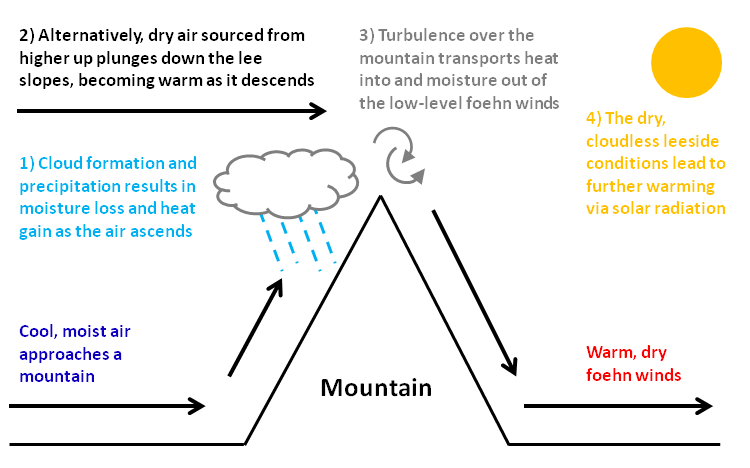
There are four known causes of the Foehn warming and drying effect. These mechanisms often act together, with their contributions varying depending on the size and shape of the mountain barrier and on the meteorological conditions, such as the upstream wind speed, temperature and humidity.
When winds blow over elevated terrain, air forced upwards expands and cools due to the decrease in pressure with height. Since colder air can hold less water vapor, moisture condenses to form clouds and precipitates as rain or snow on the mountain's upwind slopes. The change of state from vapor to liquid water releases latent heat energy which heats the air, partially countering the cooling that occurs as the air rises. The subsequent removal of moisture as precipitation renders this heat gain by the air irreversible, leading to the warm, dry, Foehn conditions as the air descends in the mountain's lee. This mechanism has become a popular textbook example of atmospheric thermodynamics. However, the common occurrence of 'dry' Foehn events, where there is no precipitation, implies there must be other mechanisms.
Isentropic draw-down is the draw-down of warmer, drier air from aloft. When the approaching winds are insufficiently strong to propel the low-level air up and over the mountain barrier, the airflow is said to be 'blocked' by the mountain and only air higher up near mountain-top level is able to pass over and down the lee slopes as Foehn winds. These higher source regions provide Foehn air that becomes warmer and drier on the leeside after it is compressed with descent due to the increase in pressure towards the surface.
When river water passes over rocks, turbulence is generated in the form of rapids, and white water reveals the turbulent mixing of the water with the air above. Similarly, as air passes over mountains, turbulence occurs and the atmosphere is mixed in the vertical. This mixing generally leads to a downward warming and upward moistening of the cross-mountain airflow, and consequently to warmer, drier Foehn winds in the valleys downwind.
Hub AI
Foehn wind AI simulator
(@Foehn wind_simulator)
Foehn wind
A Foehn, or Föhn (German pronunciation: [føːn], UK: /fɜːn/, US: /feɪn/ fayn, US also /fʌn, fɜːrn/ fu(r)n), is a type of dry, relatively warm downslope wind in the lee of a mountain range. It is a rain shadow wind that results from the subsequent adiabatic warming of air that has dropped most of its moisture on windward slopes (see orographic lift). As a consequence of the different adiabatic lapse rates of moist and dry air, the air on the leeward slopes becomes warmer than equivalent elevations on the windward slopes.
Foehn winds can raise temperatures by as much as 14 °C (25 °F) in just a matter of hours. Switzerland, southern Germany, and Austria have a warmer climate due to the Foehn, as moist winds off the Mediterranean Sea blow over the Alps.
The name Foehn (German: Föhn, pronounced [ˈføːn]) arose in the Alpine region. Originating from Latin (ventus) favonius, a mild west wind of which Favonius was the Roman personification and probably transmitted by Romansh: favuogn or just fuogn, the term was adopted as Old High German: phōnno. In the Southern Alps, the phenomenon is known as Föhn but also Italian: favonio and fen in Serbo-Croatian and Slovene. The German word Föhn (pronounced the same way) also means 'hairdryer', while the word Fön is a genericized trademark today owned by AEG. The form phon is used in French-speaking parts of Switzerland as well as in Northern Italy.
The name Föhn was originally used to refer to the south wind which blows during the winter months and brings thaw conditions to the northern side of the Alps. Because Föhn later became a generic term that was extended to other mountain ranges around the world that experience similar phenomena, the name "Alpine föhn" (Alpenföhn) was coined for the Föhns of the Alpine region.
There are four known causes of the Foehn warming and drying effect. These mechanisms often act together, with their contributions varying depending on the size and shape of the mountain barrier and on the meteorological conditions, such as the upstream wind speed, temperature and humidity.
When winds blow over elevated terrain, air forced upwards expands and cools due to the decrease in pressure with height. Since colder air can hold less water vapor, moisture condenses to form clouds and precipitates as rain or snow on the mountain's upwind slopes. The change of state from vapor to liquid water releases latent heat energy which heats the air, partially countering the cooling that occurs as the air rises. The subsequent removal of moisture as precipitation renders this heat gain by the air irreversible, leading to the warm, dry, Foehn conditions as the air descends in the mountain's lee. This mechanism has become a popular textbook example of atmospheric thermodynamics. However, the common occurrence of 'dry' Foehn events, where there is no precipitation, implies there must be other mechanisms.
Isentropic draw-down is the draw-down of warmer, drier air from aloft. When the approaching winds are insufficiently strong to propel the low-level air up and over the mountain barrier, the airflow is said to be 'blocked' by the mountain and only air higher up near mountain-top level is able to pass over and down the lee slopes as Foehn winds. These higher source regions provide Foehn air that becomes warmer and drier on the leeside after it is compressed with descent due to the increase in pressure towards the surface.
When river water passes over rocks, turbulence is generated in the form of rapids, and white water reveals the turbulent mixing of the water with the air above. Similarly, as air passes over mountains, turbulence occurs and the atmosphere is mixed in the vertical. This mixing generally leads to a downward warming and upward moistening of the cross-mountain airflow, and consequently to warmer, drier Foehn winds in the valleys downwind.