


Community hub
Recent from talks
Contribute something to knowledge base
Content stats: 0 posts, 0 articles, 1 media, 0 notes
Members stats: 0 subscribers, 0 contributors, 0 moderators, 0 supporters
Subscribers
Supporters
Contributors
Moderators
Hub AI
Frequency modulation synthesis AI simulator
(@Frequency modulation synthesis_simulator)
Hub AI
Frequency modulation synthesis AI simulator
(@Frequency modulation synthesis_simulator)
Frequency modulation synthesis
Frequency modulation synthesis (or FM synthesis) is a form of sound synthesis whereby the frequency of a waveform is changed by modulating its frequency with a modulator. The (instantaneous) frequency of an oscillator is altered in accordance with the amplitude of a modulating signal.
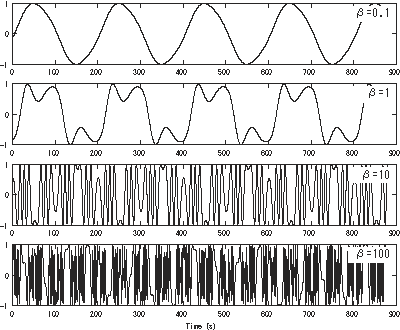
FM synthesis can create both harmonic and inharmonic sounds. To synthesize harmonic sounds, the modulating signal must have a harmonic relationship to the original carrier signal. As the amount of frequency modulation increases, the sound grows progressively complex. Through the use of modulators with frequencies that are non-integer multiples of the carrier signal (i.e. inharmonic), inharmonic bell-like and percussive spectra can be created.
FM synthesis using analog oscillators may result in pitch instability. However, FM synthesis can also be implemented digitally, which is more stable and became standard practice.
Digital FM synthesis (equivalent to phase modulation using the time integration of instantaneous frequency) was the basis of several musical instruments beginning as early as 1974. Yamaha built the first prototype digital synthesizer in 1974, based on FM synthesis, before commercially releasing the Yamaha GS-1 in 1980. The Synclavier I, manufactured by New England Digital Corporation beginning in 1978, included a digital FM synthesizer, using an FM synthesis algorithm licensed from Yamaha. Yamaha's groundbreaking Yamaha DX7 synthesizer, released in 1983, brought FM to the forefront of synthesis in the mid-1980s.
FM synthesis also became the usual setting for games and software up until the mid-nineties. Sound cards for IBM PC compatible systems like the AdLib and Sound Blaster popularized Yamaha chips like the OPL2 and OPL3. Other computers such as the Sharp X68000 and MSX (Yamaha CX5M computer unit) utilize the OPM sound chip (with later CX5M units using the OPP sound chip). The NEC PC-88 and PC-98 computers use either the OPN and OPNA sound chips.
For arcade systems and game consoles, OPM was used in many arcade boards from the 1980s and 1990s (including Sega's System 16 and Capcom's CP System arcade boards); OPN was also used in some arcade boards in the 1980s. OPNB was notably used in SNK's Neo Geo arcade (MVS) and home console (AES) machines, as well as being used as the main basic sound generator in Taito's arcade boards (with a variant of the OPNB being used in the Taito Z System board). The related OPN2 was used in Sega's Mega Drive (Genesis), Fujitsu's FM Towns Marty, and some of Sega's arcade boards (e.g. Sega System C-2 and Sega System 32) as one of its sound generator chips.
FM synthesis was also used on a wide range of mobile phones in the 2000s to play ringtones and other sounds, using the Yamaha SMAF format.
Don Buchla implemented FM on his instruments in the mid-1960s, prior to Chowning's patent. His 158, 258 and 259 dual oscillator modules had a specific FM control voltage input, and the model 208 (Music Easel) had a modulation oscillator hard-wired to allow FM as well as AM of the primary oscillator. These early applications used analog oscillators, and this capability was also followed by other modular synthesizers and portable synthesizers including Minimoog and ARP Odyssey.
Frequency modulation synthesis
Frequency modulation synthesis (or FM synthesis) is a form of sound synthesis whereby the frequency of a waveform is changed by modulating its frequency with a modulator. The (instantaneous) frequency of an oscillator is altered in accordance with the amplitude of a modulating signal.
FM synthesis can create both harmonic and inharmonic sounds. To synthesize harmonic sounds, the modulating signal must have a harmonic relationship to the original carrier signal. As the amount of frequency modulation increases, the sound grows progressively complex. Through the use of modulators with frequencies that are non-integer multiples of the carrier signal (i.e. inharmonic), inharmonic bell-like and percussive spectra can be created.
FM synthesis using analog oscillators may result in pitch instability. However, FM synthesis can also be implemented digitally, which is more stable and became standard practice.
Digital FM synthesis (equivalent to phase modulation using the time integration of instantaneous frequency) was the basis of several musical instruments beginning as early as 1974. Yamaha built the first prototype digital synthesizer in 1974, based on FM synthesis, before commercially releasing the Yamaha GS-1 in 1980. The Synclavier I, manufactured by New England Digital Corporation beginning in 1978, included a digital FM synthesizer, using an FM synthesis algorithm licensed from Yamaha. Yamaha's groundbreaking Yamaha DX7 synthesizer, released in 1983, brought FM to the forefront of synthesis in the mid-1980s.
FM synthesis also became the usual setting for games and software up until the mid-nineties. Sound cards for IBM PC compatible systems like the AdLib and Sound Blaster popularized Yamaha chips like the OPL2 and OPL3. Other computers such as the Sharp X68000 and MSX (Yamaha CX5M computer unit) utilize the OPM sound chip (with later CX5M units using the OPP sound chip). The NEC PC-88 and PC-98 computers use either the OPN and OPNA sound chips.
For arcade systems and game consoles, OPM was used in many arcade boards from the 1980s and 1990s (including Sega's System 16 and Capcom's CP System arcade boards); OPN was also used in some arcade boards in the 1980s. OPNB was notably used in SNK's Neo Geo arcade (MVS) and home console (AES) machines, as well as being used as the main basic sound generator in Taito's arcade boards (with a variant of the OPNB being used in the Taito Z System board). The related OPN2 was used in Sega's Mega Drive (Genesis), Fujitsu's FM Towns Marty, and some of Sega's arcade boards (e.g. Sega System C-2 and Sega System 32) as one of its sound generator chips.
FM synthesis was also used on a wide range of mobile phones in the 2000s to play ringtones and other sounds, using the Yamaha SMAF format.
Don Buchla implemented FM on his instruments in the mid-1960s, prior to Chowning's patent. His 158, 258 and 259 dual oscillator modules had a specific FM control voltage input, and the model 208 (Music Easel) had a modulation oscillator hard-wired to allow FM as well as AM of the primary oscillator. These early applications used analog oscillators, and this capability was also followed by other modular synthesizers and portable synthesizers including Minimoog and ARP Odyssey.
Recent media
Recent media