Hubbry Logo
logo
Frequency modulation synthesis
Community hub

Frequency modulation synthesis

logo
0 subscribers
Read side by side
from Wikipedia
FM synthesis using 2 operators
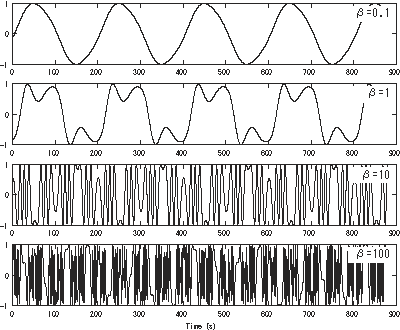
A 220 Hz carrier tone fc modulated by a 440 Hz modulating tone fm, with various choices of frequency modulation index, β. The time domain signals are illustrated above, and the corresponding spectra are shown below (spectrum amplitudes in dB).
Waveforms for each β

Spectra for each β

Frequency modulation synthesis (or FM synthesis) is a form of sound synthesis whereby the frequency of a waveform is changed by modulating its frequency with a modulator. The (instantaneous) frequency of an oscillator is altered in accordance with the amplitude of a modulating signal.[1]

FM synthesis can create both harmonic and inharmonic sounds. To synthesize harmonic sounds, the modulating signal must have a harmonic relationship to the original carrier signal. As the amount of frequency modulation increases, the sound grows progressively complex. Through the use of modulators with frequencies that are non-integer multiples of the carrier signal (i.e. inharmonic), inharmonic bell-like and percussive spectra can be created.

FM synthesis using analog oscillators may result in pitch instability.[2] However, FM synthesis can also be implemented digitally, which is more stable and became standard practice.

Applications

[edit]

In synthesizers

[edit]

Digital FM synthesis (equivalent to phase modulation using the time integration of instantaneous frequency) was the basis of several musical instruments beginning as early as 1974. Yamaha built the first prototype digital synthesizer in 1974, based on FM synthesis,[3] before commercially releasing the Yamaha GS-1 in 1980.[4] The Synclavier I, manufactured by New England Digital Corporation beginning in 1978, included a digital FM synthesizer, using an FM synthesis algorithm licensed from Yamaha.[5] Yamaha's groundbreaking Yamaha DX7 synthesizer, released in 1983, brought FM to the forefront of synthesis in the mid-1980s.[6]

In PCs, arcades, game consoles, and mobile phones

[edit]

FM synthesis also became the usual setting for games and software up until the mid-nineties. Sound cards for IBM PC compatible systems like the AdLib and Sound Blaster popularized Yamaha chips like the OPL2 and OPL3. Other computers such as the Sharp X68000 and MSX (Yamaha CX5M computer unit) utilize the OPM sound chip (with later CX5M units using the OPP sound chip). The NEC PC-88 and PC-98 computers use either the OPN and OPNA sound chips.

For arcade systems and game consoles, OPM was used in many arcade boards from the 1980s and 1990s (including Sega's System 16 and Capcom's CP System arcade boards); OPN was also used in some arcade boards in the 1980s. OPNB was notably used in SNK's Neo Geo arcade (MVS) and home console (AES) machines, as well as being used as the main basic sound generator in Taito's arcade boards (with a variant of the OPNB being used in the Taito Z System board). The related OPN2 was used in Sega's Mega Drive (Genesis), Fujitsu's FM Towns Marty, and some of Sega's arcade boards (e.g. Sega System C-2 and Sega System 32) as one of its sound generator chips.

FM synthesis was also used on a wide range of mobile phones in the 2000s to play ringtones and other sounds, using the Yamaha SMAF format.

History

[edit]

Don Buchla (mid-1960s)

[edit]

Don Buchla implemented FM on his instruments in the mid-1960s, prior to Chowning's patent. His 158, 258 and 259 dual oscillator modules had a specific FM control voltage input,[7] and the model 208 (Music Easel) had a modulation oscillator hard-wired to allow FM as well as AM of the primary oscillator.[8] These early applications used analog oscillators, and this capability was also followed by other modular synthesizers and portable synthesizers including Minimoog and ARP Odyssey.

John Chowning (late-1960s–1970s)

[edit]
Digital frequency modulation synthesis was developed by John Chowning

By the mid-20th century, frequency modulation (FM), a means of carrying sound, had been understood for decades and was being used to broadcast radio transmissions. FM synthesis was developed since 1967 at Stanford University, California, by John Chowning, through his exploration of digital synthesis and spatialization, inspired by the new possibilities of digital sound as described by Max Mathews[citation needed]. His algorithm[citation needed] was licensed to Japanese company Yamaha in 1973.[3] The implementation commercialized by Yamaha (US Patent 4018121 Apr 1977[9] or U.S. Patent 4,018,121[10]) is actually based on phase modulation[citation needed], but the results end up being equivalent mathematically as both are essentially a special case of quadrature amplitude modulation[citation needed].[11]

1970s–1980s

[edit]

Expansions by Yamaha

[edit]

Yamaha's engineers began adapting Chowning's algorithm for use in a commercial digital synthesizer, adding improvements such as the "key scaling" method to avoid the introduction of distortion that normally occurred in analog systems during frequency modulation[citation needed], though it would take several years before Yamaha released their FM digital synthesizers.[12] In the 1970s, Yamaha were granted a number of patents, under the company's former name "Nippon Gakki Seizo Kabushiki Kaisha", evolving Chowning's work.[10] Yamaha built the first prototype FM digital synthesizer in 1974.[3] Yamaha eventually commercialized FM synthesis technology with the Yamaha GS-1, the first FM digital synthesizer, released in 1980.[4] FM synthesis was the basis of some of the early generations of digital synthesizers, most notably those from Yamaha, as well as New England Digital Corporation under license from Yamaha.[5]

Yamaha DX7 FM digital synthesizer (1983)

Yamaha's DX7 synthesizer, released in 1983, was ubiquitous throughout the 1980s. Several other models by Yamaha provided variations and evolutions of FM synthesis during that decade.[13]

Yamaha had patented its hardware implementation of FM in the 1970s,[10] allowing it to nearly monopolize the market for FM technology until the mid-1990s.

[edit]

Casio developed a related form of synthesis called phase distortion synthesis, used in its CZ range of synthesizers. It had a similar (but slightly differently derived) sound quality to the DX series.

1990s

[edit]

Free use of FM after the patent expiration

[edit]

With the expiration of the Stanford University FM patent in 1995, digital FM synthesis can now be implemented freely by other manufacturers. The FM synthesis patent brought Stanford $20 million before it expired, making it (in 1994) "the second most lucrative licensing agreement in Stanford's history".[14]

Today, FM is mostly found in software-based synths such as Native Instruments' FM8 or Image-Line's Sytrus plug-ins, but it has also been incorporated into the synthesis repertoire of some modern digital synthesizers, usually coexisting as an option alongside other methods of synthesis such as subtractive, sample-based synthesis, additive synthesis, and other techniques. The degree of complexity of the FM in such hardware synths may vary from simple 2-operator FM, to the highly flexible 6-operator engines of the Korg Kronos and Alesis Fusion, to creation of FM in extensively modular engines such as those in the latest synthesisers by Kurzweil Music Systems.[citation needed]

Later use of FM and other technologies: Realtime Convolution & Modulation (AFM + Sample) and Formant Shaping Synthesis

[edit]

The Yamaha SY99[15] and FS1R[16] synthesizers marketed their highly powerful FM abilities as counterparts to sample-based synthesis and formant synthesis respectively. New hardware synths specifically marketed for their FM capabilities disappeared from the market after the release of FS1R in 1999, however, well-developed FM synthesis options are a feature of Nord Lead synths manufactured by Clavia, the Alesis Fusion range, the Korg Oasys and Kronos and the Modor NF-1. Various other synthesizers offer limited FM abilities to supplement their main engines.[citation needed]

The FS1R had 16 operators, 8 standard FM operators and 8 additional operators that used a noise source rather than an oscillator as its sound source. By adding in tuneable noise sources the FS1R could model the sounds produced in the human voice and in a wind instrument, along with making percussion instrument sounds. The FS1R also contained an additional wave form called the Formant wave form. Formants can be used to model resonating body instrument sounds like the cello, violin, acoustic guitar, bassoon, English horn, or human voice. Formants can even be found in the harmonic spectrum of several brass instruments.[17]

2000s–present

[edit]

Additional improvements: Variable Phase Modulation, FM-X Synthesis, Altered FM, etc.

[edit]

In 2016, Korg released the Korg Volca FM, a, 3-voice, 6 operators FM iteration of the Korg Volca series of compact, affordable desktop modules.[18] Korg has also released the opsix (2020) and opsix SE (2023), integrating 6 operators FM synthesis with subtractive, analogue modeling, additive, semi-modular and Waveshaping.

Yamaha released the Montage in 2016, which combines a 128-voice sample-based engine with a 128-voice FM engine. This iteration of FM is called FM-X, and features 8 operators; each operator has a choice of several basic wave forms, but each wave form has several parameters to adjust its spectrum.[19] It was then followed by the more affordable Yamaha MODX in 2018, with 64-voice, 8 operators FM-X architecture in addition to a 128-voice sample-based engine.[20] The MODX+ released in 2022 increased the number of voices of the FM-X engine to 128, the same as with the Montage.[21] The Montage was succeeded by the Montage M in 2023, which uses the same 128-voice, 8 operators FM-X engine alongside a 128-voice sample-based engine and a newly-introduced 16-voice 3 oscillator analog-based engine known as AN-X.[22]

Elektron launched the Digitone in 2018, which is an 8-voice, 4 operators FM synth featuring Elektron's renowned sequence engine.[23]

FM-X synthesis was first introduced with the Yamaha Montage synthesizers in 2016. FM-X uses 8 operators. Each FM-X operator has a set of multi-spectral wave forms to choose from, which means each FM-X operator can be equivalent to a stack of 3 or 4 DX7 FM operators. The list of selectable wave forms includes sine waves, the All1 and All2 wave forms, the Odd1 and Odd2 wave forms, and the Res1 and Res2 wave forms. The sine wave selection works the same as the DX7 wave forms. The All1 and All2 wave forms are a saw-tooth wave form. The Odd1 and Odd2 wave forms are pulse or square waves. These two types of wave forms can be used to model the basic harmonic peaks in the bottom of the harmonic spectrum of most instruments. The Res1 and Res2 wave forms move the spectral peak to a specific harmonic and can be used to model either triangular or rounded groups of harmonics further up in the spectrum of an instrument. Combining an All1 or Odd1 wave form with multiple Res1 (or Res2) wave forms (and adjusting their amplitudes) can model the harmonic spectrum of an instrument or sound.[17] [citation needed]

Combining sets of 8 FM operators with multi-spectral wave forms was first introduced in the FS1R, released in 1999 by Yamaha. It was able to achieve similar results to that of FM-X using 8 noise operators.

Spectral analysis

[edit]
2-operator demonstration: if the frequency of the modulator is lower than that of the carrier, the output note will be that of the modulator.

There are multiple variations of FM synthesis, including:

  • Various operator arrangements (known as "FM Algorithms" in Yamaha terminology)
    • 2 operators
    • Serial FM (multiple stages)
    • Parallel FM (multiple modulators, multiple-carriers),
    • Mix of them
  • Various waveform of operators
    • Sinusoidal waveform
    • Other waveforms
  • Additional modulation

etc.

As the basic of these variations, we analyze the spectrum of 2 operators (linear FM synthesis using two sinusoidal operators) on the following.

2 operators

[edit]

The spectrum generated by FM synthesis with one modulator is expressed as follows:[24][25]

For modulation signal , the carrier signal is:[note 1]

If we were to ignore the constant phase terms on the carrier and the modulator , finally we would get the following expression, as seen on Chowning 1973 and Roads 1996, p. 232:

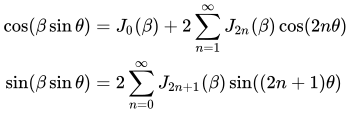
where are angular frequencies () of carrier and modulator, is frequency modulation index, and amplitudes is -th Bessel function of first kind, respectively.[note 2]

See also

[edit]

References

[edit]
[edit]
Revisions and contributorsEdit on WikipediaRead on Wikipedia
from Grokipedia
Frequency modulation synthesis is an audio synthesis technique that generates complex sounds by varying the instantaneous frequency of a carrier waveform using one or more modulating waveforms, resulting in a spectrum of sideband frequencies around the carrier.[1] This method, mathematically described by the equation $ e = A \sin(\omega_c t + I \sin(\omega_m t)) $, where $ \omega_c $ is the carrier angular frequency, $ \omega_m $ is the modulating angular frequency, and $ I $ is the modulation index, produces both harmonic and inharmonic spectra depending on the ratio of carrier to modulator frequencies.[1] Invented by John Chowning at Stanford University in the late 1960s and early 1970s, it was first detailed in his 1973 paper "The Synthesis of Complex Audio Spectra by Means of Frequency Modulation," which demonstrated its ability to create dynamic timbres resembling brass, woodwinds, and percussive instruments through evolving modulation indices.[1][2] As the first commercially viable digital synthesis method, frequency modulation synthesis was licensed by Yamaha and popularized through the DX7 synthesizer released in 1983, which sold more than 150,000 units and influenced electronic music production, sound design, and even consumer audio technologies like PC sound cards and mobile ringtones.[2][3] The technique's efficiency stems from its use of simple sinusoidal oscillators—termed "operators"—arranged in algorithms to modulate each other, enabling the creation of rich, evolving spectra with fewer computational resources than additive synthesis.[2] Sideband amplitudes are governed by Bessel functions, allowing precise control over timbre; for instance, low modulation indices yield spectra close to the pure carrier, while higher indices introduce numerous sidebands for brighter, more complex sounds.[1] Despite its digital origins, FM synthesis remains relevant in modern software synthesizers and hardware, bridging early computer music research with contemporary audio applications.[2]

Fundamentals

Definition and Principles

Frequency modulation (FM) synthesis is a sound synthesis technique that generates complex audio tones by varying the instantaneous frequency of a carrier waveform according to the amplitude of a modulating waveform, resulting in the production of harmonic or inharmonic sidebands that contribute to the overall timbre without directly altering the carrier's waveform shape.[1] This method leverages the principles of frequency modulation, originally developed in radio communications, to create rich spectra efficiently, offering precise control over tonal qualities through simple parameter adjustments.[1] At its core, FM synthesis involves a carrier-modulator relationship where the carrier, typically a sinusoidal wave at a fundamental frequency, has its frequency deviated proportionally to the instantaneous amplitude of the modulator, another sinusoidal wave whose frequency ratio to the carrier determines the spacing of resulting spectral components.[1] The extent of frequency deviation is governed by the modulation index, which influences the number and relative amplitudes of the sidebands generated around the carrier frequency.[1] In digital implementations, FM synthesis is mathematically equivalent to phase modulation (PM), as the integration of frequency variations in FM corresponds to direct phase adjustments in PM when using sinusoidal oscillators, enabling interchangeable use in computational audio generation. Sine waves serve as the primary carriers and modulators in FM synthesis due to their purity, allowing clean analysis of sideband structures without additional harmonics from the base waveforms.[1] This approach builds on fundamental audio concepts: a waveform represents a periodic variation in air pressure over time, frequency denotes the rate of these cycles measured in hertz, and timbre arises from the specific combination and evolution of frequency components in the spectrum, which FM manipulates to evoke diverse instrumental or abstract sounds.[1]

Comparison to Amplitude Modulation

Amplitude modulation (AM) synthesis operates by varying the amplitude of a carrier waveform according to a modulator waveform, producing a spectrum consisting of the carrier frequency plus upper and lower sidebands at the carrier frequency ± the modulator frequency.[4] This results in limited spectral content, typically just three components for sinusoidal inputs, which constrains its harmonic complexity.[5] In frequency modulation (FM) synthesis, the carrier's instantaneous frequency is varied by the modulator, yielding an infinite series of sidebands spaced at multiples of the modulator frequency around the carrier.[6] The modulation index $ I $, defined as the ratio of modulation depth to modulator frequency, governs the number and amplitude of these sidebands, enabling dense, controllable spectra that produce metallic, bell-like, or percussive timbres depending on $ I $'s value—low $ I $ yields few sidebands for clarinet-like tones, while high $ I $ creates clangorous effects.[7] FM offers advantages over AM in generating richer harmonics with fewer resources; as pioneered by John Chowning in the 1970s, it efficiently synthesizes complex sounds using only two oscillators, unlike AM's simpler but less versatile output.[5] Timbrally, AM suits subtractive synthesis for organic, vowel-like tones through envelope-controlled volume changes, whereas FM excels in inharmonic spectra for evolving electronic textures, such as dynamic brass or evolving pads.[8] Practically, AM has been used in early electronic music to create tremolo effects through low-frequency amplitude variations. Conversely, FM powered digital synthesizers such as the Yamaha DX7, which used it to craft iconic 1980s sounds including electric pianos, bells, and percussive hits through algorithmically linked operators.[9]

Mathematical and Spectral Analysis

Core Equations

The fundamental equation for frequency modulation (FM) synthesis in the context of audio signal generation is given by
c(t)=Accos(2πfct+Isin(2πfmt)), c(t) = A_c \cos\left(2\pi f_c t + I \sin(2\pi f_m t)\right),
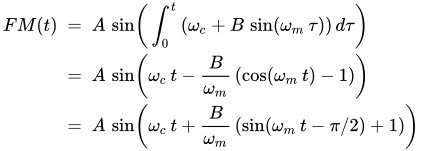
where AcA_c is the amplitude of the carrier signal, fcf_c is the carrier frequency in hertz, fmf_m is the modulating frequency in hertz, and II is the modulation index.[1] This formulation describes the instantaneous phase of the carrier as being deviated by the modulating sinusoid, producing a waveform whose spectrum consists of the carrier frequency plus symmetrically spaced sidebands.[1] The modulation index II quantifies the extent of frequency deviation and is defined as I=ΔffmI = \frac{\Delta f}{f_m}, where Δf\Delta f is the peak frequency deviation from the carrier.[1] This dimensionless parameter directly influences the amplitudes of the resulting sidebands; larger values of II increase the number and strength of sidebands, thereby enriching the harmonic content and perceived timbre of the synthesized sound.[1] FM synthesis is mathematically equivalent to phase modulation for sinusoidal modulators, as the instantaneous frequency is the time derivative of the phase.[1] Starting from the instantaneous frequency fi(t)=fc+Δfsin(2πfmt)f_i(t) = f_c + \Delta f \sin(2\pi f_m t), the phase ϕ(t)\phi(t) is obtained by integration:
ϕ(t)=2πfi(τ)dτ=2πfctΔffmcos(2πfmt)+ϕ0, \phi(t) = 2\pi \int f_i(\tau) \, d\tau = 2\pi f_c t - \frac{\Delta f}{f_m} \cos(2\pi f_m t) + \phi_0,
where ϕ0\phi_0 is a constant phase offset (often set to zero).[1] Substituting I=ΔffmI = \frac{\Delta f}{f_m} and adjusting for the sine form yields the standard FM phase term Isin(2πfmt)I \sin(2\pi f_m t), confirming the equivalence up to a phase shift.[1] For single-tone modulation, the resulting waveform can be expressed as an infinite sum using Bessel functions of the first kind:
c(t)=Acn=Jn(I)cos(2π(fc+nfm)t), c(t) = A_c \sum_{n=-\infty}^{\infty} J_n(I) \cos\left(2\pi (f_c + n f_m) t\right),
where Jn(I)J_n(I) is the nnth-order Bessel function evaluated at II, determining the amplitude of the component at frequency fc+nfmf_c + n f_m.[1] The term for n=0n=0 corresponds to the carrier, while positive and negative nn produce upper and lower sidebands, respectively; the properties of Bessel functions ensure that Jn(I)=(1)nJn(I)J_{-n}(I) = (-1)^n J_n(I) for integer nn, maintaining symmetry.[1]

Sideband Structure and Spectra

In frequency modulation (FM) synthesis with a single carrier and modulator, the resulting spectrum consists of a carrier frequency fcf_c accompanied by pairs of sidebands spaced at multiples of the modulating frequency fmf_m, where the amplitude of the nnth sideband pair is governed by the Bessel function of the first kind, Jn(I)J_n(I), with II as the modulation index. The time-domain signal can be expressed as
c(t)=Acn=Jn(I)cos(2π(fc+nfm)t), c(t) = A_c \sum_{n=-\infty}^{\infty} J_n(I) \cos\left(2\pi (f_c + n f_m) t\right),
where AcA_c is the carrier amplitude, the n=0n=0 term represents the unmodulated carrier, positive nn yields upper sidebands at fc+nfmf_c + n f_m, and negative nn yields lower sidebands at fc+nfmf_c + n f_m (with Jn(I)=(1)nJn(I)J_{-n}(I) = (-1)^n J_n(I) for integer nn).[1] The structure of these sidebands varies significantly with the modulation index II. For low values of II (e.g., I1I \approx 1), only the carrier and the first few sideband pairs (n=±1,±2n = \pm 1, \pm 2) have substantial amplitudes, producing a spectrum with limited components that often yield clear, harmonic tones when fmf_m is an integer submultiple of fcf_c (e.g., fm=fcf_m = f_c), resulting in frequencies that are integer multiples of fmf_m. In contrast, high II (e.g., I=5I = 5) activates numerous higher-order sidebands (nn up to approximately I+1I + 1), creating a broader, more complex spectrum; if fmf_m bears an irrational ratio to fcf_c (e.g., fm=fc/2f_m = f_c / \sqrt{2}), the sidebands become inharmonic, leading to bell-like or metallic timbres with non-integer frequency relationships.[1] Typical spectral plots illustrate this progression: at I=1I = 1, the spectrum features the carrier with modest first sidebands (J1(1)0.44J_1(1) \approx 0.44) and negligible higher orders, forming a narrow bandwidth of about 2fm2f_m. At I=5I = 5, multiple sideband pairs emerge prominently (e.g., J5(5)0.18J_5(5) \approx 0.18, with significant contributions up to n=6n = 6), spanning a bandwidth of roughly 2(I+1)fm12fm2(I + 1)f_m \approx 12f_m and displaying a characteristic envelope where amplitudes peak near nIn \approx I before tapering.[1] The distribution of sideband amplitudes directly controls timbre in FM synthesis, as the relative strengths determined by Jn(I)J_n(I) dictate the harmonic or inharmonic content and perceived brightness; for instance, emphasizing lower-order sidebands via moderate II produces flute-like tones, while enriching higher orders with large II evokes clangorous, percussive qualities, enabling precise sculpting of sound character through index variation.[1]

Multi-Operator Interactions

In frequency modulation (FM) synthesis, each operator functions as a sine wave generator that can serve either as a carrier—producing the primary audible output—or as a modulator, altering the instantaneous frequency of another operator.[2] Typical synthesizers employ 4 to 6 operators per voice, enabling intricate routing configurations that expand beyond simple carrier-modulator pairs.[2] This setup allows operators to interact in diverse topologies, generating complex timbres through interdependent modulations.[10] Algorithm types in multi-operator FM synthesis define how operators interconnect, with Yamaha's 4-operator architectures serving as a foundational example. These include configurations such as four independent carriers modulated in parallel by a shared source, yielding additive-like spectra with enhanced formants, or stacked modulators in series where each subsequent operator modulates the next, creating layered depth.[2] Feedback loops introduce self-modulation by routing an operator's output back to its own frequency input, often applied to a single operator in Yamaha-style designs to produce broader, sawtooth-resembling spectra without requiring additional hardware.[10] Such loops, when limited to modulation indices below 1.5, prevent chaotic noise while enriching harmonic content.[10] Cascaded modulation, where modulators chain sequentially to a final carrier, results in exponential amplification of sidebands, as each stage's modulation index compounds the spectral deviations from the prior level.[10] Frequency ratios between carriers and modulators further dictate timbre: integer ratios like 1:2 generate harmonic series suitable for tonal instruments, whereas non-integer ratios (e.g., 7:1) yield inharmonic partials ideal for bell-like or metallic sounds.[1] These interactions extend the basic sideband structure by introducing intermodulation products that fill the spectrum dynamically.[2] As the number of operators increases from 4 to 6 or more, spectral density rises dramatically, with each added interaction potentially doubling or tripling the number of significant sidebands and creating evolving timbres over time.[10] For instance, a 4-operator parallel setup might evolve from a bright, percussive attack to a sustained harmonic blend as modulation indices decay, while a 6-operator cascade can simulate evolving formants akin to vocal or brass timbres, transitioning from noisy transients to resonant sustains.[2] This scaling underscores FM's efficiency in timbre generation, where modest operator counts produce musically versatile spectra rivaling more resource-intensive methods.[2]

Implementation

Algorithmic Frameworks

Frequency modulation (FM) synthesis relies on algorithmic frameworks that define how multiple operators—each a sine wave generator with modulation capabilities—interact to produce complex timbres. In foundational implementations, such as those developed by Yamaha, these frameworks organize operators into directed graphs where modulation paths determine the signal flow from modulators to carriers. Modulators alter the frequency of subsequent operators, while carriers contribute directly to the audio output, enabling a hierarchy of interactions that generate harmonic or inharmonic spectra based on routing configurations.[11][12] A prominent example is Yamaha's 4-operator framework, which employs 8 distinct algorithms to configure modulation paths for efficient sound design in resource-constrained systems. These algorithms range from simple serial chains, where each operator modulates the next culminating in a single carrier (e.g., Algorithm 1: Op4 modulates Op3, which modulates Op2, which modulates Op1 as carrier), to parallel structures where multiple modulators independently affect shared carriers (e.g., Algorithm 8: all four operators as independent carriers for additive-like synthesis). Such graphs allow precise control over timbre evolution, with modulation depth—scaled from 0 to 99 or 127 units—adjusting the intensity of frequency deviation per path, and velocity sensitivity mapping keyboard dynamics to modulate operator levels or envelope rates for expressive performance.[13][11] Envelope generators (EGs) form a core component of these frameworks, applying time-varying amplitude control to each operator independently using a multi-stage model akin to ADSR (Attack, Decay, Sustain, Release). In practice, Yamaha systems use four rates and four levels per EG, enabling Attack to define onset sharpness, Decay and Sustain to shape sustain-phase timbre, and Release to control decay after note-off; key scaling further adapts EG parameters across the keyboard range, shortening attacks for higher registers to mimic natural instrument behavior like piano brightness. This per-operator enveloping facilitates dynamic timbre shifts, as modulating envelopes can introduce evolving spectra over time.[11][12] Feedback mechanisms enhance algorithmic flexibility by routing an operator's output back to modulate its own frequency, introducing non-linearities that yield chaotic or rich spectra beyond simple sidebands. In 4-operator setups, feedback is typically applied to a single operator (e.g., Op1 in certain algorithms), with adjustable amounts (0-7 levels) generating waveforms like sawtooth from sines when ratios are integer; combined with multi-operator interactions, this self-modulation amplifies harmonic content for bell-like or metallic tones. Frequency ratios, selected coarsely (integers 0.5-31) and finely (sub-integer tuning), dictate harmonic alignment—e.g., 1:1 for fundamentals, 2:1 for octaves—while avoiding feedback in carrier paths preserves tonal stability.[11][1] Programming paradigms in FM frameworks center on patch creation through parameter interplay: frequency ratios establish pitch relationships, modulation indices (via operator output levels) control sideband prominence, and envelope/level combinations sculpt amplitude trajectories. Seminal presets, such as those emulating acoustic piano via stacked ratios (e.g., 1:1 carrier with 4:1 modulators for inharmonic strikes) or DX7-inspired electric pianos with feedback-driven Rhodes twang, demonstrate how these elements coalesce; velocity-sensitive indices ensure softer attacks reduce modulation for realistic dynamics, prioritizing perceptual modeling over physical simulation. This approach, rooted in Chowning's original carrier-modulator structure, underscores FM's efficiency in generating instrument-like timbres through algorithmic routing rather than waveform storage.[1][14]

Hardware and Software Realizations

Hardware realizations of frequency modulation (FM) synthesis primarily rely on custom integrated circuits (ICs) optimized for digital signal processing in resource-constrained environments. Yamaha's YM3812, commonly known as the OPL2 chip, exemplifies early hardware implementations, supporting 9 simultaneous voices with 2 operators per voice for a total of 18 operators, enabling basic FM algorithms like 2-operator modulation.[15] Digital oscillators within these chips generate carrier and modulator signals using phase accumulators, where a frequency-determining phase increment is repeatedly added to an accumulator register to produce a sawtooth phase value, which is then mapped to a sine wave output via a lookup table or waveform generator.[16] To mitigate aliasing artifacts from high-frequency sidebands in FM spectra, hardware like the YM3812 and related chips incorporates techniques such as elevated sample rates (around 44.1 kHz) and post-processing low-pass filtering, though full oversampling was limited by 1980s-era silicon constraints.[17] The Yamaha DX7 synthesizer represents a more advanced hardware platform, utilizing custom ICs to deliver 16-voice polyphony with 6 operators per voice, totaling 96 operators across voices, which imposed efficiency trade-offs like shared envelope generators to manage computational limits within its era's hardware.[18] These designs prioritized sine table lookups for operator outputs to ensure waveform accuracy and harmonic fidelity, as opposed to coarser approximations that could reduce circuit complexity but introduce distortion.[19] Such trade-offs allowed the DX7 to achieve real-time performance without excessive power draw.[20] Software realizations of FM synthesis integrate digital signal processing (DSP) algorithms into digital audio workstations (DAWs) and plugin formats, offering greater flexibility and portability compared to fixed hardware. Native Instruments' FM8 serves as a representative example, functioning as a VST/AU/AAX plugin that emulates classic 6-operator FM architectures with enhanced features like dynamic morphing, processed via real-time computation in the host DAW.[21] Implementations typically employ lookup tables for sine wave generation to minimize latency, as accessing precomputed values is faster than on-the-fly trigonometric calculations, enabling polyphony far exceeding early hardware limits on modern CPUs.[22] Direct computation methods, such as iterative phase modulation formulas, are used sparingly for variable modulation depths to avoid table size overhead, balancing precision with processing efficiency in plugin environments.[19] Modern software optimizations focus on vectorized processing to achieve low-latency performance suitable for live applications. For instance, libraries like libfmsynth leverage SIMD instructions such as AVX-256 for parallel operator computations, yielding 10-15% speed improvements over scalar SSE implementations while maintaining sample-accurate FM rendering at rates up to 96 kHz.[23] These techniques extend to DAW plugins by processing multiple voices or operators in batches, reducing CPU overhead and enabling oversampling (e.g., 4x) for aliasing prevention without compromising real-time responsiveness, thus bridging hardware-era constraints with contemporary computing power. As of 2025, advancements continue with tools like Reaktor's X-Flow FM Synth, introducing playful interfaces for FM exploration in modular environments.[24][17]

Historical Development

Early Innovations (1960s–1970s)

In the mid-1960s, Don Buchla pioneered one of the earliest implementations of frequency modulation (FM) in analog synthesizers through his Buchla 100 series modular system, introduced around 1964-1965. This voltage-controlled system included modules such as the Model 144 Dual Square Wave Oscillator, Model 148 Harmonic Generator, and Model 158 Dual Sine-Sawtooth Oscillator, all of which supported wideband frequency modulation for generating complex timbres. These analog modules allowed performers to apply external control voltages to modulate oscillator frequencies, enabling experimental sound design in real-time, though limited by the era's hardware constraints. Buchla's design emphasized modular flexibility for avant-garde composition, marking a foundational step in voltage-controlled FM for electronic music production.[25] Concurrently, in 1967, John Chowning at Stanford University's Center for Computer Research in Music and Acoustics (CCRMA) discovered the potential of digital FM synthesis while experimenting with spatial audio cues on a PDP-10 computer using the MUSIC V program. Chowning realized that modulating a carrier waveform with another audio-rate signal could produce rich, harmonic spectra reminiscent of natural instruments, transitioning from analog techniques to computational precision. His early experiments, influenced by collaborations with Max Mathews of Bell Laboratories—who in 1971 suggested exploring FM for emulating recognizable timbres—laid the groundwork for algorithmic control of sound spectra. By 1971, Chowning drafted preliminary reports on audio-band FM, culminating in his seminal 1973 paper detailing the technique's ability to manipulate spectral bandwidth and evolution through modulation indices.[26][1][27] A key milestone came in 1975 when Chowning filed a patent for FM synthesis (U.S. Patent 4,018,121), securing Stanford's rights to the algorithm and highlighting its transition from academic research to potential broader application. This period also saw the first significant FM compositions, such as Chowning's "Stria" (1977), realized at CCRMA, which integrated FM timbres structured around the golden ratio for evolving, metallic textures. However, analog FM implementations like Buchla's faced notable limitations, including oscillator drift and pitch instability, which introduced unintended harmonic artifacts and made precise tuning challenging in live or extended performances. These issues underscored the advantages of Chowning's digital approach, which offered greater stability and reproducibility in the 1970s computing environment.[28][29][30]

Commercial Expansion (1980s)

In the early 1980s, Yamaha capitalized on its exclusive license of John Chowning's frequency modulation (FM) synthesis patent, acquired from Stanford University in 1974, to pioneer commercial digital synthesizers.[31] The company introduced the GS-1 in 1980, the first fully digital FM synthesizer available to the public, featuring an 8-operator architecture (four carriers and four modulators per voice) with 16-voice polyphony and preset sound cards for voice selection, though editing was limited to external programming.[32] This was followed by the groundbreaking DX7 in 1983, which refined the design with six operators per voice, 32 configurable algorithms for routing modulation paths, and 128 internal presets expandable via ROM cartridges, enabling a wide range of metallic, bell-like, and percussive timbres that defined the era's electronic sound.[33] The DX series expanded FM synthesis through algorithmic flexibility, allowing users to stack operators in series, parallel, or feedback configurations to create complex spectra, while preset banks provided accessible starting points for musicians without deep programming knowledge.[34] Amid Yamaha's patent dominance, competitors like Casio developed workarounds, launching the CZ series in 1984 with phase distortion (PD) synthesis—a digital method that approximated FM effects by altering oscillator phase accumulation rather than frequency, using eight-stage envelopes and dual oscillators per voice to produce similar harmonic distortions at lower computational cost.[35] The commercial success of FM synthesis was epitomized by the DX7, which sold over 160,000 units by the late 1980s, becoming the best-selling synthesizer of its time and profoundly influencing pop and electronic music genres.[36] Artists such as Stevie Wonder integrated it into hit recordings, notably employing DX7 patches for electric piano and bass sounds on his 1985 album In Square Circle, including the track "Part-Time Lover," which helped popularize FM's crisp, evolving tones in mainstream productions.[37] Beyond music instruments, Yamaha's YM2151 chip—an 8-channel, 4-operator FM sound generator—powered numerous 1980s arcade games, delivering polyphonic scores for titles from Sega and others, thus embedding FM synthesis in gaming culture. Yamaha's aggressive enforcement of its FM-related patents, including infringement notices to other manufacturers, restricted direct competition and solidified its market leadership throughout the decade.[17]

Post-Patent Evolution (1990s–Present)

The expiration of the Stanford University patent on FM synthesis in 1994 enabled broader adoption by removing licensing restrictions, paving the way for independent implementations in both hardware and software. This shift spurred the creation of open-source FM tools and libraries in the late 1990s, facilitating integration into digital audio software and game engines for more accessible sound design. The era saw a general pivot toward PCM-based synthesis in consumer products. In the 2000s, hybrid FM approaches proliferated, blending traditional modulation with sampling for expanded sonic possibilities. Yamaha's Advanced FM (AFM) system, first featured in the SY77 (1989) and refined in the SY99 (1991), combined FM operators with Advanced Wave Memory (AWM) sample playback, allowing dynamic layering of synthesized and recorded elements. The 2001 release of the DX200 desktop synthesizer revived classic 6-operator FM in a compact, programmable format, appealing to both vintage enthusiasts and modern producers. Concurrently, formant shaping emerged in vocal synthesis tools like Yamaha's Vocaloid (2004), which adjusted spectral envelopes to emulate human-like vocals. The 2010s and early 2020s witnessed sophisticated enhancements to FM architectures, emphasizing flexibility and audio quality. Yamaha's Montage series, launched in 2016, introduced FM-X, an advanced engine supporting 8 operators per voice with per-operator envelopes, 88 algorithms, and external signal processing for intricate, evolving timbres. Software platforms like Ableton Live's Operator provided intuitive FM via phase modulation, enabling real-time harmonic exploration with low latency. Techniques such as variable phase modulation, implemented in Korg's Opsix (2021)—dubbed an "Altered FM" synthesizer—altered modulation paths to suppress aliasing, producing clearer spectra across high registers without excessive computational overhead. As of 2025, FM synthesis trends emphasize automation, modularity, and accessibility through emerging technologies. AI-driven tools, such as generative models trained on DX7 patches, automate patch creation by optimizing operator ratios and envelopes to replicate or innovate sounds, as demonstrated in projects like the 2020 AI DX7 cartridge generator. Integration into Eurorack modular systems has surged, with 2020s modules like the Jomox Mod FM (offering 8-voice polyphony and MIDI control) and RYK Modular Vector Wave (combining FM with vector mixing) enabling tactile, experimental workflows. Open hardware initiatives, including FPGA recreations of Yamaha's OPN-series chips (e.g., jt12 core for YM2612), allow customizable, drop-in FM engines for retro and new builds, fostering community-driven evolution.

Applications and Variations

In Musical Synthesizers

Frequency modulation (FM) synthesis has been integral to hardware musical synthesizers since the 1980s, with the Yamaha DX7 serving as a pioneering example that popularized the technique through its 6-operator architecture and 32 fixed algorithms for generating complex timbres from simple sine waves.[3] This keyboard synthesizer provided 16-voice polyphony, enabling rich, layered performances in genres like pop and electronic music.[38] Descendants such as the Yamaha TX802, introduced in 1987, expanded on this foundation as a rackmount tone generator with 8-part multitimbral operation, allowing integration into multi-synthesizer setups for sequencing and key mapping while maintaining the core 6-operator FM engine.[39] More recent hardware realizations include the Yamaha Reface DX, released in 2015, which offers a compact, portable 4-operator FM design with 8-voice polyphony, battery operation, and built-in effects for on-the-go composition and performance.[40] In 2024, the Dtronics DT-DX emerged as a hardware multi-timbral FM synthesizer based on the open-source Dexed engine, providing portable DX7-style synthesis.[41] Also in 2025, Frap Tools released the Magnolia, an 8-voice analog through-zero FM synthesizer designed for expressive polyphonic performances.[42] In software, FM synthesis thrives through emulations that replicate classic hardware sounds with added flexibility. Dexed, a free multi-format plugin, accurately models the Yamaha DX7's sound generation and serves as a librarian for its MIDI cartridges, allowing users to load and edit original presets.[43] Native Instruments' FM8 expands on DX7 emulation with enhanced modulation options, preset libraries capturing iconic timbres like electric pianos and bells, and support for custom algorithms.[21] Ableton's Operator integrates FM synthesis into its digital audio workstation, combining 4 operators with subtractive elements and extensive preset banks that mimic vintage FM textures for seamless workflow in production.[44] In June 2025, GForce Software introduced Halogen FM, a plugin that simplifies FM programming with intuitive controls for dynamic sound design.[45] These plugins often include expansive preset libraries that preserve and evolve the metallic, harmonic-rich sounds of early FM instruments, facilitating easy access for composers without hardware. Performance with FM synthesizers emphasizes real-time parameter adjustments for dynamic expression, such as modulating operator ratios or envelopes via knobs and sliders to evolve timbres during play.[46] MIDI integration enables polyphonic control and synchronization across devices; for instance, the DX7's MIDI implementation supports note polyphony up to 16 voices and parameter automation, allowing integration with sequencers for live ensemble performances.[33] This setup is particularly suited to expressive playing, where performers can tweak modulation depth or feedback in real time to create evolving pads and leads. FM synthesis holds significant educational value in teaching sound design, as its operator-based structure demonstrates how programmable carrier-modulator ratios generate specific harmonics, offering hands-on insight into timbre creation without relying on sampled waveforms.[47] Tools like Dexed and Operator are commonly used in curricula to illustrate these concepts, enabling students to experiment with algorithm variations and envelope shaping to understand spectral control.[48]

In Computing and Gaming Platforms

Frequency modulation (FM) synthesis found widespread adoption in computing and gaming platforms during the 1980s and 1990s due to its computational efficiency and ability to generate complex timbres with limited hardware resources. In personal computers, the AdLib Music Synthesizer Card, released in August 1987, introduced FM synthesis to IBM PC compatibles through the Yamaha YM3812 (OPL2) chip, which supported 9 channels of 2-operator FM synthesis for 8-bit mono audio output.[49] This card became the de facto standard for early PC gaming sound, enabling immersive music and effects in titles like Monkey Island and The Secret of Monkey Island, as developers optimized for its capabilities to fit within the constraints of low-cost hardware.[50] Subsequent sound cards, such as the Creative Labs Sound Blaster series starting in 1989, maintained backward compatibility with AdLib's FM interface, allowing seamless integration into DOS games without requiring hardware-specific code changes. The Sound Blaster's OPL2 emulation ensured that thousands of DOS-era titles, including Doom and Duke Nukem, could leverage FM synthesis for dynamic soundtracks, contributing to the era's distinctive metallic and percussive audio aesthetics.[51] In arcade machines and home consoles, FM synthesis powered chiptune compositions; the Sega Genesis (1988) employed the Yamaha YM2612 chip, a 6-channel 4-operator FM synthesizer capable of richer timbres than its predecessors, which defined soundtracks for games like Sonic the Hedgehog and Streets of Rage.[52] Nintendo incorporated FM synthesis in the late 1980s through cartridges using the Konami VRC7 mapper with a YM2413-based FM core, providing 9 channels in select Famicom titles such as Lagrange Point (1991). In mobile and embedded devices, FM synthesis enabled compact audio generation for ringtones and alerts in early cellular phones during the 2000s, often via Yamaha's SMAF format and chips like the YM3526, which supported polyphonic playback in resource-constrained environments. Devices such as early Nokia models in the 2000s exemplified this efficiency, using FM-based tone generation for customizable monophonic ringtones that became cultural icons.[53] The legacy of FM synthesis persists in 8-bit and 16-bit gaming aesthetics, characterized by its bright, evolving harmonics that evoke nostalgia in retro titles, and continues through modern emulators like DOSBox-X, which as of May 2025 accurately replicates OPL2/OPL3 FM chips for authentic playback of classic PC and console games on contemporary hardware.[54]

Advanced Extensions

Hybrid methods in frequency modulation (FM) synthesis have expanded its capabilities by integrating it with other synthesis techniques, such as realtime convolution with samples. In Yamaha's SY77 and SY99 synthesizers, Realtime Convolution and Modulation (RCM) combines Advanced FM (AFM) with Advanced Wave Memory (AWM2) sample playback, allowing sampled waveforms to be convolved in real time with FM-generated spectra for richer, hybrid timbres.[55] This approach enables dynamic interaction between pre-recorded samples and FM modulation, producing sounds that blend the harmonic complexity of FM with the organic textures of sampled sources.[56] Similarly, formant shaping techniques adapt FM for vocal synthesis by emphasizing resonant frequencies that mimic human vocal tract formants. Researchers at Stanford's Center for Computer Research in Music and Acoustics (CCRMA) have demonstrated how FM spectra can approximate formant clusters using multi-operator configurations, where modulation indices are tuned to boost specific harmonic bands corresponding to vowel sounds.[57] This method facilitates the creation of synthetic voices with adjustable timbre, as seen in modern FM implementations like those in the Yamaha FS1R, which incorporate formant filters to shape FM outputs into vocal-like resonances.[46] Modern variants of FM synthesis build on foundational principles with enhanced control mechanisms, such as FM-X, which introduces dynamic envelopes for more expressive sound evolution. Developed by Yamaha for instruments like the Montage series, FM-X extends traditional FM with eight operators and multi-stage envelopes per operator, allowing modulation depths and ratios to evolve over time via decay and release phases, thus enabling evolving textures beyond static FM patches.[58] Phase distortion (PD) synthesis, originally from Casio's CZ series, has evolved in contemporary tools through refined implementations that enhance its pseudo-FM characteristics. For instance, Bitwig Studio's Phase-4 oscillator employs PD alongside phase modulation to generate metallic and percussive tones with greater precision, incorporating feedback loops for timbral variation not present in original hardware.[59] Altered FM variants further innovate by incorporating wavetables, as in Korg's Opsix synthesizer, where operators can load custom wavetables as carriers or modulators, blending FM's sideband generation with wavetable scanning for hybrid spectra that shift dynamically across waveform positions.[60] Experimental extensions push FM into interdisciplinary territories, including granular FM and AI-modulated indices. Granular FM hybrids, such as those in Imaginando's FRMS synthesizer, layer granular processing over FM engines, where short grains of FM-modulated audio are scattered and overlapped to create evolving, textured soundscapes with granular density controlling modulation depth.[61] AI integration modulates FM indices in real time for adaptive synthesis; the DDX7 framework, presented at ISMIR 2022, uses differentiable FM models trained via machine learning to infer and adjust operator parameters from target sounds, enabling AI-driven timbre morphing with modulation indices optimized for perceptual similarity.[62] Integration with physical modeling has emerged in 2020s research, combining FM for harmonic content with modal synthesis for transient simulation. A hybrid approach at CCRMA uses FM to generate initial spectra that feed into physical models of vibrating strings, while recent work on differentiable modal synthesis incorporates FM as a modulation layer in neural physical models to simulate nonlinear string behaviors with high fidelity.[63] Future directions in FM synthesis explore quantum-inspired techniques for generating ultra-complex spectra and leverage open-source advancements. Quantum-inspired FM, as prototyped in Q1Synth, utilizes quantum state vectors to drive FM parameters, producing spectra with interference patterns akin to quantum superposition, potentially enabling exponentially richer harmonic interactions beyond classical computation limits.[64] Open-source tools like Surge XT continue to democratize these extensions; its 2024 update (version 1.3.4) enhanced FM capabilities with expanded oscillator options and performance optimizations, with development toward version 1.4.0 ongoing as of October 2025, supporting complex multi-operator routing in a free, cross-platform environment.[65]

References

User Avatar
No comments yet.