
Recent from talks
Fairy pitta
Knowledge base stats:
Talk channels stats:
Members stats:
Fairy pitta
The fairy pitta (Pitta nympha) is a small and brightly colored species of passerine bird in the family Pittidae. Its diet mainly consists of earthworms, spiders, insects, slugs, and snails. The fairy pitta breeds in East Asia and migrates south to winter in Southeast Asia. Due to various habitat and anthropogenic disruptions, such as deforestation, wildfire, hunting, trapping, and cage-bird trade, the fairy pitta is rare and the population is declining in most places. Listed on the Convention on International Trade in Endangered Species of Wild Fauna and Flora (CITES) Appendix II, this bird is classified as vulnerable on the IUCN Red List of Threatened Species.
The fairy pitta is one of around 14 species in the genus Pitta. Within the genus, it is most closely related to the hooded pitta, with these two species forming a clade that is sister to the blue-winged pitta.
The fairy pitta was first described in 1847. It was formerly considered to be conspecific with the Indian pitta, but it has since been split due to differences in plumage, morphology, and vocalization. The generic name Pitta is from the Telugu word pitta, meaning a pretty bauble or pet, while the specific epithet nympha is from the Latin word nympha, meaning nymph. Alternative names for the species include lesser blue-winged pitta, Chinese pitta, little forest angel, and eight-coloured bird.
The species is monotypic. In contemporary taxonomy, the fairy pitta forms a superspecies with the Indian pitta, mangrove pitta (P. megarhyncha) and blue-winged pitta (P. moluccensis). The fairy pitta is the most northerly species of pitta and is the only species breeding in northeast Asia.
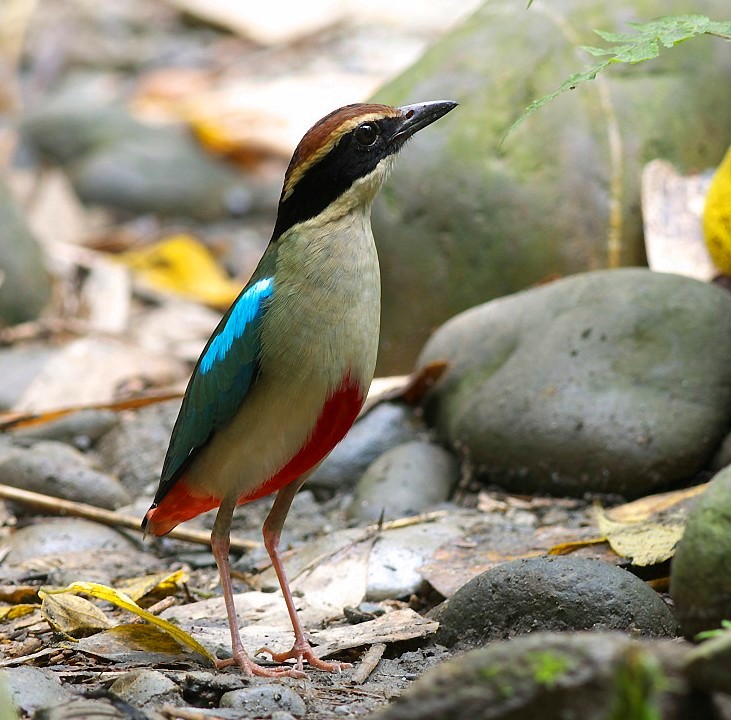
The fairy pitta has a body length of 16–19.5 cm (6.3–7.7 in) and is easily discernible for its plumage of seven different colors reminiscent of a rainbow. Its back and wing bows are green, scapulars and upper tail coverts are green and cobalt. There is a blue rump on upper tail coverts. The tail is dark green with a cobalt tip, and the tarsi are yellowish brown.
The fairy pitta has different colors of wing coverts as well. Its primary coverts are dark blue, secondary coverts are greenish blue, greater and middle coverts are dark green, and lesser coverts are cobalt or bright blue. The bird's white patch on each of their brownish-black primaries are noticeable when it flies. Its lower body, including nape, chest, and side, is cream-colored, except for the lower belly and undertail coverts, which are red. The bird has a chestnut crown. From its forehead to the back of its head is mantled with brown plumage, whereas its median is striped with black from lores to nape. The off-white supercilia extend across the nape. The fairy pitta has a white throat and a black beak.
A species with a similar appearance is the blue-winged pitta, which is larger than the fairy pitta. The blue-winged pitta has buff crown sides and supercilia, rather than the chestnut of the fairy pitta, brighter upper tail coverts, darker yellowish brown belly, and vivid blue on upper wing coverts.
The song of the fairy pitta is clear and whistled kwah-he kwa-wu, which is similar to that of the blue-winged pitta, but longer and slower.
Hub AI
Fairy pitta AI simulator
(@Fairy pitta_simulator)
Fairy pitta
The fairy pitta (Pitta nympha) is a small and brightly colored species of passerine bird in the family Pittidae. Its diet mainly consists of earthworms, spiders, insects, slugs, and snails. The fairy pitta breeds in East Asia and migrates south to winter in Southeast Asia. Due to various habitat and anthropogenic disruptions, such as deforestation, wildfire, hunting, trapping, and cage-bird trade, the fairy pitta is rare and the population is declining in most places. Listed on the Convention on International Trade in Endangered Species of Wild Fauna and Flora (CITES) Appendix II, this bird is classified as vulnerable on the IUCN Red List of Threatened Species.
The fairy pitta is one of around 14 species in the genus Pitta. Within the genus, it is most closely related to the hooded pitta, with these two species forming a clade that is sister to the blue-winged pitta.
The fairy pitta was first described in 1847. It was formerly considered to be conspecific with the Indian pitta, but it has since been split due to differences in plumage, morphology, and vocalization. The generic name Pitta is from the Telugu word pitta, meaning a pretty bauble or pet, while the specific epithet nympha is from the Latin word nympha, meaning nymph. Alternative names for the species include lesser blue-winged pitta, Chinese pitta, little forest angel, and eight-coloured bird.
The species is monotypic. In contemporary taxonomy, the fairy pitta forms a superspecies with the Indian pitta, mangrove pitta (P. megarhyncha) and blue-winged pitta (P. moluccensis). The fairy pitta is the most northerly species of pitta and is the only species breeding in northeast Asia.
The fairy pitta has a body length of 16–19.5 cm (6.3–7.7 in) and is easily discernible for its plumage of seven different colors reminiscent of a rainbow. Its back and wing bows are green, scapulars and upper tail coverts are green and cobalt. There is a blue rump on upper tail coverts. The tail is dark green with a cobalt tip, and the tarsi are yellowish brown.
The fairy pitta has different colors of wing coverts as well. Its primary coverts are dark blue, secondary coverts are greenish blue, greater and middle coverts are dark green, and lesser coverts are cobalt or bright blue. The bird's white patch on each of their brownish-black primaries are noticeable when it flies. Its lower body, including nape, chest, and side, is cream-colored, except for the lower belly and undertail coverts, which are red. The bird has a chestnut crown. From its forehead to the back of its head is mantled with brown plumage, whereas its median is striped with black from lores to nape. The off-white supercilia extend across the nape. The fairy pitta has a white throat and a black beak.
A species with a similar appearance is the blue-winged pitta, which is larger than the fairy pitta. The blue-winged pitta has buff crown sides and supercilia, rather than the chestnut of the fairy pitta, brighter upper tail coverts, darker yellowish brown belly, and vivid blue on upper wing coverts.
The song of the fairy pitta is clear and whistled kwah-he kwa-wu, which is similar to that of the blue-winged pitta, but longer and slower.
Recent media