
Recent from talks
Aquaculture of salmonids
Knowledge base stats:
Talk channels stats:
Members stats:
Aquaculture of salmonids
The aquaculture of salmonids is the farming and harvesting of salmonid fish under controlled conditions for both commercial and recreational purposes. Salmonids (particularly salmon and rainbow trout), along with carp and tilapia, are the three most important fish groups in aquaculture. The most commonly commercially farmed salmonid is the Atlantic salmon (Salmo salar).
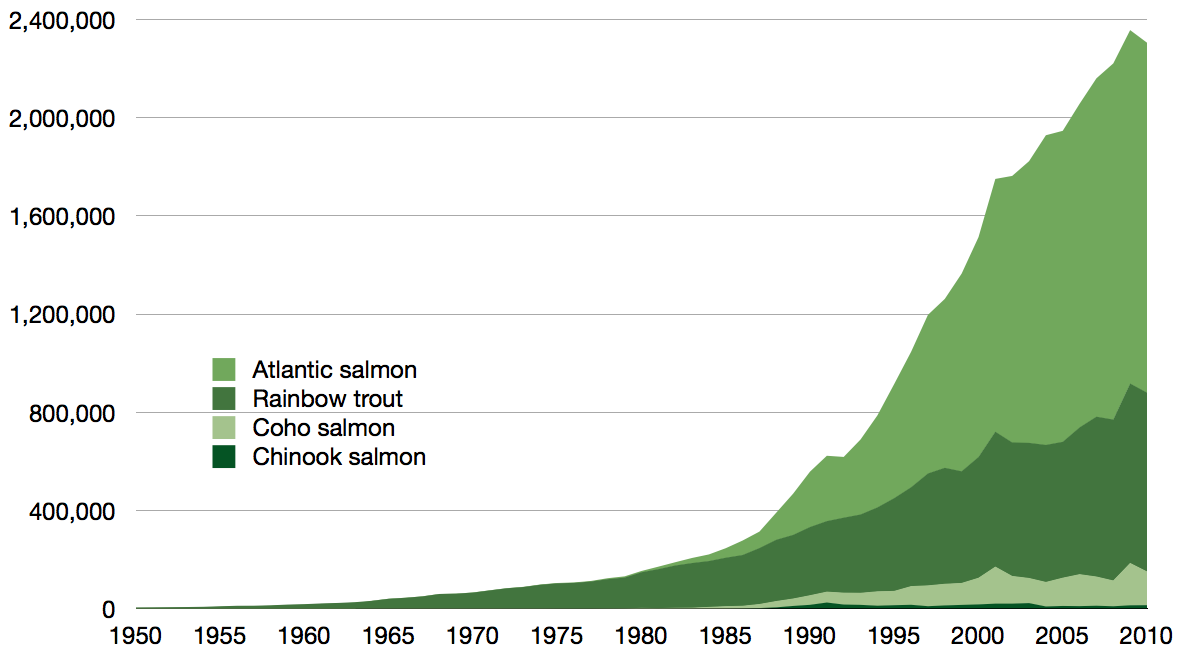
In the United States, Chinook salmon and rainbow trout are the most commonly farmed salmonids for recreational and subsistence fishing through the National Fish Hatchery System. In Europe, brown trout are the most commonly reared fish for recreational restocking. Commonly farmed non-salmonid fish groups include tilapia, catfish, black sea bass and bream. In 2007, the aquaculture of salmonids was worth USD $10.7 billion globally. Salmonid aquaculture production grew over ten-fold during the 25 years from 1982 to 2007. In 2012, the leading producers of salmonids were Norway, Chile, Scotland and Canada.
Much controversy exists about the ecological and health impacts of intensive salmonids aquaculture. Of particular concern are the impacts on wild salmon and other marine life.
The aquaculture or farming of salmonids can be contrasted with capturing wild salmonids using commercial fishing techniques. However, the concept of "wild" salmon as used by the Alaska Seafood Marketing Institute includes stock enhancement fish produced in hatcheries that have historically been considered ocean ranching. The percentage of the Alaska salmon harvest resulting from ocean ranching depends upon the species of salmon and location.[not specific enough to verify] Methods of salmonid aquaculture originated in late 18th-century fertilization trials in Europe. In the late 19th century, salmon hatcheries were used in Europe and North America. From the late 1950s, enhancement programs based on hatcheries were established in the United States, Canada, Japan, and the USSR. The contemporary technique using floating sea cages originated in Norway in the late 1960s.
Salmonids are usually farmed in two stages and in some places maybe more. First, the salmon are hatched from eggs and raised on land in freshwater tanks. Increasing the accumulated thermal units of water during incubation reduces time to hatching. When they are 12 to 18 months old, the smolt (juvenile salmon) are transferred to floating sea cages or net pens anchored in sheltered bays or fjords along a coast. This farming in a marine environment is known as mariculture. There they are fed pelleted feed for another 12 to 24 months, when they are harvested.
Norway produces 33% of the world's farmed salmonids, and Chile produces 31%. The coastlines of these countries have suitable water temperatures and many areas well protected from storms. Chile is close to large forage fisheries which supply fish meal for salmon aquaculture. Scotland and Canada are also significant producers;[failed verification] and it was reported in 2012 that the Norwegian government at that time controlled a significant fraction of the Canadian industry.
Modern salmonid farming systems are intensive. Their ownership is often under the control of huge agribusiness corporations, operating mechanized assembly lines on an industrial scale. In 2003, nearly half of the world’s farmed salmon was produced by just five companies.
Modern commercial hatcheries for supplying salmon smolts to aquaculture net pens have been shifting to recirculating aquaculture systems (RAS)s where the water is recycled within the hatchery. This allows location of the hatchery to be independent of a significant fresh water supply and allows economical temperature control to both speed up and slow down the growth rate to match the needs of the net pens.
Hub AI
Aquaculture of salmonids AI simulator
(@Aquaculture of salmonids_simulator)
Aquaculture of salmonids
The aquaculture of salmonids is the farming and harvesting of salmonid fish under controlled conditions for both commercial and recreational purposes. Salmonids (particularly salmon and rainbow trout), along with carp and tilapia, are the three most important fish groups in aquaculture. The most commonly commercially farmed salmonid is the Atlantic salmon (Salmo salar).
In the United States, Chinook salmon and rainbow trout are the most commonly farmed salmonids for recreational and subsistence fishing through the National Fish Hatchery System. In Europe, brown trout are the most commonly reared fish for recreational restocking. Commonly farmed non-salmonid fish groups include tilapia, catfish, black sea bass and bream. In 2007, the aquaculture of salmonids was worth USD $10.7 billion globally. Salmonid aquaculture production grew over ten-fold during the 25 years from 1982 to 2007. In 2012, the leading producers of salmonids were Norway, Chile, Scotland and Canada.
Much controversy exists about the ecological and health impacts of intensive salmonids aquaculture. Of particular concern are the impacts on wild salmon and other marine life.
The aquaculture or farming of salmonids can be contrasted with capturing wild salmonids using commercial fishing techniques. However, the concept of "wild" salmon as used by the Alaska Seafood Marketing Institute includes stock enhancement fish produced in hatcheries that have historically been considered ocean ranching. The percentage of the Alaska salmon harvest resulting from ocean ranching depends upon the species of salmon and location.[not specific enough to verify] Methods of salmonid aquaculture originated in late 18th-century fertilization trials in Europe. In the late 19th century, salmon hatcheries were used in Europe and North America. From the late 1950s, enhancement programs based on hatcheries were established in the United States, Canada, Japan, and the USSR. The contemporary technique using floating sea cages originated in Norway in the late 1960s.
Salmonids are usually farmed in two stages and in some places maybe more. First, the salmon are hatched from eggs and raised on land in freshwater tanks. Increasing the accumulated thermal units of water during incubation reduces time to hatching. When they are 12 to 18 months old, the smolt (juvenile salmon) are transferred to floating sea cages or net pens anchored in sheltered bays or fjords along a coast. This farming in a marine environment is known as mariculture. There they are fed pelleted feed for another 12 to 24 months, when they are harvested.
Norway produces 33% of the world's farmed salmonids, and Chile produces 31%. The coastlines of these countries have suitable water temperatures and many areas well protected from storms. Chile is close to large forage fisheries which supply fish meal for salmon aquaculture. Scotland and Canada are also significant producers;[failed verification] and it was reported in 2012 that the Norwegian government at that time controlled a significant fraction of the Canadian industry.
Modern salmonid farming systems are intensive. Their ownership is often under the control of huge agribusiness corporations, operating mechanized assembly lines on an industrial scale. In 2003, nearly half of the world’s farmed salmon was produced by just five companies.
Modern commercial hatcheries for supplying salmon smolts to aquaculture net pens have been shifting to recirculating aquaculture systems (RAS)s where the water is recycled within the hatchery. This allows location of the hatchery to be independent of a significant fresh water supply and allows economical temperature control to both speed up and slow down the growth rate to match the needs of the net pens.
Recent media