


Community hub
Recent from talks
Contribute something
Nothing was collected or created yet.
Featherbed frame
View on Wikipedia | This article has multiple issues. Please help improve it or discuss these issues on the talk page. (Learn how and when to remove these messages)
|


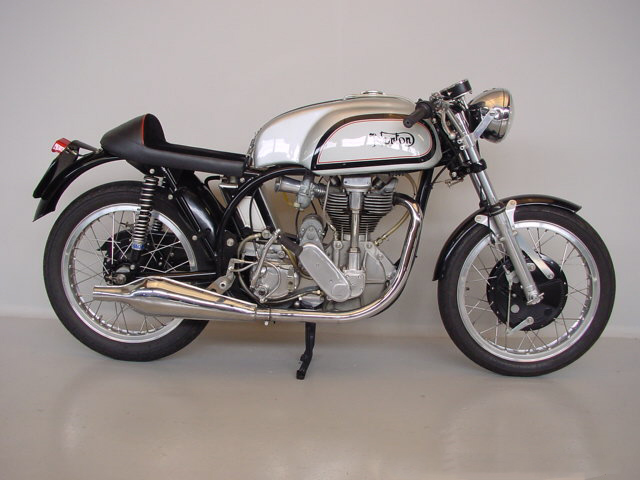
The featherbed frame was a motorcycle frame invented by the McCandless brothers and offered to the British Norton motorcycle company to improve the performance of their racing motorcycles in 1950. It was considered revolutionary at the time,[2][3][full citation needed] and the best handling frame that a racer could have.[4][2][5][full citation needed] Later adopted for Norton production motorcycles,[6] it was also widely used by builders of custom hybrids such as the Triton,[7] becoming legendary and remaining influential to this day.[8][9][3]
The Featherbed inspired other frame builders who based their own products on similar principles, including the 1960s heavyweight Münch Mammut,[10] a lightweight version for a 250 cc BSA C15 engine,[11] and the 1970-conceived Dresda frame.[12][13]
The Featherbed was replaced by the Norton Isolastic frame in 1967 for the then newly developed Norton Commando which used a rubber-mounted engine and gearbox,[14][full citation needed] although Norton continued to offer the Mercury with a Featherbed frame until production ceased by 1970. Replicas of the frame continue to be produced by specialist companies.[15][16][17][full citation needed]

Origins
[edit]In 1949 brothers Rex and Cromie McCandless offered Norton a new frame to support their successful 500cc race single. Rex McCandless was a self-taught Belfast motorcycle engineer and raced competitively with his brother on a Triumph Tiger 100. He had made several improvements to the Triumph, notably an innovative new frame with a swinging arm fitted with vertical hydraulic shock absorbers from a Citroen car.[18] BSA bought several of his converted motorcycles but Norton saw the real opportunity and contracted him to work exclusively for them from 1949. The Norton Motorcycle Company were concerned at the reliability of their plunger (or "Garden Gate") frame, as several had broken through the stress of racing. Norton engineer Joe Craig solved the problems by making the frames heavier but handling suffered as a consequence.[18][dead link]
Norton commissioned the McCandless brothers to design a complete frame, incorporating a swinging arm. McCandless' finished design was expensive, as it required over forty feet of the best Reynolds steel tubing. It was a welded twin loop with a swinging arm fitted with their own design of shock absorbers, with a heavily braced cross-over headstock. In two months a prototype motorcycle with the new frame was on the test track and it was tested on the Isle of Man in the winter of 1949. It performed well and Norton decided that the Norton works team would have motorcycles with the new frames. The Norton works was not well equipped so the sif-bronze welding was undertaken by the McCandless brothers who produced the eight frames for the racing team by hand.[17] Production featherbed frames were made under Ken Sprayson's direction at Reynolds, who became known as 'The Frame man'[19][7][9]
The patent
[edit]Norton applied for a patent for the design on 13 October 1949 and it was granted as reference 664,667 but the completed specification was not published until 9 January 1952. The Featherbed frame was simply constructed:[20]
This invention relates to a new or improved frame for a motorcycle which comprises two substantially parallel rectangular loops each formed from a single length of tubing, and the ends of the tube forming each loop cross and are welded to each other at the top front corner of the loop, the free ends of the tube which extend beyond the crossing point being welded to the side of an inclined head tube adjacent to the top and bottom thereof. The assembled frame is extremely strong for its weight and designed to provide the maximum resistance to any stresses applied to the frame by road shocks or by the driving torque of the power unit.
The Featherbed name
[edit]Harold Daniell was a successful Isle of Man TT racer with three victories and several placings in the Tourist Trophy races and the Manx Grand Prix.[21] After testing the new Norton frame in 1950 he declared that it was like "riding on a featherbed" compared with riding the "garden gate[22]"—and it has been called the featherbed frame ever since.[23]
Racing success
[edit]Further testing took place at Montlhery race track with four motorcycles running flat-out for two days. The new frame stood up well to tests and saw its UK launch at Blandford Camp in Dorset in April 1950.

Geoff Duke had won the Senior Clubmans TT and the Senior Manx Grand Prix in 1949 on the earlier type Nortons, so was a clear choice for Norton to really put the new Featherbed-framed race bikes to the test. Duke won the race on the new design and several racing successes followed with Norton winning first three places in the 1950 Senior and Junior TT's.[18][dead link] In the Friday Senior TT Duke set a new lap record of 93.33 mph and also broke the overall race record, finishing in two hours, 51 minutes and 45 seconds; he had previously finished second to Artie Bell (Norton) in Monday's Junior TT. (Harold Daniell's Norton was third.) When it came to the bends on the twisting Island course the new frame gave the Nortons a distinct advantage.[17][dead link]
Featherbed frames were also successfully modified for use in off-road racing or motorcycle scrambling.[24][full citation needed] In the 1950s, Ron Hankin designed a featherbed-inspired Moto Cross frame for Les Archer junior, having curved downtubes to allow for greater front suspension movement without fouling the wheel on the frame, and with heavy bracing around the steering head tube. The frame was used with Manx Norton engines prepared by tuner Ray Petty, and also with a 500 cc Norton Dominator engine.[25]
Featherbed variants
[edit] | This section may contain information not important or relevant to the article's subject. (September 2019) |
Manx racer in Reynolds 531
[edit]Weight and strength were key factors in the design of the featherbed frame for the Norton racing team's Manx. 16-gauge Reynolds 531, a high-tensile manganese-molybdenum steel alloy, was used as it allowed the frame tubes to be made thinner for the same strength, as well as making for a more responsive frame. All the joints were Sifbronze welded,[26][27] – a relatively low-temperature flame-braze – except for the sub frame which was initially bolted-on but welded in later versions.[28]
Norton International
[edit]In 1953 the Norton International was relaunched with a new version of the Featherbed frame made from grade A mild steel.[29]
Domiracer 'Lowboy'
[edit]In 1956, Norton development engineer Doug Hele was tasked with creating a 500 cc overhead valve road-based racing machine to challenge the larger-displacement side valve 750 Harley Davidsons run in the same class at AMA-organised Daytona 200 races. Initially unsuccessful, the project was turned into creating a road-based race engine as a replacement for the ageing Manx Norton racer engine. Hele designed a lighter-weight, lower frame with slightly shorter wheelbase, based on Featherbed principles having slightly altered frame runs and shortened telescopic front forks which became known as Lowboy. The project was named Domiracer, and one was successfully raced to third-place by Tom Phillis in the 1961 Senior TT race.[30][31] In 1962 the factory developed a Lowboy with a 350 cc Manx Norton single-cylinder engine and a 650 cc version using the Dominator 650SS engine but with a full-height Manx frame, both as tried by Derek Minter.[32]
In 1962 the race shop closed and was sold to Paul Dunstall, who had already developed his own Norton Dominator-engined race machine campaigned by Fred Neville (deceased 1961) and Dave Downer (deceased 1963). Dunstall successfully developed 500, 650 and 750 versions, later producing a Lowboy frame kits sold to the general public. After the Dunstall organisation closed in the early 1980s, other specialists offered the Lowboy frame.[32][31][33][34]
Single and Twin cylinder roadsters in Featherbeds
[edit] | This section may be too long and excessively detailed. (September 2019) |
| This section may contain material unrelated to the topic of the article. (September 2019) |
Having earlier installed the Dominator twin-cylinder engine of 500 cc and 600 cc, in 1959 Norton put the old single cylinder Model 50 (350 cc) and the ES2 (500 cc) into the Featherbed frame to rationalise production. Using grade A mild steel, the size of this engine determined the space between the top and bottom rails of the full duplex cradle. In 1960 the top rails were installed at the rear of the tank.[35] Riders complained that these wideline Featherbed frames were uncomfortably wide at 11.5 inches (29 cm) but it was not until 1960 that the top runs of the frame were narrowed towards the front of the seat, with corresponding overall styling changes including tank and seat to create the slimline frame.
The slimline was used until the last of the vertical twin cylinder models in the late 1960s, the Norton Mercury, a limited-production run of single carburettor 650 cc machines based on the Dominator;[36][37] the Norton Commando with its new frame design and angled-forward engine having been launched at the Earls Court show in 1967 took over as the 750 cc range-topper, later enlarged to 830 cc, but badged as '850'.
Dresda
[edit] | This section may contain material unrelated to the topic of the article. (September 2019) |
Dave Degens created his first hybrid motorcycle of a Triumph engine/Norton rolling chassis in 1961 when working for former racer and motorcycle race shop owner Geoff Monty, using a racing Manx Norton with a blown engine. The bike was sold before it was finished, and realising there was a potential business, in 1963 Degens bought into Dresda Autos, a small scooter shop in South London together with business partner Richard 'Dickie' Boon, keeping the existing name.[38]
Degens created what he termed as Dresda Triton from 1963, with the Motorcycle Mechanics' road test of June 1964 stating "The firm has sold well over fifty to date ...", naming two mechanics/bike builders in addition to Degens, who was a regular short-circuit road racer, having ridden for Monty and Paul Dunstall on his ex-works 500 cc Norton Domiracer with lowboy frame designed by Doug Hele in the 1963 and 1964 Manx Grands Prix.[38][39][40]
In 1970, racer and bike shop owner Dave Degens produced his first bespoke Dresda frame, after his business name Dresda Autos. Based on the geometry of the smaller-capacity (250 cc/350 cc) Aermacchis he had previously raced, the new frame had tube runs and layout based on the Featherbed, but with upscaled proportions to allow for the use of taller, heavier, more-powerful 650 cc parallel twin cylinder engines, similar to his 1965 Barcelona 24-hour endurance race-winning Dresda Triton. The new bike used Degens' later development of a unit construction race-prepared Triumph engine, unlike the earlier models having a separate engine and gearbox.
The new configuration won the 1970 Barcelona 24-hour race, reprising Degens' 1965 win. After this success, French motorcycle dealer Japauto commissioned Degens to build a bespoke race-frame for the still-new Honda CB750 four-cylinder engine that had been specially enlarged for racing to 900 cc.

This machine won the 1972 Bol d'Or 24-hour endurance race.[41]
Degens subsequently offered frame kits for self-builders using Triumph and Honda engines, and also produced complete machines for road-use, named Dresda Triumph and Dresda Honda.[12][13][42]
Special hybrids
[edit]In addition to the better-known Triumph-Norton and Vincent-Norton,[43][44] a small number of other hybrid motorcycles,[note 1][45] sometimes known as 'specials', have been created using the featherbed frame, mostly with associated Norton-sourced, matching running gear:
- Noriel – Norton featherbed frame with Ariel Square Four engine.[46][47]
- NorBSA – Norton featherbed frame with BSA 500 or 650 twin cylinder engine, or Gold Star 350 or 500 single cylinder engine.[48]
- Norley – Norton featherbed frame with Harley Davidson V-twin engine.[49]
Notes
[edit]- ^ A hybrid motorcycle consists of one manufacturer's major part(s) conjoined with other manufacturers' major components, in this case a Norton Featherbed frame basis, powered by a Triumph engine (Triton) or Vincent engine (Norvin) or other more-obscure engines, including two-strokes sourced from boats or Saab cars
References
[edit]- ^ New Manx Nortons from Port Talbot. Classic Racer, Summer 1989, pp.61-63 Accessed 10 January 2018
- ^ a b "As opposition companies strove to develop completely new machines with multi-cylinder engines, far more powerful than the Norton single, Bracebridge Street was content to find new speed in 1950 with a revolutionary new frame which steered and handled so superbly that it immediately earned the now forever-famous tag Featherbed". Sixty Years of Speed, 1967 a Motorcycle News publication, pp.41-42 Accessed 26 January 2018
- ^ a b Motorcycle handling and chassis design: the art and science by Tony Foale. 2006
- ^ "Introduced in 1950, the featherbed Norton frame, designed by Rex McCandless, of Belfast, became, and still is, the standard by which handling and steering of all racing machines is judged". Sixty Years of Speed, 1967 a Motorcycle News publication, p.41 Accessed 26 January 2018
- ^ The Café Racer Phenomenon by A Walker. 2009
- ^ Motorcycle Mechanics, August 1966, pp.36-37 Featherbed stripdown. "Developed from the one-time, world-beating Manx Norton, the Dominator 'featherbed' frame is still regarded as the ultimate in steering, handling and roadholding." Accessed 8 February 2018
- ^ a b Do not mourn the Featherbed! Motorcycle Sport, August 1978, p.218 "No one would argue that there was a better roadholding bike in the 50s than the Norton. That it was capable of taking more power than the Dommie engine could give was proved not only on the race track by the Manx version and the Domiracer but also on the road by those who put Triumph engines in them." Accessed 10 January 2018
- ^ Motor Cycle, 23 April 1964, pp.494-497 Norton Featherbed Twins by John Ebrell. "The famous featherbed frame, beloved of specials builders. Its absolute rigidity makes a big contribution to the legendary Norton roadholding". Accessed and added 4 February 2018
- ^ a b Do not mourn the Featherbed! Motorcycle Sport, August 1978, p.218 "The Featherbed Nortons were some of the all time greats, but to ascribe to the shape of the frame some magic properties is to detract from the design of the whole bicycle, its weight distribution and geometry and to give to the frame's progenitors some of the credit due to the likes of Ken Sprayson, who knows a thing or three about its development." Accessed 10 January 2018
- ^ Motor Cycle, 3 February 1966, pp.142-143 On the Four Winds by 'Nitor'. "Engine is from the NSU Prinz car and may be specified in 43 or 52 bhp trim. In my picture you can see how well it fits into a featherbed-style frame". Accessed and added 2014-09-28. Re-accessed and quotation added 8 September 2018
- ^ Motor Cycle, 24 November 1963, pp.696-699 All the rage by John Ebrell. " ...Ilford's CeeR-Speedshop. For £29 they'll supply the C15 rider with a featherbed-type duplex frame". Accessed and added 2014-09-28
- ^ a b Motorcycle Mechanics, October 1970, pp.48-50. The Resurrection Man. Accessed and added 9 November 2017
- ^ a b Bike, December 1984, pp.48-51. Accessed and added 9 November 2017
- ^ Norton By Mick Woollett. 2004.
- ^ Classic Bike, October 1989, p.80 Barber Engineering advert (Norfolk, England). Replica frame builder. G50/7R, Featherbed and Seeley Mk3. Other frames to pattern." Accessed 10 January 2018
- ^ Andover Norton Frames and Auxiliaries made to factory drawings Archived 16 February 2015 at the Wayback Machine Retrieved 2014-09-28
- ^ a b c Myatt, Steven. "Featherbed frame". Archived from the original on 3 November 2006. Retrieved 3 January 2009.
- ^ a b c d'Orleans, Paul. "Rex McCandless and the Featherbed Frame". Archived from the original on 31 October 2009. Retrieved 3 January 2009.
- ^ "Ken Sprayson The Frame Man - National Motorcycle Museum". www.nationalmotorcyclemuseum.co.uk. Archived from the original on 27 May 2019. Retrieved 17 November 2017.
- ^ "Patent Specification" (PDF). Archived from the original (PDF) on 29 September 2009. Retrieved 9 January 2009.
- ^ IOMTT.com Harold Daniell results database[permanent dead link] (retrieved 5 November 2006)
- ^ Garden gate is a reference to the plunger frame Nortons of this era
- ^ "Harold Daniell". Archived from the original on 6 January 2009. Retrieved 3 January 2009.
- ^ Off-Road Giants!: Heroes of 1960s Motorcycle Sport by Andy Westlake
- ^ That was the year... ...Les Archer became European MX champion Archived 9 February 2018 at the Wayback Machine Classic Dirt Bike, 7 April 2017. Retrieved 8 February 2018
- ^ "Suffolk Iron Foundry (1920)". Graces Industrial Guide. Archived from the original on 2 August 2013. Retrieved 24 August 2013.
- ^ "SUFFOLK IRON FOUNDRY (1920) LTD. Sif bronze Works, Stowmarket, Suffolk". The Commercial Motor Archive. 5 March 1965. Archived from the original on 2 December 2013. Retrieved 24 August 2013.
- ^ Currie, Bob (1993). Classic British Motorcycles. Chancellor Press. ISBN 978-1-85152-250-7.
- ^ "Norton International History". 28 October 2008. Archived from the original on 10 January 2010. Retrieved 24 December 2008.
- ^ "Undoubtedly a successful experiment but it did not go into production. In 1961 Norton prepared a special 500 ohv twin based on the Dominator roadster and Australian Tom Phillis raced it into 3rd place at 98.78 mph with a fastest lap of 100.36 mph. The frame was a lower-built version of the famous featherbed". Machines of the TT, Sixty Years of Speed, 1967 a Motorcycle News publication, p.42 Accessed 1 February 2018
- ^ a b Story of the Domiracer, Classic Racer, Autumn 1988, pp.52-57 Accessed 4 February 2018
- ^ a b The Minter Line Motor Cycle, 4 October 1962 pp.406-409. Accessed 28 January 2018
- ^ Dunstall Lowboy frame kit, part number 1060, undated catalogue "The Dunstall Lowboy racing frame assembly allows you to build your own compact light and competitive racing 750. The kit is designed to accept the 750 Norton engine, but the 650 or 500 will fit just as easily." Accessed 28 January 2018
- ^ Classic Racer, Summer 1989, p.11 Mick Hemmings advert, Accessed 28 January 2018. "Domiracer Lowboy Frame Kit. As used by Tom Phillis and designed by Doug Hele. Will take Manx or Twin engines c/w wide tubular singing arm, taper rollers."
- ^ "The Origin of the Famous Norton Featherbed Frame". Archived from the original on 20 October 2008. Retrieved 3 January 2009.
- ^ Motorcycle Mechanics, May 1969, p.63 SHOWTIME. Show scene '69. "Last of the traditional Nortons is the 647 cc Mercury. This machine has the Commando type cylinder head and single carburettor, producing 47 bhp. A rev counter and stainless steel mudguards are available as extras". Accessed 3 January 2016
- ^ Real Classic Norton Mercury Archived 8 September 2015 at the Wayback Machine Retrieved 2014-09-28
- ^ a b Motorcycle Mechanics, June 1964, pp.28-29, and 58 "MM's fastest road test! The fabulous 126 mph Dresda Triton". Accessed 16 January 2018
- ^ Motorcycle Sport, Manx Grand Prix 1964 October 1964, pp.371-373, 378-379 and 380-384 Accessed 16 January 2018
- ^ Dave Degens' results Archived 17 January 2018 at the Wayback Machine, Manx Grand Prix, IoM TT Database. Retrieved 16 January 2018
- ^ Motorcycle Mechanics, November 1973, p.26 Dresda advert, "Dresda frame kit for 500 and 750 Honda, as used on the winning machine at the 1972 Bol d'Or". Accessed 16 January 2018
- ^ Motorcycle Mechanics, July 1973, p.25 Dresda Autos advert (London, England). All motorcycle builders. Dresda are now established in a new factory and can offer the specialised service that YOU want. If you are building a new bike we can offer Dresda race-proven frames to suit most engines and give 25 per cent weight reduction on overall machines." Accessed January 2018
- ^ Motorcycle Mechanics, July 1964, p.13 Next Month: What's coming in the August issue. Build a Triton. "We get hundreds of requests for information on how to build a Triumph/Norton hybrid. So next month we'll tell you how—...". Accessed 8 February 2018
- ^ Motorcycle Mechanics, December 1964, pp.34-35, Vin–Nor sprinter. "John Willers of Mitcham started building his Vincent/Norton special several years ago. He aimed to make it a dual–purpose machine that would see off anything else on the road and also acquit itself creditably on the sprint strips". Accessed 7 February 2018
- ^ Motor Cycle, Special Equipment supplement 1 June 1967, p.735 Triton. "THIS hybrid with Norton frame and Triumph engine is no mere Metropolitan toy". Accessed 9 March 2018
- ^ Motor Cycle, 5 November 1964, pp.792-793 Featherbed Four – Dick Wright's four-pipe model, by David Dixon. "No disrespect to Ariels, but there have always been enthusiastic Square Four owners who yearned for race-bred steering and roadholding. If only the 997 cc four-cylinder unit could be shoehorned into a Norton Featherbed frame...". Accessed and added 7 February 2018
- ^ Motor Cycle, 17 February 1966, Classified advertising, p.12 (supplement iv) Specials – "1965 Noriel 1,000cc 4...£245". E.S. Longstaff Ltd., 68 New Rd., Edmonton, London, N.9. Accessed and added 18 February 2018
- ^ Motorcycle Mechanics, July 1964, p.17 "Can We Help You? Q. Is it possible to fit a BSA 650cc Super Rocket engine into my 1958 Norton Dominator 88 frame?...A. ...We would suggest you do not go ahead with a conversion such as this unless you have engineering experience and first-class workshop facilities. ...". Accessed 8 February 2018
- ^ Mecum to Auction Norley Cafe Racer Motorcycle at Original Spring Classic Event[permanent dead link] Motorcyclist online, 4 May 2011. Retrieved 7 February 2018
Further reading
[edit]- 40 Years of the Featherbed Norton, Peter Kneale, 1990 Isle of Man TT Official Souvenir Programme, pp. 15–17
