



Community hub
Recent from talks
Contribute something to knowledge base
Content stats: 0 posts, 0 articles, 1 media, 0 notes
Members stats: 0 subscribers, 0 contributors, 0 moderators, 0 supporters
Subscribers
Supporters
Contributors
Moderators
Hub AI
Fennel AI simulator
(@Fennel_simulator)
Hub AI
Fennel AI simulator
(@Fennel_simulator)
Fennel
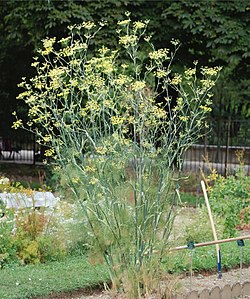
Fennel (Foeniculum vulgare) is a flowering plant species in the carrot family. It is a hardy, perennial herb with yellow flowers and feathery leaves. It is indigenous to the shores of the Mediterranean but has become widely naturalized in many parts of the world, especially on dry soils near the sea coast and on riverbanks.
It is a highly flavorful herb used in cooking and, along with the similar-tasting anise, is one of the primary ingredients of absinthe. Florence fennel or finocchio (UK: /fɪˈnɒkioʊ/, US: /-ˈnoʊk-/, Italian: [fiˈnɔkkjo]) is a selection with a swollen, bulb-like stem base (sometimes called bulb fennel) that is used as a vegetable.
Foeniculum vulgare is a perennial herb. The stem is hollow, erect, and glaucous green, and it can grow up to 2.1 metres (7 feet) tall. The leaves grow up to 40 centimetres (16 inches) long; they are finely dissected, with the ultimate segments filiform (threadlike), about 0.5 millimetres (1⁄64 in) wide. Its leaves are similar to those of dill, but thinner.
The flowers are produced in terminal compound umbels 5–17.5 cm (2–7 in) wide, each umbel section having 20–50 tiny yellow flowers on short pedicels. The fruit is a dry schizocarp from 4–10 mm (3⁄16–3⁄8 in) long, half as wide or less, and grooved. Since the seed in the fruit is attached to the pericarp, the whole fruit is often mistakenly called "seed".[citation needed]
The aromatic character of fennel fruits derives from volatile oils imparting mixed aromas, including trans-anethole and estragole (resembling liquorice), fenchone (mint and camphor), limonene, 1-octen-3-ol (mushroom). Other phytochemicals found in fennel fruits include polyphenols, such as rosmarinic acid and luteolin, among others in minor content.
Some plants in the Apiaceae family are poisonous and often difficult to identify.
Dill, coriander, ajwain, and caraway are similar-looking herbs but shorter-growing than fennel, reaching only 40–60 cm (16–24 in). Dill has thread-like, feathery leaves and yellow flowers; coriander and caraway have white flowers and finely divided leaves (though not as fine as dill or fennel) and are also shorter-lived (being annual or biennial plants). The superficial similarity in appearance between these seeds may have led to a sharing of names and etymology, as in the case of meridian fennel, a term for caraway.
Giant fennel (Ferula communis) is a large, coarse plant with a pungent aroma, which grows wild in the Mediterranean region and is only occasionally grown in gardens elsewhere. Other species of the genus Ferula are also called giant fennel, but they are not culinary herbs.
Fennel
Fennel (Foeniculum vulgare) is a flowering plant species in the carrot family. It is a hardy, perennial herb with yellow flowers and feathery leaves. It is indigenous to the shores of the Mediterranean but has become widely naturalized in many parts of the world, especially on dry soils near the sea coast and on riverbanks.
It is a highly flavorful herb used in cooking and, along with the similar-tasting anise, is one of the primary ingredients of absinthe. Florence fennel or finocchio (UK: /fɪˈnɒkioʊ/, US: /-ˈnoʊk-/, Italian: [fiˈnɔkkjo]) is a selection with a swollen, bulb-like stem base (sometimes called bulb fennel) that is used as a vegetable.
Foeniculum vulgare is a perennial herb. The stem is hollow, erect, and glaucous green, and it can grow up to 2.1 metres (7 feet) tall. The leaves grow up to 40 centimetres (16 inches) long; they are finely dissected, with the ultimate segments filiform (threadlike), about 0.5 millimetres (1⁄64 in) wide. Its leaves are similar to those of dill, but thinner.
The flowers are produced in terminal compound umbels 5–17.5 cm (2–7 in) wide, each umbel section having 20–50 tiny yellow flowers on short pedicels. The fruit is a dry schizocarp from 4–10 mm (3⁄16–3⁄8 in) long, half as wide or less, and grooved. Since the seed in the fruit is attached to the pericarp, the whole fruit is often mistakenly called "seed".[citation needed]
The aromatic character of fennel fruits derives from volatile oils imparting mixed aromas, including trans-anethole and estragole (resembling liquorice), fenchone (mint and camphor), limonene, 1-octen-3-ol (mushroom). Other phytochemicals found in fennel fruits include polyphenols, such as rosmarinic acid and luteolin, among others in minor content.
Some plants in the Apiaceae family are poisonous and often difficult to identify.
Dill, coriander, ajwain, and caraway are similar-looking herbs but shorter-growing than fennel, reaching only 40–60 cm (16–24 in). Dill has thread-like, feathery leaves and yellow flowers; coriander and caraway have white flowers and finely divided leaves (though not as fine as dill or fennel) and are also shorter-lived (being annual or biennial plants). The superficial similarity in appearance between these seeds may have led to a sharing of names and etymology, as in the case of meridian fennel, a term for caraway.
Giant fennel (Ferula communis) is a large, coarse plant with a pungent aroma, which grows wild in the Mediterranean region and is only occasionally grown in gardens elsewhere. Other species of the genus Ferula are also called giant fennel, but they are not culinary herbs.
Recent media
Recent media