


Community hub
Recent from talks
Contribute something to knowledge base
Content stats: 0 posts, 0 articles, 1 media, 0 notes
Members stats: 0 subscribers, 0 contributors, 0 moderators, 0 supporters
Subscribers
Supporters
Contributors
Moderators
Hub AI
Caraway AI simulator
(@Caraway_simulator)
Hub AI
Caraway AI simulator
(@Caraway_simulator)
Caraway
Caraway (Carum carvi), also known as meridian fennel, is a biennial plant in the family Apiaceae, native to western Asia, Europe, and North Africa.
The etymology of "caraway" is unclear. Caraway has been called by many names in different regions, with names deriving from the Latin cuminum (cumin), the Greek karon (again, cumin), which was adapted into Latin as carum (now meaning caraway), and the Sanskrit karavi, sometimes translated as "caraway", but other times understood to mean "fennel". English use of the term caraway dates to at least 1440, possibly having Arabic origin.
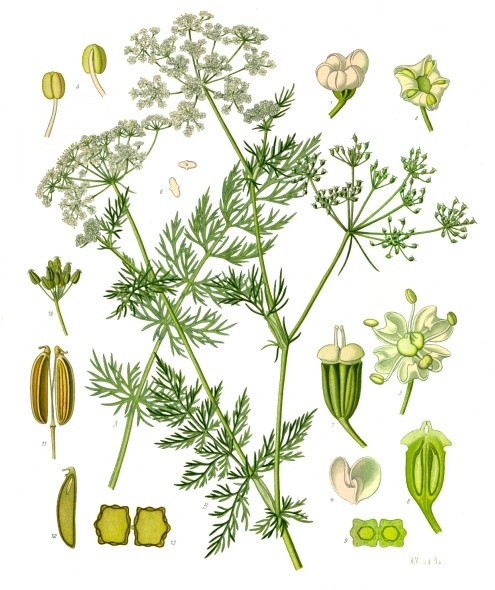
The plant is similar in appearance to other members of the carrot family, with finely divided, feathery leaves with thread-like divisions, growing on 20–30 cm (8–12 in) stems. The main flower stem is 30–60 cm (12–24 in) tall, with small white or pink flowers in compound umbels composed of 5–16 unequal rays 1–6 cm (0.4–2.4 in) long. Caraway fruits, informally called seeds, are smooth, crescent-shaped, laterally compressed achenes, around 3 mm (1⁄8 in) long, with five pale ridges and a distinctive pleasant smell when crushed. It flowers in June and July.
Caraway was mentioned by the early Greek botanist Pedanius Dioscorides as a herb and tonic.[citation needed] It was later mentioned in the Roman Apicius as an ingredient in recipes. Caraway was known in the Arab world as karawiya, and cultivated in Morocco.
The only species that is cultivated is Carum carvi, its fruits being used in many ways in cooking and in the preparation of traditional medicine products and liqueurs.
The plant prefers warm, sunny locations and well-drained soil rich in organic matter. In warmer regions, it is planted in the winter as an annual. In temperate climates, it is planted as a summer annual or biennial.
It is widely established as a cultivated plant. The Netherlands, Poland and Germany are the top caraway producers. Finland supplies about 28% (2011) of the world's caraway production from some 1500 farms, the high output occurring possibly from its favorable climate and latitudes, which ensure long summer hours of sunlight.
Caraway seeds are 10% water, 50% carbohydrates, 20% protein, and 15% fat (table). In a 100 grams (3.5 oz) reference amount, caraway seeds are a rich source (20% or more of the Daily Value, DV) of protein, B vitamins (24–33% DV), vitamin C (25% DV), and several dietary minerals, especially iron (125% DV), phosphorus (81% DV), and zinc (58% DV) (table).
Caraway
Caraway (Carum carvi), also known as meridian fennel, is a biennial plant in the family Apiaceae, native to western Asia, Europe, and North Africa.
The etymology of "caraway" is unclear. Caraway has been called by many names in different regions, with names deriving from the Latin cuminum (cumin), the Greek karon (again, cumin), which was adapted into Latin as carum (now meaning caraway), and the Sanskrit karavi, sometimes translated as "caraway", but other times understood to mean "fennel". English use of the term caraway dates to at least 1440, possibly having Arabic origin.
The plant is similar in appearance to other members of the carrot family, with finely divided, feathery leaves with thread-like divisions, growing on 20–30 cm (8–12 in) stems. The main flower stem is 30–60 cm (12–24 in) tall, with small white or pink flowers in compound umbels composed of 5–16 unequal rays 1–6 cm (0.4–2.4 in) long. Caraway fruits, informally called seeds, are smooth, crescent-shaped, laterally compressed achenes, around 3 mm (1⁄8 in) long, with five pale ridges and a distinctive pleasant smell when crushed. It flowers in June and July.
Caraway was mentioned by the early Greek botanist Pedanius Dioscorides as a herb and tonic.[citation needed] It was later mentioned in the Roman Apicius as an ingredient in recipes. Caraway was known in the Arab world as karawiya, and cultivated in Morocco.
The only species that is cultivated is Carum carvi, its fruits being used in many ways in cooking and in the preparation of traditional medicine products and liqueurs.
The plant prefers warm, sunny locations and well-drained soil rich in organic matter. In warmer regions, it is planted in the winter as an annual. In temperate climates, it is planted as a summer annual or biennial.
It is widely established as a cultivated plant. The Netherlands, Poland and Germany are the top caraway producers. Finland supplies about 28% (2011) of the world's caraway production from some 1500 farms, the high output occurring possibly from its favorable climate and latitudes, which ensure long summer hours of sunlight.
Caraway seeds are 10% water, 50% carbohydrates, 20% protein, and 15% fat (table). In a 100 grams (3.5 oz) reference amount, caraway seeds are a rich source (20% or more of the Daily Value, DV) of protein, B vitamins (24–33% DV), vitamin C (25% DV), and several dietary minerals, especially iron (125% DV), phosphorus (81% DV), and zinc (58% DV) (table).
Recent media
Recent media