Hubbry Logo
FerdiadFerdiadMain
Open search
Ferdiad
Community hub
Ferdiad
logo
8 pages, 0 posts
0 subscribers
Be the first to start a discussion here.
Ferdiad
Ferdiad
from Wikipedia

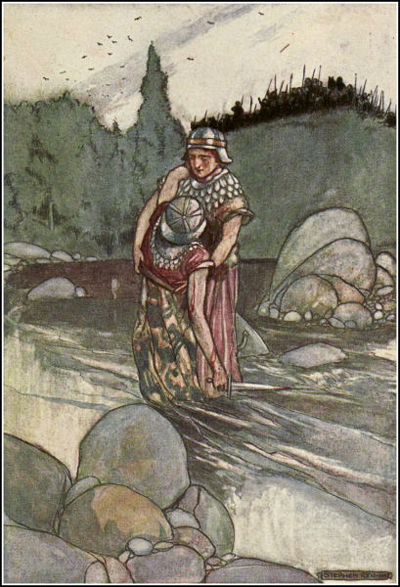
"Ferdia Falls by the Hand of Cuchulain", illustration by Stephen Reid from Eleanor Hull's The Boys' Cuchulain, 1904

Ferdiad (pronounced [ˈfʲerd̠ʲiːa̯ð]; also Fer Diad, Ferdia, Fear Diadh), son of Damán, son of Dáire, of the Fir Domnann, is a warrior of Connacht in the Ulster Cycle of Irish mythology. In the Táin Bó Cúailnge, Ferdiad finds himself on the side of the war opposite to that taken by his best friend and foster-brother Cú Chulainn, with whom he had trained in arms under the renowned warrior woman Scáthach. He and Cú Chulainn are equal in all martial feats, with two exceptions: the Gáe Bulg, a barbed spear which Scáthach has taught only Cú Chulainn to use; and Ferdiad's horn skin, which no weapon can pierce.

When Ailill and Medb, king and queen of Connacht, invade Ulster to steal the bull Donn Cúailnge, their progress is held up by Cú Chulainn, who demands single combat. After Cú Chulainn has defeated a series of Connacht champions, Medb sends for Ferdiad, but he only agrees to fight Cú Chulainn after Findabair, Ailill and Medb's daughter, has seductively plied him with alcohol, and Medb has variously bribed, shamed and goaded him to do so. They fight in the ford for three days, first fighting with eight swords, darts, and spears, then fighting with "throwing-spears" and lances, and finally moving on to "heavy, hard-smiting swords." It is on the third day that Ferdiad starts to gain the upper hand. At this point, Cú Chulainn calls to his charioteer, Laeg, for the Gáe Bolga, which he floats down the river to him. Cú Chulainn throws a light spear at Ferdiad's chest, causing him to raise his shield, and then picks up the Gáe Bolga between his toes and thrusts it through his anus, upon which the barbs spread throughout his body, killing him. The Gáe Bolga is then removed from Ferdiad's body by Laeg, and Cú Chulainn mourns Ferdiad's death, praising his strength and bravery:

"Ah, Ferdiad, betrayed to death."
"Our last meeting, oh, how sad!"
"Thou to die I to remain."
"Ever sad our long farewell!"[1][2]

Scholars believe that the fight between Cú Chulainn and Ferdiad is a late addition to the Táin, originating not earlier than the eleventh century and drawing on earlier episodes in the story.[3]

Ferdiad's name has been interpreted as meaning "man of smoke", "man of the pair" or "man of two feet", and may be a back-formation from the placename Áth Fhir Diad (Ardee, County Louth) which is supposedly named after him.[3]

Some modern scholars see his relationship with Cú Chulainn, and his death, as having homoerotic undertones.[4][5][6][7]

Legacy

[edit]
A Statue of Cuchulainn and Ferdia in Ardee, Co. Louth, Ireland.

The ford on which he died is named Áth Fhirdiad (Ferdiad's ford in Irish) Ardee, County Louth is named after him (Baile Átha Fhirdhia).[8][9]

A bronze statue stands in Bridge Street, Ardee depicting the battle and the death of Ferdiad.[10][11]

See also

[edit]

References

[edit]
[edit]
Revisions and contributorsEdit on WikipediaRead on Wikipedia
from Grokipedia
Ferdiad (: Fer Diad) is a legendary warrior from the of early , celebrated for his prowess in battle and his tragic role as the foster-brother of the hero in the epic (The Cattle Raid of Cooley). Born as the son of Daman and grandson of , Ferdiad hailed from the men of Domnann and underwent rigorous martial training under the warrior-woman in Alba (ancient ), where he forged a profound bond of companionship and mutual respect with . This relationship, marked by shared hardships and equality in skill—particularly their mastery of the deadly barbed spear known as the Gae Bulga—positioned Ferdiad as one of the few warriors deemed a true match for the Ulster champion. During the , a central narrative of the depicting Queen of 's invasion of to seize the prized brown bull Donn Cúailnge, Ferdiad initially refuses to join the Connacht forces due to his loyalty to , who single-handedly defends Ulster while its warriors are debilitated by a . Medb, however, relentlessly persuades him through promises of vast wealth, the hand of her daughter Finnabair in marriage, and even sovereignty over his people, overriding warnings from his charioteer that a friend would cause his demise. Reluctantly, Ferdiad advances to the ford at Áth Fhirdiad (modern on the River Dee), where he engages in a series of escalating duels over four consecutive days. The combat escalates over the first three days, beginning with spear and shield fighting on the first day, progressing to spear-throwing on the second, and involving intense swordplay with heavy armor on the third, with the two warriors sharing fires and meals each night in fleeting echoes of their former camaraderie. On the fourth day, exhausted and betrayed by Medb's false assurances to both sides, Cú Chulainn—urged by his charioteer Láeg—employs the Gae Bulga to deliver a fatal wound, piercing Ferdiad through the body and causing him to fall dead in the ford, which is thereafter named Áth Fhir Diad ("Ferdiad's Ford") in his honor. In the aftermath, , stricken with grief, laments the loss of his "friend and foster-brother," carrying Ferdiad's body northward for burial and composing elegies that underscore the profound sorrow of their divided fates. Ferdiad's episode represents a pivotal climax in the Táin, illustrating the epic's exploration of heroism tempered by personal tragedy, and his character endures as a symbol of reluctant valor in Irish literary tradition.

Mythological Background

Lineage and Origins

In , Ferdiad (Old Irish: Fer Diad) is identified as the son of Damán and grandson of , a lineage that situates him within the heroic traditions of ancient . This familial background underscores his noble warrior heritage, as detailed in medieval manuscripts compiling the tales. Ferdiad hails from the Fir Domnann, a tribe associated with , distinguishing him from the Ulster-based protagonists of the cycle and aligning him with the forces opposing them in key narratives. As a member of this group, he embodies the martial prowess typical of Connacht champions, with his tribal origins emphasizing his role as an outsider to Ulster's heroic lineage. The earliest surviving references to Ferdiad appear in the Book of Leinster, a 12th-century manuscript that preserves Recension I of the Táin Bó Cúailnge, where he is established as a formidable fighter whose reputation precedes the central events of the cattle raid. This textual attestation highlights his significance as a preeminent in the , long before his antagonistic confrontation with Ulster's defender in the epic.

Training and Relationship with Cú Chulainn

Ferdiad, a warrior from , traveled to the territory of , the renowned warrior-woman whose domain was located in what is traditionally identified as or Alba, to hone his martial skills. There, he joined a group of Irish warriors, including , in rigorous training under her guidance. This shared apprenticeship formed the foundation of their close bond, as they endured intense drills together in her fortified dún, mastering the arts of combat far from their homeland. During their time with , Ferdiad and developed an unparalleled equality in prowess, becoming foster-brothers through a solemn of mutual and enduring . They swore a perpetual covenant never to oppose one another, viewing each other as heart's comrades, kin, and confidants who would fare forth together into battle. This underscored their deep trust, positioning Ferdiad as 's equal partner in arms, forged through shared hardships and loyalty. Under Scáthach's tutelage, the two warriors achieved mastery over a wide array of weapons and techniques, including feats of strength, agility, and strategy that made them formidable equals. Ferdiad gained a protective horn-skin that hardened his body like horn in combat, rendering it impervious to ordinary blades or points. In contrast, Cú Chulainn alone was taught the deadly Gáe Bulg, a barbed spear launched from the foot that provided him a singular advantage, though their overall skills remained closely matched.

Role in the Táin Bó Cúailnge

Summoning to the Connacht Army

As the Connacht and allied forces advanced into Ulster during the Táin Bó Cúailnge, Cú Chulainn single-handedly held them at bay through a series of fierce single combats at various fords, defeating champions such as Loch, Nár, and Ferbaeth in succession. With their army stalled, Queen Medb and King Ailill devised a strategy to recruit a warrior capable of matching Cú Chulainn's prowess, turning their attention to Ferdiad mac Daman, a renowned fighter from Irrus Domnann who had trained alongside Cú Chulainn under Scáthach in Scotland and shared a deep foster-brother bond with him. Messengers were dispatched to summon Ferdiad to the Connacht camp, emphasizing his equal skill in arms as the ideal counter to Ulster's defender. Upon Ferdiad's arrival, Medb employed a multifaceted approach of and to secure his commitment. She hosted lavish feasts with ale to intoxicate him and lower his guard, while promising substantial rewards: the fertile Plain of Ai in , equivalent in size to the Plain of Murthemne in ; the position of sub-king over one-fifth of ; a and attire valued at the worth of thrice seven bondmaids; and, most enticingly, their daughter in marriage, with herself placed at his side to serve drinks, food, and kisses to further sway him. These offers were framed as honors befitting his status, but Medb also leveraged "pillow-talk" tactics, using her intimate influence over Ailill to ensure unified pressure and subtly threatening Ferdiad with social disgrace if he refused. To bind him irrevocably, druids imposed geasa—sacred taboos and oaths—upon him, including vows to fight at the specified ford and warnings of satire and shame should he withdraw, rendering refusal tantamount to personal ruin. Ferdiad initially resisted, citing his unbreakable oath of friendship with , forged during their shared youth and training, which prohibited them from ever opposing one another in battle. He protested the of pitting foster-brothers against each other, expressing deep reluctance and even attempting to negotiate terms, such as requiring six sureties before engaging. However, the combined weight of the geasa, the intoxicating revelry, the seductive presence of , and the allure of power and land eroded his resolve over several days of feasting and deliberation. Ultimately, Ferdiad yielded, departing his home under duress and arriving at the encampment near the Ford of Ferdiad (Ath Ferdiad), where he prepared to confront his former comrade as the army's last hope to break the stalemate.

The Three-Day Duel

The duel between Ferdiad and Cú Chulainn commenced on the first day at the Ford of Ferdiad (Áth Ferdiad), where the two foster-brothers, trained together under Scáthach in Scotland, faced each other with profound reluctance from Cú Chulainn's side. He repeatedly pleaded with Ferdiad to withdraw, citing their unbreakable bond and warning of Queen Medb's deceptive promises of marriage to Finnabair as bait, but Ferdiad, compelled by the rewards of land, chariots, and gold offered by Medb, pressed on with grim determination. The combat opened with an exchange of the choicest feats of arms using shields, long spears, and short swords, showcasing their equal mastery of defensive and offensive techniques honed in their youth. As the morning wore on without blood being drawn, they escalated to straight-cutting throwing-spears bound with flaxen cords, piercing each other's shields and armor repeatedly. By afternoon, both warriors inflicted wounds on one another, their bodies marked by gashes yet protected enough to prevent fatal injury, ending the day in a stalemate as sunset approached and exhaustion set in. Throughout the day's clashes, taunts flew across the ford, with Ferdiad mocking Cú Chulainn's former service to Connacht and his vulnerability, while Cú Chulainn countered by decrying the satire and coercion used by Medb's bards to force Ferdiad's participation, heightening the emotional strain. Despite the ferocity, moments of their shared history surfaced; after the fighting ceased, Cú Chulainn sent his charioteer Láeg with healing herbs, salves, and food from his stores, which Ferdiad accepted in a brief gesture of lingering camaraderie, though the psychological toll was evident in Cú Chulainn's deepening sorrow over battling his closest companion. This interplay of combat and regret underscored the duel's tragic core, as described in the medieval recensions of the Táin Bó Cúailnge. On the second day, the duel intensified with tactical escalation, as the warriors donned heavier armor and wielded great, well-tempered, red-forged lances from their chariots, launching volleys that splintered shields and drew through shallow but numerous cuts. Transitioning to close-quarters combat, they gripped massive, hard-smiting swords with inlaid hilts, hacking at each other's defenses in a grueling display of strength and precision, their blows carving deep gashes into flesh and bone alike, far surpassing the previous day's injuries. , aided by Láeg's strategic maneuvers to reposition and supply him mid-fight, matched Ferdiad's , but neither could claim ; the session dragged into evening with both men, their horses, and charioteers utterly spent, retreating to their camps without resolution. The psychological burden mounted palpably, with Cú Chulainn observing Ferdiad's darkening mood and renewed pleas falling on deaf ears, while Ferdiad's taunts grew defensive, justifying his role as upholding warrior honor against Ulster's champion. Unlike the first day, no exchange of healing remedies occurred, signaling the fraying of their fraternal ties under the relentless pressure of duty and , a theme amplified in the Táin's later recensions through vivid depictions of their internal conflicts. Medb's camp provided Ferdiad with fresh healers and provisions to sustain him, further stoking Cú Chulainn's resentment toward the queen's manipulations.

Death and Immediate Aftermath

On the third day of the duel, exhausted from the previous encounters, Cú Chulainn and Ferdiad continued with massive swords, inflicting deep gashes on their bodies from dawn into the afternoon. As the fight further intensified, they transitioned to full-body grapples and wrestling feats, with Ferdiad protected by his horn-skin armor that resisted Cú Chulainn's attempts to overpower him. Eventually, Cú Chulainn's charioteer, Láeg, supplied him with the Gáe Bulg, a barbed spear prepared in the river's current and launched from his toes under Ferdiad's shield. The spear entered Ferdiad's body through his anus, expanding into thirty barbs that pierced his vital organs, including his heart, causing fatal wounds that could not be extracted without further mutilation. In his dying moments, Ferdiad forgave , declaring, "Strong is the spear-shaft cast by your right hand. My ribs like spoils are broken; my heart is gore," while blaming Queen 's manipulation for forcing them into combat. Overcome with grief, lamented the loss of his foster-brother and comrade, , "Alas, O noble warrior! O brave Fer Diad! ... All was play and pleasure until I met with Fer Diad in the ford." He carried Ferdiad's body northward across the ford, laying it triumphantly with its face toward , and cursed and the forces for their deceitful tactics. Ferdiad's death temporarily broke Cú Chulainn's defense, allowing the army under and Ailill to advance southward past the ford toward Cooley, though it underscored the tragic cost of heroism in the ongoing cattle raid.

Name and Etymology

Linguistic Meaning

The name Ferdiad (Old Irish Fer Diad) breaks down into the elements fer, meaning "man" or "," and diad, which scholars have interpreted in multiple ways within linguistic contexts. One prominent etymology renders it as "man of smoke," deriving diad from a root associated with or , possibly evoking an elusive or ephemeral quality in the character's warrior nature. Another interpretation links it to "man of the pair" or "man of two persons," positing diad as a fossilized form of Old Irish díad meaning "two persons," which may reflect the dualistic themes of camaraderie and in the narrative. Medieval spellings of the name vary across manuscripts, appearing as Fer Diad in the (c. 1160), a key of the , while earlier forms in the (c. 1100) similarly use Fer Diad without significant deviation. Primary sources such as the manuscripts offer no explicit mythological explanation for the name, implying it functions as a descriptive rather than one derived from narrative backstory. This absence highlights how such names in literature often prioritize linguistic symbolism over etiological tales.

Associated Locations

The primary location associated with Ferdiad is Áth Fhir Diad, or the Ford of Ferdiad, situated at the modern town of Ardee in County Louth, Ireland, where the climactic duel of the Táin Bó Cúailnge is said to have occurred. This ford on the River Dee marked a strategic crossing point, and the site's name endures as Baile Átha Fhirdhia, directly deriving from the mythological figure and event. Ardee possesses notable archaeological and historical layers, with evidence of dense settlement during the Bronze Age (c. 2500–600 BCE) and Early Iron Age (c. 600 BCE–400 CE), periods contemporaneous with the Ulster Cycle's legendary setting. Prehistoric monuments in the vicinity, including ring barrows and burial sites, suggest ongoing human activity that may underpin the area's mythic significance. In medieval lore, Ardee functioned as a fortified frontier town of the English Pale, garrisoned against Irish forces and referenced in records of military rendezvous. A surviving medieval high cross in the town further attests to its role in early Christian and Norman-era heritage. The location also ties into broader historical border dynamics between and , as chronicled in the , which document recurring conflicts and raids in the Louth-Meath borderlands during the medieval period. These entries portray Ardee as a contested zone in inter-provincial rivalries, mirroring the epic tensions of the Táin.

Cultural Depictions and Interpretations

In Medieval Irish Literature

Ferdiad's primary appearance in medieval occurs in the epic , the central tale of the , where he is depicted as a formidable warrior compelled to his foster-brother over four days at Áth Fhir Diad during Queen Medb's invasion of . Scholars consider this episode a later into the saga's earlier core narrative, which originated in the 8th or , with the Ferdiad material itself likely composed in the 11th or 12th century to heighten dramatic tension. Significant variations in the episode's portrayal emerge across the surviving recensions of the Táin. The First Recension, preserved fragmentarily in manuscripts such as (c. 1106) and supplemented by the Yellow Book of Lecan (14th century), presents a comparatively brief account of the , focusing primarily on the physical with minimal elaboration on the warriors' emotional turmoil or backstory. In this version, the narrative advances swiftly, emphasizing tactical exchanges over interpersonal depth. By contrast, the more expansive treatment in the (c. 1160, II) transforms the episode into a pivotal , extending the duel across detailed daily confrontations and incorporating lengthy dialogues that reveal Ferdiad's hesitation and the bonds forged during their joint training under the warrior-woman in —a motif influenced by ancillary narratives such as Tochmarc Emire. This recension amplifies Ferdiad's thematic function as a tragic counterpart to , embodying the irreconcilable tensions between foster-brotherhood and allegiance to opposing lords, thereby underscoring the saga's exploration of heroic isolation and divided loyalties.

In Modern Adaptations and Scholarship

Ferdiad features prominently in 20th-century literary retellings of the Ulster Cycle myths, which often emphasize the emotional depth of his bond with Cú Chulainn. Lady Gregory's 1902 prose collection Cuchulain of Muirmthemne adapts the duel as a poignant clash between foster-brothers, underscoring themes of loyalty and tragic inevitability amid the Connacht invasion. Morgan Llywelyn's 1989 historical novel Red Branch expands on Ferdiad's character as Cú Chulainn's steadfast companion, delving into the psychological strain of their forced opposition and the personal costs of warrior honor. In , Ferdiad is memorialized through public that captures the ’s aftermath. The bronze work Carrying the Slain Ferdia by Irish sculptor Ann Meldon Hugh, located in , —named after the mythical ford Áth Fhirdiad—portrays Cú tenderly bearing his dying friend, symbolizing grief and fraternal loss. Scholarly examinations of the 20th and 21st centuries have illuminated the episode's compositional history and interpretive layers. Linguists and mythologists, analyzing the manuscripts, conclude that the Ferdiad was a later , with its archaic Irish showing 11th-century influences and serving to amplify narrative through prolonged . Twentieth-century critics have noted homoerotic elements in the foster-brothers' intimacy, evident in their shared training, affectionate banter, and the eroticized language of their four-day battle, which blends violence with sensual vulnerability. In broader , the narrative has been linked to Irish nationalist discourse, where Medb's coercion of Ferdiad exemplifies manipulated heroism, mirroring colonial-era exploitations of Irish identity and the tragic pitting of kin against kin.
Add your contribution
Related Hubs
User Avatar
No comments yet.