
Hubbry Logo
Fermi energyFermi energyMain
Open search
Fermi energy
Community hub
Fermi energy
logo
7 pages, 0 posts
0 subscribers
Be the first to start a discussion here.
Fermi energy
Fermi energy
from Wikipedia

The Fermi energy is a concept in quantum mechanics usually referring to the energy difference between the highest and lowest occupied single-particle states in a quantum system of non-interacting fermions at absolute zero temperature. In a Fermi gas, the lowest occupied state is taken to have zero kinetic energy, whereas in a metal, the lowest occupied state is typically taken to mean the bottom of the conduction band.

The term "Fermi energy" is often used to refer to a different yet closely related concept, the Fermi level (also called electrochemical potential).[note 1] There are a few key differences between the Fermi level and Fermi energy, at least as they are used in this article:

  • The Fermi energy is only defined at absolute zero, while the Fermi level is defined for any temperature.
  • The Fermi energy is an energy difference (usually corresponding to a kinetic energy), whereas the Fermi level is a total energy level including kinetic energy and potential energy.
  • The Fermi energy can only be defined for non-interacting fermions (where the potential energy or band edge is a static, well defined quantity), whereas the Fermi level remains well defined even in complex interacting systems, at thermodynamic equilibrium.

Since the Fermi level in a metal at absolute zero is the energy of the highest occupied single particle state, then the Fermi energy in a metal is the energy difference between the Fermi level and lowest occupied single-particle state, at zero-temperature.

Context

[edit]

In quantum mechanics, a group of particles known as fermions (for example, electrons, protons and neutrons) obey the Pauli exclusion principle. This states that two fermions cannot occupy the same quantum state. Since an idealized non-interacting Fermi gas can be analyzed in terms of single-particle stationary states, we can thus say that two fermions cannot occupy the same stationary state. These stationary states will typically be distinct in energy. To find the ground state of the whole system, we start with an empty system, and add particles one at a time, consecutively filling up the unoccupied stationary states with the lowest energy. When all the particles have been put in, the Fermi energy is the kinetic energy of the highest occupied state.

As a consequence, even if we have extracted all possible energy from a Fermi gas by cooling it to near absolute zero temperature, the fermions are still moving around at a high speed. The fastest ones are moving at a velocity corresponding to a kinetic energy equal to the Fermi energy. This speed is known as the Fermi velocity. Only when the temperature exceeds the related Fermi temperature, do the particles begin to move significantly faster than at absolute zero.

The Fermi energy is an important concept in the solid state physics of metals and superconductors. It is also a very important quantity in the physics of quantum liquids like low temperature helium (both normal and superfluid 3He), and it is quite important to nuclear physics and to understanding the stability of white dwarf stars against gravitational collapse.

Formula and typical values

[edit]

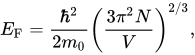
The Fermi energy for a three-dimensional, non-relativistic, non-interacting ensemble of identical spin-12 fermions is given by[1] where N is the number of particles, m0 the rest mass of each fermion, V the volume of the system, and the reduced Planck constant.
Metals

[edit]

Under the free electron model, the electrons in a metal can be considered to form a Fermi gas. The number density of conduction electrons in metals ranges between approximately 1028 and 1029 electrons/m3, which is also the typical density of atoms in ordinary solid matter. This number density produces a Fermi energy of the order of 2 to 10 electronvolts.[2]

White dwarfs

[edit]

Stars known as white dwarfs have mass comparable to the Sun, but have about a hundredth of its radius. The high densities mean that the electrons are no longer bound to single nuclei and instead form a degenerate electron gas. Their Fermi energy is about 0.3 MeV.

Nucleus

[edit]

Another typical example is that of the nucleons in the nucleus of an atom. The radius of the nucleus admits deviations, so a typical value for the Fermi energy is usually given as 38 MeV.

[edit]

Using this definition of above for the Fermi energy, various related quantities can be useful.

The Fermi temperature is defined as where is the Boltzmann constant, and the Fermi energy. The Fermi temperature can be thought of as the temperature at which thermal effects are comparable to quantum effects associated with Fermi statistics.[3] The Fermi temperature for a metal is a couple of orders of magnitude above room temperature.

Other quantities defined in this context are Fermi momentum and Fermi velocity
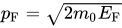
These quantities are respectively the momentum and group velocity of a fermion at the Fermi surface.

The Fermi momentum can also be described as where , called the Fermi wavevector, is the radius of the Fermi sphere.[4] is the electron density.

These quantities may not be well-defined in cases where the Fermi surface is non-spherical.

See also

[edit]

Notes

[edit]

References

[edit]

Further reading

[edit]
Revisions and contributorsEdit on WikipediaRead on Wikipedia
from Grokipedia
The Fermi energy, denoted EFE_F, is the highest occupied energy level of electrons (or other fermions) in a quantum system at absolute zero temperature (T=0T = 0 K), representing the boundary between occupied and unoccupied states in momentum space. This concept, rooted in Fermi-Dirac statistics and the Pauli exclusion principle, describes the ground-state configuration of non-interacting fermions, such as conduction electrons in metals, where all states below EFE_F are filled and those above are empty. It serves as a fundamental parameter in condensed matter physics, influencing electronic, thermal, and optical properties of materials. In the free electron gas model, which approximates the behavior of valence electrons in metals as a degenerate Fermi gas, the Fermi energy is derived from the requirement that the total number of electrons fills the available states up to the Fermi surface—a hypersurface in k-space enclosing occupied momentum states. The explicit formula for a three-dimensional system is EF=22m(3π2n)2/3E_F = \frac{\hbar^2}{2m} (3\pi^2 n)^{2/3}, where \hbar is the reduced Planck's constant, mm is the electron mass, and n=N/Vn = N/V is the electron number density. This yields typical values ranging from 2 eV to 12 eV for common metals; for example, copper has EF7.00E_F \approx 7.00 eV, lithium 4.74\approx 4.74 eV, and aluminum 11.7\approx 11.7 eV, corresponding to Fermi temperatures (defined as TF=EF/kBT_F = E_F / k_B, with kBk_B Boltzmann's constant) on the order of 10410^4 to 10510^5 K—far exceeding room temperature. At finite temperatures, the sharp cutoff at EFE_F broadens due to thermal excitation, governed by the Fermi-Dirac distribution function f(E)=11+e(EEF)/kBTf(E) = \frac{1}{1 + e^{(E - E_F)/k_B T}}, which gives the occupation probability of a state at energy EE. In metals, where EFE_F lies within the conduction band, only electrons near EFE_F (within ~kBTk_B T of it) contribute to transport properties like electrical conductivity and heat capacity, explaining the high conductivity and low specific heat of metals at room temperature. In semiconductors and insulators, EFE_F typically resides in the band gap, determining carrier concentrations via doping or temperature effects, while in superconductors, phenomena like the energy gap opening below the critical temperature interact with EFE_F to enable zero-resistance states. The Fermi energy thus underpins band theory and the classification of materials, with extensions to more complex systems like semiconductors via the density of states and effective mass approximations.

Definition and Fundamentals

Core Definition

The Fermi energy, denoted EFE_F, is the highest occupied energy level of fermions at absolute zero temperature (T=0T = 0 K), marking the precise boundary between fully occupied and unoccupied quantum states in the ground state of a many-fermion system. This definition arises from the requirement that the chemical potential μ\mu at T=0T = 0 K coincides with EFE_F, ensuring the step-function behavior of the distribution where all states below EFE_F are occupied and those above are empty. In fermionic systems, such as electrons in a solid, particles obey the Pauli exclusion principle, which prohibits more than one fermion from occupying the same quantum state. Consequently, available energy levels are filled sequentially from the lowest up to EFE_F in degenerate systems at absolute zero, creating a filled Fermi sea that determines the system's ground-state configuration. The occupation of states follows Fermi-Dirac statistics, which accounts for this quantum indistinguishability and exclusion. This quantum filling contrasts sharply with a classical ideal gas, where particles follow Maxwell-Boltzmann statistics and can pile into lower energy states without restriction, leading to thermal pressure rather than the degeneracy pressure arising from the Pauli principle in fermionic systems.

Physical Significance

The Fermi energy plays a central role in the quantum mechanical description of fermionic systems, originating from the application of Fermi-Dirac statistics to the free electron gas in metals. This concept was developed by Enrico Fermi in his 1926 paper on the quantization of an ideal monatomic gas, where he introduced a statistical method for indistinguishable particles that obey what would later be recognized as Fermi statistics, and further refined by Arnold Sommerfeld in 1928 to model the conduction electrons in metals. At absolute zero temperature, the Fermi energy EFE_F denotes the highest energy level occupied by fermions in their ground state, a direct consequence of the Pauli exclusion principle, which forbids two identical fermions from sharing the same quantum state. In dense systems like the electron gas, this principle requires electrons to fill all available single-particle states up to EFE_F, creating a filled Fermi sea that spans a range of momenta and energies. Without this exclusion, fermions would collapse into the lowest energy state, leading to instability; instead, the occupation up to EFE_F provides the foundational stability for such systems, preventing overcrowding in lower states and enabling the existence of matter in its observed form. The Fermi energy also underlies degeneracy pressure, a quantum pressure arising from the Pauli exclusion principle that resists further compression of fermionic matter. This pressure stems from the increased kinetic energy required to occupy higher momentum states when density rises, effectively countering external forces such as gravity in compact astrophysical objects like white dwarfs or electrostatic forces in atomic nuclei. In white dwarfs, for instance, electron degeneracy pressure supported by EFE_F balances gravitational collapse up to the Chandrasekhar limit, beyond which the star cannot remain stable as a degenerate object. In contrast to classical systems, where particle behavior is dominated by thermal energy kBTk_B T, fermionic systems exhibit quantum degeneracy when EFkBTE_F \gg k_B T, making statistical quantum effects prevalent even at modest temperatures. The associated Fermi temperature TF=EF/kBT_F = E_F / k_B in metals typically ranges from 10410^4 to 10510^5 K—far exceeding room temperature (around 300 K)—ensuring that only a small fraction of electrons near EFE_F participate in thermal excitations, while the majority remain locked in the degenerate ground state.

Theoretical Derivation

Fermi-Dirac Distribution

The Fermi-Dirac distribution describes the statistical distribution of particles known as fermions, which are indistinguishable quantum particles that obey the Pauli exclusion principle, allowing at most one particle per quantum state. This distribution was independently derived in 1926 by Enrico Fermi and Paul Dirac as part of early quantum statistical mechanics, providing the occupation probability for fermions in thermal equilibrium. The average occupation number f(E)f(E) for a single-particle state of energy EE is given by f(E)=1e(Eμ)/kBT+1,f(E) = \frac{1}{e^{(E - \mu)/k_B T} + 1}, where μ\mu is the chemical potential, kBk_B is Boltzmann's constant, and TT is the temperature. This function arises from the quantum mechanical treatment of indistinguishable particles, assuming familiarity with the grand canonical partition function for systems where particle exchange with a reservoir maintains fixed μ\mu. At absolute zero temperature (T=0T = 0 K), the Fermi-Dirac distribution simplifies to a step function: f(E)=1f(E) = 1 for E<μE < \mu, indicating all states below the chemical potential are fully occupied, and f(E)=0f(E) = 0 for E>μE > \mu, meaning all higher states are empty. In this degenerate limit, the chemical potential μ\mu coincides with the Fermi energy EFE_F, marking the highest occupied energy level. This sharp cutoff reflects the fermionic nature, where the exclusion principle fills the lowest available states completely before higher ones. In comparison to other statistical distributions, the Fermi-Dirac form differs fundamentally from the Bose-Einstein distribution for bosons, which replaces the +1+1 with 1-1 in the denominator, permitting multiple occupancy and potential Bose-Einstein condensation at low temperatures. The antisymmetric wavefunctions required for fermions under particle exchange ensure no double occupancy, a consequence highlighted in Dirac's formulation of quantum mechanics. At high temperatures or low densities, where f(E)1f(E) \ll 1, the Fermi-Dirac distribution approximates the classical Maxwell-Boltzmann distribution f(E)e(Eμ)/kBTf(E) \approx e^{-(E - \mu)/k_B T}, recovering the behavior for distinguishable particles.

Derivation of Fermi Energy

The derivation of the Fermi energy is based on the free electron model, introduced by Arnold Sommerfeld in 1927 to incorporate Fermi-Dirac statistics into the theory of electrons in metals. This model assumes non-interacting fermions confined in a three-dimensional potential well, where electrons obey the Pauli exclusion principle. It assumes electrons move freely without scattering from lattice ions or each other, and the system is treated at absolute zero temperature (T=0), where thermal effects are negligible. At T=0, the Fermi-Dirac distribution simplifies to a step function, fully occupying all quantum states up to the Fermi energy EFE_F and leaving higher states empty, ensuring conservation of the total number of particles. To find EFE_F, the total number of electrons NN is determined by integrating the density of states g(E)g(E) from 0 to EFE_F. The density of states g(E)g(E) represents the number of available electron states per unit energy interval in the system. For a three-dimensional free electron gas, g(E)g(E) is derived from the phase space in k-space, where the energy dispersion is parabolic: E=2k22mE = \frac{\hbar^2 k^2}{2m}, with mm the electron mass and \hbar the reduced Planck's constant. Accounting for two spin states and the volume VV of the system, the density of states is g(E)=V2π2(2m2)3/2E1/2.g(E) = \frac{V}{2\pi^2} \left( \frac{2m}{\hbar^2} \right)^{3/2} E^{1/2}. This expression arises from counting the number of states within spherical shells in k-space, transforming to energy space, and including spin degeneracy. The total number of electrons is then given by the ground-state filling condition: N=0EFg(E)dE=0EFV2π2(2m2)3/2E1/2dE.N = \int_0^{E_F} g(E) \, dE = \int_0^{E_F} \frac{V}{2\pi^2} \left( \frac{2m}{\hbar^2} \right)^{3/2} E^{1/2} \, dE. Evaluating the integral yields N=V2π2(2m2)3/223EF3/2=V3π2(2mEF2)3/2.N = \frac{V}{2\pi^2} \left( \frac{2m}{\hbar^2} \right)^{3/2} \cdot \frac{2}{3} E_F^{3/2} = \frac{V}{3\pi^2} \left( \frac{2m E_F}{\hbar^2} \right)^{3/2}. Solving for EFE_F involves rearranging terms, first introducing the Fermi wavevector kF=(3π2n)1/3k_F = (3\pi^2 n)^{1/3} where n=N/Vn = N/V is the electron density, and then substituting EF=2kF22mE_F = \frac{\hbar^2 k_F^2}{2m}. This step-by-step process confirms that the Fermi energy satisfies particle number conservation by precisely filling states up to EFE_F. The resulting expression demonstrates EF(N/V)2/3E_F \propto (N/V)^{2/3}, highlighting the dependence on electron density. This proportionality was first established by Arnold Sommerfeld in 1927, applying Fermi-Dirac statistics to the free electron gas model for metals.

Formulas and Calculations

General Expression

The Fermi energy EFE_F for a three-dimensional free electron gas at absolute zero temperature is given by the expression EF=22m(3π2n)2/3,E_F = \frac{\hbar^2}{2m} (3 \pi^2 n)^{2/3}, where n=N/Vn = N/V denotes the electron number density, mm is the effective mass of the electron (typically the free electron mass me=9.109×1031m_e = 9.109 \times 10^{-31} kg), and =h/2π\hbar = h / 2\pi is the reduced Planck's constant with h=6.626×1034h = 6.626 \times 10^{-34} J s. This formula arises from filling the lowest energy states up to the Fermi level in momentum space, determining the maximum kinetic energy of electrons in the ground state. Associated with EFE_F are the Fermi wavevector kF=(3π2n)1/3k_F = (3 \pi^2 n)^{1/3}, which defines the radius of the occupied sphere in k-space, and the Fermi velocity vF=kF/mv_F = \hbar k_F / m, representing the speed of electrons at the Fermi surface. To compute EFE_F for a given nn, substitute the electron density (in units of m3^{-3}) into the formula; for instance, the energy is expressed in joules when using SI units for \hbar and mm, though electronvolts (1 eV = 1.602 \times 10^{-19} J) are often convenient for atomic-scale energies. In systems with an arbitrary density of states g(E)g(E), the Fermi energy generalizes to the energy level where the total number of electrons NN satisfies N=0g(E)f(E)dE0EFg(E)dEN = \int_0^\infty g(E) f(E) \, dE \approx \int_0^{E_F} g(E) \, dE at zero temperature, with f(E)f(E) the Fermi-Dirac occupation function that approaches a step function at T=0T=0. This definition ensures all states below EFE_F are occupied, accommodating exactly NN fermions according to the Pauli exclusion principle.

Density of States Integration

The density of states, denoted g(E)g(E), quantifies the number of available quantum states per unit energy interval at energy EE. At absolute zero temperature, the Fermi energy EFE_F is determined by filling all states up to EFE_F, such that the total number of electrons NN satisfies N=0EFg(E)dEN = \int_0^{E_F} g(E) \, dE. This integral equation is central to computing EFE_F for a given electron density n=N/Vn = N/V, where VV is the system volume, as solving for EFE_F directly links the particle density to the highest occupied energy level. For a three-dimensional system of non-interacting electrons with parabolic dispersion ε=2k22m\varepsilon = \frac{\hbar^2 k^2}{2m}, the density of states takes the form g(E)=V2π2(2m2)3/2E1/2,g(E) = \frac{V}{2\pi^2} \left( \frac{2m}{\hbar^2} \right)^{3/2} E^{1/2}, which includes a factor of 2 accounting for spin degeneracy. Integrating this expression yields N=V3π2(2mEF2)3/2,N = \frac{V}{3\pi^2} \left( \frac{2m E_F}{\hbar^2} \right)^{3/2}, resulting in EFn2/3E_F \propto n^{2/3}. This scaling arises from the E1/2E^{1/2} dependence of g(E)g(E), illustrating how the energy variation of available states governs the Fermi energy's dependence on density. In lower-dimensional or non-parabolic systems, the form of g(E)g(E) changes, altering the integration and thus EFE_F. For a two-dimensional electron gas with parabolic bands, g(E)g(E) is energy-independent (constant), leading to EFnE_F \propto n. In one dimension, g(E)1/Eg(E) \propto 1/\sqrt{E}
Add your contribution
Related Hubs
User Avatar
No comments yet.