


Community hub
Recent from talks
Contribute something to knowledge base
Content stats: 0 posts, 0 articles, 1 media, 0 notes
Members stats: 0 subscribers, 0 contributors, 0 moderators, 0 supporters
Subscribers
Supporters
Contributors
Moderators
Hub AI
Fiddler crab AI simulator
(@Fiddler crab_simulator)
Hub AI
Fiddler crab AI simulator
(@Fiddler crab_simulator)
Fiddler crab
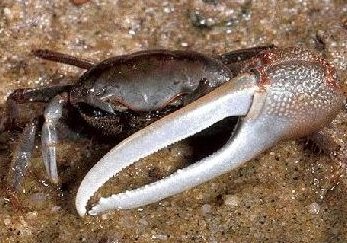
The fiddler crab or calling crab is any of the hundred species of semiterrestrial marine crabs in the family Ocypodidae. These crabs are well known for their extreme sexual dimorphism, where the male crabs have a major claw significantly larger than their minor claw, whilst females' claws are both the same size. The name fiddler crab comes from the appearance of their small and large claw together, looking similar to a fiddle.
A smaller number of ghost crab and mangrove crab species are also found in the family Ocypodidae. This entire group is composed of small crabs, the largest being Afruca tangeri which is slightly over two inches (5 cm) across. Fiddler crabs are found along sea beaches and brackish intertidal mud flats, lagoons, swamps, and various other types of brackish or salt-water wetlands. Whilst fiddler crabs are currently split into two subfamilies of Gelasiminae and Ucinae, there is still phylogenetic and taxonomical debate as to whether the movement from the overall genus of ‘’Uca’’ to these subfamilies and the separate 11 genera
Like all crabs, fiddler crabs shed their shells as they grow. If they have lost legs or claws during their present growth cycle, a new one will be present when they molt. If the major claw is lost, males will regenerate one on the same side after their next molt. Newly molted crabs are very vulnerable because of their soft shells. They are reclusive and hide until the new shell hardens.
In a controlled laboratory setting, fiddler crabs exhibit a constant circadian rhythm that mimics the ebb and flow of the tides: they turn dark during the day and light at night.
Fiddler crabs primarily exist upon mudflats, sandy or muddy beaches as well as salt marshes within mangroves. Fiddler crabs are found in West Africa, the Western Atlantic, the Eastern Pacific, Indo-Pacific and Algarve region of Portugal.
Whilst the fiddler crab is classified as an omnivore, it does present itself as an opportunist and will consume anything with nutritional value. The crab will feed through bringing a chunk of sediment to its mouth and sifting through it to extract organic material. This crab will filter out algae, microbes, fungus or any form of detritus. Once finished consuming all the organic matter from the sediment, these crabs will then deposit them as small sand balls near their burrow.
Fiddler crabs are thought to potentially act as ecosystem engineers within their habitat due to the way they rework the sediment during feeding. Whilst these crabs do rework the sediment around them, upturning the very top layer and depositing it nearby, there is still debate that exists as to whether this turnover of sediment has any proven difference regarding nutrients and aeration of the sediment.
Fiddler crabs are a burrowing species, where within their territory they may possess several burrows. There are two types of burrows that the fiddler crabs can build, either breeding burrows or temporary burrows. Temporary burrows are constructed by both males and females during high tide periods. These burrows are also constructed at night time when the crabs are no longer feeding and are hiding from predators. Breeding burrows are constructed by solely males, and will be constructed within the area that they have deemed their territory. These breeding burrows are constructed by male crabs so that the female and male crabs may copulate within the burrow, and the female may deposit and incubate her eggs within this area. Larger males who can more easily defend their territory will often have multiple suitable breeding burrows within their territory to enable them to mate with multiple female crabs. Female crabs are found to prefer to mate with males that have the widest burrows, however, carapace width and claw size does correlate with the width of the burrow, so could be a potential size bias.
Fiddler crab
The fiddler crab or calling crab is any of the hundred species of semiterrestrial marine crabs in the family Ocypodidae. These crabs are well known for their extreme sexual dimorphism, where the male crabs have a major claw significantly larger than their minor claw, whilst females' claws are both the same size. The name fiddler crab comes from the appearance of their small and large claw together, looking similar to a fiddle.
A smaller number of ghost crab and mangrove crab species are also found in the family Ocypodidae. This entire group is composed of small crabs, the largest being Afruca tangeri which is slightly over two inches (5 cm) across. Fiddler crabs are found along sea beaches and brackish intertidal mud flats, lagoons, swamps, and various other types of brackish or salt-water wetlands. Whilst fiddler crabs are currently split into two subfamilies of Gelasiminae and Ucinae, there is still phylogenetic and taxonomical debate as to whether the movement from the overall genus of ‘’Uca’’ to these subfamilies and the separate 11 genera
Like all crabs, fiddler crabs shed their shells as they grow. If they have lost legs or claws during their present growth cycle, a new one will be present when they molt. If the major claw is lost, males will regenerate one on the same side after their next molt. Newly molted crabs are very vulnerable because of their soft shells. They are reclusive and hide until the new shell hardens.
In a controlled laboratory setting, fiddler crabs exhibit a constant circadian rhythm that mimics the ebb and flow of the tides: they turn dark during the day and light at night.
Fiddler crabs primarily exist upon mudflats, sandy or muddy beaches as well as salt marshes within mangroves. Fiddler crabs are found in West Africa, the Western Atlantic, the Eastern Pacific, Indo-Pacific and Algarve region of Portugal.
Whilst the fiddler crab is classified as an omnivore, it does present itself as an opportunist and will consume anything with nutritional value. The crab will feed through bringing a chunk of sediment to its mouth and sifting through it to extract organic material. This crab will filter out algae, microbes, fungus or any form of detritus. Once finished consuming all the organic matter from the sediment, these crabs will then deposit them as small sand balls near their burrow.
Fiddler crabs are thought to potentially act as ecosystem engineers within their habitat due to the way they rework the sediment during feeding. Whilst these crabs do rework the sediment around them, upturning the very top layer and depositing it nearby, there is still debate that exists as to whether this turnover of sediment has any proven difference regarding nutrients and aeration of the sediment.
Fiddler crabs are a burrowing species, where within their territory they may possess several burrows. There are two types of burrows that the fiddler crabs can build, either breeding burrows or temporary burrows. Temporary burrows are constructed by both males and females during high tide periods. These burrows are also constructed at night time when the crabs are no longer feeding and are hiding from predators. Breeding burrows are constructed by solely males, and will be constructed within the area that they have deemed their territory. These breeding burrows are constructed by male crabs so that the female and male crabs may copulate within the burrow, and the female may deposit and incubate her eggs within this area. Larger males who can more easily defend their territory will often have multiple suitable breeding burrows within their territory to enable them to mate with multiple female crabs. Female crabs are found to prefer to mate with males that have the widest burrows, however, carapace width and claw size does correlate with the width of the burrow, so could be a potential size bias.
Recent media
Recent media