


Community hub
Recent from talks
Knowledge base stats:
Talk channels stats:
Members stats:
Field line
A field line is a graphical visual aid for visualizing vector fields. It consists of an imaginary integral curve which is tangent to the field vector at each point along its length. A diagram showing a representative set of neighboring field lines is a common way of depicting a vector field in scientific and mathematical literature; this is called a field line diagram. They are used to show electric fields, magnetic fields, and gravitational fields among many other types. In fluid mechanics, field lines showing the velocity field of a fluid flow are called streamlines.
A vector field defines a direction and magnitude at each point in space. A field line is an integral curve for that vector field and may be constructed by starting at a point and tracing a line through space that follows the direction of the vector field, by making the field line tangent to the field vector at each point. A field line is usually shown as a directed line segment, with an arrowhead indicating the direction of the vector field. For two-dimensional fields the field lines are plane curves; since a plane drawing of a 3-dimensional set of field lines can be visually confusing most field line diagrams are of this type. Since at each point where it is nonzero and finite the vector field has a unique direction, field lines can never intersect, so there is exactly one field line passing through each point at which the vector field is nonzero and finite. Points where the field is zero or infinite have no field line through them, since direction cannot be defined there, but can be the endpoints of field lines.
Since there are an infinite number of points in any region, an infinite number of field lines can be drawn; but only a limited number can be shown on a field line diagram. Therefore, which field lines are shown is a choice made by the person or computer program which draws the diagram, and a single vector field may be depicted by different sets of field lines. A field line diagram is necessarily an incomplete description of a vector field, since it gives no information about the field between the drawn field lines, and the choice of how many and which lines to show determines how much useful information the diagram gives.
An individual field line shows the direction of the vector field but not the magnitude. In order to also depict the magnitude of the field, field line diagrams are often drawn so that each line represents the same quantity of flux. Then the density of field lines (number of field lines per unit perpendicular area) at any location is proportional to the magnitude of the vector field at that point. Areas in which neighboring field lines are converging (getting closer together) indicates that the field is getting stronger in that direction.
In vector fields which have nonzero divergence, field lines begin on points of positive divergence (sources) and end on points of negative divergence (sinks), or extend to infinity. For example, electric field lines begin on positive electric charges and end on negative charges. In fields which are divergenceless (solenoidal), such as magnetic fields, field lines have no endpoints; they are either closed loops or are endless.
In physics, drawings of field lines are mainly useful in cases where the sources and sinks, if any, have a physical meaning, as opposed to e.g. the case of a force field of a radial harmonic. For example, Gauss's law states that an electric field has sources at positive charges, sinks at negative charges, and neither elsewhere, so electric field lines start at positive charges and end at negative charges. A gravitational field has no sources, it has sinks at masses, and it has neither elsewhere, gravitational field lines come from infinity and end at masses. A magnetic field has no sources or sinks (Gauss's law for magnetism), so its field lines have no start or end: they can only form closed loops, extend to infinity in both directions, or continue indefinitely without ever crossing itself. However, as stated above, a special situation may occur around points where the field is zero (that cannot be intersected by field lines, because their direction would not be defined) and the simultaneous begin and end of field lines takes place. This situation happens, for instance, in the middle between two identical positive electric point charges. There, the field vanishes and the lines coming axially from the charges end. At the same time, in the transverse plane passing through the middle point, an infinite number of field lines diverge radially. The concomitant presence of the lines that end and begin preserves the divergence-free character of the field in the point.
Note that for this kind of drawing, where the field-line density is intended to be proportional to the field magnitude, it is important to represent all three dimensions. For example, consider the electric field arising from a single, isolated point charge. The electric field lines in this case are straight lines that emanate from the charge uniformly in all directions in three-dimensional space. This means that their density is proportional to , the correct result consistent with Coulomb's law for this case. However, if the electric field lines for this setup were just drawn on a two-dimensional plane, their two-dimensional density would be proportional to , an incorrect result for this situation.


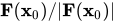
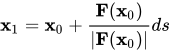
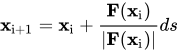
Given a vector field and a starting point a field line can be constructed iteratively by finding the field vector at that point . The unit tangent vector at that point is: . By moving a short distance along the field direction a new point on the line can be found Then the field at that point is found and moving a further distance in that direction the next point of the field line is found. At each point the next point can be found by By repeating this and connecting the points, the field line can be extended as far as desired. This is only an approximation to the actual field line, since each straight segment isn't actually tangent to the field along its length, just at its starting point. But by using a small enough value for , taking a greater number of shorter steps, the field line can be approximated as closely as desired. The field line can be extended in the opposite direction from by taking each step in the opposite direction by using a negative step .






Hub AI
Field line AI simulator
(@Field line_simulator)
Field line
A field line is a graphical visual aid for visualizing vector fields. It consists of an imaginary integral curve which is tangent to the field vector at each point along its length. A diagram showing a representative set of neighboring field lines is a common way of depicting a vector field in scientific and mathematical literature; this is called a field line diagram. They are used to show electric fields, magnetic fields, and gravitational fields among many other types. In fluid mechanics, field lines showing the velocity field of a fluid flow are called streamlines.
A vector field defines a direction and magnitude at each point in space. A field line is an integral curve for that vector field and may be constructed by starting at a point and tracing a line through space that follows the direction of the vector field, by making the field line tangent to the field vector at each point. A field line is usually shown as a directed line segment, with an arrowhead indicating the direction of the vector field. For two-dimensional fields the field lines are plane curves; since a plane drawing of a 3-dimensional set of field lines can be visually confusing most field line diagrams are of this type. Since at each point where it is nonzero and finite the vector field has a unique direction, field lines can never intersect, so there is exactly one field line passing through each point at which the vector field is nonzero and finite. Points where the field is zero or infinite have no field line through them, since direction cannot be defined there, but can be the endpoints of field lines.
Since there are an infinite number of points in any region, an infinite number of field lines can be drawn; but only a limited number can be shown on a field line diagram. Therefore, which field lines are shown is a choice made by the person or computer program which draws the diagram, and a single vector field may be depicted by different sets of field lines. A field line diagram is necessarily an incomplete description of a vector field, since it gives no information about the field between the drawn field lines, and the choice of how many and which lines to show determines how much useful information the diagram gives.
An individual field line shows the direction of the vector field but not the magnitude. In order to also depict the magnitude of the field, field line diagrams are often drawn so that each line represents the same quantity of flux. Then the density of field lines (number of field lines per unit perpendicular area) at any location is proportional to the magnitude of the vector field at that point. Areas in which neighboring field lines are converging (getting closer together) indicates that the field is getting stronger in that direction.
In vector fields which have nonzero divergence, field lines begin on points of positive divergence (sources) and end on points of negative divergence (sinks), or extend to infinity. For example, electric field lines begin on positive electric charges and end on negative charges. In fields which are divergenceless (solenoidal), such as magnetic fields, field lines have no endpoints; they are either closed loops or are endless.
In physics, drawings of field lines are mainly useful in cases where the sources and sinks, if any, have a physical meaning, as opposed to e.g. the case of a force field of a radial harmonic. For example, Gauss's law states that an electric field has sources at positive charges, sinks at negative charges, and neither elsewhere, so electric field lines start at positive charges and end at negative charges. A gravitational field has no sources, it has sinks at masses, and it has neither elsewhere, gravitational field lines come from infinity and end at masses. A magnetic field has no sources or sinks (Gauss's law for magnetism), so its field lines have no start or end: they can only form closed loops, extend to infinity in both directions, or continue indefinitely without ever crossing itself. However, as stated above, a special situation may occur around points where the field is zero (that cannot be intersected by field lines, because their direction would not be defined) and the simultaneous begin and end of field lines takes place. This situation happens, for instance, in the middle between two identical positive electric point charges. There, the field vanishes and the lines coming axially from the charges end. At the same time, in the transverse plane passing through the middle point, an infinite number of field lines diverge radially. The concomitant presence of the lines that end and begin preserves the divergence-free character of the field in the point.
Note that for this kind of drawing, where the field-line density is intended to be proportional to the field magnitude, it is important to represent all three dimensions. For example, consider the electric field arising from a single, isolated point charge. The electric field lines in this case are straight lines that emanate from the charge uniformly in all directions in three-dimensional space. This means that their density is proportional to , the correct result consistent with Coulomb's law for this case. However, if the electric field lines for this setup were just drawn on a two-dimensional plane, their two-dimensional density would be proportional to , an incorrect result for this situation.
Given a vector field and a starting point a field line can be constructed iteratively by finding the field vector at that point . The unit tangent vector at that point is: . By moving a short distance along the field direction a new point on the line can be found Then the field at that point is found and moving a further distance in that direction the next point of the field line is found. At each point the next point can be found by By repeating this and connecting the points, the field line can be extended as far as desired. This is only an approximation to the actual field line, since each straight segment isn't actually tangent to the field along its length, just at its starting point. But by using a small enough value for , taking a greater number of shorter steps, the field line can be approximated as closely as desired. The field line can be extended in the opposite direction from by taking each step in the opposite direction by using a negative step .