


Community hub
Recent from talks
Knowledge base stats:
Talk channels stats:
Members stats:
First quantization
First quantization is a procedure for converting equations of classical particle equations into quantum wave equations. The companion concept of second quantization converts classical field equations in to quantum field equations.
However, this need not be the case. In particular, a fully quantum version of the theory can be created by interpreting the interacting fields and their associated potentials as operators of multiplication, provided the potential is written in the canonical coordinates that are compatible with the Euclidean coordinates of standard classical mechanics. First quantization is appropriate for studying a single quantum-mechanical system (not to be confused with a single particle system, since a single quantum wave function describes the state of a single quantum system, which may have arbitrarily many complicated constituent parts, and whose evolution is given by just one uncoupled Schrödinger equation) being controlled by laboratory apparatuses that are governed by classical mechanics, for example an old fashioned voltmeter (one devoid of modern semiconductor devices, which rely on quantum theory—however though this is sufficient, it is not necessary), a simple thermometer, a magnetic field generator, and so on.
Published in 1901, Max Planck deduced the existence and value of the constant now bearing his name from considering only Wien's displacement law, statistical mechanics, and electromagnetic theory. Four years later in 1905, Albert Einstein went further to elucidate this constant and its deep connection to the stopping potential of electrons emitted in the photoelectric effect. The energy in the photoelectric effect depended not only on the number of incident photons (the intensity of light) but also the frequency of light, a novel phenomenon at the time. (This work would earn Einstein the 1921 Nobel Prize in Physics.) It can then be concluded that this was a key onset of quantization, that is the discretization of matter into fundamental constituents.
About eight years later Niels Bohr in 1913, published his famous three part series where, essentially by fiat, he posits the quantization of the angular momentum in hydrogen and hydrogen like metals. Where in effect, the orbital angular momentum of the (valence) electron, takes the form , where , referred to as a quantum number, is presumed a whole number . In the original presentation, the orbital angular momentum of the electron was named , the Planck constant divided by two pi as , and the quantum number or "counting of number of passes between stationary points", as stated by Bohr originally as, . See references[which?] above for more detail.





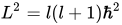
While it would be later shown that this assumption is not entirely correct, it in fact ends up being rather close to the correct expression for the orbital angular momentum operator's (eigenvalue) quantum number for large values of the quantum number , and indeed this was part of Bohr's own assumption. Regard the consequence of Bohr's assumption , and compare it with the correct version known today as . Clearly for large , there is little difference, just as well as for , the equivalence is exact. Without going into further historical detail, it suffices to stop here and regard this era of the history of quantization to be the "old quantum theory", meaning a period in the history of physics where the corpuscular nature of subatomic particles began to play an increasingly important role in understanding the results of physical experiments, whose mandatory conclusion was the discretization of key physical observable quantities. However, unlike the era below described as the era of first quantization, this era was based solely on purely classical arguments such as Wien's displacement law, thermodynamics, statistical mechanics, and the electromagnetic theory. In fact, the observation of the Balmer series of hydrogen in the history of spectroscopy dates as far back as 1885.


Nonetheless, the watershed events that would come to denote the era of first quantization took place in the vital years spanning 1925–1928. Simultaneously the authors Max Born and Pascual Jordan in December 1925, together with Paul Dirac also in December 1925, then Erwin Schrödinger in January 1926, following that, Werner Heisenberg together with Born and Jordan in August 1926, and finally Dirac in 1928. The results of these publications were three theoretical formalisms, two of which proved to be equivalent; that of Born, Heisenberg and Jordan was equivalent to that of Schrödinger, while Dirac's 1928 theory came to be regarded as the relativistic version of the prior two. Lastly, it is worth mentioning the publication of Heisenberg and Pauli in 1929, which can be regarded as the first attempt at "second quantization", a term used verbatim by Pauli in a 1943 publication of the American Physical Society.
For purposes of clarification and understanding of the terminology as it evolved over history, it suffices to end with the major publication that helped recognize the equivalence of the matrix mechanics of Born, Heisenberg, and Jordan 1925–1926 with the wave equation of Schrödinger in 1926. The collected and expanded works of John von Neumann showed that the two theories were mathematically equivalent, and it is this realization that is today understood as first quantization.
To understand the term first quantization one must first understand what it means for something to be quantum in the first place. The classical theory of Newton is a second order nonlinear differential equation that gives the deterministic trajectory of a system of mass, . The acceleration, , in Newton's second law of motion, , is the second derivative of the system's position as a function of time. Therefore, it is natural to seek solutions of the Newton equation that are at least second order differentiable.


Hub AI
First quantization AI simulator
(@First quantization_simulator)
First quantization
First quantization is a procedure for converting equations of classical particle equations into quantum wave equations. The companion concept of second quantization converts classical field equations in to quantum field equations.
However, this need not be the case. In particular, a fully quantum version of the theory can be created by interpreting the interacting fields and their associated potentials as operators of multiplication, provided the potential is written in the canonical coordinates that are compatible with the Euclidean coordinates of standard classical mechanics. First quantization is appropriate for studying a single quantum-mechanical system (not to be confused with a single particle system, since a single quantum wave function describes the state of a single quantum system, which may have arbitrarily many complicated constituent parts, and whose evolution is given by just one uncoupled Schrödinger equation) being controlled by laboratory apparatuses that are governed by classical mechanics, for example an old fashioned voltmeter (one devoid of modern semiconductor devices, which rely on quantum theory—however though this is sufficient, it is not necessary), a simple thermometer, a magnetic field generator, and so on.
Published in 1901, Max Planck deduced the existence and value of the constant now bearing his name from considering only Wien's displacement law, statistical mechanics, and electromagnetic theory. Four years later in 1905, Albert Einstein went further to elucidate this constant and its deep connection to the stopping potential of electrons emitted in the photoelectric effect. The energy in the photoelectric effect depended not only on the number of incident photons (the intensity of light) but also the frequency of light, a novel phenomenon at the time. (This work would earn Einstein the 1921 Nobel Prize in Physics.) It can then be concluded that this was a key onset of quantization, that is the discretization of matter into fundamental constituents.
About eight years later Niels Bohr in 1913, published his famous three part series where, essentially by fiat, he posits the quantization of the angular momentum in hydrogen and hydrogen like metals. Where in effect, the orbital angular momentum of the (valence) electron, takes the form , where , referred to as a quantum number, is presumed a whole number . In the original presentation, the orbital angular momentum of the electron was named , the Planck constant divided by two pi as , and the quantum number or "counting of number of passes between stationary points", as stated by Bohr originally as, . See references[which?] above for more detail.
While it would be later shown that this assumption is not entirely correct, it in fact ends up being rather close to the correct expression for the orbital angular momentum operator's (eigenvalue) quantum number for large values of the quantum number , and indeed this was part of Bohr's own assumption. Regard the consequence of Bohr's assumption , and compare it with the correct version known today as . Clearly for large , there is little difference, just as well as for , the equivalence is exact. Without going into further historical detail, it suffices to stop here and regard this era of the history of quantization to be the "old quantum theory", meaning a period in the history of physics where the corpuscular nature of subatomic particles began to play an increasingly important role in understanding the results of physical experiments, whose mandatory conclusion was the discretization of key physical observable quantities. However, unlike the era below described as the era of first quantization, this era was based solely on purely classical arguments such as Wien's displacement law, thermodynamics, statistical mechanics, and the electromagnetic theory. In fact, the observation of the Balmer series of hydrogen in the history of spectroscopy dates as far back as 1885.
Nonetheless, the watershed events that would come to denote the era of first quantization took place in the vital years spanning 1925–1928. Simultaneously the authors Max Born and Pascual Jordan in December 1925, together with Paul Dirac also in December 1925, then Erwin Schrödinger in January 1926, following that, Werner Heisenberg together with Born and Jordan in August 1926, and finally Dirac in 1928. The results of these publications were three theoretical formalisms, two of which proved to be equivalent; that of Born, Heisenberg and Jordan was equivalent to that of Schrödinger, while Dirac's 1928 theory came to be regarded as the relativistic version of the prior two. Lastly, it is worth mentioning the publication of Heisenberg and Pauli in 1929, which can be regarded as the first attempt at "second quantization", a term used verbatim by Pauli in a 1943 publication of the American Physical Society.
For purposes of clarification and understanding of the terminology as it evolved over history, it suffices to end with the major publication that helped recognize the equivalence of the matrix mechanics of Born, Heisenberg, and Jordan 1925–1926 with the wave equation of Schrödinger in 1926. The collected and expanded works of John von Neumann showed that the two theories were mathematically equivalent, and it is this realization that is today understood as first quantization.
To understand the term first quantization one must first understand what it means for something to be quantum in the first place. The classical theory of Newton is a second order nonlinear differential equation that gives the deterministic trajectory of a system of mass, . The acceleration, , in Newton's second law of motion, , is the second derivative of the system's position as a function of time. Therefore, it is natural to seek solutions of the Newton equation that are at least second order differentiable.