Hubbry Logo
Parameterized complexityParameterized complexityMain
Open search
Parameterized complexity
Community hub
Parameterized complexity
logo
7 pages, 0 posts
0 subscribers
Be the first to start a discussion here.
Parameterized complexity
from Wikipedia

In computer science, parameterized complexity is a branch of computational complexity theory that focuses on classifying computational problems according to their inherent difficulty with respect to multiple parameters of the input or output. The complexity of a problem is then measured as a function of those parameters. This allows the classification of NP-hard problems on a finer scale than in the classical setting, where the complexity of a problem is only measured as a function of the number of bits in the input. This appears to have been first demonstrated in Gurevich, Stockmeyer & Vishkin (1984). The first systematic work on parameterized complexity was done by Downey & Fellows (1999).

Under the assumption that P ≠ NP, there exist many natural problems that require super-polynomial running time when complexity is measured in terms of the input size only but that are computable in a time that is polynomial in the input size and exponential or worse in a parameter k. Hence, if k is fixed at a small value and the growth of the function over k is relatively small then such problems can still be considered "tractable" despite their traditional classification as "intractable".

The existence of efficient, exact, and deterministic solving algorithms for NP-complete, or otherwise NP-hard, problems is considered unlikely, if input parameters are not fixed; all known solving algorithms for these problems require time that is exponential (so in particular super-polynomial) in the total size of the input. However, some problems can be solved by algorithms that are exponential only in the size of a fixed parameter while polynomial in the size of the input. Such an algorithm is called a fixed-parameter tractable (FPT) algorithm, because the problem can be solved efficiently (i.e., in polynomial time) for constant values of the fixed parameter.

Problems in which some parameter k is fixed are called parameterized problems. A parameterized problem that allows for such an FPT algorithm is said to be a fixed-parameter tractable problem and belongs to the class FPT, and the early name of the theory of parameterized complexity was fixed-parameter tractability.

Many problems have the following form: given an object x and a nonnegative integer k, does x have some property that depends on k? For instance, for the vertex cover problem, the parameter can be the number of vertices in the cover. In many applications, for example when modelling error correction, one can assume the parameter to be "small" compared to the total input size. Then it is challenging to find an algorithm that is exponential only in k, and not in the input size.

In this way, parameterized complexity can be seen as two-dimensional complexity theory. This concept is formalized as follows:

A parameterized problem is a language , where is a finite alphabet. The second component is called the parameter of the problem.
A parameterized problem L is fixed-parameter tractable if the question "?" can be decided in running time , where f is an arbitrary function depending only on k. The corresponding complexity class is called FPT.
A parameterized problem uses the natural parameter when its parameter is the size of the solution to the problem.

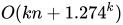
For example, there is an algorithm that solves the vertex cover problem in time,[1] where n is the number of vertices and k is the size of the vertex cover. This means that vertex cover is fixed-parameter tractable with the size of the solution as the parameter (its natural parameter).
Complexity classes

[edit]

FPT

[edit]

FPT contains the fixed parameter tractable problems, which are those that can be solved in time for some computable function f. Typically, this function is thought of as single exponential, such as , but the definition admits functions that grow even faster. This is essential for a large part of the early history of this class. The crucial part of the definition is to exclude functions of the form , such as .

The class FPL (fixed parameter linear) is the class of problems solvable in time for some computable function f.[2] FPL is thus a subclass of FPT. An example is the Boolean satisfiability problem, parameterised by the number of variables. A given formula of size m with k variables can be checked by brute force in time . A vertex cover of size k in a graph of order n can be found in time , so the vertex cover problem is also in FPL.

An example of a problem that is thought not to be in FPT is graph coloring parameterised by the number of colors. It is known that 3-coloring is NP-hard, and an algorithm for graph k-coloring in time for would run in polynomial time in the size of the input. Thus, if graph coloring parameterised by the number of colors were in FPT, then P = NP.

There are a number of alternative definitions of FPT. For example, the running-time requirement can be replaced by . Also, a parameterised problem is in FPT if it has a so-called kernel. Kernelization is a preprocessing technique that reduces the original instance to its "hard kernel", a possibly much smaller instance that is equivalent to the original instance but has a size that is bounded by a function in the parameter.

FPT is closed under a parameterised notion of reductions called fpt-reductions. Such reductions transform an instance of some problem into an equivalent instance of another problem (with ) and can be computed in time where is a polynomial.

Obviously, FPT contains all polynomial-time computable problems. Moreover, it contains all optimisation problems in NP that allow an efficient polynomial-time approximation scheme (EPTAS).

W hierarchy

[edit]

The W hierarchy is a collection of computational complexity classes. A parameterized problem is in the class W[i], if every instance can be transformed (in fpt-time) to a combinatorial circuit that has weft at most i, such that if and only if there is a satisfying assignment to the inputs that assigns 1 to exactly k inputs. The weft is the largest number of logical units with fan-in greater than two on any path from an input to the output. The total number of logical units on the paths (known as depth) must be limited by a constant that holds for all instances of the problem.

Note that and for all . The classes in the W hierarchy are also closed under fpt-reduction.

A complete problem for W[i] is Weighted i-Normalized Satisfiability:[3] given a Boolean formula written as an AND of ORs of ANDs of ... of possibly negated variables, with layers of ANDs or ORs (and i alternations between AND and OR), can it be satisfied by setting exactly k variables to 1?

Many natural computational problems occupy the lower levels, W[1] and W[2].

W[1]

[edit]

Examples of W[1]-complete problems include

  • deciding if a given graph contains a clique of size k
  • deciding if a given graph contains an independent set of size k
  • deciding if a given nondeterministic single-tape Turing machine accepts within k steps ("short Turing machine acceptance" problem). This also applies to nondeterministic Turing machines with f(k) tapes and even f(k) of f(k)-dimensional tapes, but even with this extension, the restriction to f(k) tape alphabet size is fixed-parameter tractable. Crucially, the branching of the Turing machine at each step is allowed to depend on n, the size of the input. In this way, the Turing machine may explore nO(k) computation paths.

W[2]

[edit]

Examples of W[2]-complete problems include

  • deciding if a given graph contains a dominating set of size k
  • deciding if a given nondeterministic multi-tape Turing machine accepts within k steps ("short multi-tape Turing machine acceptance" problem). Crucially, the branching is allowed to depend on n (like the W[1] variant), as is the number of tapes. An alternate W[2]-complete formulation allows only single-tape Turing machines, but the alphabet size may depend on n.

W[t]

[edit]

can be defined using the family of Weighted Weft-t-Depth-d SAT problems for : is the class of parameterized problems that fpt-reduce to this problem, and .

Here, Weighted Weft-t-Depth-d SAT is the following problem:

  • Input: A Boolean formula of depth at most d and weft at most t, and a number k. The depth is the maximal number of gates on any path from the root to a leaf, and the weft is the maximal number of gates of fan-in at least three on any path from the root to a leaf.
  • Question: Does the formula have a satisfying assignment of Hamming weight exactly k?

It can be shown that for the problem Weighted t-Normalize SAT is complete for under fpt-reductions.[4] Here, Weighted t-Normalize SAT is the following problem:

  • Input: A Boolean formula of depth at most t with an AND-gate on top, and a number k.
  • Question: Does the formula have a satisfying assignment of Hamming weight exactly k?

W[P]

[edit]

W[P] is the class of problems that can be decided by a nondeterministic -time Turing machine that makes at most nondeterministic choices in the computation on (a k-restricted Turing machine). Flum & Grohe (2006)

It is known that FPT is contained in W[P], and the inclusion is believed to be strict. However, resolving this issue would imply a solution to the P versus NP problem.

Other connections to unparameterised computational complexity are that FPT equals W[P] if and only if circuit satisfiability can be decided in time , or if and only if there is a computable, nondecreasing, unbounded function f such that all languages recognised by a nondeterministic polynomial-time Turing machine using nondeterministic choices are in P.

W[P] can be loosely thought of as the class of problems where we have a set S of n items, and we want to find a subset of size k such that a certain property holds. We can encode a choice as a list of k integers, stored in binary. Since the highest any of these numbers can be is n, bits are needed for each number. Therefore total bits are needed to encode a choice. Therefore we can select a subset with nondeterministic choices.

XP

[edit]

XP is the class of parameterized problems that can be solved in time for some computable function f. These problems are called slicewise polynomial, in the sense that each "slice" of fixed k has a polynomial algorithm, although possibly with a different exponent for each k. Compare this with FPT, which merely allows a different constant prefactor for each value of k. XP contains FPT, and it is known that this containment is strict by diagonalization.

para-NP

[edit]

para-NP is the class of parameterized problems that can be solved by a nondeterministic algorithm in time for some computable function f. It is known that if and only if .[5]

A problem is para-NP-hard if it is -hard already for a constant value of the parameter. That is, there is a "slice" of fixed k that is -hard. A parameterized problem that is -hard cannot belong to the class , unless . A classic example of a -hard parameterized problem is graph coloring, parameterized by the number k of colors, which is already -hard for (see Graph coloring#Computational complexity).

A hierarchy

[edit]

The A hierarchy is a collection of computational complexity classes similar to the W hierarchy. However, while the W hierarchy is a hierarchy contained in NP, the A hierarchy more closely mimics the polynomial-time hierarchy from classical complexity. It is known that A[1] = W[1] holds.

See also

[edit]

Notes

[edit]

References

[edit]
[edit]
Revisions and contributorsEdit on WikipediaRead on Wikipedia
from Grokipedia
Parameterized complexity is a branch of that extends classical notions of tractability by analyzing algorithmic problems in terms of both the input size nn and an additional parameter kk, often a small capturing a structural aspect of the input, such as the solution size in optimization problems. This framework classifies problems as fixed-parameter tractable (FPT) if they can be solved in time f(k)nO(1)f(k) \cdot n^{O(1)}, where ff is a depending only on kk, allowing efficient algorithms when kk is small even for large nn. In contrast to classical complexity, which lumps many NP-hard problems together as intractable, parameterized complexity provides a finer-grained to distinguish those that are "tractable" for bounded parameters from those that remain hard. The field originated in the early 1990s through the work of Rod Downey and Michael R. Fellows, who formalized it after their collaboration at a 1990 conference in , building on earlier ideas in theory and fixed-parameter algorithms. Their seminal book, Parameterized Complexity (1999), established the core theory, including the W-hierarchy for measuring intractability, where problems like kk- are W-complete under parameterized reductions, suggesting they are unlikely to be FPT unless the fails. Early milestones included density theorems (1993) and completeness results for problems like kk-Step Halting (1996), which solidified the analogy to classical . Key techniques in parameterized complexity include kernelization, which preprocesses instances to produce an equivalent problem of size bounded by a function of kk alone, enabling practical solvers for FPT problems. For example, the problem admits a kernel with O(k2)O(k^2) vertices and is solvable in O(2kn)O(2^k n) time, making it applicable in bioinformatics and network analysis. The theory also encompasses the broader class XP (slicewise polynomial time, f(k)ng(k)f(k) \cdot n^{g(k)}), which includes problems solvable efficiently for fixed kk but not necessarily FPT. Applications span graph algorithms, logic, and , where parameters like or solution depth reveal hidden tractability in otherwise hard domains.

Introduction

Definition and Motivation

Parameterized complexity is a framework within computational complexity theory that extends classical analysis by incorporating a secondary parameter kk alongside the primary input size nn, allowing for a more nuanced classification of problem hardness. In this setting, a problem is considered tractable if it admits an algorithm running in time f(k)nO(1)f(k) \cdot n^{O(1)}, where ff is an arbitrary computable function depending solely on the parameter kk, and the exponent in the polynomial term is a constant independent of kk. This formulation, introduced by Downey and Fellows, shifts focus from uniform polynomial-time solvability to efficiency when the parameter remains bounded, even for large inputs. The primary motivation for parameterized complexity stems from the shortcomings of classical complexity theory, such as the versus NP classification, which treats all NP-hard problems as uniformly intractable without accounting for structural restrictions or small values in practical instances. For example, classical theory lumps together problems like —NP-hard for arbitrary graphs—with those solvable in polynomial time, overlooking cases where the minimum size kk is small (e.g., k400k \leq 400), rendering exponential dependence on kk feasible despite superpolynomial growth in nn. Downey and Fellows developed this theory to address such gaps, enabling the identification of "easy" subclasses of hard problems where parameters capture inherent instance limitations. By contrast to classical , where intractability often implies no subexponential algorithms unless P = NP, the parameterized approach defines fixed-parameter tractability to isolate parameter-dependent costs, yielding algorithms efficient for restricted but realistic inputs. This refinement fosters practical advancements, such as tailored heuristics and exact solvers for NP-hard optimization in fields like bioinformatics and network design, where parameters like solution size or are naturally small, thereby connecting theoretical bounds to deployable computational tools.

Historical Development

The origins of parameterized complexity trace back to the late and early , when researchers began exploring ways to refine the analysis of NP-hard problems by incorporating problem-specific parameters beyond input size. Rodney G. Downey and Michael R. Fellows played pivotal roles in this foundational work, developing the initial concepts of parameterized tractability through a series of papers that emphasized algorithms running in time f(k)nO(1)f(k) \cdot n^{O(1)}, where kk is the parameter and nn is the input size. Their efforts were influenced by applications in and , aiming to distinguish tractable cases within hard problems. In the early , the field formalized key structures, including the class of fixed-parameter tractable (FPT) problems and the W-hierarchy for capturing parameterized intractability. Karl R. Abrahamson, Downey, and Fellows introduced these in a series of papers starting around 1993, establishing completeness results for classes like W[P] and linking parameterized hardness to logical reductions. The W-hierarchy drew inspiration from , providing a framework to classify problems based on the complexity of their logical definitions. This period also saw the of Downey and Fellows' seminal monograph in 1999, which systematized the theory and highlighted its connections to graph minors and . The 2000s marked significant advancements in algorithmic techniques, with kernelization emerging as a core preprocessing method. Michael R. Fellows and collaborators formalized kernelization as a systematic reduction to instances bounded by a function of the parameter, building on earlier preprocessing ideas; a landmark experimental study on vertex cover kernels appeared in 2004. Concurrently, the color-coding technique, originally proposed by Noga Alon, Raphael Yuster, and Uri Zwick in 1995 for subgraph detection, was adapted and expanded within parameterized contexts for designing FPT algorithms for problems like longest path. These developments were bolstered by influences from extremal graph theory and randomized methods. A key milestone was the first workshop on parameterized complexity, held in December 2000 in , , at the Institute of Mathematical Sciences. Subsequent workshops, such as the one held in December 2002 in Kanpur, , in conjunction with FST-TCS and organized by Fellows and Venkatesh Raman, fostered international collaboration. In recent progress up to 2025, advances in lower bounds based on the (ETH) have tightened the theory's boundaries; Dániel Marx and others developed ETH-based techniques from 2007 onward to prove no f(k)no(k)f(k) \cdot n^{o(k)} algorithms exist for certain problems, assuming ETH. As of 2025, ongoing advancements include the 19th International Symposium on Parameterized and Exact Computation (IPEC 2024) and EU-funded projects like of Parameterized Complexity exploring applications in and . Kernelization has integrated with exact algorithms, yielding practical tools for NP-hard optimization, while the field continues to draw from logic and graph theory for new classifications.

Parameterized Problems

Formal Framework

In parameterized complexity, a parameterized problem is formally defined as a pair (Q,κ)(Q, \kappa), where QΣ×NQ \subseteq \Sigma^* \times \mathbb{N} is a language over a finite alphabet Σ\Sigma, and κ:ΣN\kappa: \Sigma^* \to \mathbb{N} is a computable parameterization function that assigns a natural number parameter value to each instance xΣx \in \Sigma^*. The set QQ encodes the decision question, with instances appearing as pairs (x,k)(x, k) where k=κ(x)k = \kappa(x) represents the parameter. This framework extends classical complexity by distinguishing the input size n=xn = |x| from the typically small parameter kk, enabling finer-grained analysis of tractability. The focus in parameterized complexity is primarily on decision problems, where Q={(x,k)xLk}Q = \{(x, k) \mid x \in L_k\} and Lk={xΣ(x,k)Q}L_k = \{x \in \Sigma^* \mid (x, k) \in Q\} denotes the k-slice of QQ, consisting of all instances with parameter exactly kk that satisfy the problem. Search and optimization variants exist but are often reduced to decision versions for complexity analysis; for instance, an seeks to minimize or maximize a solution subject to feasibility, with the decision counterpart checking for a given threshold. Parameterizations can vary by domain: standard parameterizations treat kk as an explicit input value; in graph problems, vertex parameters count entities like clique , edge parameters count incidences like feedback edges, and structural parameters measure inherent graph properties such as or . Algorithmic efficiency in this setting is measured using running time notations that separate dependence on kk from nn. A problem admits an fpt-time algorithm if it can be solved in time O(f(k)nc)O(f(k) \cdot n^c) for some computable function ff and constant c>0c > 0, independent of kk. The O-notation O(f(k))O^*(f(k)) suppresses polynomial factors in nn, so O(f(k))O^*(f(k)) equivalently means O(f(k)nO(1))O(f(k) \cdot n^{O(1)}), highlighting the exponential growth solely in the parameter. Parameterized reductions preserve the complexity structure across problems. A parameterized reduction from (Q,κ)(Q, \kappa) to (Q,κ)(Q', \kappa') is a polynomial-time computable function f:Σ×NΣ×Nf: \Sigma^* \times \mathbb{N} \to \Sigma^{*'} \times \mathbb{N} such that (x,k)Q(x, k) \in Q if and only if f(x,k)=(x,k)Qf(x, k) = (x', k') \in Q', and moreover, k=κ(x)g(k)k' = \kappa'(x') \leq g(k) for some computable function g:NNg: \mathbb{N} \to \mathbb{N}. This ensures the parameter size remains bounded by a function of the original kk, allowing reductions to respect fixed-parameter tractability.

Classic Examples

One of the most prominent examples in parameterized complexity is the problem, where the goal is to find a set of at most k vertices that covers all edges in a graph. This problem is NP-hard in the classical sense but fixed-parameter tractable (FPT) when parameterized by k, the solution size. A key result is a kernelization procedure that reduces any instance to an equivalent one with at most 2k vertices, enabling efficient FPT algorithms running in time O(2^k k n + k^3) or better. The Independent Set problem asks for a set of k vertices with no edges between them. Classically NP-hard, it is W-complete when parameterized by k, implying it is unlikely to admit an FPT algorithm unless FPT = W. This hardness holds under standard assumptions in parameterized complexity and serves as a benchmark for W-hardness reductions. Similarly, the , seeking a set of k pairwise adjacent vertices, is NP-hard classically and W-complete parameterized by k. Its completeness in the W class makes it a hard problem, with no known FPT algorithms and strong evidence against their existence. The problem requires a set of k vertices such that every vertex is either in the set or adjacent to one in it. NP-hard in the classical setting, it is W-complete when parameterized by k, placing it at a higher level of hardness in the parameterized hierarchy and underscoring the limitations of FPT techniques for domination-type problems. The Traveling Salesman Problem (TSP) involves finding a minimum-cost tour visiting all vertices exactly once. When parameterized by k, the total tour cost (assuming positive integer edge weights), it is FPT, solvable via dynamic programming that bounds the state space by the parameter in special cases like unit or binary weights, with running times such as O((2k)^n) refined to FPT through techniques like inclusion-exclusion.
ProblemClassical ComplexityParameterParameterized Complexity
NP-hardk (size)FPT
Independent SetNP-hardk (size)W-complete
NP-hardk (size)W-complete
TSPNP-hardk (cost)FPT

Tractable Classes

Fixed-Parameter Tractable (FPT)

The class of fixed-parameter tractable problems, denoted FPT, encompasses parameterized decision problems solvable by an whose running time is bounded by f(k)nO(1)f(k) \cdot n^{O(1)}, where ff is some depending solely on the kk, nn is the size of the input instance, and the exponent in the polynomial term is independent of kk. This runtime form ensures that the non-polynomial dependence on the input size is isolated within the parameter, enabling efficient computation when kk is small, regardless of how large nn may be. In the theory of parameterized complexity, FPT serves as the principal notion of tractability, analogous to the class P in classical complexity, delineating problems amenable to practical algorithms under natural parameterizations. The class includes numerous optimization and decision problems arising in and beyond, where fixed-parameter algorithms exploit the structure imposed by small parameter values to achieve solvability. FPT is closed under parameterized (FPT) reductions: if there exists a parameterized reduction from problem AA to problem BB computable in g(k)nO(1)g(k) \cdot n^{O(1)} time for some computable gg, and BB \in FPT, then AA \in FPT. This closure underpins the development of the parameterized complexity hierarchy and allows algorithmic techniques to propagate across related problems. Prominent examples of problems in FPT include , parameterized by the size kk of the desired cover. This problem admits a dynamic programming that runs in O(2kkn)O(2^k k n) time, where nn is the number of vertices in the input graph, by branching on edges and bounding the search tree depth by kk. Another example is the Traveling Salesman Problem (TSP) parameterized by the solution size kk, which can be solved in f(k)nO(1)f(k) n^{O(1)} time using a Held-Karp-style dynamic programming approach over subsets of vertices of size at most kk. These examples illustrate how FPT algorithms often combine exponential dependence on kk with polynomial scaling in nn, making them viable for real-world instances with modest parameter values. The significance of FPT extends to its embodiment of parameterized efficiency, capturing a broad range of problems that are intractable in the classical sense but solvable in practice when parameterized appropriately. However, the () implies that no problem in FPT admits an running in f(k)no(1)f(k) \cdot n^{o(1)} time unless fails, underscoring that the nO(1)n^{O(1)} factor cannot be improved to subpolynomial for certain core problems without resolving major open questions in complexity theory. This lower bound reinforces the conceptual sharpness of the FPT definition and motivates ongoing research into refined parameterized s.

Slicewise Polynomial (XP)

The class XP, or Slicewise Polynomial, consists of all parameterized problems that admit an running in time O(f(k)ng(k))O(f(k) \cdot n^{g(k)}), where ff and gg are computable functions depending only on the kk, and nn is the input size. This formulation ensures that for any fixed value of the kk, the problem restricted to that slice can be solved in time in nn, though the degree of the polynomial may grow with kk. The name "slicewise polynomial" reflects this property: each fixed- slice is polynomial-time solvable, distinguishing XP from classical -time classes where the degree is independent of any . XP properly contains the class FPT of fixed-parameter tractable problems, since any FPT algorithm with running time O(f(k)nc)O(f(k) \cdot n^c) for constant cc satisfies the XP bound by setting g(k)=cg(k) = c. However, under the widely believed assumption that W \neq FPT, there exist problems in XP that are not in FPT, highlighting XP's role in capturing partially tractable cases where efficiency degrades as kk increases. A classic example is the kk-Clique problem, where the input is a graph and parameter kk, asking whether the graph contains a clique of size kk; this can be solved in O(nk)O(n^k) time by enumerating all subsets of kk vertices and checking for completeness, placing it in XP but known to be W-complete and thus presumed outside FPT. XP is closed under parameterized reductions, meaning if a problem L1L_1 reduces to L2L_2 via an FPT reduction and L2L_2 \in XP, then L1L_1 \in XP; this follows because the reduction's time bound preserves the slicewise structure. Although XP algorithms are theoretically tractable for small kk, their practicality is limited by the potentially high exponents in ng(k)n^{g(k)}, making them less efficient than FPT methods for real-world applications. In the broader landscape of parameterized complexity, XP serves to delineate "mildly intractable" problems—those solvable in time per parameter slice—from fully intractable ones, providing a baseline for hardness separations beyond FPT.

Intractable Classes

Parameterized NP (para-NP)

In parameterized complexity, para-NP is defined as the class of all parameterized decision problems that can be verified by a in fixed-parameter tractable time, specifically in time O(f(k)nc)O(f(k) \cdot n^c) for some ff, constant c1c \geq 1, input size nn, and kk. This nondeterministic FPT-time characterization makes para-NP the direct parameterized analogue of the classical NP, where verification occurs in polynomial time without parameters. The class para-NP contains several key parameterized complexity classes as subclasses. In particular, the fixed-parameter tractable class FPT and the slicewise polynomial class XP are both contained in para-NP, as deterministic FPT algorithms run in time subsumed by nondeterministic FPT, and XP algorithms operate within nf(k)n^{f(k)} time, which bounds nondeterministic FPT verification. Additionally, the entire W-hierarchy (W, W, etc.) is contained in para-NP, since problems in these classes admit nondeterministic FPT algorithms with bounded nondeterminism related to the parameter. Completeness for para-NP is established under fixed-parameter tractable (FPT) reductions. A canonical para-NP-complete problem is the parameterized halting problem (p-HALT), where the input consists of a MM and an input string xx of length nn, with k=M+xk = |M| + |x|, asking whether MM accepts xx. This problem captures the full power of para-NP, as any para-NP problem can be FPT-reduced to it via simulation of the verifier, and it is in para-NP by direct nondeterministic simulation in FPT time. Problems that are para-NP-complete under FPT reductions are considered intractable in the parameterized sense, as solving them in FPT time would imply FPT = para-NP, which is believed unlikely due to its analogy to the classical P = NP conjecture. Unlike classical NP, where hardness is uniform across input sizes, para-NP leverages the parameter kk to provide finer granularity, allowing some problems to be FPT (tractable) for small kk while remaining para-NP-hard overall, thus enabling more nuanced algorithmic analysis.

W-Hierarchy

The W-hierarchy provides a finer of parameterized intractability within para-NP, distinguishing levels of hardness based on the depth of nondeterministic verification required for solutions parameterized by kk. Introduced as a syntactic hierarchy analogous to the , it consists of classes WW for t1t \geq 1, along with W[P]W[P] at the top, each capturing problems whose solution involves increasingly complex layers of existential choices. The classes are defined using weighted satisfiability (WSAT) for nondeterministic Boolean circuits. For each t1t \geq 1, WW is the closure under FPT-reductions of the parameterized problem p-WSat(Γt,d\Gamma_{t,d}), where Γt,d\Gamma_{t,d} denotes the class of circuits with weft at most tt and depth at most dd (for constant dtd \geq t). In p-WSat(Γt,d\Gamma_{t,d}), the input is a circuit CΓt,dC \in \Gamma_{t,d} and parameter kk, and the question is whether CC has a satisfying assignment of Hamming weight exactly kk. The weft of a circuit measures the maximum number of unrestricted-fan-in AND or OR gates (called "large" gates) along any path from an input node to the output; small gates (NOT, AND/OR with fan-in at most 2) do not contribute to the weft. Circuits can be normalized to depth 2 while preserving weft, with the root being a large AND gate and internal layers consisting of large OR gates of bounded fan-in. This model captures nondeterministic computation where each layer of weft corresponds to a level of existential branching, allowing the nondeterministic machine to guess subsets of size bounded by functions of kk. W[P]W[P] extends this to circuits where the number of small gates between large gates is bounded by a polynomial in the input size. The hierarchy satisfies the inclusions \mathrm{FPT} \subseteq W{{grok:render&&&type=render_inline_citation&&&citation_id=1&&&citation_type=wikipedia}} \subseteq W{{grok:render&&&type=render_inline_citation&&&citation_id=2&&&citation_type=wikipedia}} \subseteq \cdots \subseteq W[P] \subseteq \mathrm{para\text{-}NP}, with each WW contained in the slicewise polynomial class XP and the entire hierarchy presumed proper under standard conjectures in parameterized complexity. Membership in WW implies the problem is solvable by a running in time f(k)nO(1)f(k) n^{O(1)} with at most g(k)logng(k) \log n nondeterministic steps for computable f,gf, g. It is a central assumption in the field that \mathrm{FPT} \neq W{{grok:render&&&type=render_inline_citation&&&citation_id=1&&&citation_type=wikipedia}}, as equality would collapse much of the parameterized world to FPT and imply unlikely equalities like P=NP\mathrm{P} = \mathrm{NP}. A problem is complete for WW if it is in WW and every problem in WW reduces to it via FPT-reduction; such completeness signifies that the problem encodes the full nondeterministic complexity at level tt, often requiring tt layers of existential choices in its verification. Logically, WW is characterized as the FPT-closure of the model-checking problem for the fragment Σt1\Sigma_t^1 of existential , where the first-order part has a with at most t1t-1 blocks of alternating quantifiers (starting with universal). This logical depth corresponds to tt-ary branching: each weft layer allows guessing a tt-sized or set relation of bounded by tt, with first-order checks verifying properties like connectivity or coverage in the . Being W{{grok:render&&&type=render_inline_citation&&&citation_id=1&&&citation_type=wikipedia}}-hard thus implies no FPT exists unless \mathrm{FPT} = W{{grok:render&&&type=render_inline_citation&&&citation_id=1&&&citation_type=wikipedia}}, providing a baseline for intractability. For certain WW-complete problems, the () yields tight lower bounds, such as no 2o(k)nO(1)2^{o(k)} n^{O(1)}-time for t=1t=1, underscoring the exponential dependence on the intrinsic to these classes.

A-Hierarchy

The A-hierarchy in parameterized complexity theory consists of classes AA for t1t \geq 1, defined as the closure under fixed-parameter tractable (FPT) reductions of the parameterized model-checking problem p-MC(Σt)p\text{-MC}(\Sigma_t), where Σt\Sigma_t denotes the tt-th level of the Levy hierarchy in , featuring tt alternating blocks of quantifiers beginning with existential. Equivalently, AA is characterized via alternating weighted problems p-AWSatt(Γt,dΔt,d)p\text{-AWSat}_t(\Gamma_{t,d} \cup \Delta_{t,d}), where the circuits or formulas involve t1t-1 alternations between existential and universal weighted layers of bounded depth dd. This structure captures problems with bounded alternation depth in their quantifier prefix, analogous to the but parameterized by solution size. The A-hierarchy generalizes the W-hierarchy, with A{{grok:render&&&type=render_inline_citation&&&citation_id=1&&&citation_type=wikipedia}} = W{{grok:render&&&type=render_inline_citation&&&citation_id=1&&&citation_type=wikipedia}} and W{{grok:render&&&type=render_inline_citation&&&citation_id=2&&&citation_type=wikipedia}} = A{{grok:render&&&type=render_inline_citation&&&citation_id=2&&&citation_type=wikipedia}}, while for t1t \geq 1, WAW \subseteq A holds, though some relations specify WA[t+1]W \subseteq A[t+1]. Higher levels of the A-hierarchy thus encompass W-hard problems but introduce greater expressive power through alternation, enabling classification of problems that require over existential choices, such as those resembling quantified formulas (QBF) in a parameterized setting. Completeness in the A-hierarchy is established for problems like the parameterized quantified Boolean formula problem at level tt, which is AA-complete under FPT reductions, reflecting the direct analogy to ΣtP\Sigma_t^P-completeness in classical complexity. Other examples include p-Clique-Dominating-Setp\text{-Clique-Dominating-Set}, which is A{{grok:render&&&type=render_inline_citation&&&citation_id=2&&&citation_type=wikipedia}}-complete, demonstrating how alternation captures intertwined existential and universal constraints in graph problems. The classes satisfy AA[t+1]A \subseteq A[t+1] for all t1t \geq 1 and the full A-hierarchy is contained in para-NP, with the inclusions presumed to be strict, though this remains unproven. This hierarchy refines the analysis of parameterized intractability for problems involving adversarial or game-like structures, such as p-Short-Geographyp\text{-Short-Geography}, which is complete for the unbounded alternation class AW[]AW[*] and models two-player games with parameterized move lengths.

Techniques and Reductions

FPT Reductions

In parameterized complexity, an FPT reduction (also known as an fpt-reduction) from a parameterized problem (L,κ)(L, \kappa) to another (L,λ)(L', \lambda) is a mapping that transforms an instance (x,k)(x, k) of LL into an instance (x,k)(x', k') of LL' such that (x,k)L(x, k) \in L (x,k)L(x', k') \in L', where x=f(x,k)x' = f(x, k), k=g(k)k' = g(k) for some ff and g:NNg: \mathbb{N} \to \mathbb{N}, and the mapping runs in time O(h(k)xc)O^*(h(k) \cdot |x|^c) for some computable hh and constant c1c \geq 1. This ensures the reduction is fixed-parameter tractable in the sense that its running time depends polynomially on the input size x|x| and only via a computable function on the kk. FPT reductions were formalized as a core tool for comparing parameterized problems, allowing the transfer of algorithmic or results between them. A prominent type of FPT reduction is the polynomial-time kernel reduction, where the output instance (x,k)(x', k') has size bounded by a solely of kk, independent of x|x|, and the transformation runs in polynomial time in x|x|. Such reductions are particularly useful for preprocessing, as they shrink large instances to manageable sizes dependent only on the parameter, while preserving the yes/no answer. FPT reductions preserve membership in the class FPT: if (L,λ)(L', \lambda) is fixed-parameter tractable and (L,κ)fpt(L,λ)(L, \kappa) \leq_\text{fpt} (L', \lambda), then (L,κ)(L, \kappa) is also in FPT. Conversely, they are used to establish hardness: if (L,κ)(L, \kappa) is hard for some parameterized class (e.g., W-hard) under FPT reduction and (L,κ)fpt(L,λ)(L, \kappa) \leq_\text{fpt} (L', \lambda), then (L,λ)(L', \lambda) inherits the same hardness. For instance, the parameterized fpt-reduces to Independent Set by complementing the input graph (reversing edges), showing that hardness for one implies hardness for the other; specifically, since is W-hard, so is Independent Set under this reduction. In the context of para-NP completeness, Cook-Levin-style FPT reductions construct parameterized versions of classical NP-complete problems from instances. For example, any parameterized problem in para-NP fpt-reduces to the parameterized problem via a reduction mimicking the classical Cook-Levin construction, where the parameter bounds the circuit size or length, establishing that Circuit Satisfiability is para-NP-complete. Simple examples of FPT reductions include parameter padding techniques, where dummy elements are added to an instance to adjust the without altering the yes/no answer. For the parameterized problem on graphs, one can pad the graph with isolated vertices and increase the parameter accordingly to simulate reductions from other problems, ensuring the transformation remains FPT-time computable. FPT reductions also close classes like FPT under their operation, meaning the class contains all problems reducible to any of its members.

Kernelization and Preprocessing

Kernelization is a fundamental preprocessing technique in parameterized complexity that transforms a given instance of a parameterized problem into an equivalent instance of size bounded solely by a function of the parameter value, enabling efficient subsequent solving. Formally, for a parameterized problem (L,κ)(L, \kappa), a kernelization is a polynomial-time algorithm that, on input (x,k)(x, k) with κ(x)=k\kappa(x) = k, outputs an instance (x,k)(x', k') such that xg(k)|x'| \leq g(k) for some gg, kkk' \leq k, and (x,k)L(x, k) \in L if and only if (x,k)L(x', k') \in L. This reduction must preserve the yes/no answer and is itself an FPT reduction applied to instances of the same problem. Kernelization is intimately connected to fixed-parameter tractability: a decidable parameterized problem is FPT if and only if it admits a . In contrast, a Turing kernel allows preprocessing with access to an for the parameterized problem itself, potentially via multiple calls, which provides a more flexible but computationally stronger form of reduction; however, the existence of a (standard) kernelization is equivalent to FPT membership, while polynomial Turing kernels characterize a broader class but are not directly equivalent in the same way. At the core of kernelization are data reduction rules, which are safe simplification steps that preserve equivalence and are applied exhaustively until no further reductions are possible. These rules often exploit structural properties of the instance relative to the . A classic example is the Buss rules for the problem, parameterized by solution size kk: if a vertex has degree greater than kk, include it in the cover, delete it and its incident edges, and decrement kk; after applying this, if the remaining graph has more than k(k+1)k(k+1) edges, reject the instance as a no-instance, as any cover would need at least one endpoint per edge. This yields a kernel with O(k2)O(k^2) edges. Kernels are categorized by the growth rate of the bounding function g(k)g(k). A exists if g(k)g(k) is a in kk, such as O(kc)O(k^c) for constant c>0c > 0; a linear kernel is a special case where g(k)=O(k)g(k) = O(k), often desirable for vertex-bounded problems where the number of vertices is linearly bounded in kk. Linear vertex kernels are particularly valuable in graph problems, as they facilitate bounded-search-tree or dynamic programming approaches on the reduced instance. Prominent examples illustrate kernelization's power. For , the Nemhauser-Trotter algorithm produces a kernel with at most 2k2k vertices by solving a and partitioning vertices into sets where inclusion or exclusion in an optimal cover is provably forced, reducing the instance to the undecided half-integral part. For , parameterized by solution size kk, a quadratic kernel of size at most 4k24k^2 vertices can be obtained via reduction rules that eliminate vertices in sunflowers or apply crown decompositions to bound the graph's structure. Despite these successes, kernelization has inherent limitations: numerous FPT problems, such as Clique or Dominating Set, admit no polynomial kernel unless NPcoNP/poly\mathsf{NP} \subseteq \mathsf{coNP}/\mathsf{poly}, as established by cross-composition techniques that distill multiple instances into one while preserving polynomial-size reductions only under this strong assumption. Recent refinements, such as those for graph coloring variants, confirm that even under structural parameters, polynomial kernels are impossible without collapsing complexity classes in this manner.

Algorithmic Methods

Bounded search trees, also known as branching algorithms, form a fundamental technique in parameterized complexity for solving fixed-parameter tractable (FPT) problems by recursively partitioning the search space based on the value. These algorithms construct a where each node represents a partial solution, and branching occurs by considering a small number of choices that reduce the parameter, ensuring the tree's depth is bounded by the parameter kk. The running time is analyzed via recurrences that capture the , leading to exponential dependence only on kk. For instance, in the problem—finding a set of at most kk vertices that covers all edges—a simple branching rule selects an uncovered edge uvuv and branches into two cases: including uu in the cover (reducing kk by 1 and removing incident edges) or including vv (similarly reducing kk by 1). This yields the recurrence T(k)2T(k1)T(k) \leq 2T(k-1), but a refined considering the edge's role improves it to T(k)T(k1)+T(k2)T(k) \leq T(k-1) + T(k-2), solved by the τ1.618\tau \approx 1.618 from the , giving O(1.618kn)O(1.618^k \cdot n) time. Further optimizations, such as handling high-degree vertices separately, achieve O(1.2738kkn)O(1.2738^k \cdot k n) time, demonstrating how measure-and-conquer tightens bounds beyond basic recurrences. These methods excel for problems with local structure, like set cover variants, where branching on elements reduces the instance size exponentially in kk. Color-coding is a randomized technique particularly effective for detecting small subgraphs in large graphs, transforming the problem into finding "colorful" instances via random coloring. Introduced for problems like long path detection, it assigns each vertex one of kk colors uniformly at random, ensuring that a desired kk-vertex subgraph becomes colorful (all vertices distinct colors) with probability at least k!/kkekk! / k^k \approx e^{-k}. A dynamic programming subroutine then searches for colorful subgraphs in O(2kk2n)O(2^k \cdot k^2 n) time using inclusion of color sets. Repetition O(eklogn)O(e^k \log n) times boosts success probability to 11/n1 - 1/n. For derandomization, a family of O(ek)O(e^k) perfect hash functions (colorings) guarantees at least one colorful instance, yielding deterministic O(2kk2n)O(2^k \cdot k^2 n) time. This applies to subgraph isomorphism for fixed patterns, such as finding induced PkP_k (paths of length kk). Although primarily for graphs, extensions handle problems like dd-Hitting Set in uniform hypergraphs, where color-coding identifies colorful transversals to hit all hyperedges, combined with derandomization for FPT solvability in O((2e)kpoly(n))O((2e)^k \cdot poly(n)) time. Dynamic programming on tree decompositions provides a meta-algorithm for problems on graphs with bounded ww, exploiting the graph's -like structure to compute solutions bottom-up. A decomposition is a where each node () is a of vertices of size at most w+1w+1, covering edges and maintaining connectivity. For a problem expressible in monadic (MSO), such as or , states track configurations over bags, with transitions ensuring consistency across the . The number of states is f(w)f(w) (e.g., 2O(w2)2^{O(w^2)} for MSO), and computation per is in nn, yielding total time f(w)nO(1)f(w) \cdot n^{O(1)}. Courcelle's theorem formalizes this: any MSO-definable graph property is solvable in linear time f(w)nf(w) \cdot n on bounded graphs, proven via translation to automata acceptance. Practical implementations use nice decompositions (introducing join, forget, introduce nodes) to simplify DP, applicable to MSO2 (quantifying over sets) for problems like Hamiltonicity, with f(w)=2O(wlogw)nf(w) = 2^{O(w \log w)} \cdot n time. This paradigm underpins FPT algorithms for -bounded classes, including minor-closed families by Robertson-Seymour theory. The inclusion-exclusion principle, often accelerated via fast , enables efficient computation over power sets in FPT algorithms for counting or optimization problems involving subsets. Inclusion-exclusion computes unions or intersections by alternating sums over supersets/subsets, but naive implementation is O(3kpoly(n))O(3^k \cdot poly(n)) due to O(2k)O(2^k) terms. Fast subset convolution optimizes the convolution h(S)=ASf(A)g(SA)h(S) = \sum_{A \subseteq S} f(A) g(S \setminus A) from O(3n)O(3^n) to O(2nn)O(2^n n) using ranked Möbius transform (fast zeta/möbius over subset lattice), leveraging fast Fourier-like transforms on the lattice. In FPT contexts, with universe size kk, this yields O(2kk2)O(2^k k^2) per operation, crucial for dynamic programming on subsets like Steiner tree counting or exact set cover. For example, in the kk-, it speeds up knapsack-like recurrences. These techniques integrate with other methods, such as preprocessing via kernelization to bound the instance before convolution. Derandomization in FPT often employs algebraic methods to convert randomized algorithms into deterministic ones without inflating the exponential base. For color-coding-based solvers, algebraic derandomization uses multilinear detection over algebraic circuits to find witnesses (e.g., paths) in O(2O(klogk)poly(n))O(2^{O(\sqrt{k \log k})} \cdot poly(n))
Add your contribution
Related Hubs
User Avatar
No comments yet.