



Community hub
Recent from talks
Contribute something
Nothing was collected or created yet.
Omega constant
View on WikipediaThe omega constant is a mathematical constant defined as the unique real number that satisfies the equation

It is the value of W(1), where W is Lambert's W function. The name is derived from the alternate name for Lambert's W function, the omega function. The numerical value of Ω is given by
- Ω = 0.567143290409783872999968662210... (sequence A030178 in the OEIS).
- 1/Ω = 1.763222834351896710225201776951... (sequence A030797 in the OEIS).
Properties
[edit]Fixed point representation
[edit]The defining identity can be expressed, for example, as

or

as well as

Computation
[edit]One can calculate Ω iteratively, by starting with an initial guess Ω0, and considering the sequence

This sequence will converge to Ω as n approaches infinity. This is because Ω is an attractive fixed point of the function e−x.
It is much more efficient to use the iteration
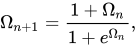
because the function
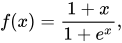
in addition to having the same fixed point, also has a derivative that vanishes there. This guarantees quadratic convergence; that is, the number of correct digits is roughly doubled with each iteration.
Using Halley's method, Ω can be approximated with cubic convergence (the number of correct digits is roughly tripled with each iteration): (see also Lambert W function § Numerical evaluation).

Integral representations
[edit]An identity due to Victor Adamchik[citation needed] is given by the relationship
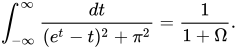
Other relations due to Mező[1][2] and Kalugin-Jeffrey-Corless[3] are:


The latter two identities can be extended to other values of the W function (see also Lambert W function § Representations).
Transcendence
[edit]The constant Ω is transcendental. This can be seen as a direct consequence of the Lindemann–Weierstrass theorem. For a contradiction, suppose that Ω is algebraic. By the theorem, e−Ω is transcendental, but Ω = e−Ω, which is a contradiction. Therefore, it must be transcendental.[4]
References
[edit]- ^ Mező, István. "An integral representation for the principal branch of the Lambert W function". Retrieved 24 April 2022.
- ^ Mező, István (2020). "An integral representation for the Lambert W function". arXiv:2012.02480 [math.CA]..
- ^ Kalugin, German A.; Jeffrey, David J.; Corless, Robert M. (2011). "Stieltjes, Poisson and other integral representations for functions of Lambert W". arXiv:1103.5640 [math.CV]..
- ^ Mező, István; Baricz, Árpád (November 2017). "On the Generalization of the Lambert W Function" (PDF). Transactions of the American Mathematical Society. 369 (11): 7928. doi:10.1090/tran/6911. Retrieved 28 April 2023.
External links
[edit]- Weisstein, Eric W. "Omega Constant". MathWorld.
- "Omega constant (1,000,000 digits)", Darkside communication group (in Japan), retrieved 2017-12-25
Omega constant
View on GrokipediaDefinition and background
Defining equation
The Omega constant, denoted by , is defined as the unique real solution to the equation where is the base of the natural logarithm.[3] This uniqueness follows from the behavior of the function , which is strictly increasing for because its derivative in that interval, and ranges from to as goes from to , crossing 1 exactly once.[3] A brief rearrangement of the defining equation yields , confirming its positive value less than 1.[3] Direct consequences of the equation include the equivalent forms and .[4] The Omega constant can also be expressed as , where is the principal branch of the Lambert W function, the multivalued inverse of .[3]Relation to Lambert W function
The Omega constant is defined as the value of the principal branch of the Lambert W function evaluated at 1, that is, , where satisfies the equation for complex .[1] The Lambert W function serves as the multivalued inverse of the function . For certain domains, particularly , it exhibits multiple real branches, but the principal branch provides the real-valued solution for real , where . This principal branch is the one relevant to the Omega constant, as lies within its domain and yields the unique real solution greater than 0.[4][3] The nomenclature "omega function" for the Lambert W function arises from historical usages of the Greek letter in related mathematical contributions, a convention that directly influenced the naming of the Omega constant for .[4] A key property unique to among real values of the Lambert W function is that it is the sole positive real number satisfying , derived from the defining relation by rearranging to isolate this equivalence.[1]Historical context
The Lambert W function, of which the Omega constant is a specific value, traces its origins to the work of Swiss polymath Johann Heinrich Lambert in 1758. In his paper "Observationes variae" published in Acta Helvetica, Lambert developed a continued fraction expansion to solve transcendental equations of the form , laying foundational groundwork for inverting functions involving exponentials.[3] This approach implicitly addressed the structure later formalized as the W function, though Lambert did not explicitly define it as such.[3] Building on Lambert's contributions, Leonhard Euler extended the analysis in 1779 through his paper "De serie Lambertina" in the Acta Academiae Scientiarum Petropolitanae. Euler derived series solutions for equations like and explored special cases, providing the first explicit description of the function's behavior in solving .[3] Despite these 18th-century advancements, the function saw limited recognition and was largely overlooked in mainstream mathematics for over a century, with no major explicit references to the value as a distinct constant prior to the 20th century.[3] The function experienced multiple rediscoveries across applied fields in the 20th century, but it remained obscure until computational needs revived interest in the late 1980s. Implemented in the Maple computer algebra system around 1986 and initially denoted as , it gained traction through its utility in solving nonlinear equations in physics and engineering.[5] A pivotal 1993 technical report by Robert M. Corless and colleagues at the University of Waterloo systematically documented its history, proposed the standardized name "Lambert W function," and highlighted its branches and applications, marking a turning point in its adoption.[3] The alias "omega function" for the Lambert W function emerged in the early 1990s, as noted in the Maple V Language Reference Manual, reflecting its resemblance to the Greek letter in certain notations.[3] This led to the designation "Omega constant" for the specific value in late-20th-century literature, with notable appearances in the Online Encyclopedia of Integer Sequences (OEIS) as sequence A030178 around the mid-1990s, where it is described as the decimal expansion of the solution to and occasionally termed the Omega constant.[6]Mathematical properties
Fixed-point identities
The Omega constant, denoted , satisfies the primary fixed-point equation , which arises directly from its definition as the solution to .[1] This equation positions as the unique attractive fixed point of the function in the real numbers, where iteration of converges to from a wide interval of starting values.[3] Taking the natural logarithm of both sides of yields , or equivalently, .[1] Rearranging the original defining relation gives , so .[1] These identities highlight the algebraic interdependence between and its reciprocal, underscoring the constant's role in solving transcendental equations involving exponentials and logarithms.[3] A notable implication of the fixed-point property is its connection to infinite tetration, or power towers. Specifically, the infinite power tower of base , denoted , converges to , as the limit satisfies , matching the primary fixed-point equation.[1] This convergence holds within the broader interval for the base, illustrating 's emergence in iterated exponentiation.[3]Transcendence
The Omega constant , defined as the unique real solution to the equation , is a transcendental number.[2] This transcendence follows directly from the Lindemann–Weierstrass theorem, which states that if is a nonzero algebraic number, then is transcendental. To see this, suppose for contradiction that is algebraic and nonzero. Then would also be algebraic by the theorem, but the defining equation implies . Since is algebraic and nonzero, is likewise algebraic, leading to a contradiction because a transcendental number cannot equal an algebraic one. Thus, must be transcendental. As a transcendental number, is irrational and cannot be the root of any nonzero polynomial equation with rational coefficients. Moreover, it has no closed-form expression in terms of elementary functions beyond its definition via the Lambert function at 1, . The same argument establishes the transcendence of for any nonzero algebraic , where denotes the principal branch of the Lambert function.[7]Representations and computation
Numerical value
The Omega constant is approximately [6]. Its reciprocal is approximately [8]. Simple rational approximations include (with absolute error less than $0.00511/19 \approx 0.5789 as an upper bound (with absolute error approximately $0.012).[6] High-precision numerical values of are readily available through mathematical software, such as the Wolfram Language functionProductLog[1].[1]
Iterative methods
The Omega constant, as the unique positive real solution to the equation , can be approximated using fixed-point iterations derived from rearrangements of this defining relation. These methods generate sequences that converge to , with the choice of iteration function determining the order of convergence. Initial guesses are typically selected in the interval (0, 1) for stability, as the function behaviors ensure monotonic or oscillatory convergence within this basin when starting near 0.5. A basic fixed-point iteration arises directly from . Beginning with , the recurrence is given by This scheme converges linearly, meaning the error where the rate . To see this, note that for a fixed-point iteration with continuously differentiable and , the Banach fixed-point theorem guarantees local convergence, and the linear rate follows from the mean value theorem applied to the error: for some between and , approaching asymptotically. Starting from , the sequence oscillates but remains bounded and contracts toward , achieving about 10 correct digits after roughly 30 iterations in double precision. For faster convergence, an accelerated fixed-point iteration can be used, based on the rearrangement , which follows from adding 1 to both sides of the original equation and dividing by . The update is This exhibits quadratic convergence, where the error satisfies for some constant . The higher order stems from the iteration function having ; differentiating gives , and substituting yields zero since . For sufficiently close initial guesses like , the method is stable and doubles the number of correct digits per iteration once in the quadratic regime, typically reaching machine precision in under 10 steps. Higher-order methods, such as Halley's method applied to the root-finding problem , provide cubic convergence. Halley's iteration, a householder method of order three, is derived from the Padé approximant to or equivalently from the third-order Taylor expansion of the inverse function. The update formula is This arises by combining Newton's step with a correction term involving the second derivative , yielding the general Halley form . The cubic rate means , tripling correct digits per step near the root. With , convergence is stable and rapid, often requiring only 5–6 iterations for high precision. These iterative approaches are commonly employed to obtain the numerical value of the Omega constant to arbitrary precision.Integral representations
One prominent integral representation involving the Omega constant arises from evaluating a definite integral over the real line via contour integration techniques: The derivation employs a semicircular contour in the upper half-plane, where the integrand's poles are located at for integer branch indices of the Lambert W function; the residue at the principal branch pole yields the result after accounting for vanishing contributions from the arc as the radius tends to infinity.[9] Another integral representation expresses directly as a logarithmic integral over : This form is obtained by specializing a more general integral representation for the principal branch of the Lambert W function, derived from the Nuttall-Bouwkamp integral for and relating it to the Taylor series coefficients of , with .[10] These integral forms provide pathways for numerically approximating through quadrature methods, complementing its connection to the Lambert W function for broader generalizations.[10]Series expansions
The Omega constant , defined as the value of the principal branch of the Lambert W function at the argument 1, , possesses a formal power series representation obtained by substituting into the Taylor series expansion of around . The power series for is given by which converges for .[3] At , this yields the formal series Since , the series diverges, but it provides an asymptotic representation of and can be resummed using methods such as Borel summation for numerical evaluation or analytic continuation beyond the radius of convergence.[3] Additional series expansions for near incorporate directly and facilitate high-precision computations in a neighborhood of this point. One such expansion, utilizing second-order Eulerian numbers , is where . This double series converges for in the complex disk , which includes .[11]References
- https://proofwiki.org/wiki/Omega_Constant_is_Transcendental