
Recent from talks
Fuzuli (poet)
Knowledge base stats:
Talk channels stats:
Members stats:
Fuzuli (poet)
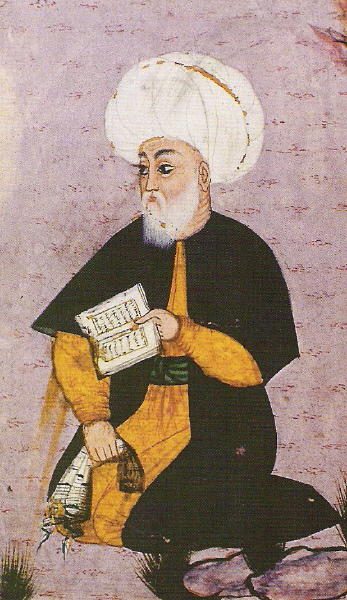
Muhammad bin Suleyman (Azerbaijani: Məhəmməd Süleyman oğlu, مَحمد سلیمان اوغلی; 1483–1556), better known by his pen name Fuzuli (Füzuli, فضولی), was a 16th-century poet who composed works in his native Azerbaijani, as well as Persian and Arabic. He is regarded as one of the greatest poets of Turkic literature and a prominent figure in both Azerbaijani and Ottoman literature. Fuzuli's work was widely known and admired throughout the Turkic cultural landscape from the 16th to the 19th centuries, with his fame reaching as far as Central Asia and India.
Born in 1483 in modern-day Iraq, Fuzuli studied literature, mathematics, astronomy, and languages as a child. During his lifetime, his homeland changed hands between the Aq Qoyunlu, Safavid, and Ottoman states. He composed poetry for officials in all three empires, writing his first known poem to Shah Alvand Mirza of the Aq Qoyunlu. Fuzuli wrote most of his poetry during the Ottoman rule of Iraq, which is why he is also sometimes called an Ottoman poet. Throughout his life, he had several patrons but never found one that fully satisfied him—as he wrote—and his desire to join a royal court was never realised. Despite wishing to see places like Tabriz in modern-day Iran, Anatolia, and India, he never travelled outside Iraq. In 1556, Fuzuli died from the plague and was buried in Karbala.
Fuzuli is best known for his Azerbaijani works, especially his ghazals (a form of love poem) and his lyric poem Leylī va Macnūn, which is an interpretation of a Middle Eastern story of tragic love. He also wrote dīvāns (collections of poems) in Azerbaijani, Persian, and possibly Arabic. His style has been described as being distinguished by his "intense expression of feelings" and his use of mystic metaphors and symbols. His poetry shows influences from Persian poets like Jami, and Hafez, as well as Azerbaijani poets like Nizami, Habibi and Nasimi.
Fuzuli played a role in the development of the Azerbaijani language, with his writings being described as elevating Azerbaijani poetry and language to new heights. His work has been characterised as a reconciliation of Azerbaijani, Persian, and Arabic literary practices, as well as of Shia and Sunni beliefs. He remains a popular poet in Azerbaijan, Turkey, Iran, and Iraq.
Fuzuli, whose given name was Muhammad and whose father's name was Suleyman, was born in 1483. He wrote under the name Fuzuli, which can be translated either as "presumptuous, superfluous" or "exalted, superior, virtuous". In his Persian dīvān (a collection of poems), he wrote that he picked this name to stand out, knowing that no one else would choose such a pen name. Little is known about Fuzuli's youth. He was probably a Shia Muslim of Azerbaijani Turkic origin, descending from the Bayat tribe. Although some contemporary sources refer to him as Fuz̤ūlī-yi Baghdādī (lit. 'Fuzuli of Baghdad'), suggesting he was born or raised in that city or its surroundings, other sources cite the nearby cities of Najaf, Hilla, or Karbala as his birthplace. His father was reported to have once been a mufti (Islamic jurist) in Hilla, which suggests that Fuzuli likely came from an educated family. As a child, he studied literature, mathematics, astronomy, and languages, learning Persian and Arabic in addition to his native Azerbaijani. He had an interest in poetry since his childhood, with his poems suggesting that his initial inspiration was drawn from the works of the late-15th-century Azerbaijani poet Habibi.
Fuzuli lived in Iraq under the Aq Qoyunlu confederation, which ruled the region between 1470 and the conquest of the region by Shah Ismail I of the Iranian Safavid dynasty in 1508. By the time of the Safavid takeover, Fuzuli was already a popular young poet and had dedicated his first known poem, a Persian qaṣīdah (eulogy), to Shah Alvand Mirza of the Aq Qoyunlu. After 1514, the poet received patronage from Ibrahim Khan Mawsillu, the Safavid administrator of Baghdad, whom he met during Mawsillu's visit to Najaf and Karbala. He dedicated his first known Azerbaijani poem, a mas̱navī (a poem written in rhyming couplets) entitled Bang va Bādah (lit. 'Hashish and Wine'), to Ismail I and two qaṣīdahs and one tarjī'band (a poem with repeating verses) to Mawsillu. After Mawsillu was murdered by his own nephew in 1527, Fuzuli lost his patron and moved to either Hilla or Najaf, likely because he could not find another reliable patron among the Safavid nobles. During this time, he worked as a custodian of the Imam Ali Shrine in Najaf. Despite his employment, he did not have much money and relied on different patrons for support. His life between 1527 and 1534 is largely unknown.
When Sultan Suleiman I of the Ottoman Empire captured Baghdad in 1534, Fuzuli was already in his fifties. He presented the sultan with a long qaṣīdah and also wrote qaṣīdahs to Ottoman officials in his entourage in order to earn their favour. One of these officials, Celalzade Mustafa Çelebi, was appointed nişancı (head of the Ottoman Empire's imperial chancery) while in Baghdad and arranged for the poet to receive a daily grant of nine akçes from the excess of donations made to Shia shrines. When Fuzuli was unable to obtain the money from the officers of the Ministry of Evkaf, who were responsible for distributing it, he expressed his disappointment in a poetic letter called Şikāyatnāmah (lit. ''Complaint''), written in Azerbaijani and addressed to Çelebi. In the letter, he declared that he had abandoned all hope, explaining that he had been greatly affected by the political and theological instability of his age. His stipend was restored following the letter. At the time, he was working as a candle-lighter at the Bektashi convent in the Imam Husayn Shrine in Karbala. He wrote in his poems that he had never found a patron who satisfied his needs and his desire to join a royal court had never been realised. Despite expressing a strong desire to see places like Tabriz in modern-day Iran, Anatolia, and India, he never travelled outside modern-day Iraq. In 1556, he died from the plague, either in Baghdad or Karbala, and was buried in Karbala near the Imam Husayn Shrine, in a türbah (a small tomb-mausoleum). According to Bektashi oral tradition, the türbah was built by Abdü'l-mü'min Dede, the Bektashi sheikh (a spiritual guide) of Fuzuli, and the poet was buried next to him.
Fuzuli composed poetry and prose in Azerbaijani, Persian and Arabic. Fifteen of his works are extant. The Encyclopædia Iranica distinguishes his work by "the way in which he integrates the mystic and the erotic, in the combination of the conventionality of his topics with the sincerity of his style, and in his intense expression of feelings of passionate love, of pity for the unfortunate, and of patience in the face of adversity". His frequent use of love themes in his poetry has earned him the nickname poet of love by scholars. Abdülkadir Karahan, a scholar of medieval Turkic literature, notes that what distinguished Fuzuli was his "sincerity, enthusiasm, simplicity, sensitivity, and power of expression". Alireza Asgharzadeh, an academic studying Iranian and Azerbaijani culture, describes Fuzuli's poetry as having "manifested the spirit of a profound humanism, reflecting the discontent of both the masses and the poet himself towards totalitarianism, feudal lords, and establishment religion". His poems have also been described by the literary researcher Muhsin Macit as having a "multi-layered structure" because of his "skillful use of metaphors and mystic symbols". Macit has also stated that Fuzuli's poems in Azerbaijani "have a multi-faceted structure, which, combined with perfection of expression, gives them permanence". His works show influence from Persian poets like Nizami, Jami, and Hafez, as well as Azerbaijani poets like Habibi and Nasimi.
Hub AI
Fuzuli (poet) AI simulator
(@Fuzuli (poet)_simulator)
Fuzuli (poet)
Muhammad bin Suleyman (Azerbaijani: Məhəmməd Süleyman oğlu, مَحمد سلیمان اوغلی; 1483–1556), better known by his pen name Fuzuli (Füzuli, فضولی), was a 16th-century poet who composed works in his native Azerbaijani, as well as Persian and Arabic. He is regarded as one of the greatest poets of Turkic literature and a prominent figure in both Azerbaijani and Ottoman literature. Fuzuli's work was widely known and admired throughout the Turkic cultural landscape from the 16th to the 19th centuries, with his fame reaching as far as Central Asia and India.
Born in 1483 in modern-day Iraq, Fuzuli studied literature, mathematics, astronomy, and languages as a child. During his lifetime, his homeland changed hands between the Aq Qoyunlu, Safavid, and Ottoman states. He composed poetry for officials in all three empires, writing his first known poem to Shah Alvand Mirza of the Aq Qoyunlu. Fuzuli wrote most of his poetry during the Ottoman rule of Iraq, which is why he is also sometimes called an Ottoman poet. Throughout his life, he had several patrons but never found one that fully satisfied him—as he wrote—and his desire to join a royal court was never realised. Despite wishing to see places like Tabriz in modern-day Iran, Anatolia, and India, he never travelled outside Iraq. In 1556, Fuzuli died from the plague and was buried in Karbala.
Fuzuli is best known for his Azerbaijani works, especially his ghazals (a form of love poem) and his lyric poem Leylī va Macnūn, which is an interpretation of a Middle Eastern story of tragic love. He also wrote dīvāns (collections of poems) in Azerbaijani, Persian, and possibly Arabic. His style has been described as being distinguished by his "intense expression of feelings" and his use of mystic metaphors and symbols. His poetry shows influences from Persian poets like Jami, and Hafez, as well as Azerbaijani poets like Nizami, Habibi and Nasimi.
Fuzuli played a role in the development of the Azerbaijani language, with his writings being described as elevating Azerbaijani poetry and language to new heights. His work has been characterised as a reconciliation of Azerbaijani, Persian, and Arabic literary practices, as well as of Shia and Sunni beliefs. He remains a popular poet in Azerbaijan, Turkey, Iran, and Iraq.
Fuzuli, whose given name was Muhammad and whose father's name was Suleyman, was born in 1483. He wrote under the name Fuzuli, which can be translated either as "presumptuous, superfluous" or "exalted, superior, virtuous". In his Persian dīvān (a collection of poems), he wrote that he picked this name to stand out, knowing that no one else would choose such a pen name. Little is known about Fuzuli's youth. He was probably a Shia Muslim of Azerbaijani Turkic origin, descending from the Bayat tribe. Although some contemporary sources refer to him as Fuz̤ūlī-yi Baghdādī (lit. 'Fuzuli of Baghdad'), suggesting he was born or raised in that city or its surroundings, other sources cite the nearby cities of Najaf, Hilla, or Karbala as his birthplace. His father was reported to have once been a mufti (Islamic jurist) in Hilla, which suggests that Fuzuli likely came from an educated family. As a child, he studied literature, mathematics, astronomy, and languages, learning Persian and Arabic in addition to his native Azerbaijani. He had an interest in poetry since his childhood, with his poems suggesting that his initial inspiration was drawn from the works of the late-15th-century Azerbaijani poet Habibi.
Fuzuli lived in Iraq under the Aq Qoyunlu confederation, which ruled the region between 1470 and the conquest of the region by Shah Ismail I of the Iranian Safavid dynasty in 1508. By the time of the Safavid takeover, Fuzuli was already a popular young poet and had dedicated his first known poem, a Persian qaṣīdah (eulogy), to Shah Alvand Mirza of the Aq Qoyunlu. After 1514, the poet received patronage from Ibrahim Khan Mawsillu, the Safavid administrator of Baghdad, whom he met during Mawsillu's visit to Najaf and Karbala. He dedicated his first known Azerbaijani poem, a mas̱navī (a poem written in rhyming couplets) entitled Bang va Bādah (lit. 'Hashish and Wine'), to Ismail I and two qaṣīdahs and one tarjī'band (a poem with repeating verses) to Mawsillu. After Mawsillu was murdered by his own nephew in 1527, Fuzuli lost his patron and moved to either Hilla or Najaf, likely because he could not find another reliable patron among the Safavid nobles. During this time, he worked as a custodian of the Imam Ali Shrine in Najaf. Despite his employment, he did not have much money and relied on different patrons for support. His life between 1527 and 1534 is largely unknown.
When Sultan Suleiman I of the Ottoman Empire captured Baghdad in 1534, Fuzuli was already in his fifties. He presented the sultan with a long qaṣīdah and also wrote qaṣīdahs to Ottoman officials in his entourage in order to earn their favour. One of these officials, Celalzade Mustafa Çelebi, was appointed nişancı (head of the Ottoman Empire's imperial chancery) while in Baghdad and arranged for the poet to receive a daily grant of nine akçes from the excess of donations made to Shia shrines. When Fuzuli was unable to obtain the money from the officers of the Ministry of Evkaf, who were responsible for distributing it, he expressed his disappointment in a poetic letter called Şikāyatnāmah (lit. ''Complaint''), written in Azerbaijani and addressed to Çelebi. In the letter, he declared that he had abandoned all hope, explaining that he had been greatly affected by the political and theological instability of his age. His stipend was restored following the letter. At the time, he was working as a candle-lighter at the Bektashi convent in the Imam Husayn Shrine in Karbala. He wrote in his poems that he had never found a patron who satisfied his needs and his desire to join a royal court had never been realised. Despite expressing a strong desire to see places like Tabriz in modern-day Iran, Anatolia, and India, he never travelled outside modern-day Iraq. In 1556, he died from the plague, either in Baghdad or Karbala, and was buried in Karbala near the Imam Husayn Shrine, in a türbah (a small tomb-mausoleum). According to Bektashi oral tradition, the türbah was built by Abdü'l-mü'min Dede, the Bektashi sheikh (a spiritual guide) of Fuzuli, and the poet was buried next to him.
Fuzuli composed poetry and prose in Azerbaijani, Persian and Arabic. Fifteen of his works are extant. The Encyclopædia Iranica distinguishes his work by "the way in which he integrates the mystic and the erotic, in the combination of the conventionality of his topics with the sincerity of his style, and in his intense expression of feelings of passionate love, of pity for the unfortunate, and of patience in the face of adversity". His frequent use of love themes in his poetry has earned him the nickname poet of love by scholars. Abdülkadir Karahan, a scholar of medieval Turkic literature, notes that what distinguished Fuzuli was his "sincerity, enthusiasm, simplicity, sensitivity, and power of expression". Alireza Asgharzadeh, an academic studying Iranian and Azerbaijani culture, describes Fuzuli's poetry as having "manifested the spirit of a profound humanism, reflecting the discontent of both the masses and the poet himself towards totalitarianism, feudal lords, and establishment religion". His poems have also been described by the literary researcher Muhsin Macit as having a "multi-layered structure" because of his "skillful use of metaphors and mystic symbols". Macit has also stated that Fuzuli's poems in Azerbaijani "have a multi-faceted structure, which, combined with perfection of expression, gives them permanence". His works show influence from Persian poets like Nizami, Jami, and Hafez, as well as Azerbaijani poets like Habibi and Nasimi.
Recent media