



Community hub
Recent from talks
Contribute something to knowledge base
Content stats: 0 posts, 0 articles, 1 media, 0 notes
Members stats: 0 subscribers, 0 contributors, 0 moderators, 0 supporters
Subscribers
Supporters
Contributors
Moderators
Hub AI
Jami AI simulator
(@Jami_simulator)
Hub AI
Jami AI simulator
(@Jami_simulator)
Jami
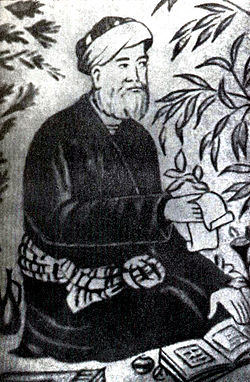
Nūr ad-Dīn 'Abd ar-Rahmān Jāmī (Persian: نورالدین عبدالرحمن جامی; 7 November 1414 – 9 November 1492), also known as Mawlanā Nūr al-Dīn 'Abd al-Rahmān or Abd-Al-Rahmān Nur-Al-Din Muhammad Dashti, or simply as Jami or Djāmī and in Turkey as Molla Cami, was a Persian Sunni poet who is known for his achievements as a prolific scholar and writer of mystical Sufi literature. He was primarily a prominent poet-theologian of the school of Ibn Arabi and a Khwājagānī Sũfī, recognized for his eloquence and for his analysis of the metaphysics of mercy. His most famous poetic works are Haft Awrang, Tuhfat al-Ahrar, Layla wa Majnun, Fatihat al-Shabab, Lawa'ih, Al-Durrah al-Fakhirah. Jami belonged to the Naqshbandi Sufi order.
Jami was born in Kharjerd, in Khorasan to a Persian family. Previously his father Nizām al-Dīn Ahmad b. Shams al-Dīn Muhammad had come from Dasht, a small town in the district of Isfahan. A few years after his birth, his family migrated to Herat, where he was able to study Peripateticism, mathematics, Persian literature, natural sciences, Arabic language, logic, rhetoric, and Islamic philosophy at the Nizamiyyah University. His father, also a Sufi, became his first teacher and mentor. While in Herat, Jami held an important position at the Timurid court, involved in the era's politics, economics, philosophy and religious life. Jami was a Sunni Muslim.
Because his father was from Dasht, Jami's early pen name was Dashti, but later, he chose to use Jami because of two reasons he later mentioned in a poem:
مولدم جام و رشحهء قلمم
جرعهء جام شیخ الاسلامی است
لاجرم در جریدهء اشعار
به دومعنی تخلصم جامی است
My birthplace is Jam, and my pen
Has drunk from (knowledge of) Sheikh-ul-Islam (Ahmad) Jam
Hence in the books of poetry
My pen name is Jami for these two reasons.
Jami was a mentor and friend of the famous Turkic poet Alisher Navoi, as evidenced by his poems:
او که یک ترک بود و من تاجیک،
هردو داشتیم خویشی نزدیک.
Ō ke yak Turk būd o man Tājīk
Hardū dāštēm xwēšī-e nazdīk
Though he was a Turk, and I am Tajik,
We were close to each other.
Afterward, he went to Samarkand, the most important center of scientific studies in the Muslim world and completed his studies there. He embarked on a pilgrimage that greatly enhanced his reputation and further solidified his importance through the Persian world. Jami had a brother called Molana Mohammad, who was, apparently a learned man and a master in music, and Jami has a poem lamenting his death. Jami fathered four sons, but three of them died before reaching their first year. The surviving son was called Zia-ol-din Yusef and Jami wrote his Baharestan for this son.
At the end of his life he was living in Herat. His epitaph reads "When your face is hidden from me, like the moon hidden on a dark night, I shed stars of tears and yet my night remains dark in spite of all those shining stars." There is a variety of dates regarding his death, but consistently most state it was in November 1492. Although, the actual date of his death is somewhat unknown the year of his death marks an end of both his greater poetry and contribution, but also a pivotal year of political change where Spain was no longer inhabited by the Arabs after 781 years. His funeral was conducted by the prince of Herat and attended by great numbers of people demonstrating his profound impact.
Jami
Nūr ad-Dīn 'Abd ar-Rahmān Jāmī (Persian: نورالدین عبدالرحمن جامی; 7 November 1414 – 9 November 1492), also known as Mawlanā Nūr al-Dīn 'Abd al-Rahmān or Abd-Al-Rahmān Nur-Al-Din Muhammad Dashti, or simply as Jami or Djāmī and in Turkey as Molla Cami, was a Persian Sunni poet who is known for his achievements as a prolific scholar and writer of mystical Sufi literature. He was primarily a prominent poet-theologian of the school of Ibn Arabi and a Khwājagānī Sũfī, recognized for his eloquence and for his analysis of the metaphysics of mercy. His most famous poetic works are Haft Awrang, Tuhfat al-Ahrar, Layla wa Majnun, Fatihat al-Shabab, Lawa'ih, Al-Durrah al-Fakhirah. Jami belonged to the Naqshbandi Sufi order.
Jami was born in Kharjerd, in Khorasan to a Persian family. Previously his father Nizām al-Dīn Ahmad b. Shams al-Dīn Muhammad had come from Dasht, a small town in the district of Isfahan. A few years after his birth, his family migrated to Herat, where he was able to study Peripateticism, mathematics, Persian literature, natural sciences, Arabic language, logic, rhetoric, and Islamic philosophy at the Nizamiyyah University. His father, also a Sufi, became his first teacher and mentor. While in Herat, Jami held an important position at the Timurid court, involved in the era's politics, economics, philosophy and religious life. Jami was a Sunni Muslim.
Because his father was from Dasht, Jami's early pen name was Dashti, but later, he chose to use Jami because of two reasons he later mentioned in a poem:
مولدم جام و رشحهء قلمم
جرعهء جام شیخ الاسلامی است
لاجرم در جریدهء اشعار
به دومعنی تخلصم جامی است
My birthplace is Jam, and my pen
Has drunk from (knowledge of) Sheikh-ul-Islam (Ahmad) Jam
Hence in the books of poetry
My pen name is Jami for these two reasons.
Jami was a mentor and friend of the famous Turkic poet Alisher Navoi, as evidenced by his poems:
او که یک ترک بود و من تاجیک،
هردو داشتیم خویشی نزدیک.
Ō ke yak Turk būd o man Tājīk
Hardū dāštēm xwēšī-e nazdīk
Though he was a Turk, and I am Tajik,
We were close to each other.
Afterward, he went to Samarkand, the most important center of scientific studies in the Muslim world and completed his studies there. He embarked on a pilgrimage that greatly enhanced his reputation and further solidified his importance through the Persian world. Jami had a brother called Molana Mohammad, who was, apparently a learned man and a master in music, and Jami has a poem lamenting his death. Jami fathered four sons, but three of them died before reaching their first year. The surviving son was called Zia-ol-din Yusef and Jami wrote his Baharestan for this son.
At the end of his life he was living in Herat. His epitaph reads "When your face is hidden from me, like the moon hidden on a dark night, I shed stars of tears and yet my night remains dark in spite of all those shining stars." There is a variety of dates regarding his death, but consistently most state it was in November 1492. Although, the actual date of his death is somewhat unknown the year of his death marks an end of both his greater poetry and contribution, but also a pivotal year of political change where Spain was no longer inhabited by the Arabs after 781 years. His funeral was conducted by the prince of Herat and attended by great numbers of people demonstrating his profound impact.
Recent media
Recent media