Hubbry Logo
FlashcardFlashcardMain
Open search
Flashcard
Community hub
Flashcard
logo
8 pages, 0 posts
0 subscribers
Be the first to start a discussion here.
Contribute something
Flashcard
Flashcard
from Wikipedia

Physical flashcards with Chinese words on one side and English on the other, for learning a language
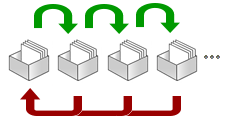
A set of flashcards demonstrating the Leitner system. Cards that the learner knows are promoted to a box for less frequent review (indicated by green arrows); cards for which the learner has forgotten the meaning are demoted to be studied more frequently (indicated by red arrows).

A flashcard or flash card is a card bearing information on both sides, usually intended to practice and/or aid memorization. It can be virtual (part of a flashcard software) or physical.

Typically, each flashcard bears a question or definition on one side and an answer or target term on the other. As such, flashcards are often used to memorize vocabulary, historical dates, formulae, or any subject matter that can be learned via a question-and-answer format.

Flashcards are an application of the testing effect, the finding that long-term memory is increased when some part of an individual's learning period is devoted to retrieving information through testing with proper feedback. Study habits affect the rate at which a flashcard user learns, and proper spacing of flashcards has been proven to accelerate learning.[1]

Format

[edit]

Two-sided cards

[edit]

Physical flashcards are two-sided. They have a number of uses and can be simple or elaborate depending on the user's needs and preferences. One may also use two parallel decks in tandem, such as an English-Japanese deck in conjunction with a Japanese-English deck.

Example

[edit]

An English-speaking student learning the Chinese word (rén 'person' or 'people') may write a card with the following sides.

Front:

Q: person
A: , rén

Reverse:

Q:
A: rén, person

Three-sided cards

[edit]

Electronic flashcards may have a three-sided card.[2] Such a card has three fields, Q, A, and A*, where Q & A are reversed on flipping, but A* is always in the answer—the two "sides" are thus Q/A,A* and A/Q,A*. These are most often used for learning foreign vocabulary, where the foreign pronunciation is not transparent from the foreign writing. In this case, the question (Q) is the native word, the answer (A) is the foreign word (written), and the pronunciation is always part of the answer (A*). This is particularly the case for character-based languages like Chinese hanzi and Japanese kanji, but it can also be used for other non-phonetic spellings such as English as a second language.

The purpose of three-sided cards is to provide the benefits of two-sided cards—ease of authoring (enter data once to create two cards), synchronized updates (changes to one are reflected in the other), and spacing between opposite sides (so opposite sides of the same card are not tested too close together)—without the card needing to be symmetric. It is analogous to an arbitrary number of data fields associated with a single record, with each field representing a different aspect of a fact or bundle of facts.

Psychology

[edit]

Flashcards specifically exercise the mental process of active recall: given a question, one must produce the correct answer. However, many have raised several questions regarding optimal usage of flashcards: how does one precisely use them, how frequently does one review, and how does one react to errors, either complete failures to recall or partial mistakes? Various systems have been developed, mostly based around spaced repetition, the technique of increasing time intervals between reviews whenever a card is recalled correctly.

Spaced repetition

[edit]

Spaced repetition is an evidence-based learning technique which incorporates increasing time intervals between each review of a flashcard in order to harness the spacing effect. Spaced repetition is an evidence-based learning technique which incorporates increasing time intervals between each review of a flashcard in order to harness the spacing effect.[3][failed verification]

Newly introduced and more difficult flashcards are shown more frequently, whereas older and less difficult flashcards are shown less frequently. The use of spaced repetition has been shown to generally increase one's rate of learning.[4] Although the principle is useful in many contexts, spaced repetition is commonly applied in contexts in which a learner must memorize a large number of items and retain them in long-term memory. It is therefore often used in vocabulary acquisition amidst second language learning. Additionally, spaced repetition software has been developed to aid the learning process through a virtual format as opposed to merely a physical one.[5]

Leitner system

[edit]
In the Leitner system, correctly answered cards are advanced to the next, less frequent box, while incorrectly answered cards return to the first box for more aggressive review and repetition.

The Leitner system is a widely used method of efficiently using flashcards. Originally proposed by the German science journalist Sebastian Leitner in the 1970s, it is a simple implementation of the principle of spaced repetition where cards are reviewed at increasing intervals.

In this method, flashcards are sorted into groups according to how well the learner knows each one in the Leitner's learning box. The learners then try to recall the solution written on a flashcard. If they succeed, they send the card to the next group. If they fail, they send it back to the first group. Each succeeding group has a longer period of time before the learner is required to revisit the cards. In Leitner's original method published in his book So lernt man Lernen (How to learn to learn), the schedule of repetition was governed by the size of the five partitions in the learning box, which were 1, 2, 5, 8, and 14 centimetres (0.4, 0.8, 2.0, 3.1, and 5.5 in), respectively. The learner only reviewed some of the cards in a section whenever it became full, subsequently moving them forward or backward depending on whether they remembered them.

Software

[edit]
Example of a virtual flashcard: using flashcard software Anki to review a mathematical formula. First, only the question is displayed. Then the answer is displayed too, for verification.

There is a wide range of software, including open source and online services, available for creating and using virtual flashcards as a learning aid.

History

[edit]

Paper flashcards have been used since at least the 19th century. Reading Disentangled (1834), a set of phonics flashcards by English educator Favell Lee Mortimer, is believed by some to be the first known usage of flashcards.[6] A single-sided hornbook was also known to have been used for early literacy education.[citation needed]

The Leitner system for scheduling flashcards was introduced by German scientific journalist Sebastian Leitner in the 1970s with his book, So lernt man lernen.[7] Later, the SuperMemo program and algorithm (specifically the SM-2 algorithm, which is the most popular in other programs) was introduced in 1987 by Polish researcher Piotr Woźniak.[8]

References

[edit]
Revisions and contributorsEdit on WikipediaRead on Wikipedia
from Grokipedia
A flashcard is a two-sided card used as an educational tool to facilitate active recall and memory retention, with a prompt such as a question, term, or on one side and the corresponding answer, , or on the other. Flashcards originated in the early as part of monitorial systems in Britain, evolving from simple printed cards for instruction to versatile tools for various subjects. By the 20th century, flashcards had gained widespread adoption in formal education and self-study across age groups and disciplines, from elementary vocabulary building to professional training in fields like medicine and law. Their effectiveness stems from cognitive principles such as active recall and spaced repetition. Empirical studies, including meta-analyses, demonstrate that regular flashcard use improves academic performance, with gains in vocabulary acquisition, comprehension, and subject mastery compared to passive reading methods. In contemporary settings, flashcards have evolved into digital formats via apps and platforms that automate and adapt to individual progress, making them accessible for in an increasingly mobile world. Tools like these have been particularly valuable in higher education and , where they support efficient review of complex material without requiring extensive instructor involvement. Despite their simplicity, flashcards remain a versatile, evidence-based staple, bridging traditional with modern technology to foster deeper understanding and retention.

Overview

Definition

A flashcard is a simple yet effective educational tool consisting of a card that presents on one or both sides, typically structured with a prompt or question on the front and a corresponding answer or explanation on the back. This format allows learners to engage directly with the material in a compact, portable manner suitable for individual or group study. The core components of a flashcard include the front side, which features a stimulus such as a term, word, question, or incomplete statement designed to prompt recall, and the back side, which supplies the targeted response, , or additional details to verify understanding. Optional enhancements, such as images, diagrams, or color coding, may be added to the front or back to support visual associations and improve engagement, particularly in subjects involving spatial or conceptual learning. Flashcards are primarily designed to aid through active self-testing, where users attempt to retrieve from the prompt before flipping to check the response, thereby strengthening neural pathways for retention. This process encourages repetition and can incorporate techniques to schedule reviews at increasing intervals for more efficient long-term learning.

Primary Uses

Flashcards are widely employed in educational settings to facilitate the of foundational across various disciplines. In language learning, they are particularly effective for acquisition, where one side of the card presents a word and the other its , translation, or example sentence, enabling learners to build lexical proficiency through repeated exposure. In , flashcards support the mastery of basic concepts such as facts by presenting problems on one side and solutions on the other, allowing students to arithmetic skills efficiently. Similarly, in instruction, they aid in retaining key dates, events, and figures by associating timelines or narratives with visual cues, helping students connect chronological facts to broader contexts. In professional training, flashcards serve as a practical tool for acquiring specialized and preparing for exams. For instance, students use them to memorize anatomical terms, drug names, and diagnostic criteria, which supports the rapid retrieval of factual information during . professionals also apply flashcards to develop competencies in areas like patient assessment and ethical guidelines, structuring training around targeted skill sets to enhance performance in real-world scenarios. This approach extends to other fields, such as teacher , where flashcards help candidates review pedagogical theories and exam-specific content for standardized tests. Beyond formal education and training, flashcards contribute to self-improvement by promoting personal expansion and behavioral . They are used for building trivia , with cards featuring questions and answers on diverse topics like or , fostering general intellectual growth through self-quizzing. In habit building, individuals create cards to track daily affirmations or routine reminders, encouraging consistent and motivation over time. The versatility of flashcards makes them adaptable to diverse learning environments, from structured classrooms to . In classroom settings, teachers distribute them for group activities that reinforce active recall, a cognitive process where learners retrieve information from to strengthen retention. For , parents customize cards to align with individualized curricula, providing flexible reinforcement for subjects like reading or without requiring extensive resources. Individual study benefits similarly, as learners can carry portable decks for on-the-go review, accommodating personal schedules and pacing.

Formats

Physical Cards

Physical flashcards are constructed from durable materials such as , cardstock, or index cards, often measuring 3 by 5 inches, to withstand repeated handling during study sessions. For enhanced longevity, especially in educational or frequent-use settings, cards may be laminated to protect against wear, tearing, and moisture. The traditional design is two-sided, with a prompt or question on the front and the corresponding answer or detail on the back, facilitating quick flipping for self-testing. For instance, a flashcard might feature the word "apple" on the front, accompanied by its ("a round with or and crisp ") and a simple on the back to aid visual association. Variations include multi-sided cards, such as three-sided formats used in subjects like , where each card displays three elements (e.g., numbers in an ) that can be partially covered to create branching questions or explore related concepts, like and division relationships. Production methods range from handmade cards, where content is written or drawn directly onto blank stock by learners or educators, to commercially printed sets generated from digital designs for uniformity and larger quantities. These cards are commonly stored in protective boxes for organized stacking or bound with metal rings for portable, flip-through access.

Digital Cards

Digital flashcards represent electronic adaptations of traditional study aids, enabling users to create, store, and review information through software interfaces on computing devices. Unlike physical cards, they leverage digital storage and processing to support enhanced flexibility in content presentation and user interaction. These cards typically consist of a front (prompt) and back (response), displayed sequentially to facilitate active recall, with transitions managed automatically by the application. Digital flashcards support diverse formats to accommodate varied learning needs. Text-based cards form the foundational structure, allowing for structured input of questions and answers in plain or formatted text. Multimedia integration extends this capability, incorporating images for visual associations, audio for pronunciation or auditory cues, and video for dynamic explanations, which research indicates can enhance vocabulary retention in language learning contexts. For instance, studies on mobile-assisted learning highlight the perceived helpfulness of such multimedia elements in improving engagement and retention compared to text-only formats. Storage for digital flashcards occurs primarily through application-specific databases or file-based systems, ensuring efficient retrieval and management of large collections. Many platforms use relational to organize cards by fields such as front, back, tags, and metadata, allowing for quick querying during study sessions. Export and import standards facilitate interoperability across tools, with files serving as a common format for transferring card data, including delimited text for prompts, responses, and optional media links. Packaged deck files, such as those in proprietary formats, also enable bulk sharing while preserving structure. Interactivity distinguishes digital flashcards by automating and personalizing the process. Auto-flipping reveals the answer after a user prompt, reducing manual handling and maintaining focus on content. shuffles card order to prevent rote and promote broader recall. tracking monitors user metrics, such as correct responses and frequency, to adjust session difficulty and provide analytics. These features, observed in self-regulated study practices among students, contribute to more efficient learning. Accessibility in digital flashcards is achieved through cross-device compatibility, allowing seamless synchronization and use across desktops, mobiles, and tablets via cloud-based or local syncing mechanisms. This portability supports studying in diverse environments without physical constraints, with responsive interfaces ensuring usability on varying screen sizes. Research comparing platforms confirms that such multi-device support correlates with higher engagement in vocabulary acquisition tasks. Many applications integrate spaced repetition algorithms to schedule reviews based on performance, optimizing long-term retention without requiring manual intervention.

Learning Principles

Spaced Repetition

Spaced repetition is a learning technique that schedules reviews of flashcards at progressively longer intervals, determined by the learner's recall success, to counteract the natural decay of memory known as the . This approach exploits the psychological principle that information is forgotten rapidly at first but more slowly over time if reinforced appropriately, as demonstrated in early experiments where retention dropped to about 58% after 20 minutes, 44% after one hour, and 33% after one day without review. By timing repetitions just before forgetting occurs, spaced repetition strengthens memory traces and promotes efficient consolidation into long-term storage. The basic algorithm for draws inspiration from Hermann Ebbinghaus's observations on memory decay, adjusting review intervals based on performance: for instance, a card answered correctly might be reviewed after one day, then three days, and subsequently one week, with intervals expanding further for consistent success. If recall fails, the interval resets to a shorter duration to rebuild familiarity. This adaptive scheduling optimizes study time by focusing more frequently on challenging material while reducing reviews for well-mastered content. Cognitive psychology research consistently shows that enhances long-term retention compared to massed practice, with meta-analyses indicating up to twice the recall efficiency after delays of weeks or months. For example, studies across diverse domains like language learning and medical diagnostics have found that spaced sessions lead to superior memory durability, often doubling retention rates over four months versus cramming. A manual application of this principle to flashcards involves the , where cards are sorted into boxes representing difficulty levels, with harder ones reviewed daily and easier ones less often. These benefits stem from neurobiological mechanisms, such as enhanced synaptic strengthening through , which is more effectively triggered by than intensive sessions. Overall, transforms flashcards from simple memorization tools into a dynamic system for sustained .

Active Recall

Active recall is a learning technique that involves actively retrieving information from through self-testing, rather than passively rereading or reviewing material. This process prompts learners to generate responses to prompts or questions without external cues, thereby engaging the in effortful retrieval to reconstruct knowledge. The mechanism underlying active recall relies on the , where the act of retrieving information strengthens neural pathways associated with consolidation. Research demonstrates that successful retrieval during testing enhances retention more effectively than restudying the same material, as it identifies knowledge gaps and reinforces traces through repeated activation. This effect is attributed to the cognitive effort required, which promotes deeper encoding and reduces over time. In the context of flashcards, active is facilitated by designing cards with a prompt on one side (such as a question or term) and the answer concealed on the other, compelling the user to attempt retrieval before verification. After generating a response, learners check the accuracy against the provided answer, correcting errors and reinforcing correct through immediate feedback. This iterative process transforms flashcards from passive tools into dynamic instruments for strengthening. Empirical evidence supports the superiority of active recall over passive strategies like highlighting or summarizing for retention. A seminal study found that students who engaged in repeated testing retained 61% of material after one week, compared to 40% for those who restudied, with benefits persisting in long-term assessments. Similarly, in , electronic flashcards using retesting yielded significantly higher recall rates (e.g., 76% vs. 61% after one week) than restudying approaches. A 2024 of 32 studies across educational levels confirmed that active recall strategies consistently improve academic performance and , with effect sizes indicating robust gains in knowledge retention over passive methods. When combined with , active recall optimizes learning outcomes by timing retrieval practice at increasing intervals, though the core benefit stems from the retrieval act itself.

Historical Development

Origins

The of flashcards is attributed to 19th-century educators responding to the demands of expanding formal during the industrial era. In 1805, British Quaker and educational reformer Joseph Lancaster introduced "reading cards" in his influential book Improvements in Education as a practical tool for teaching literacy to large groups of underprivileged students in overcrowded schools. These cards consisted of enlarged excerpts from and texts mounted on boards, allowing simultaneous instruction for up to 20 pupils without requiring individual books, and they marked an early formalized adaptation of card-based memory aids for classroom use. In , such tools aligned with the monitorial system Lancaster championed, emphasizing efficient, low-cost methods to address rising needs amid and factory work. In the early , American educators adopted similar cards for arithmetic and instruction to drill basic skills. Figures like school principal William Silas Maxson promoted their application in , where cards featuring graduated problems helped break the tedium of rote practice for students of varying ages. While later innovations, such as Dr. Sebastian Leitner's system introduced in 1972, built upon these foundations, the core flashcard concept solidified in the 1800s as a versatile aid for foundational learning. By the early , flashcards had spread widely into formal schooling in both and the , becoming staples in public education systems to support industrial-era workforce preparation.

Modern Evolution

In the mid-20th century, flashcards gained prominence in educational systems through repetitive drills. This made flashcards a staple tool for rote in classrooms, particularly in subjects like , , and , as educators sought efficient methods to reinforce learning. During the era, their use surged in the United States to bolster competitive academic performance against Soviet advancements, with commercial boxed sets becoming widely available for home reinforcement of school curricula. The late 20th century marked the onset of computerization in flashcard technology, transitioning from paper-based tools to digital formats that automated repetition scheduling. Pioneering software like , developed by Piotr Wozniak in , introduced algorithmic to optimize review intervals based on user performance, fundamentally enhancing retention efficiency over manual methods. This innovation laid the groundwork for computerized flashcards, enabling paths and reducing cognitive overload from excessive reviews. Entering the , the proliferation of smartphones post-2000 catalyzed an explosion in mobile flashcard applications, making them accessible for on-the-go study. Apps such as Anki, released in 2006 as an open-source platform, and , launched in 2007, democratized digital flashcards by supporting multimedia content and community-shared decks, with millions of users adopting them for diverse subjects. Open-source contributions further accelerated this evolution, as developers like those behind Anki fostered collaborative improvements in algorithms and interfaces, promoting widespread customization and integration of advanced features like image occlusion. The global impact of flashcards amplified during the digital education boom after 2010, particularly with the rise of massive open online courses (MOOCs). Studies have explored the integration of flashcards, including AI-generated ones, to support self-paced learning and retention in online environments. By embedding flashcards into adaptive ecosystems, educators worldwide harnessed their scalability to address diverse learner needs, from to lifelong skill-building.

Tools and Implementation

Creation Methods

Flashcard creation begins with thoughtful content design to maximize learning efficiency. Prompts on the front of a card should typically be phrased as questions rather than declarative statements to promote active recall, where the learner generates the answer independently. This approach encourages deeper processing compared to passive reading of statements. Balancing detail levels is crucial; each card should focus on a single concept, term, or fact, with complex topics broken into multiple cards to avoid overload. Incorporating mnemonics, such as acronyms or associations, can aid retention for abstract or sequential information, like using "ROY G. BIV" for the colors of the spectrum. Best practices emphasize conciseness in wording to keep prompts and answers brief, ideally fitting on one side of a standard card without excessive text. For complex topics, integrating visuals like diagrams or images enhances comprehension and , particularly when the material involves spatial or visual elements. Creators should test cards for clarity by reviewing them themselves or with peers, ensuring prompts are unambiguous and answers directly address the cue without ambiguity. For physical production, standard index cards (typically 3x5 inches) are cut or trimmed to uniform sizes using or a for a neat deck. Writing tools such as fine-tip markers or pens are recommended. In digital formats, content is entered using basic templates that separate prompt and answer fields, allowing for easy formatting and duplication across cards. Customization tailors cards to individual learner needs, such as creating bilingual versions for language study where the prompt in the native language elicits the target language response on the reverse. This method supports vocabulary building by leveraging familiar cues to reinforce new terms. Cards can also be adapted for specific subjects, like adding phonetic guides for pronunciation in or diagrams for . To integrate with , creators organize decks by difficulty or category for systematic review.

Software Applications

Software applications for flashcards have evolved into sophisticated platforms that leverage algorithms, , and cloud synchronization to enhance learning efficiency. Popular tools include Anki, an open-source program renowned for its intelligent scheduling based on user performance; , which emphasizes collaborative sharing and community-driven content; Brainscape, focused on adaptive algorithms that prioritize difficult material; RemNote, which integrates with auto-generated flashcards; and StudySmarter, offering AI-driven study plans and . These applications share core features such as deck management for organizing flashcards into customizable sets, support for elements like images, audio, and video to enrich content, and seamless across devices including desktops, smartphones, and tablets. Recent versions incorporate AI-assisted generation, where users can upload documents like PDFs or text to automatically create flashcards, reducing manual effort while ensuring relevance to study topics. Regarding algorithms, Anki implements a modified version of the SM-2 spaced repetition system, originally developed for , which adjusts review intervals based on ease factors and user ratings to optimize long-term retention. and Brainscape employ proprietary adaptive spacing mechanisms that similarly increase intervals for well-remembered cards while shortening them for challenging ones, though specifics remain closed-source. Emerging trends in flashcard software as of 2025 include some experimental projects integrating (VR) and (AR) for immersive experiences, such as overlaying 3D models onto cards to aid spatial learning in subjects like or languages. Accessibility enhancements, particularly voice input for creating and reviewing cards, have also gained prominence, enabling hands-free interaction for users with motor impairments or those multitasking.

References

Add your contribution
Related Hubs
Contribute something
User Avatar
No comments yet.