Hubbry Logo
logo
Flims
Community hub

Flims

logo
0 subscribers
Read side by side
from Wikipedia

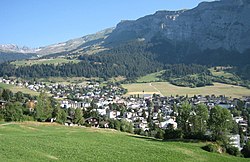
Flims (Romansh: Flem) is a municipality in the Imboden Region in the Swiss canton of the Grisons. The town of Flims is dominated by the Flimserstein which one can see from almost anywhere in the area.

Key Information

Flims consists of the village of Flims (called Flims Dorf) and the hamlets of Fidaz and Scheia as well as Flims-Waldhaus, the initial birthplace of tourism in Flims, where most of the hotels were built before and after around 1900.

A wide view of Flims Waldhaus

Geography

[edit]
Caumasee

Flims has an area of 50.5 km2 (19.5 sq mi). Of this area, 33.7% is used for agricultural purposes, while 28.9% is forested. Of the rest of the land, 3.6% is settled (buildings or roads) and the remainder (33.9%) is non-productive (rivers, glaciers or mountains).[2]

Glarus Thrust world heritage at Piz Dolf and Piz Segnas
Rhine cutting through Flims Rockslide debris

Before 2017, the municipality was located in the Trin sub-district, of the Imboden district, after 2017 it was part of the Imboden Region. Flims is located on a terrace north of the Rhine valley, forming the Ruinaulta gorge here. The country-side has numerous streams and lakes north of the village, from which the name derives; "fluminae" in Latin means "many streams". The main river is called Flem while Caumasee and Crestasee to the south of the town do not have tributaries for lying in the debris area of prehistoric Flims Rockslide, where the landscape is very rough and completely forested as there was no agriculture possible ever.

The lowest point of the municipality is at the Rhine river in the Ruinaulta at 630 meters, while Piz Segnas reaches 3099 m. Both Piz Segnas and neighbouring Piz Dolf show the line of the Glarus thrust in its upper part, now a UNESCO world heritage. The easiest access to the area is an aerial cableway to Fil de Cassons from Flims or any of various hikes to this ridge lying southeast of Piz Dolf. One route uses the ascent via Val Bargis, a wild valley running around Flimserstein.[3]

History

[edit]
Aerial view from 400 m by Walter Mittelholzer (1923)

Flims is first mentioned in 765 as Fleme.[4]

Into the 1990s, Flims dairymen delivered their milk to a dairy store in town from which villagers collected their raw or pasteurized milk daily. The location of the store is now being used as tourist information centre and the milk is being treated elsewhere. The small, quiet village was traditionally a winter home for dairymen whose animals grazed on the lush green slopes of summer. Cabins reminiscent of Heidi still dot the hillsides and ski slopes of Weisse Arena. The dairymen's winter homes are easily identified by their structure which includes stalls on ground level, home on upper level. The style allowed for rising heat from the animals to help heat the home during bitter winter months.

In 1877, in the Belle Époque, the first hotel for recreation opened, the Park Hotel Archived 2011-07-07 at the Wayback Machine. The hotel also took over the lake Caumasee and built swimming baths. In 1940 the first purpose-built holiday homes were built, nowadays more than half of all flats and homes are being used for recreation purposes.

Ancient Flims was populated since the Bronze Age, the remains of a medieval castle (Burg Belmont) can be reached by foot from the end of the public road at Fidaz within 40 minutes.

Languages

[edit]

Most of the population (as of 2000) speaks German (80.0%), with Romansh being second most common ( 6.7%).[2]

Languages in Flims
Languages Census 1980 Census 1990 Census 2000
Number Percent Number Percent Number Percent
German 1439 67.0  % 1802 80.0% 2038 80.0%
Romansh 432 20.0  % 200 9.0% 171 7.0%
Italian 91 4.0  % 62 3.0% 60 3.0%
Population 2136 100% 2258 100% 2549 100%

Weather

[edit]
Crap Sogn Gion

The Swiss climate is generally temperate, with a peak of precipitation in summer. The wettest month is August during which time Flims receives an average of 128 mm (5.0 in) of precipitation falling for an average of 12.8 days. The driest month of the year is October with an average of 82 mm (3.2 in) of precipitation over 12.8 days.[5] From October to March a lot of Switzerland suffers from fog, which does not reach Flims normally. During this period weather can remain stable for weeks and temperatures are often inverted, which means that modestly higher areas such as Flims are actually warmer than lower lying areas.

Sports

[edit]

Originally growing as a summer spa town in a distinctly wind sheltered and wide open area, especially since the building of big Hotels from 1877 on, it is nowadays also famous for winter sports (mainly skiing and snowboarding) and is now part of the Weisse Arena resort which combines the formerly separate resorts of Flims, Laax and Falera. It is regular host to international competitions such as the FIS World Championship in skiing and the Burton European Open in snowboarding. In 2004 the resort was featured in the popular Xbox snowboarding video game, Amped 2, and then in 2005 in the sequel Amped 3 on the Xbox 360. Due to the easy access the Weisse Arena cable-cars provide to the mountains, the town has become a popular winter and summer tourist locale.

Today Flims is a year-round resort popular not only with winter sports of snowboarding, cross country skiing, downhill skiing and sledding, but also summer sports including hiking, rock climbing, paragliding, mountain biking and swimming in Caumasee, a spring-fed, iridescent-blue-water lake. The area of Conn is a good point of view over the Ruinaulta (Rhine gorge), an impressive rafting and canoeing aera. There are annual figure skating camps run by Viktor Kudriavtsev and Marina Kudriatseva. Skaters who have been regulars at the camps include Swiss national team members Jamal Othman, Sarah Meier, and Stéphane Lambiel, as well as international skaters Evan Lysacek, Gregor Urbas, Karel Zelenka, Kiira Korpi, and Ari-Pekka Nurmenkari.

Skiing area
Flims mountains from left: 7 peaks of "Tschingelhörner", Piz Segnas (highest on horizon), Piz Dolf and Fil de Cassons

Heritage sites of national significance

[edit]
Schlössli or Rathaus (town council building) in Flims

The Schlössli in Flims is listed as a Swiss heritage site of national significance.[6] The mountains north of Flims are listed as a UNESCO world heritage site for their visibility of tectonic activity.

Demographics

[edit]
Flims Swiss Reformed Church
Flims Catholic Church

Flims has a population (as of 31 December 2020) of 2,915.[7] As of 2008, 19.0% of the population was made up of foreign nationals. Over the last 10 years the population has grown at a rate of 8%.[2]

As of 2000, the gender distribution of the population was 50.1% male and 49.9% female.[8] The age distribution, as of 2000, in Flims is; 219 people or 8.6% of the population are between 0 and 9 years old. 138 people or 5.4% are 10 to 14, and 184 people or 7.2% are 15 to 19. Of the adult population, 371 people or 14.6% of the population are between 20 and 29 years old. 443 people or 17.4% are 30 to 39, 354 people or 13.9% are 40 to 49, and 338 people or 13.3% are 50 to 59. The senior population distribution is 245 people or 9.6% of the population are between 60 and 69 years old, 147 people or 5.8% are 70 to 79, there are 90 people or 3.5% who are 80 to 89, and there are 20 people or 0.8% who are 90 to 99.[9]

In the 2007 federal election the most popular party was the SVP which received 33.4% of the vote. The next three most popular parties were the FDP (32.8%), the SPS (20.2%) and the CVP (12.3%).[2]

The entire Swiss population is generally well educated. In Flims about 71.3% of the population (between age 25–64) have completed either non-mandatory upper secondary education or additional higher education (either university or a Fachhochschule).[2]

Flims has an unemployment rate of 2.25%. As of 2005, there were 73 people employed in the primary economic sector and about 27 businesses involved in this sector. 205 people are employed in the secondary sector and there are 33 businesses in this sector. 1,156 people are employed in the tertiary sector, with 179 businesses in this sector.[2]

From the 2000 census, 932 or 36.6% are Roman Catholic, while 1,239 or 48.6% belonged to the Swiss Reformed Church. Of the rest of the population, there are 63 individuals (or about 2.47% of the population) who belong to the Orthodox Church, and there are 7 individuals (or about 0.27% of the population) who belong to another Christian church. There are 35 (or about 1.37% of the population) who are Islamic. There are 9 individuals (or about 0.35% of the population) who belong to another church (not listed on the census), 148 (or about 5.81% of the population) belong to no church, are agnostic or atheist, and 116 individuals (or about 4.55% of the population) did not answer the question.[9]

The historical population is given in the following table:[4][8][10]

Year Population
1850 906
1900 789
1950 1,148
1960 1,444
1970 1,936
1980 2,136
1990 2,258
2000 2,549
2010 2,587
2016 2,702

Sightseeing attractions

[edit]
Yellow House

References

[edit]
[edit]
Revisions and contributorsEdit on WikipediaRead on Wikipedia
from Grokipedia
Flims is a municipality and renowned resort town in the Imboden District of the eastern Swiss canton of Graubünden, situated at an elevation of about 1,081 meters (3,547 feet) above sea level in the Surselva region.[1] Nestled amid dramatic alpine scenery, including the Rhine Gorge—often called the "Swiss Grand Canyon"—and the turquoise Lake Cauma (Caumasee), Flims spans 50.51 square kilometers (19.50 square miles) and features a mix of villages such as Flims-Dorf, Flims-Waldhaus, Fidaz, and Scheia.[1][2] With a population of 2,902 as of late 2024, the municipality has a density of 57 inhabitants per square kilometer and a demographic composition that is 75.5% Swiss nationals, with significant minorities from Germany and Portugal; the median age is around 43 years, reflecting a balanced distribution across age groups.[2] The region's landscape was profoundly shaped by the Flims rock avalanche, a massive prehistoric event approximately 9,500 years ago that deposited over 11 cubic kilometers of debris, dammed the Vorderrhein River to form a temporary lake, and carved the iconic Ruinaulta Gorge through subsequent erosion.[3] This geological drama is part of the Swiss Tectonic Arena Sardona, a UNESCO World Heritage Site designated in 2008 for its exceptional illustration of mountain-building processes, including the visible Glarus Overthrust fault near Flims.[4] Human settlement in the area dates back to at least the Bronze Age, with the name "Flims" (Romansh: Flem) first appearing in historical records in the 8th century as Fleme, linked to early ecclesiastical donations in the region.[5] Economically, Flims thrives on tourism, forming the heart of the Flims Laax Falera holiday region, which attracts visitors for its Weisse Arena ski area boasting 216 kilometers (134 miles) of slopes, snowboarding parks, and cross-country trails, alongside summer pursuits like hiking, mountain biking, and via ferrata climbing on routes such as the historic Pinut path, Switzerland's oldest documented secured climbing route from 1739.[1][6][7] Notable attractions include the serene Lake Cresta for swimming and boating, the panoramic Il Spir viewpoint, and the Yellow House cultural center showcasing regional art and history.[1] The municipality's commitment to sustainable development is evident in the 2025 acquisition by Flims, Laax, and Falera of ski area assets for CHF 50 million, securing the infrastructure under communal ownership.[8][9] Flims also preserves its multilingual heritage, with German, Romansh, and Italian spoken, reflecting Graubünden's cultural diversity.[1]

Geography and Environment

Location and Topography

Flims is a municipality situated in the Imboden Region of the Swiss canton of Graubünden, encompassing an area of 50.5 km².[10] This expansive territory reflects the diverse alpine landscape characteristic of eastern Switzerland, where the municipality forms part of the broader Surselva area.[11] The village center lies at an elevation of 1,081 meters above sea level, positioned at the base of the prominent Flimserstein mountain, which rises to over 2,600 meters and shapes the local topography with its steep ridges and forested slopes.[10][5] Flims occupies a natural terrace overlooking the Rhine Valley to the south, immediately adjacent to the dramatic Ruinaulta gorge carved by the Anterior Rhine River.[1][11] This elevated plateau provides a strategic vantage point, with the surrounding terrain transitioning from forested highlands to the deeper valley incisions below. In terms of proximity, Flims borders the municipality of Laax to the west, sharing the expansive Flimserwald forest as a natural divider, while to the south it adjoins the Domat/Ems area along the Rhine Valley floor.[11][1] These connections integrate Flims into a network of alpine communities, facilitating access to regional trails and transport routes that skirt the gorge's edges. The topography, marked by glacial remnants and undulating plateaus, supports a mix of meadows and woodlands, with the terrain gently sloping northward away from the river.[11]

Natural Features and Protected Areas

Flims is renowned for its striking natural landscapes, shaped by geological events such as the prehistoric Flims rockslide, which formed unique water bodies and terrains. Among these, Lake Cauma (Caumasee), a turquoise karst lake fed by underground springs, stands out for its swimmable waters and idyllic setting within the Flimser Forest.[12][13] Nearby, the smaller Lake Cresta (Crestasee) offers crystal-clear waters surrounded by forested hills, providing a scenic contrast with its pristine, reflective surface.[14] The region's topography rises dramatically to Piz Segnas, the highest point at 3,099 meters, offering panoramic views of the surrounding Glarus Alps and serving as a prominent peak in the local mountain system.[15] A key natural landmark is the Ruinaulta gorge, often called Switzerland's Grand Canyon, featuring dramatic white limestone cliffs and rock formations carved by the Anterior Rhine River over millennia, resulting from the ancient Flims rockslide that blocked the valley and reshaped the landscape.[16][17] The Glarus Thrust, a major tectonic fault visible in exposed rock layers, exemplifies continental collision processes and is part of the Swiss Tectonic Arena Sardona, designated a UNESCO World Heritage site in 2008 for its outstanding geological significance, spanning about 300 square kilometers across multiple cantons including Graubünden.[18][19] These features support rich biodiversity, particularly in the Flimser Forest and alpine meadows, where diverse rock substrates foster varied flora and fauna, including endemic alpine plants, raised bogs, and alluvial ecosystems adapted to the tectonic terrain.[20][21] The area's protected status under the UNESCO designation helps preserve this ecological diversity, with forests providing habitat for native species and meadows sustaining seasonal wildflowers and wildlife.[22]

History

Early Settlement and Medieval Period

The region around Flims shows evidence of pre-Roman settlement dating back to the Bronze Age, with archaeological finds such as grinding stones, sickles, and a bronze needle from the second millennium BC discovered at sites like Val Serris, Sogn Barcazi, Schiedberg, and Salums.[23] These artifacts indicate early human activity in the area, likely by Raetian peoples who inhabited the broader Graubünden region before the arrival of the Romans in 15 BC.[11] The Roman conquest integrated the Anterior Rhine Valley into the province of Raetia, influencing local toponymy and leaving indirect traces through the evolution of the Romansh language, though no direct Roman structures have been identified in Flims itself.[23] Flims receives its first documented mention in 765 AD as "Fleme" in the testament of Bishop Tello of Chur, a member of the Victorid family, who bequeathed cleared lands in the area to the Disentis Monastery.[11] The name derives from the Latin "Flumina," referring to the abundant springs and rivers in the locality.[23] This early medieval record marks the beginning of organized land development in the Rhine Valley, with ecclesiastical institutions like the Abbey of Pfäfers acquiring significant holdings by around 840 AD, including courts, churches, mills, and arable land that supported agricultural expansion.[11] During the High Middle Ages, Flims experienced further development under both clerical and secular lords, with the Barons of Belmont establishing their influence from the 12th century onward.[24] Burg Belmont, constructed at the turn of the 10th to 11th century and expanded in the mid-12th century with a ring wall, cistern, and residential buildings, served as the ancestral seat of this noble family, first attested in 1137/39 through Lutefridus de Belmonte.[24] The castle played a key role in regional power dynamics, including alliances with the Vaz family—several Belmonts held positions as Chur cathedral canons and even the bishopric (Konrad von Belmont, 1273–1282)—and involvement in conflicts like the 1352 Belmonter Fehde against the Counts of Werdenberg-Heiligenberg.[24] The barony ended in 1371 with the death of Ulrich Walter, the last Freiherr von Belmont, after which control passed to the Sax-Misox family until 1483.[23] Flims's strategic location in the Rhine Valley positioned it along important medieval trade routes, facilitating commerce through the Lukmanier Pass and supporting local markets like Marcau, first documented in 1488 with associated weighing scales (Staderas) for goods.[11] Membership in the Grey League from 1424 enhanced its economic ties, integrating the settlement into the burgeoning confederation of Graubünden and promoting regional exchange of agricultural products, timber, and transit goods.[23] Additionally, Walser migrants from Vals settled on the Fidaz terrace after 1300, contributing to agricultural diversification and population growth during this period.[11]

Modern Era and Tourism Development

The modern era in Flims marked a pivotal shift toward tourism as the dominant economic force, beginning with the establishment of organized hospitality infrastructure in the late 19th century. In 1877, the Waldhaus Flims opened as an alpine summer spa hotel, founded by Chur natives Peter-Jakob Bener-Caviezel and Dr. Paul Lorenz, drawing initial visitors for health retreats amid the region's pristine mountain landscapes.[25] This venue, initially known as the Kur- und Seebadanstalt Waldhaus, exemplified the growing appeal of the Swiss Alps as a wellness destination, attracting affluent Europeans seeking curative air and scenery.[26] By positioning Flims as a serene retreat, the hotel laid the foundation for sustained tourist influx, transitioning the village from agrarian roots to a budding resort hub. Accessibility transformed dramatically with the opening of the Rhaetian Railway's Albula line in 1903, connecting the Engadine and broader Graubünden region to major transport networks. This engineering feat, spanning challenging alpine terrain, reduced travel times from northern Switzerland and facilitated influxes of leisure travelers, elevating Flims' profile within the burgeoning Swiss tourism sector. The railway's socio-economic ripple effects were profound, spurring hotel expansions and local commerce while integrating remote valleys like that of Flims into national and international travel circuits.[27] Prior to this, access relied on arduous coach routes over mountain passes, limiting visitor numbers; post-1903, annual tourist arrivals in Graubünden surged, with Flims benefiting from its proximity to the Rhine Gorge and tectonic landscapes.[28] The 20th century witnessed accelerated resort development in Flims, particularly in the post-World War II period, as Switzerland capitalized on global demand for alpine vacations. The 1945 inauguration of the first detachable chairlift from Flims to Foppa-Alp revolutionized winter access, enabling reliable skiing infrastructure and shifting emphasis toward year-round operations.[29] This aligned with Switzerland's broader economic boom, where tourism grew exponentially due to increased leisure travel and the allure of winter sports, positioning Flims as a multifaceted destination blending summer hiking with emerging ski facilities.[30] By the late 20th century, innovations like the 1970s expansion of lift networks solidified Flims' status, with winter overnights surpassing summer figures for the first time in 1970, reflecting a mature tourism economy.[31]

Demographics and Society

Population and Growth

As of December 31, 2020, the permanent resident population of Flims stood at 2,915.[32] By 2024, this figure was estimated at 2,902, reflecting a slight annual decline of 0.11% from 2020 onward, amid broader trends of population stabilization in Swiss alpine municipalities.[32] Projections for 2025 suggest a continued modest size around 2,900, influenced by balanced migration and natural change rates typical of tourism-dependent areas.[32] Historically, Flims experienced steady population growth, increasing from 2,549 in 2000 to 2,660 in 2010—a rise of 4.4% over the decade—followed by a more pronounced expansion to 2,915 by 2020, representing a 9.6% increase in the subsequent ten years.[32] This growth has been largely driven by the influx of residents attracted to the area's burgeoning tourism sector, including seasonal workers and retirees seeking alpine lifestyles.[32] Migration patterns underscore this dynamic, with approximately 28% of the 2024 estimated population born abroad, primarily from European countries such as Germany, Italy, and Portugal, contributing to net positive inflows through the 2010s before tapering recently.[32] The population density in Flims is approximately 57.5 inhabitants per square kilometer, based on its 50.51 km² area, which remains low compared to urban Swiss centers and highlights its rural-alpine character.[32] Age distribution shows an aging demographic, with about 26% of residents aged 65 and older in 2024 estimates, 61% in the working-age group of 18-64, and 14% under 18, reflecting patterns of retirement migration to scenic destinations.[32] Foreign nationals comprised 19.0% of the population in 2008, a figure that has since risen to around 24.5% by recent estimates, underscoring ongoing internationalization tied to economic opportunities in hospitality and services.[32]

Languages and Cultural Composition

Flims, located in the multilingual canton of Graubünden, exhibits a predominantly German-speaking population, with Swiss German serving as the primary language for the majority of residents. According to the 2000 census, 80.0% of the population spoke German as their main language, a figure that increased to 84.5% based on pooled structural surveys from 2010 to 2014, reflecting a trend toward greater dominance amid regional linguistic shifts.[33][34] Romansh, one of Switzerland's four national languages and prominent in Graubünden, is spoken as the main language by a minority of 6.7% in 2000, rising to 10.1% in the 2010-2014 period, underscoring the canton's enduring multilingual heritage.[33][34] Italian represents a smaller but notable linguistic presence at 2.5% in the 2010-2014 surveys, influenced by proximity to Italian-speaking regions and cross-border interactions.[34] Other languages, including English, Portuguese, and various immigrant tongues, contribute to the mix due to Flims' role as a tourism hub and its growing immigrant community; foreign nationals comprised about 19.0% of the population in 2008, with recent estimates indicating further increases driven by seasonal workers and international residents attracted to the area's economic opportunities.[32] This diversity enriches the cultural composition, where approximately 2,900 residents as of 2020 navigate a blend of local traditions and global influences.[32] Cultural life in Flims reflects these linguistic groups through events that celebrate heritage and integration. Romansh-speaking communities participate in traditional observances like Chalandamarz, a spring festival on March 1 involving bell-ringing processions and songs to welcome the season, emblematic of Graubünden's Romansh customs.[35] Additionally, the annual Alpine Festival features parades of decorated livestock and local music, tying into broader Swiss-German rural traditions while fostering community ties across language lines.[36] Multicultural initiatives, such as the "Flims Goes International" evening, highlight immigrant contributions through global cuisine and performances, promoting cultural exchange among diverse linguistic backgrounds.[37]

Economy and Tourism

Economic Structure and Employment

Flims maintains a robust economic structure aligned with low unemployment in the canton of Graubünden, which stood at 1.1% in July 2025, indicating continued resilience in local employment conditions.[38] The economy is predominantly service-oriented, with tourism as the primary driver in the tertiary sector. Small-scale agriculture and forestry contribute modestly but vitally to the local economy, employing a limited workforce while preserving traditional land use and providing supplementary income for residents. Local businesses, often family-run, further bolster economic sustainability by offering essential goods and services, fostering community ties and reducing reliance on external supply chains. In 2025, Flims, along with Laax and Falera, invested CHF 50 million to enhance tourism infrastructure and secure the ski area's future under communal ownership.[8] Post-2020, Flims has demonstrated economic resilience amid global challenges, with employment trends remaining stable through 2025, supported by the canton's overall low unemployment.[39]

Tourism Industry and Attractions

Flims Laax functions as a year-round resort destination, drawing visitors for diverse seasonal pursuits that bolster the local economy through substantial overnight stays. In the winter of 2023/24, hotels recorded 245,616 overnights, a 12% increase from 219,409 the prior season, reflecting robust demand. Local estimates position tourism as a major economic driver in alpine areas like Flims, contributing up to 10% of regional GDP through visitor spending on accommodations and services.[40][41] Prominent attractions emphasize natural and wellness experiences tailored to summer visitors. Lake Cauma (Caumasee), a striking turquoise alpine lake with water temperatures reaching 24°C, offers designated swimming areas, floating platforms, and surrounding lawns for sunbathing, accessible via short hikes and open daily during the bathing season. The region features approximately 250 km of well-marked hiking trails through forests, cliffs, and mountain landscapes, accommodating various fitness levels and providing scenic routes like those around enchanted woodlands and glacial mills. Complementing these, spa facilities such as the 850 m² La Senda Spa include indoor pools and wellness treatments, promoting relaxation amid the alpine setting.[42][43] The FlemXpress RopeTaxi represents a pioneering feat of engineering in the region, operating as the world's first on-demand gondola system. Developed by Bartholet Maschinenbau, this innovative transport solution features autonomous cabins that operate individually and stop only when needed, improving efficiency, occupancy, and reducing noise. Construction began in 2022, with partial operations starting in 2023 and the full line expected to open by winter 2025-26, enhancing access to ski areas in winter and mountain biking trails in summer.[44][45][46] Since 2020, sustainable tourism has expanded in Flims Laax via the Greenstyle initiative, implementing over 200 projects focused on renewable energy, zero waste, and biodiversity preservation, with a target of 100% renewable energy usage by 2030. These efforts encompass ranger-led nature education, wildflower planting campaigns, and a foundation supporting environmental protection, enhancing the destination's appeal to eco-conscious travelers without formal eco-certifications specified.[47] International visitors significantly influence the local economy, comprising a majority of overnight stays in Swiss alpine resorts, and 2024-2025 trends indicate full recovery to pre-pandemic levels, mirroring national figures of nearly 43 million hotel overnights in 2024.[48]

Climate

Seasonal Weather Patterns

Flims experiences a temperate alpine climate, marked by pronounced seasonal shifts that influence local activities and landscapes. Winters, spanning December to March, bring cold temperatures with average highs around 0°C and lows near -6°C in January, accompanied by frequent snowfall that accumulates to depths supporting skiing and snowboarding. This period features shorter days and often overcast skies, with precipitation primarily falling as snow.[49] Summers, from June to September, offer mild and comfortable conditions conducive to outdoor pursuits like hiking, with July recording average highs of 21°C and lows of 11°C under longer daylight hours exceeding 15 hours. Temperatures remain moderate, rarely exceeding 25°C, while rainfall increases, fostering lush greenery in the surrounding valleys and forests. Clearer skies during this season, with over 50% clear days in July, enhance visibility for exploring alpine trails.[49] Transitional seasons of spring (March to May) and autumn (September to November) exhibit greater variability, with fluctuating temperatures, frequent fog in valleys, and intermittent rain that can limit prolonged outdoor endeavors. Spring sees gradual warming from January's chill to May highs around 13°C, interspersed with lingering snowmelt and showers, while autumn cools from summer peaks to November averages below 5°C, often with misty mornings and increased precipitation influencing daily routines.[49]

Climate Data and Environmental Influences

Flims, located at an elevation of approximately 1,040 meters in the Swiss Alps, experiences a temperate alpine climate with an annual average temperature of around 6°C, characterized by cool summers and cold winters. Monthly temperatures typically range from a mean of -3°C in January to 16°C in July, with significant diurnal variations due to the mountainous terrain. Precipitation is abundant, totaling about 1,811 mm annually, distributed relatively evenly but with peaks in summer; June is the wettest month at approximately 180 mm, while February is the driest at 100 mm. These figures reflect data from long-term observations, highlighting Flims' position in a precipitation-rich valley influenced by orographic lift from surrounding peaks.[50][51] The alpine topography of the region profoundly shapes local weather patterns, creating microclimates where conditions can vary sharply over short distances. Valleys like the Domleschg, where Flims lies, trap moisture and foster fog, while elevated slopes receive heavier snowfall. Föhn winds, warm and dry downslope gusts originating from the Mediterranean, periodically disrupt these patterns, rapidly raising temperatures by up to 20°C and reducing humidity, which benefits activities like paragliding but can exacerbate fire risks in dry seasons. This phenomenon, common across Graubünden, exemplifies how the Alps' barrier effect warms leeward areas while channeling strong winds through passes.[52][53] Long-term climate trends indicate accelerated warming in Switzerland's alpine zones, with temperatures rising 2.9°C above pre-industrial levels as of 2024—faster than the global average due to elevation and land-atmosphere interactions. In Graubünden, this manifests as shorter snow seasons, reduced glacier mass, and more frequent heatwaves, with projections from Climate CH2025 forecasting a further 1-3°C increase by mid-century under moderate emissions scenarios. Summers are becoming drier overall, though intense rainfall events are intensifying, contributing to erosion and flooding risks in valleys like Flims'. These shifts, driven by global greenhouse gas emissions, have already shortened the reliable snow cover period by several weeks since the 1980s.[54][55] Historical weather events underscore the region's vulnerability to extremes amplified by its topography. Heavy snowfalls in the Swiss Alps during the 2018 winter exceeded 2 meters in higher elevations, periodically isolating communities and straining infrastructure in Graubünden. Conversely, droughts like the severe 2022 event across Switzerland led to low water levels in the Rhine tributaries near Flims, impacting agriculture and hydropower. More recently, in August 2025, a thunderstorm-triggered debris flow in the Sorte hamlet of Graubünden highlighted the growing threat of compound events—intense rain on warming soils—exacerbating landslides in this geologically active area.[56][57][58]

Sports and Recreation

Winter Sports Facilities

Flims is renowned for its extensive winter sports infrastructure, primarily centered around the Weisse Arena ski area, which interconnects the villages of Flims, Laax, and Falera in the Graubünden region of Switzerland.[59] This interconnected network offers 216 kilometers of slopes suitable for all skill levels, ranging from beginner-friendly blues to challenging blacks, supported by modern lift systems that ensure efficient access across the terrain.[59] The area's elevation spans from 1,100 meters in the valley to over 3,000 meters at the peaks, providing reliable snow cover and diverse riding opportunities throughout the winter season.[60] Key facilities within the Weisse Arena include a comprehensive array of cable cars and gondolas, with 30 lifts in total facilitating quick ascents and minimizing wait times for visitors.[59] These include notable installations like the Arena Express gondola from Flims and the Laax-Crap Sogn Gion cable car, which were upgraded in 2010 to increase capacity by up to 20%.[61] A recent innovative addition to this gondola network is the FlemXpress RopeTaxi, the world's first on-demand gondola system, featuring autonomous individual cabins that operate efficiently and stop only when needed, enhancing access to the slopes.[44][62] In October 2025, the municipalities of Flims, Laax, and Falera assumed ownership of the Weisse Arena infrastructure via a CHF 50 million investment, ensuring its long-term sustainability.[9] Complementing the slopes are five dedicated snow parks, including the renowned Snowpark Laax with Europe's largest superpipe, designed for freestyle skiing and snowboarding with features like rails, jumps, and halfpipes.[63] These parks cater to advanced riders seeking progression parks and big air competitions, enhancing Flims' appeal as a hub for freestyle disciplines.[64] The region has hosted prestigious international events, underscoring its status in competitive winter sports. In 2019, Laax within the Weisse Arena served as the venue for FIS Snowboard World Cup events, including slopestyle and halfpipe competitions that drew top athletes like Chloe Kim and Scotty James. The Burton European Open, a flagship freestyle snowboarding contest established in Laax in 2001, continues to attract global participants for slopestyle and halfpipe challenges, solidifying the area's reputation for high-level competitions.[65] Beyond physical venues, Flims and Laax have gained virtual prominence, appearing as playable locations in the snowboarding video games Amped 2 (2003) and Amped 3 (2005), where players explore recreated slopes and parks.[66]

Summer Activities and Events

Flims offers a diverse array of summer activities centered on its stunning alpine landscapes, including extensive hiking and mountain biking trails that weave around pristine lakes and dramatic gorges. The Connbächli nature trail, a 6 km family-friendly route starting near Lake Cauma, explores waterways and forests with interactive elements like ship-building stations, taking about 1.5 hours to complete.[67] More challenging hikes, such as the Wasserweg trail, delve into the underground springs feeding Flims' lakes, while the High Valley of Bargis path from Fidaz showcases local Graubünden cuisine amid high-alpine scenery.[1] Mountain biking enthusiasts can access over 300 km of trails via the FlemXpress RopeTaxi, the world's first on-demand gondola system and a feat of engineering with autonomous individual cabins, including routes through the Rhine Gorge—known as the "Grand Canyon of Switzerland"—with viewpoints like the Il Spir observation platform offering panoramic vistas of the tectonic formations.[1][67][44][62] Aquatic and aerial pursuits provide refreshing alternatives, with Lake Cauma (Caumasee) serving as a highlight for swimming and boating amid its turquoise waters surrounded by pine forests. This car-free lake, accessible by a short walk from Flims village, features rowboat rentals and designated swimming areas, drawing visitors for its crystal-clear depths up to 34 meters.[1][67] Paragliding launches from sites near Flimserstein, such as Crap Sogn Gion at 2,228 meters, allow tandem flights over the valley, landing in Flims or nearby Larnags, with operators like Flightbase providing year-round experiences.[53] Adventure seekers can tackle the historic Pinut via ferrata, Switzerland's oldest such route dating to 1907 and renovated in 2007, ascending from Fidaz through vertical rock faces on the Flimserstein with 27 ladders, steps, and a 20-meter natural tunnel. Rated K1-2 difficulty, it suits participants aged 12 and older, covering 480 meters of elevation gain in about 30 minutes of climbing, followed by a 2-hour descent via alpine paths.[68] Guided nature tours enhance these experiences, such as interpretive walks along the Rhine Gorge or Bargis plateau, led by local experts highlighting geological wonders like the Swiss Tectonic Arena Sardona UNESCO site.[1][69] Summer in Flims also features cultural events that blend recreation with local flair, including the recurring Flimsfestival with sunrise concerts (Sonnenaufgang) and live music performances in venues like hotel lobbies or mountain settings. Family-oriented events and markets pop up seasonally, offering comedy, cabaret, and artisanal goods amid the alpine backdrop, often held in Flims village or Laax.[70][71]

Cultural Heritage

Sites of National Significance

Flims features several officially recognized sites of national significance, primarily documented in Switzerland's Inventory of Cultural Property of National and Regional Significance (KGS) managed by the Federal Office of Culture (BAK). The Schlössli, located at Via dil Casti 2 in Flims-Dorf, is classified as a class A cultural property of national importance under KGS number 3016.[72] Constructed in 1682 as a manor house for Johann Gaudenz von Capol, a prominent local figure, the building exemplifies late 17th-century Swiss architecture with its strict exterior and ornate interior, including the renowned "Reiche Stube" (Rich Room) featuring elaborate wood paneling from 1684 that was temporarily exhibited in Berlin before returning to Flims.[73] Today, it functions as the municipal town hall, ensuring its ongoing use and visibility to the public.[74] The ruins of Burg Belmont, situated northeast of Flims on a rocky outcrop, represent a key medieval heritage site dating to the 10th or 11th century and associated with the Barons of Belmont. While primarily a local landmark, these ruins contribute to the broader cultural and historical fabric protected under cantonal heritage guidelines, with remnants including wall sections and foundations that illustrate early feudal structures in Graubünden.[75] Preservation efforts for these sites are coordinated by the municipality of Flims, the Canton of Graubünden, and federal bodies like the BAK, emphasizing maintenance, documentation, and public access. The Schlössli benefits from regular upkeep as a functional public building, while hiking trails provide accessible viewpoints to Burg Belmont ruins, promoting sustainable tourism without compromising structural integrity.[76]

Local Traditions and Landmarks

Flims' cultural traditions are profoundly shaped by its location in the Surselva region, where the Sursilvan dialect of Romansh is spoken and influences local customs. One prominent Romansh-influenced practice is the production of alpine cheese, crafted from the milk of cows grazing on nutrient-rich mountain pastures during the summer transhumance period, a method that preserves the region's pastoral heritage and contributes to specialties like Graubünden Alpkäse.[77] This tradition underscores the community's connection to the land, with cheese-making often occurring in remote alpine huts as part of seasonal routines. Community events in Flims revolve around seasonal changes, particularly the end-of-summer harvest of dairy resources. The annual Alpabzug Flimserstein exemplifies this, a longstanding alpine festival held in late September that marks the descent of approximately 200 cows and calves from high pastures back to the valley.[78] Participants adorn the animals with flowers and bells for a festive procession, accompanied by live music, market stalls offering local crafts and foods, and a communal breakfast, fostering social bonds and celebrating the culmination of the grazing season. Among Flims' notable landmarks is the Evangelische Kirche St. Martin, a reformed church situated in the historic core of Flims-Dorf, which serves as a focal point for religious and social gatherings reflective of the area's Protestant heritage. Traditional chalets dot the landscape, exemplifying Graubünden's alpine architectural style with their sturdy wooden frames, sloped roofs for heavy snow, and integration of local timber to harmonize with the mountainous terrain. The Yellow House stands out as an emblematic structure, its distinctive design capturing the essence of 19th-century regional building practices.[79] These features highlight Flims' blend of functionality and aesthetic simplicity, rooted in centuries of adaptation to the harsh alpine environment.

References

User Avatar
No comments yet.