Hubbry Logo
Flip cupFlip cupMain
Open search
Flip cup
Community hub
Flip cup
logo
8 pages, 0 posts
0 subscribers
Be the first to start a discussion here.
Flip cup
Flip cup
from Wikipedia
Flip Cup
Drinking Game
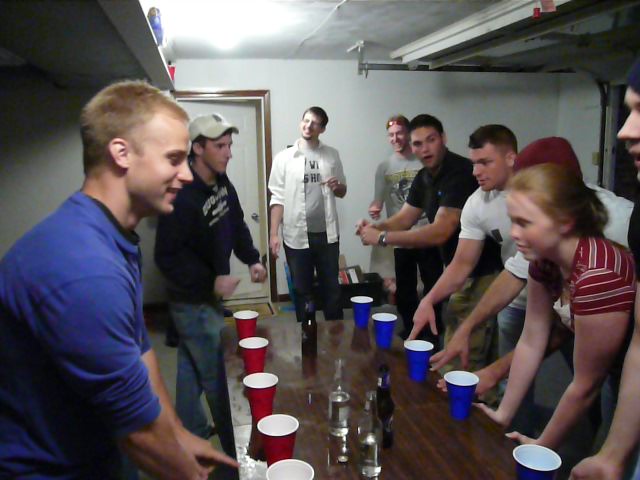
A game of flip cup about to begin (2007)
Players4+
Setup time2–3 minutes
Playing timeAs long as teams choose
ChanceEasy
SkillsCup-flipping, Beer-chugging

Flip cup is a team-based drinking game[1] where players must, in turn, drain a plastic cup of beer and then "flip" the cup so that it lands face-down on the table. If the cup falls off the table, any player can return said cup to the playing field. Several flip cup tournaments have been held in the United States.[2]

A 2017 survey by the American Addiction Centers found flip cup to be the most quickly intoxicating drinking game played by those surveyed, with participants being able to reach a theoretical blood alcohol content of 0.08, the legal driving limit, within 20 minutes of play.[3]

Gameplay

[edit]
An animation of the Flip Cup action

Two teams of an equal number of players stand on opposite sides of a table, facing one another. The players directly facing are opponents. In front of each teammate is a disposable plastic cup filled with a set amount of beer. Generally, the first line inside a disposable cup is used as a marker.

At the start, it is customary for the initiating players to make a toast, after which the first member of each team drinks the entirety of their beverage. When finished, the cup is placed open side up at the edge of the table, and the player who drank it attempts to flip the cup, by flicking or lifting the bottom of the cup until it flips and lands face down on the table, If a cup is knocked over in the chain whilst moving to the next cup the player must go back and re-flip. The player may not use two hands, or blow on the cup to guide it to flip over. If the player is unsuccessful on the first try, the cup is reset and re-flipped. Only after the first teammate is done flipping successfully can the next person proceed. Additionally, subsequent players may not touch or manipulate their cup until the previous player has successfully flipped their cup. Whichever team finishes drinking and flipping all its cups first wins.

References

[edit]
Revisions and contributorsEdit on WikipediaRead on Wikipedia
from Grokipedia
Flip cup is a fast-paced, team-based originating in the United States in the late . Typically played with cups filled with or another beverage, two teams compete in relay fashion by rapidly consuming and flipping their cups upside down. The game emphasizes speed, coordination, and competitive spirit, making it a staple at college parties, social gatherings, and informal tournaments among young adults.

History

Origins

Flip cup is believed to have originated in 1987 among a group of college students in . The game emerged in an area near several prominent institutions, including , , and , where students sought engaging ways to consume inexpensive at social gatherings. Early iterations of the game utilized readily available plastic cups, such as Solo-style disposable ones, filled with to create a simple yet competitive drinking activity. These cups were chosen for their affordability and suitability for the flipping mechanic, transforming routine partying into a team-oriented challenge without requiring additional equipment. Apocryphal tales falsely attribute the game's invention to George Washington's troops during the Revolutionary War at in 1777–1778, claiming they used tin cups for similar purposes; however, such stories are debunked, as tin cups lack the lightweight flexibility needed for the modern flip technique. In its nascent form, flip cup was played informally in dormitories and house parties, lacking standardized rules and evolving organically through casual experimentation.

Spread and popularity

Flip cup rapidly gained traction as a staple on U.S. campuses during the , evolving from its late-1980s origins into a widespread activity due to its straightforward rules and minimal setup requirements. By the early 2000s, it had become one of the most recognized drinking games among American undergraduates, often played at social gatherings with inexpensive materials like plastic cups and . The game's popularity extended internationally in the 2000s, particularly to the , where equivalents to Solo cups—such as those sold by specialty retailers like Cadogan—facilitated its adoption alongside . This spread was aided by cultural exchanges through media and student travel, making flip cup a fixture in European party scenes by the mid-2000s. Key factors driving its enduring appeal include its simplicity, requiring only participants, a table, and basic beverages, which keeps costs low and minimal. Its team-based format promotes inclusivity for groups of varying sizes, typically accommodating 8 to 20 players, while serving as an effective social that encourages interaction and friendly competition. Surveys underscore its prevalence in American universities; for instance, an analysis of Instagram posts near college campuses found flip cup accounting for 20.1% of drinking game mentions, ranking it third behind beer pong and quarters. This data highlights its status as a top choice among students, with similar patterns observed across institutions like Yale.

Rules and Setup

Equipment and preparation

Flip cup requires minimal equipment, primarily consisting of plastic cups, a suitable table, and a beverage of choice. The standard cups are 16-ounce red Solo-style plastic cups, one per player, which are durable and designed for easy flipping due to their shape and material. A long, flat table measuring 6 to 8 feet in length and about 2 feet in width is essential, often a standard beer pong table to accommodate teams on opposite sides without overcrowding. The beverage is typically beer, poured into each cup to about one-third to one-half full or up to the cup's measurement line to balance drinkability and game speed. The game necessitates a minimum of four players, divided into two equal teams of 2 to 10 participants each, with larger groups allowing for more competitive lines. Teams are positioned facing each other across the table, standing behind their respective lines of cups to facilitate relay-style play. Preparation involves several straightforward steps to ensure a smooth start. First, divide players into teams and determine the playing order, such as by age, random , or agreement, which typically takes under a minute. Next, fill the cups with the chosen beverage and arrange them in a straight line along the table's edge, matching the number of players per team. The entire setup, including positioning teams and optionally starting with a group toast or , usually requires only 2 to 3 minutes. For safety, players should emphasize responsible drinking by moderating beverage amounts and pace, especially since alcohol is involved. Additionally, use a stable, clean, and dry table surface to minimize spills, slips, or injuries from unstable setups.

Basic gameplay

Flip cup is played by two teams of equal size, typically lined up along opposite sides of a long table, with each player positioned in front of their own plastic cup filled with a beverage, such as beer. The game proceeds as a relay, beginning with the first player on each team simultaneously drinking the contents of their cup in its entirety. After finishing, the player places the empty cup right-side up on the edge of the table, with the base slightly overhanging, and uses one hand to flick the bottom of the cup, attempting to flip the cup 180 degrees so it lands face down stably on the table. The next player on the team may only begin their turn after the previous player has successfully completed the flip; unsuccessful attempts require the player to reset the cup to its starting position and retry without limit until success is achieved. Key rules enforce fair play and technique: players must use only one hand for the flip, without steadying, touching, or guiding the cup with the other hand, and blowing on the cup is prohibited. If the cup falls off the table during an attempt, any player may retrieve it, but the flipping player must reset and retry from the starting position. The sequence continues down the line for all team members, maintaining the order without skipping or acting out of turn, which results in immediate disqualification for the team. The first team to have all players successfully drink and flip their cups, leaving all cups face down, wins the round. Games often consist of multiple rounds, with teams rotating positions or accumulating points based on wins, though a single round determines the victor in casual play. Common etiquette includes teams cheering or toasting the opposing team before starting a round to build camaraderie, while strictly prohibiting any physical interference with the other team's cups or players until their turn concludes.

Variations

Relay and speed variations

In relay style flip cup, teams line up along the table, and play proceeds in strict sequence, with each player waiting until the previous teammate has successfully flipped their cup before beginning to drink and flip their own. This variation heightens team dependency, as a single delay can bottleneck the entire and determine the outcome. A Flip-Off variation requires each player to and flip two cups instead of one, increasing the speed and challenge of the . Speed rounds introduce a time constraint to accelerate gameplay, typically limiting each player to 10–15 seconds to consume their and execute the flip. Failure within the time limit results in a team setback, such as passing the turn without progress or requiring a restart, which intensifies the pressure and rewards quick coordination. The one-cup flip variation standardizes the challenge by requiring all players to use the same size and type, often opting for smaller cups than the typical 16-ounce Solo variety to increase difficulty and ensure uniformity across teams. This setup minimizes discrepancies in flip mechanics and emphasizes precision over power. A drinking limit variant caps participation at two cups per player per round, promoting while maintaining momentum; if a flip fails, the player takes only an extra sip rather than a full , allowing the to continue without excessive penalties.

Penalty and challenge variations

In penalty and challenge variations of flip cup, rule modifications introduce risks, additional physical demands, or team-wide consequences to heighten competition and skill requirements beyond standard gameplay. These tweaks often penalize errors with extra consumption or eliminations, while rewarding precision with advantages like skipped turns or bonuses. One common team penalty rule addresses consecutive failures by a single player, where five unsuccessful flips in a row by an individual results in the entire team starting over from the beginning. This variation emphasizes accountability and can significantly alter game momentum, as a struggling participant risks derailing the team's progress. The bounce rule adds a layer of dexterity challenge after a player drinks their cup but before attempting the flip; the empty cup must be bounced off the table to land upright, with a successful bounce allowing the player to skip the subsequent flip or grant their team an extra point, while failure requires an additional sip from another cup or a team penalty sip. This mechanic tests hand-eye coordination and timing, often leading to humorous mishaps that prolong rounds and increase overall consumption. Rage Cage is a challenge variation that incorporates a deck of cards placed in the center; after flipping their cup, a player draws a card dictating penalties (like extra drinks) or bonuses for the team or opponents, adding unpredictability and strategy. Survivor flip cup incorporates an elimination system as its core penalty, played in multiple rounds where the losing team must remove one player—typically by team vote or random selection—reducing their lineup until the team is eliminated. The number of cups per round remains constant, with the remaining players responsible for multiple drinks and flips, amplifying pressure and turning the game into a progressive test of endurance and reliability. Batavia Downs, a team-free variant using a circular table setup, challenges players to and flip continuously in sequence around the group. Players are eliminated if they get "lapped" (unable to complete their flip before the player to their left), sitting out subsequent rounds, while cups are refilled quickly to maintain the relentless pace. The game continues until one player remains, creating pressure as penalties accumulate for those unable to keep up.

Cultural significance

Role in college and party culture

Flip cup serves as a prominent social lubricant in and settings, facilitating interactions among participants by emphasizing fun and shared experiences over individual performance. As a team-based , it promotes through coordinated efforts where players encourage one another to drink and flip cups quickly, enhancing group cohesion and reducing social barriers in informal gatherings. This dynamic is particularly evident in its suitability for larger groups of 8 to 20 players, allowing for broad inclusivity regardless of prior relationships or skill levels, thereby fostering a and collective excitement. The game's structure contributes to rapid alcohol consumption, which can significantly impact drinking habits and blood alcohol concentration (BAC) levels. A 2017 survey by the American Addiction Centers of 1,000 college students identified flip cup as the most quickly intoxicating , with participants potentially reaching a BAC of 0.08—the legal driving limit—in approximately 20 minutes during standard play. Such fast-paced aligns with broader research on drinking games, which often lead to elevated BAC rises due to the competitive format that encourages swift intake. Despite its competitive elements, flip cup prioritizes enjoyment and participation over technical proficiency, making it accessible to players of varying drinking speeds or flipping abilities. This non-competitive ethos ensures that the focus remains on communal laughter and lighthearted rivalry, enabling even novices to join without feeling sidelined. In mixed social environments, it frequently integrates with other casual games like , acting as an equalizer that balances participation across diverse groups and sustains party energy.

Tournaments and media depictions

Flip cup has evolved from casual party play to organized competitions, particularly in the United States during the 2000s, with events like the World Series of Flip Cup highlighting its competitive potential. The inaugural tournament took place in , in 2007, organized by the self-proclaimed Flip Cup Guys, and quickly expanded, drawing teams from across the country. By 2008, the event culminated in a championship where the Two Finger Fanatics from Arlington, Virginia, secured their second consecutive victory, emphasizing the game's blend of speed, skill, and endurance. In 2009, the Flip Cup Guys partnered with the Hooters Calendar Girls to host the World's Largest Flip Cup Tournament at the Hooters Casino Hotel in , Nevada, attracting six-person teams with registration fees supporting spectator access and prizes. College campuses have also hosted notable competitions, such as Florida State University's fraternity event in 2017, which set a with 229 participants and raised over $10,000 for charity through flip cup relays. These U.S. tournaments often include cash prizes, with examples like a 2013 qualifier offering a trip to and a chance at $10,000 for top performers. The popularity of flip cup tournaments has continued into the , with annual events such as the Stonewall Philly Flip Cup Tournament in 2025, where teams of five compete for trophies and prizes, demonstrating its enduring appeal in social and fundraising contexts. Internationally, flip cup has gained traction in informal leagues and challenges since the , particularly in the UK where it features in -based social events and stag parties as a team . gatherings in the UK have incorporated flip cup into broader drinking game nights, aligning with traditions of competitive pub activities, though structured leagues remain less formalized than in the U.S. Post-2010s, online platforms have amplified its global reach through viral challenges, such as videos of giant-scale flip cup races that have garnered millions of views and inspired user-submitted competitions worldwide. In media, flip cup frequently appears in depictions of college and party culture, reinforcing its status as a quintessential . It has been portrayed in films set in fraternity environments, evoking the rowdy energy of campus life, and featured prominently on television, including multiple segments on The Tonight Show Starring and where host competes against celebrities like , , and in inflatable-suited variants of the game. Recent appearances include a 2022 "Sniff Cup Flip Cup" game with and a 2023 "Flip Shots" challenge with and . Articles have likened major tournaments to the "Super Bowl of drinking games," capturing the event's spectacle and communal hype, as seen in coverage of record-breaking competitions that draw hundreds of participants. Amid the excitement of tournaments, media discussions emphasize responsible play due to the risks of rapid alcohol consumption. Flip cup's fast-paced format can elevate blood alcohol concentration (BAC), increasing chances of , blackouts, and alcohol poisoning. Legal concerns arise from potential violations of underage drinking laws and liability for organizers, with experts advocating for age verification and hydration breaks to mitigate hazards in competitive settings.

References

Add your contribution
Related Hubs
User Avatar
No comments yet.