



Community hub
Recent from talks
Knowledge base stats:
Talk channels stats:
Members stats:
Fluxus
Fluxus was an international, interdisciplinary community of artists, composers, designers, and poets during the 1960s and 1970s who, inspired by John Cage, engaged in experimental art performances which emphasized the artistic tradition of chance-based process over the finished product. Fluxus is known for experimental contributions to different artistic media and disciplines and for generating new art forms. These art forms include intermedia, a term coined by Fluxus artist Dick Higgins; conceptual art, first developed by Henry Flynt, an artist contentiously associated with Fluxus; and video art, first pioneered by Nam June Paik and Wolf Vostell. Dutch gallerist and art critic Harry Ruhé describes Fluxus as "the most radical and experimental art movement of the sixties".
They produced performance "events", which included enactments of scores, "Neo-Dada" noise music, and time-based works, as well as concrete poetry, visual art, urban planning, architecture, design, literature, and publishing. Many Fluxus artists share anti-commercial and anti-art sensibilities. Fluxus is sometimes described as "intermedia". The ideas and practices of composer John Cage heavily influenced Fluxus, especially his notions that one should embark on an artwork without a conception of its end, and his understanding of the work as a site of interaction between artist and audience. The process of creating was privileged over the finished product. Another notable influence were the readymades of Marcel Duchamp, a French artist who was active in Dada (1916 – c. 1922). George Maciunas, largely considered to be the founder of this fluid movement, coined the name Fluxus in 1961 to title a proposed magazine.
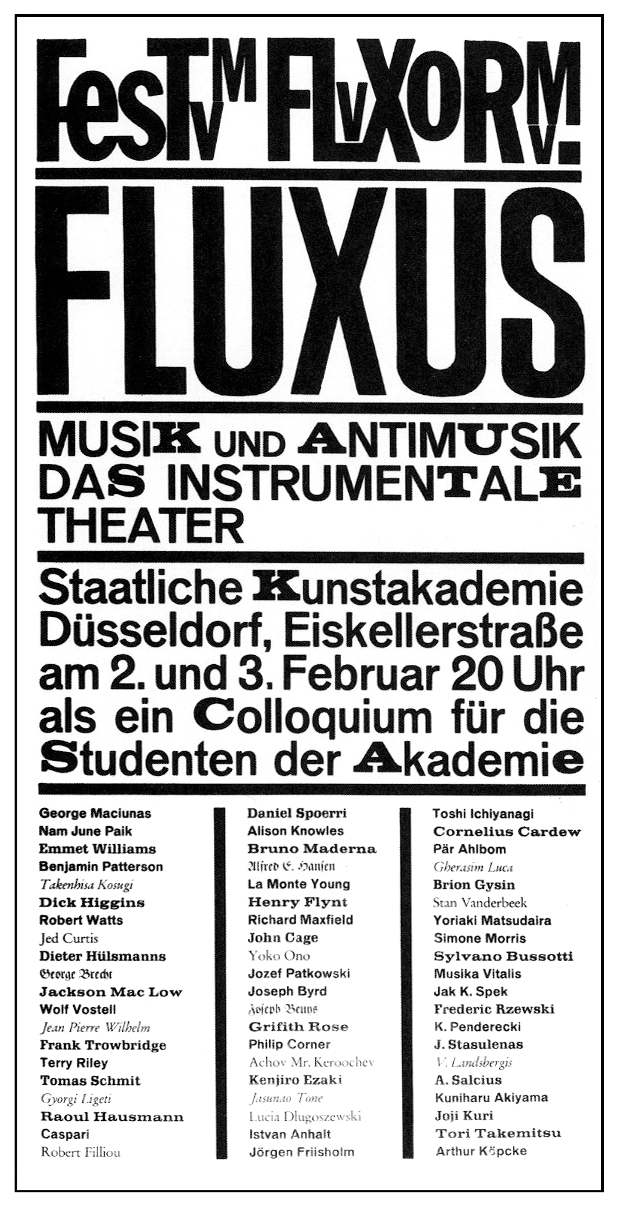
Many artists of the 1960s took part in Fluxus activities, including Joseph Beuys, Willem de Ridder, George Brecht, John Cage, Robert Filliou, Al Hansen, Dick Higgins, Bengt af Klintberg, Alison Knowles, Addi Køpcke, Yoko Ono, Nam June Paik, Shigeko Kubota, La Monte Young, Mary Bauermeister, Joseph Byrd, Ben Patterson, Daniel Spoerri, Eric Andersen, Ken Friedman, Terry Riley and Wolf Vostell. Not only were they a diverse community of collaborators who influenced each other, they were also, largely, friends. They collectively had what were, at the time, radical ideas about art and the role of art in society. Fluxus founder George Maciunas proposed a well known manifesto, but few considered Fluxus to be a true movement, and therefore the manifesto was not largely adopted. Instead, a series of festivals in Wiesbaden, Copenhagen, Stockholm, Amsterdam, London, and New York, gave rise to a loose but robust community with many similar beliefs. In keeping with the reputation Fluxus earned as a forum of experimentation, some Fluxus artists came to describe Fluxus as a laboratory.
The origins of Fluxus lie in many of the concepts explored by composer John Cage in his experimental music of the 1930s through the 1960s. After attending courses on Zen Buddhism taught by D. T. Suzuki, Cage taught a series of classes in experimental composition from 1957 to 1959 at the New School for Social Research in New York City. These classes explored the notions of chance and indeterminacy in art, using music scores as a basis for compositions that could be performed in potentially infinite ways. Some of the artists and musicians who became involved in Fluxus, including Jackson Mac Low, La Monte Young, George Brecht, Al Hansen, and Dick Higgins attended Cage's classes. A major influence is found in the work of Marcel Duchamp. Also of importance was Dada Poets and Painters, edited by Robert Motherwell, a book of translations of Dada texts that was widely read by members of Fluxus. The term anti-art, a precursor to Dada, was coined by Duchamp around 1913, when he created his first readymades from found objects (ordinary objects found or purchased and declared art). Indifferently chosen, readymades and altered readymades challenged the notion of art as an inherently optical experience, dependent on academic art skills. The most famous example is Duchamp's altered readymade Fountain (1917), a work which he signed "R. Mutt." While taking refuge from WWI in New York, in 1915 Duchamp formed a Dada group with Francis Picabia and American artist Man Ray. Other key members included Arthur Cravan, Florine Stettheimer, and the Elsa von Freytag-Loringhoven, credited by some with proposing the idea for Fountain to Duchamp. By 1916 these artists, especially Duchamp, Man Ray, and Picabia, became the center for radical anti-art activities in New York City. Their artworks would inform Fluxus and conceptual art in general. In the late 1950s and very early 1960s, Fluxus and contemporaneous groups or movements, including Happenings, Nouveau réalisme, mail art, and action art in Japan, Austria, and other international locations were, often placed under the rubric of Neo-Dada".
A number of other contemporary events are credited as either anticipating Fluxus or as constituting proto-Fluxus events. The most commonly cited include the series of Chambers Street loft concerts, in New York, curated by Yoko Ono and La Monte Young in 1961, featuring pieces by Ono, Jackson Mac Low, Joseph Byrd, and Henry Flynt; the month-long Yam festival held in upstate New York by George Brecht and Robert Watts in May 1963 with Ray Johnson and Allan Kaprow (the culmination of a year's worth of Mail Art pieces); and a series of concerts held in Mary Bauermeister's studio, Cologne, 1960–61, featuring Nam June Paik and John Cage among many others. It was at one of these events in 1960, during his Etude pour Piano, that Paik leapt into the audience and cut John Cage's tie off, ran out of the concert hall, and then phoned the hall's organisers to announce the piece had ended. As one of the movement's founders, Dick Higgins, stated:
Fluxus started with the work, and then came together, applying the name Fluxus to work which already existed. It was as if it started in the middle of the situation, rather than at the beginning.
In 1961 the American musician/artist La Monte Young had been enlisted to guest-edit an East Coast issue of the Wast Coast literary journal Beatitude to be called Beatitude East. But as the Beatitude connection was prematurly terminated, George Maciunas, a trained graphic designer, asked Young if he could layout and help publish the Neo-Dada material. Maciunas supplied the paper, design, and some money for publishing the anthology which contained the work of New York avant-garde artists from that time. The project took the title of An Anthology of Chance Operations from its full title An Anthology of chance operations concept art anti-art indeterminacy improvisation meaningless work natural disasters plans of action stories diagrams Music poetry essays dance constructions mathematics compositions. An Anthology of Chance Operations was completed and published in 1963 by Jackson Mac Low and La Monte Young, as Maciunas had by then moved to Germany to escape his creditors. After opening a short-lived art gallery on Madison Avenue, which showed work by Dick Higgins, Yoko Ono, Jonas Mekas, Ray Johnson, Henry Flynt and La Monte Young, Maciunas moved to Wiesbaden, West Germany, having taken a job as a graphic designer with the US Air Force in late 1961 after the gallery had gone bust. From Wiesbaden, Maciunas continued his contact with Young and other New York City-based artists and with expatriate American artists like Benjamin Patterson and Emmett Williams, whom he met in Europe. By September 1962, Maciunas was joined by Dick Higgins and Alison Knowles who traveled to Europe to help him promote a second planned publication to be called Fluxus, the first of a series of yearbooks of artists' works. Maciunas had first come up with the title Fluxus for a never done anthology of New York's Lithuanian artists, but instead applied the term to artists working in the Anthology of Chance Operations vein. Because after fleeing Lithuania at the end of World War II, his family settled in New York, where he first met the group of avant-garde artists and musicians centered around John Cage and La Monte Young. Thus Maciunas coined the name Fluxus not for his perceived group of Lithuanian artists but for the Neo-Dada art being produced by a range of artists with a shared sensibility as an attempt to "fuse... cultural, social, & political revolutionaries into [a] united front and action".
Maciunas first publicly coined the term Fluxus (meaning 'to flow') in a 'brochure prospectus' that he distributed to the audience at a festival he had organized, called Après Cage; Kleinen Sommerfest (After Cage; a Small Summer Festival), in Wuppertal, West Germany, 9 June 1962.
Hub AI
Fluxus AI simulator
(@Fluxus_simulator)
Fluxus
Fluxus was an international, interdisciplinary community of artists, composers, designers, and poets during the 1960s and 1970s who, inspired by John Cage, engaged in experimental art performances which emphasized the artistic tradition of chance-based process over the finished product. Fluxus is known for experimental contributions to different artistic media and disciplines and for generating new art forms. These art forms include intermedia, a term coined by Fluxus artist Dick Higgins; conceptual art, first developed by Henry Flynt, an artist contentiously associated with Fluxus; and video art, first pioneered by Nam June Paik and Wolf Vostell. Dutch gallerist and art critic Harry Ruhé describes Fluxus as "the most radical and experimental art movement of the sixties".
They produced performance "events", which included enactments of scores, "Neo-Dada" noise music, and time-based works, as well as concrete poetry, visual art, urban planning, architecture, design, literature, and publishing. Many Fluxus artists share anti-commercial and anti-art sensibilities. Fluxus is sometimes described as "intermedia". The ideas and practices of composer John Cage heavily influenced Fluxus, especially his notions that one should embark on an artwork without a conception of its end, and his understanding of the work as a site of interaction between artist and audience. The process of creating was privileged over the finished product. Another notable influence were the readymades of Marcel Duchamp, a French artist who was active in Dada (1916 – c. 1922). George Maciunas, largely considered to be the founder of this fluid movement, coined the name Fluxus in 1961 to title a proposed magazine.
Many artists of the 1960s took part in Fluxus activities, including Joseph Beuys, Willem de Ridder, George Brecht, John Cage, Robert Filliou, Al Hansen, Dick Higgins, Bengt af Klintberg, Alison Knowles, Addi Køpcke, Yoko Ono, Nam June Paik, Shigeko Kubota, La Monte Young, Mary Bauermeister, Joseph Byrd, Ben Patterson, Daniel Spoerri, Eric Andersen, Ken Friedman, Terry Riley and Wolf Vostell. Not only were they a diverse community of collaborators who influenced each other, they were also, largely, friends. They collectively had what were, at the time, radical ideas about art and the role of art in society. Fluxus founder George Maciunas proposed a well known manifesto, but few considered Fluxus to be a true movement, and therefore the manifesto was not largely adopted. Instead, a series of festivals in Wiesbaden, Copenhagen, Stockholm, Amsterdam, London, and New York, gave rise to a loose but robust community with many similar beliefs. In keeping with the reputation Fluxus earned as a forum of experimentation, some Fluxus artists came to describe Fluxus as a laboratory.
The origins of Fluxus lie in many of the concepts explored by composer John Cage in his experimental music of the 1930s through the 1960s. After attending courses on Zen Buddhism taught by D. T. Suzuki, Cage taught a series of classes in experimental composition from 1957 to 1959 at the New School for Social Research in New York City. These classes explored the notions of chance and indeterminacy in art, using music scores as a basis for compositions that could be performed in potentially infinite ways. Some of the artists and musicians who became involved in Fluxus, including Jackson Mac Low, La Monte Young, George Brecht, Al Hansen, and Dick Higgins attended Cage's classes. A major influence is found in the work of Marcel Duchamp. Also of importance was Dada Poets and Painters, edited by Robert Motherwell, a book of translations of Dada texts that was widely read by members of Fluxus. The term anti-art, a precursor to Dada, was coined by Duchamp around 1913, when he created his first readymades from found objects (ordinary objects found or purchased and declared art). Indifferently chosen, readymades and altered readymades challenged the notion of art as an inherently optical experience, dependent on academic art skills. The most famous example is Duchamp's altered readymade Fountain (1917), a work which he signed "R. Mutt." While taking refuge from WWI in New York, in 1915 Duchamp formed a Dada group with Francis Picabia and American artist Man Ray. Other key members included Arthur Cravan, Florine Stettheimer, and the Elsa von Freytag-Loringhoven, credited by some with proposing the idea for Fountain to Duchamp. By 1916 these artists, especially Duchamp, Man Ray, and Picabia, became the center for radical anti-art activities in New York City. Their artworks would inform Fluxus and conceptual art in general. In the late 1950s and very early 1960s, Fluxus and contemporaneous groups or movements, including Happenings, Nouveau réalisme, mail art, and action art in Japan, Austria, and other international locations were, often placed under the rubric of Neo-Dada".
A number of other contemporary events are credited as either anticipating Fluxus or as constituting proto-Fluxus events. The most commonly cited include the series of Chambers Street loft concerts, in New York, curated by Yoko Ono and La Monte Young in 1961, featuring pieces by Ono, Jackson Mac Low, Joseph Byrd, and Henry Flynt; the month-long Yam festival held in upstate New York by George Brecht and Robert Watts in May 1963 with Ray Johnson and Allan Kaprow (the culmination of a year's worth of Mail Art pieces); and a series of concerts held in Mary Bauermeister's studio, Cologne, 1960–61, featuring Nam June Paik and John Cage among many others. It was at one of these events in 1960, during his Etude pour Piano, that Paik leapt into the audience and cut John Cage's tie off, ran out of the concert hall, and then phoned the hall's organisers to announce the piece had ended. As one of the movement's founders, Dick Higgins, stated:
Fluxus started with the work, and then came together, applying the name Fluxus to work which already existed. It was as if it started in the middle of the situation, rather than at the beginning.
In 1961 the American musician/artist La Monte Young had been enlisted to guest-edit an East Coast issue of the Wast Coast literary journal Beatitude to be called Beatitude East. But as the Beatitude connection was prematurly terminated, George Maciunas, a trained graphic designer, asked Young if he could layout and help publish the Neo-Dada material. Maciunas supplied the paper, design, and some money for publishing the anthology which contained the work of New York avant-garde artists from that time. The project took the title of An Anthology of Chance Operations from its full title An Anthology of chance operations concept art anti-art indeterminacy improvisation meaningless work natural disasters plans of action stories diagrams Music poetry essays dance constructions mathematics compositions. An Anthology of Chance Operations was completed and published in 1963 by Jackson Mac Low and La Monte Young, as Maciunas had by then moved to Germany to escape his creditors. After opening a short-lived art gallery on Madison Avenue, which showed work by Dick Higgins, Yoko Ono, Jonas Mekas, Ray Johnson, Henry Flynt and La Monte Young, Maciunas moved to Wiesbaden, West Germany, having taken a job as a graphic designer with the US Air Force in late 1961 after the gallery had gone bust. From Wiesbaden, Maciunas continued his contact with Young and other New York City-based artists and with expatriate American artists like Benjamin Patterson and Emmett Williams, whom he met in Europe. By September 1962, Maciunas was joined by Dick Higgins and Alison Knowles who traveled to Europe to help him promote a second planned publication to be called Fluxus, the first of a series of yearbooks of artists' works. Maciunas had first come up with the title Fluxus for a never done anthology of New York's Lithuanian artists, but instead applied the term to artists working in the Anthology of Chance Operations vein. Because after fleeing Lithuania at the end of World War II, his family settled in New York, where he first met the group of avant-garde artists and musicians centered around John Cage and La Monte Young. Thus Maciunas coined the name Fluxus not for his perceived group of Lithuanian artists but for the Neo-Dada art being produced by a range of artists with a shared sensibility as an attempt to "fuse... cultural, social, & political revolutionaries into [a] united front and action".
Maciunas first publicly coined the term Fluxus (meaning 'to flow') in a 'brochure prospectus' that he distributed to the audience at a festival he had organized, called Après Cage; Kleinen Sommerfest (After Cage; a Small Summer Festival), in Wuppertal, West Germany, 9 June 1962.