Hubbry Logo
Visual artsVisual artsMain
Open search
Visual arts
Community hub
Visual arts
logo
8 pages, 0 posts
0 subscribers
Be the first to start a discussion here.
Contribute something
Visual arts
Visual arts
from Wikipedia

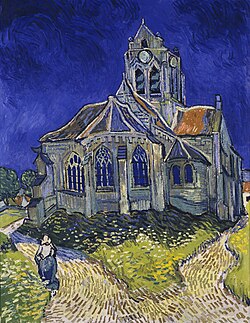
Vincent van Gogh painting The Church at Auvers from 1890 gray church against blue sky
The Church at Auvers, an oil painting by Vincent van Gogh (1890)

The visual arts are art forms such as painting, drawing, printmaking, sculpture, ceramics, photography, video, image, filmmaking, design, crafts, and architecture. Many artistic disciplines such as performing arts, conceptual art, and textile arts, also involve aspects of the visual arts, as well as arts of other types. Within the visual arts,[1] the applied arts,[2] such as industrial design, graphic design, fashion design, interior design, and decorative art[3] are also included.

Current usage of the term "visual arts" includes fine art as well as applied or decorative arts and crafts, but this was not always the case. Before the Arts and Crafts Movement in Britain and elsewhere at the turn of the 20th century, the term 'artist' had for some centuries often been restricted to a person working in the fine arts (such as painting, sculpture, or printmaking) and not the decorative arts, crafts, or applied visual arts media. The distinction was emphasized by artists of the Arts and Crafts Movement, who valued vernacular art forms as much as high forms.[4] Art schools made a distinction between the fine arts and the crafts, maintaining that a craftsperson could not be considered a practitioner of the arts.

The increasing tendency to privilege painting, and to a lesser degree sculpture, above other arts has been a feature of Western art as well as East Asian art. In both regions, painting has been seen as relying to the highest degree on the imagination of the artist and being the furthest removed from manual labour – in Chinese painting, the most highly valued styles were those of "scholar-painting", at least in theory practiced by gentleman amateurs. The Western hierarchy of genres reflected similar attitudes.

Education and training

[edit]

Training in the visual arts has generally been through variations of the apprentice and workshop systems. In Europe, the Renaissance movement to increase the prestige of the artist led to the academy system for training artists, and today most of the people who are pursuing a career in the arts train in art schools at tertiary levels. Visual arts have now become an elective subject in most education systems.[5][6]

In East Asia, arts education for nonprofessional artists typically focused on brushwork; calligraphy was numbered among the Six Arts of gentlemen in the Chinese Zhou dynasty, and calligraphy and Chinese painting were numbered among the four arts of scholar-officials in imperial China.[7][8][9]

Leading country in the development of the arts in Latin America, in 1875 created the National Society of the Stimulus of the Arts, founded by painters Eduardo Schiaffino, Eduardo Sívori, and other artists. Their guild was rechartered as the National Academy of Fine Arts in 1905 and, in 1923, on the initiative of painter and academic Ernesto de la Cárcova, as a department in the University of Buenos Aires, the Superior Art School of the Nation. Currently, the leading educational organization for the arts in the country is the UNA Universidad Nacional de las Artes.[10]

Drawing

[edit]
A detailed drawing of a female warrior titled 'Extinction' by Christiaan Tonnis, created in 1981 with graphite and colored pencils, measuring 13.6 x 18.5 inches. Belongs to Kunstverein Familie Montez since December 2010.
Christiaan Tonnis - Female Warrior #14 'Extinction', pencil and colored pencil on paper, 1981

Drawing is a means of making an image, illustration or graphic using any of a wide variety of tools and techniques available online and offline. It generally involves making marks on a surface by applying pressure from a tool, or moving a tool across a surface using dry media such as graphite pencils, pen and ink, inked brushes, wax color pencils, crayons, charcoals, pastels, and markers. Digital tools, including pens, stylus, that simulate the effects of these are also used. The main techniques used in drawing are: line drawing, hatching, crosshatching, random hatching, shading, scribbling, stippling, and blending. An artist who excels at drawing is referred to as a draftsman or draughtsman.[11]

Drawing and painting go back tens of thousands of years.[12] Art of the Upper Paleolithic includes figurative art beginning at least 40,000 years ago.[13] Non-figurative cave paintings consisting of hand stencils and simple geometric shapes are even older.[12] Paleolithic cave representations of animals are found in areas such as Lascaux, France, Altamira, Spain,[14] Maros, Sulawesi in Asia,[15] and Gabarnmung, Australia.[16]

In ancient Egypt, ink drawings on papyrus, often depicting people, were used as models for painting or sculpture.[17] Drawings on Greek vases, initially geometric, later developed into the human form with black-figure pottery during the 6th century BC.[18]

With paper becoming more common in Europe by the 14th century,[19] drawing was adopted by masters such as Sandro Botticelli, Raphael, Michelangelo, and Leonardo da Vinci, who sometimes treated drawing as an art in its own right, rather than a preparatory stage for painting or sculpture.[20]

Painting

[edit]

Painting taken literally is the practice of applying pigment suspended in a carrier (or medium) and a binding agent (a glue) to a surface (support) such as paper, canvas or a wall. However, when used in an artistic sense it means the use of this activity in combination with drawing, composition, or other aesthetic considerations in order to manifest the expressive and conceptual intention of the practitioner. Painting is also used to express spiritual motifs and ideas; sites of this kind of painting range from artwork depicting mythological figures on pottery to The Sistine Chapel, to the human body itself.[21]

History

[edit]

Origins and early history

[edit]
Lascaux painting
Nefertari with Isis

Like drawing, painting has its documented origins in caves and on rock faces.[22] The earliest known cave paintings, dating to between 32,000-30,000 years ago, are found in the Chauvet cave in southern France;[23] the celebrated polychrome murals of Lascaux date to around 17,000–15,500 years ago.[24] In shades of red, brown, yellow and black, the paintings on the walls and ceilings depict bison, cattle (aurochs), horses and deer.[25]

Paintings of human figures can be found in the tombs of ancient Egypt. In the great temple of Ramesses II, Nefertari, his queen, is depicted being led by Isis.[26] The Greeks contributed to painting but much of their work has been lost. One of the best remaining representations are the Hellenistic Fayum mummy portraits. Another example is mosaic of the Battle of Issus at Pompeii, which was probably based on a Greek painting. Greek and Roman art contributed to Byzantine art in the 4th century BC, which initiated a tradition in icon painting.[27]

The Renaissance

[edit]

Apart from the illuminated manuscripts produced by monks during the Middle Ages, the next significant contribution to European art was from Italy's renaissance painters. From Giotto in the 13th century to Leonardo da Vinci and Raphael at the beginning of the 16th century, this was the richest period in Italian art as the chiaroscuro techniques were used to create the illusion of 3-D space.[28]

Painters in northern Europe too were influenced by the Italian school. Jan van Eyck from Belgium, Pieter Bruegel the Elder from the Netherlands and Hans Holbein the Younger from Germany are among the most successful painters of the times. They used the glazing technique with oils to achieve depth and luminosity.

Dutch masters

[edit]
Rembrandt painting Night Watch two men striding forward with a crowd
Rembrandt: The Night Watch, 1642

The 17th century witnessed the emergence of the great Dutch masters such as the versatile Rembrandt who was especially remembered for his portraits and Bible scenes, and Vermeer who specialized in interior scenes of Dutch life.

Baroque

[edit]

The Baroque started after the Renaissance, from the late 16th century to the late 17th century. Main artists of the Baroque included Caravaggio, who made heavy use of tenebrism. Peter Paul Rubens, a Flemish painter who studied in Italy, worked for local churches in Antwerp and also painted a series for Marie de' Medici. Annibale Carracci took influences from the Sistine Chapel and created the genre of illusionistic ceiling painting. Much of the development that happened in the Baroque was because of the Protestant Reformation and the resulting Counter Reformation. Much of what defines the Baroque is dramatic lighting and overall visuals.[29]

Impressionism

[edit]
Claude Monet: Impression, Sunrise (1872)

Impressionism began in France in the 19th century with a loose association of artists including Claude Monet, Pierre-Auguste Renoir and Paul Cézanne who brought a new freely brushed style to painting, often choosing to paint realistic scenes of modern life outside rather than in the studio. This was achieved through a new expression of aesthetic features demonstrated by brush strokes and the impression of reality. They achieved intense color vibration by using pure, unmixed colors and short brush strokes. The movement influenced art as a dynamic, moving through time and adjusting to newfound techniques and perception of art. Attention to detail became less of a priority in achieving, whilst exploring a biased view of landscapes and nature to the artist's eye.[30][31]

Post-impressionism

[edit]

Towards the end of the 19th century, several young painters took impressionism a stage further, using geometric forms and unnatural color to depict emotions while striving for deeper symbolism. Of particular note are Paul Gauguin, who was strongly influenced by Asian, African and Japanese art, Vincent van Gogh, a Dutchman who moved to France where he drew on the strong sunlight of the south, and Toulouse-Lautrec, remembered for his vivid paintings of night life in the Paris district of Montmartre.[32]

Symbolism, expressionism and cubism

[edit]

Edvard Munch, a Norwegian artist, developed his symbolistic approach at the end of the 19th century, inspired by the French impressionist Manet. The Scream (1893), his most famous work, is widely interpreted as representing the universal anxiety of modern man. Partly as a result of Munch's influence, the German expressionist movement originated in Germany at the beginning of the 20th century as artists such as Ernst Kirschner and Erich Heckel began to distort reality for an emotional effect.

In parallel, the style known as cubism developed in France as artists focused on the volume and space of sharp structures within a composition. Pablo Picasso and Georges Braque were the leading proponents of the movement. Objects are broken up, analyzed, and re-assembled in an abstracted form. By the 1920s, the style had developed into surrealism with Dali and Magritte.[33]

Printmaking

[edit]
Ancient Chinese engraving of female instrumentalists

Printmaking is creating, for artistic purposes, an image on a matrix that is then transferred to a two-dimensional (flat) surface by means of ink or other form of pigmentation.[34] Except in the case of a monotype, the same matrix can be used to produce many examples of the print.[35]

Historically, the major techniques (also called media) involved are woodcut,[36] line engraving,[37] etching,[38] lithography,[39] and screen printing,[40] (serigraphy, silk screening) and there are many others, including digital techniques.[41] Normally, the print is printed on paper,[19] but other mediums range from cloth and vellum,[42] to more modern materials.[43]

European history

[edit]

Prints in the Western tradition produced before about 1830 are known as old master prints. In Europe, from around 1400 AD woodcut, was used for master prints on paper by using printing techniques developed in the Byzantine and Islamic worlds. Michael Wolgemut improved German woodcut from about 1475, and Erhard Reuwich, a Dutchman, was the first to use cross-hatching. At the end of the century Albrecht Dürer brought the Western woodcut to a stage that has never been surpassed, increasing the status of the single-leaf woodcut.[44]

Chinese origin and practice

[edit]
The Chinese Diamond Sutra, the world's oldest Woodblock printing book from 868 CE
The Chinese Diamond Sutra, the world's oldest printed book (868 CE)

In China, the art of printmaking developed some 1,100 years ago as illustrations alongside text cut in woodblocks for printing on paper. Initially images were mainly religious but in the Song dynasty, artists began to cut landscapes. During the Ming (1368–1644) and Qing (1616–1911) dynasties, the technique was perfected for both religious and artistic engravings.[45][46]

Development in Japan, 1603–1867

[edit]
Hokusai color print "Red Fuji southern wind clear morning" from Thirty-six Views of Mount Fuji
Hokusai: Red Fuji from Thirty-six Views of Mount Fuji (1830–1832)

Woodblock printing in Japan (Japanese: 木版画, moku hanga) is a technique best known for its use in the ukiyo-e artistic genre; however, it was also used very widely for printing illustrated books in the same period. Woodblock printing had been used in China for centuries to print books, long before the advent of movable type, but was only widely adopted in Japan during the Edo period (1603–1867).[47][48] Although similar to woodcut in western printmaking in some regards, moku hanga differs greatly in that water-based inks are used (as opposed to western woodcut, which uses oil-based inks), allowing for a wide range of vivid color, glazes and color transparency.

After the decline of ukiyo-e and introduction of modern printing technologies, woodblock printing continued as a method for printing texts as well as for producing art, both within traditional modes such as ukiyo-e and in a variety of more radical or Western forms that might be construed as modern art. In the early 20th century, shin-hanga that fused the tradition of ukiyo-e with the techniques of Western paintings became popular, and the works of Hasui Kawase and Hiroshi Yoshida gained international popularity.[49][50] Institutes such as the "Adachi Institute of Woodblock Prints" and "Takezasado" continue to produce ukiyo-e prints with the same materials and methods as used in the past.[51][52]

Photography

[edit]

Photography is the process of making pictures by means of the action of light. The light patterns reflected or emitted from objects are recorded onto a sensitive medium, or storage chip, through a timed exposure.[53] The process is done through mechanical shutters[54] or electronically timed exposure of photons into chemical processing or digitizing devices known as cameras.[55]

The word comes from the Greek φῶς ‘’phos’’ ("light") and γραφή ‘’graphê’’ ("drawing" or "writing"), literally meaning "drawing with light".[56] Traditionally, the product of photography has been called a photograph; the term ‘’photo’’ is an abbreviation and though many call them "pictures," the term "image" has increasingly replaced "photograph," reflecting electronic capture and the broader concept of graphical representation in optics and computing.[57]

Architecture

[edit]
Timber-framed houses in Brittany

Architecture is the process and the product of planning, designing, and constructing buildings or any other structures.[58] Architectural works, in the material form of buildings, are often perceived as cultural symbols and works of art.[59] Historical civilizations are often identified with their surviving architectural achievements.[60]

The earliest surviving written work on architecture is De architectura, by the Roman architect Vitruvius in the early 1st century AD.[61] According to Vitruvius, a good building should satisfy three principles: firmitas, utilitas, venustas, translated as firmness, commodity, and delight.[62] An equivalent in modern English would be:

  1. Durability – a building should stand up robustly and remain in good condition.
  2. Utility – it should be suitable for the purposes for which it is used.
  3. Beauty – it should be aesthetically pleasing.[63]

Building first evolved out of the dynamics between needs (shelter, security, worship, etc.) and means (available building materials and attendant skills).[64] As cultures developed and knowledge began to be formalized through oral traditions and practices, building became a craft, and "architecture" is the name given to the most highly formalized versions of that craft.[65]

Filmmaking

[edit]

Filmmaking is the process of making a motion picture, from an initial conception and research, through scriptwriting, shooting and recording, animation or other special effects, editing, sound and music work and finally distribution to an audience; it refers broadly to the creation of all types of films, embracing documentary, strains of theatre and literature in film, and poetic or experimental practices, and is often used to refer to video-based processes as well.

Computer art

[edit]
Desmond Paul Henry, Picture by Drawing Machine 1, c. 1960

Visual artists are no longer limited to traditional visual arts media. Computers have been used in the visual arts since the 1960s.[66] Uses include the capturing or creating of images and forms,[67] the editing of those images (including exploring multiple compositions)[68] and the final rendering or printing (including 3D printing).[69]

Computer art is any in which computers play a role in production or display.[70] Such art can be an image, sound, animation, video, CD-ROM, DVD, video game, website, algorithm, performance or gallery installation.[71]

Many traditional disciplines now integrate digital technologies, so the lines between traditional works of art and new media works created using computers have been blurred.[72] For instance, an artist may combine traditional painting with algorithmic art and other digital techniques.[73] As a result, defining computer art by its end product can be difficult. Nevertheless, this type of art appears in art museum exhibits, but can be seen more as a tool, rather than a form as with painting.[74] On the other hand, there are computer-based artworks which belong to a new conceptual and postdigital strand, assuming the same technologies, and their social impact, as an object of inquiry.[75]

Computer usage has blurred the distinctions between illustrators, photographers, photo editors, 3-D modelers, and handicraft artists.[76] Sophisticated rendering and editing software has led to multi-skilled image developers. Photographers may become digital artists.[77] Illustrators may become animators. Handicraft may be computer-aided or use computer-generated imagery as a template.[78] Computer clip art usage has made the distinction between visual arts and page layout less obvious due to the easy access and editing of clip art in the process of paginating a document.[79]

Plastic arts

[edit]

Plastic arts is a term for art forms that involve physical manipulation of a plastic medium by moulding or modeling such as sculpture or ceramics. The term has also been applied to all the visual (non-literary, non-musical) arts.[80][81]

Materials that can be carved or shaped, such as stone, wood, concrete, or steel, have also been included in the narrower definition, since, with appropriate tools, such materials are also capable of modulation.[82] This use of the term "plastic" in the arts is different from Piet Mondrian’s use, and with the movement he termed, "Neoplasticism."[83][84]

Sculpture

[edit]

Sculpture is three-dimensional artwork created by shaping or combining hard or plastic material, sound, or text and or light, commonly stone (either rock or marble), clay, metal, glass, or wood. Some sculptures are created directly by finding or carving; others are assembled, built together and fired, welded, molded, or cast. Sculptures are often painted.[85] A person who creates sculptures is called a sculptor.

The earliest undisputed examples of sculpture belong to the Aurignacian culture, which was located in Europe and southwest Asia and active at the beginning of the Upper Paleolithic. As well as producing some of the earliest known cave art, the people of this culture developed finely crafted stone tools, manufacturing pendants, bracelets, ivory beads, and bone-flutes, as well as three-dimensional figurines.[86][87][88]

Because sculpture involves the use of materials that can be moulded or modulated, it is considered one of the plastic arts. The majority of public art is sculpture. Many sculptures together in a garden setting may be referred to as a sculpture garden. Sculptors do not always make sculptures by hand. With increasing technology in the 20th century and the popularity of conceptual art over technical mastery, more sculptors turned to art fabricators to produce their artworks. With fabrication, the artist creates a design and pays a fabricator to produce it. This allows sculptors to create larger and more complex sculptures out of materials like cement, metal and plastic, that they would not be able to create by hand. Sculptures can also be made with 3-d printing technology.

[edit]

In the United States, the law protecting the copyright over a piece of visual art gives a more restrictive definition of "visual art".[89]

A "work of visual art" is —
(1) a painting, drawing, print or sculpture, existing in a single copy, in a limited edition of 200 copies or fewer that are signed and consecutively numbered by the author, or, in the case of a sculpture, in multiple cast, carved, or fabricated sculptures of 200 or fewer that are consecutively numbered by the author and bear the signature or other identifying mark of the author; or
(2) a still photographic image produced for exhibition purposes only, existing in a single copy that is signed by the author, or in a limited edition of 200 copies or fewer that are signed and consecutively numbered by the author.

A work of visual art does not include —
(A)(i) any poster, map, globe, chart, technical drawing, diagram, model, applied art, motion picture or other audiovisual work, book, magazine, newspaper, periodical, data base, electronic information service, electronic publication, or similar publication;
  (ii) any merchandising item or advertising, promotional, descriptive, covering, or packaging material or container;
  (iii) any portion or part of any item described in clause (i) or (ii);
(B) any work made for hire; or
(C) any work not subject to copyright protection under this title.[89]

See also

[edit]

References

[edit]
[edit]
Revisions and contributorsEdit on WikipediaRead on Wikipedia
from Grokipedia
The visual arts constitute a broad category of creative endeavors that produce works primarily perceived through the sense of sight, encompassing mediums such as , , , , , ceramics, , , and . These disciplines involve the manipulation of visual elements—including line, shape, color, value, form, texture, and space—to communicate ideas, emotions, narratives, and cultural insights. The history of visual arts spans tens of thousands of years, originating in the period with the creation of symbolic markings and images on cave walls, such as the hand stencils and animal depictions in El Castillo Cave in , dated to around 40,000 BCE. These early expressions likely served ritualistic or communicative purposes within societies. As human civilizations advanced, visual arts became integral to ancient cultures in , , , and , where they manifested in monumental sculptures, temple reliefs, and frescoes that conveyed religious beliefs, royal power, and mythological stories. In the medieval era, visual arts in were heavily influenced by , featuring illuminated manuscripts, Gothic cathedrals with , and Byzantine icons that emphasized spiritual symbolism over realism. The , beginning in the in , revolutionized the field by reviving classical antiquity's focus on humanism, perspective, and anatomical accuracy, as seen in masterpieces by and . Subsequent periods brought diverse movements: the dramatic lighting and emotion of art in the 17th century; the ornate elegance of ; the restrained idealism of ; and the expressive individualism of . The 19th and 20th centuries witnessed rapid innovation with Impressionism's emphasis on light and everyday scenes, Cubism's fragmentation of form, Abstract Expressionism's emotional abstraction, and Pop Art's integration of consumer culture. Today, visual arts thrive in a globalized context, incorporating interdisciplinary approaches like , installation, and to explore contemporary issues such as identity, , and , often challenging traditional boundaries between , viewer, and object.

Overview and Definition

Scope and Characteristics

The visual arts comprise a broad category of creative endeavors that produce two- and three-dimensional works designed to engage the viewer's , conveying ideas, emotions, and narratives primarily through sight rather than or performance. These works include static forms such as paintings, sculptures, and prints, as well as dynamic ones like installations and digital projections, emphasizing the creation of images, forms, and designs that stimulate aesthetic appreciation and intellectual response. Central to visual arts are key characteristics that define their expressive potential, including the manipulation of elements such as line, shape, form, space, color, value, and texture to achieve composition and balance. Line delineates edges and suggests movement, while shape and form establish two- or three-dimensional structures; space creates illusions of depth, color evokes mood through hue and intensity, and texture adds tactile illusion or reality. A fundamental distinction lies between representational (or mimetic) approaches, which depict recognizable subjects from the real world—such as landscapes or figures—and abstract (non-representational) methods, which prioritize formal qualities like color and shape to explore emotions or concepts without literal imitation. The scope of visual arts spans immense historical breadth, originating with prehistoric cave paintings, such as those in dated to over 51,000 years ago, that employed pigments like to depict animals and possibly rituals, and extending to contemporary digital installations that integrate and algorithms. This evolution reflects technological and societal shifts while maintaining a focus on visual primacy, distinct from auditory or kinetic emphases in other art forms. Visual arts manifest as a human universal, appearing spontaneously in all known societies as an innate capacity for "artification"—transforming the ordinary into the extraordinary through patterning and exaggeration—yet they exhibit profound cultural variations in purpose and style. In some societies, such as Indigenous Australian groups, visual arts serve symbolic functions tied to spiritual narratives and totemic identities, whereas in others, like certain East Asian traditions, they emphasize decorative harmony and enhancement without overt symbolism. These differences underscore art's adaptive role in fostering social cohesion and across diverse contexts.

Distinctions from Performing and Literary Arts

Visual arts are distinguished from primarily by their emphasis on spatial composition and static presentation, which allow for immediate, non-sequential apprehension through sight, whereas unfold temporally through live action, movement, and often sound, requiring audience engagement over a duration. For instance, a or invites contemplation in a single viewing or encounter, prioritizing visual form and perceptual unity, as opposed to theater or , where or expressive progression occurs in real time via performers' actions. This spatial immediacy in visual arts fosters a focus on enduring objects or images, contrasting with the ephemeral, event-based nature of performances that rely on repetition, scripting, and audience interaction for their effect. In comparison to literary arts, visual arts differ in their direct reliance on rather than linguistic mediation and linear progression, enabling instantaneous emotional or conceptual impact without the interpretive decoding of text. Literary forms, such as novels or , engage through sequential reading, invoking via words to construct stories or ideas over time, whereas visual works like drawings or prints convey meaning through immediate sensory elements of line, color, and shape. This perceptual directness in visual arts appeals to sight as the primary medium, avoiding the multidimensional cognitive processing inherent in literature's language-based structure. Philosophically, these distinctions align with aesthetic theories that highlight visual arts' suitability for disinterested contemplation, as articulated in Immanuel Kant's , where judgments of beauty in formative arts like emphasize free play of and understanding without practical interest or emotional drive. In contrast, often evoke more engaged, agreeable responses through their dynamic, interest-laden presentations, while literary arts blend aesthetic pleasure with conceptual depth via symbolic language. Kant's framework thus underscores visual arts' contemplative purity, distinct from the temporal immersion of performance or the discursive progression of . Despite these boundaries, overlaps exist in hybrid forms such as illustrated books, which combine visual imagery with literary text, or , which incorporates temporal elements but remains classified as visual due to its dominance of sight over sound or movement. In contemporary practices, these lines blur further, yet the criterion of visual primacy—where perception hinges on visual stimuli—maintains the core identity of visual arts amid interdisciplinary experimentation.

Historical Development

Prehistoric and Ancient Periods

The earliest known expressions of visual arts emerged during the period, with cave paintings serving as profound evidence of symbolic communication among prehistoric humans. These artworks, often depicting animals, humans, and abstract symbols, are believed to have held ritualistic significance, possibly linked to hunting magic, spiritual beliefs, or communal storytelling. A prime example is the Cave in , featuring over 600 paintings dated to approximately 17,000 BCE, executed with remarkable detail using blown and brushed pigments to portray dynamic scenes of fauna like horses and . Similarly, portable sculptures such as the , a figurine from dated to around 25,000 BCE, exemplify early sculptural traditions; its exaggerated female forms suggest associations with or symbolic representations of survival and nourishment during harsh environmental conditions. These artifacts highlight the transition from utilitarian tools to intentional aesthetic and symbolic creations, using available natural materials to convey cultural narratives. In ancient civilizations, visual arts evolved into more structured forms integrated with writing, architecture, and societal functions, beginning around 3000 BCE in regions like the Nile Valley and . Egyptian tomb art, including hieroglyphics—pictorial symbols combining ideograms and phonograms—adorned burial chambers to ensure the deceased's eternal life, depicting pharaohs, deities, and daily activities in a style emphasizing order and divinity. Mesopotamian reliefs, carved in stone or , narrated royal conquests and mythological events; notable examples from Assyrian palaces, such as those at dating to the 9th–7th centuries BCE, portrayed kings in battle or ritual processions to glorify rulers and invoke divine protection. Greek visual arts advanced naturalistic representation, as seen in the friezes of the 5th century BCE, low-relief marble sculptures on the temple that illustrated the Panathenaic procession honoring , blending idealized human anatomy with civic pride to symbolize and cultural supremacy. Roman adaptations, including mosaics and frescoes, further refined these techniques for domestic and public spaces; mosaics composed of tesserae in stone, glass, and clay depicted mythological scenes or landscapes in villas, while frescoes—pigment applied to wet plaster—created illusory architectural extensions in Pompeian homes, serving both decorative and commemorative purposes. Prehistoric and ancient artists primarily utilized natural materials, reflecting resource availability and technological constraints, which underscored the arts' practical and spiritual roles. Pigments derived from ochre (iron oxides for reds and yellows), charcoal for blacks, and manganese for deeper tones were mixed with binders like animal fat or water to produce paints applied via fingers, brushes, or blowing techniques on cave walls or pottery. Sculptures and reliefs employed stone (limestone, marble), clay for modeling and firing, and later metals like bronze for durable ritual objects. These works functioned in religious contexts, such as invoking fertility or afterlife provisions; in commemoration, immortalizing leaders; and in daily life, adorning vessels or homes to enhance social status. Across emerging civilizations, visual arts manifested distinct regional styles tied to cultural identities. In , prehistoric , such as San paintings in southern regions dating back over 20,000 years, portrayed trance-induced visions of animals and hunters using red and white kaolin, symbolizing spiritual connections to the environment and communal s. In , ancient Chinese bronzes from the (c. 1600–1046 BCE), cast via piece-mold techniques into vessels adorned with masks—stylized animal motifs—served sacrificial purposes in ancestor worship, embodying cosmological harmony and elite power. These traditions laid foundational influences, later revived in periods like the for classical ideals.

Medieval and Renaissance Eras

Medieval art, emerging after the fall of the , was deeply intertwined with and served primarily as a tool for religious instruction and devotion. In the , icons and mosaics became central, with the in featuring elaborate mosaics from the 6th century onward that depicted Christ, the Virgin Mary, and imperial figures to affirm Orthodox doctrine. These works, such as the 9th-century mosaic of the Virgin and Child in the , survived periods of and exemplified the spiritual hierarchy through gold backgrounds and frontal poses. In , the Gothic style dominated from the , emphasizing verticality and light to evoke divine presence in cathedrals. , constructed between 1194 and 1220, exemplifies this through its 167 stained-glass windows, which narrate biblical stories and saints' lives using vibrant blues from and reds from , illuminating the as a "sermon in glass." These windows, largely from the early , integrated theological narratives with architectural innovation, such as ribbed vaults that allowed larger glass surfaces. Illuminated manuscripts further enriched medieval visual culture, blending text and image in monastic scriptoria. The , produced around 800 in Ireland or , is a prime Hiberno-Saxon example, featuring intricate interlaced designs, animal motifs, and carpet pages that adorn the Gospels with symbolic complexity, reflecting Celtic Christian artistry. The , spanning the 14th to 16th centuries, marked a revival of , prioritizing and scientific observation in art. In , linear perspective, formalized by and theorized by in 1435, created illusionistic depth, as seen in Masaccio's Tribute Money (c. 1427). This shift celebrated human and emotion, diverging from medieval symbolism toward naturalistic representation. Key Italian masters embodied these ideals: Leonardo da Vinci's (1503–1506) employs for subtle tonal transitions, capturing psychological depth and atmospheric landscape, while Michelangelo's frescoes (1508–1512) depict dynamic figures from Genesis with muscular torsion and emotional intensity, blending pagan with biblical narrative. The spread northward, where artists adapted Italian humanism to local traditions. Jan van Eyck's innovations in , evident in the (1432), used glazing techniques—thin, transparent layers—to achieve luminous depth and realistic textures, surpassing tempera's matte finish and influencing subsequent Flemish and Dutch schools. Techniques evolved from medieval fresco and tempera to versatile oils, enabling portable panels and finer details. Fresco, painting on wet plaster for murals like those in the Sistine Chapel, demanded swift execution but yielded durable works; tempera, egg-based on wood, provided bright colors for altarpieces; oil, popularized in the North, allowed blending and revision. Patronage shifted from dominant church commissions—funding cathedrals and icons—to secular elites like the Medici family, who supported humanist themes in Florence, fostering artistic independence. Beyond Europe, parallel developments included , which avoided figural representation to evoke divine infinity. The palace in , built in the 14th century under the , features vaults and interlocking star motifs in and tile, symbolizing cosmic order through mathematical precision. In , (960–1279) landscape scrolls emphasized harmony with nature, using ink washes on to depict misty mountains and rivers as metaphors for philosophical retreat. Works like Fan Kuan's Travelers Among Mountains and Streams (c. 1000) employ vertical composition in hanging scrolls to convey spatial recession and seasonal flux, patronized by scholar-officials amid imperial academy support.

Baroque to Romanticism

The Baroque period in visual arts, spanning the , emphasized dramatic expression and grandeur to evoke emotional intensity and religious fervor, often through dynamic compositions and theatrical lighting. Italian sculptor Gian Lorenzo Bernini's (1652) exemplifies this with its grandiose, multi-figure marble sculpture capturing a moment of spiritual rapture through swirling drapery and implied motion, blending sculpture, architecture, and painting in the Cornaro Chapel. Similarly, Caravaggio's The Calling of Saint Matthew (1600) pioneered —a stark contrast of light and shadow—to heighten realism and , drawing viewers into biblical narratives with everyday figures illuminated against dark backgrounds. These techniques reflected the era's social role in supporting absolutist monarchies and the Catholic , where art served to inspire awe and reinforce authority, as seen in commissions for churches and palaces across . By the early 18th century, the evolved into , a lighter transition marked by ornate playfulness, pastel colors, and asymmetrical curves that celebrated aristocratic leisure and sensuality. Jean-Honoré Fragonard's The Swing (1767) captures this essence in its of a flirtatious scene amid lush gardens, with swirling fabrics and hidden voyeurs evoking whimsical eroticism and decorative elegance. This style mirrored the social context of Enlightenment-era courts, particularly in under , where art shifted from monarchical grandeur to intimate, hedonistic expressions of elite refinement. Neoclassicism emerged in the late as a reaction against excess, reviving ancient Greek and Roman ideals of , order, and moral clarity through linear compositions and heroic subjects. Jacques-Louis David's (1784) embodies this with its stark geometry and stoic figures swearing patriotic duty, symbolizing Enlightenment values of reason and amid pre-revolutionary . The painting's social role aligned with revolutionary fervor, promoting sacrifice and equality in the lead-up to the of 1789. Romanticism, flourishing in the early , countered Neoclassicism's restraint by prioritizing emotional depth, , and the sublime power of over rational order. J.M.W. Turner's (1839) illustrates this through its luminous watercolor-like oil depiction of a fading towed by a steam vessel at sunset, evoking melancholy and the awe-inspiring forces of industrial change and the sea. This movement reflected post-revolutionary society's turmoil, including and social upheaval, with art expressing personal passion and the untamed sublime. Global influences began permeating Western visual arts during this era, notably through Japanese woodblock prints, which introduced flattened perspectives and bold colors that later inspired European experimentation. Katsushika Hokusai's (ca. 1830–32), from his series, exemplifies with its dynamic composition of towering waves dwarfing and fishermen, using for dramatic depth and influencing Western artists' views on composition and nature by the late . Overall, from absolutism to Romantic revolution, these periods' visual arts not only mirrored shifting social ideologies—from divine-right rule and Enlightenment reason to emotional liberation—but also laid groundwork for later breaks like Impressionism's focus on light and everyday scenes.

Modernism and 20th Century Movements

Modernism in the visual arts emerged in the late as artists sought to capture the rapid changes of industrialization and urban life, breaking from traditional representation toward innovative techniques that emphasized perception and form. , initiated by French painters in the 1870s, focused on fleeting effects of light and color through loose brushwork and painting, rejecting the polished finishes of . Claude Monet's Impression, Sunrise (1872), depicting the with hazy, diffused sunlight, exemplified this approach by prioritizing atmospheric conditions over detailed realism, and its exhibition in 1874 prompted critic to derisively name the movement after the painting's title. Monet's inclusion of modern elements like railways and factories in his landscapes reflected the encroachment of industrialization on natural scenes, symbolizing broader societal transformations in post-Haussmann . Post-Impressionism extended these innovations by infusing greater emotional depth and structural rigor, often distorting form to convey personal vision. Vincent van Gogh's (1889), painted during his time at the Saint-Paul-de-Mausole asylum, employed swirling, expressive brushstrokes in vivid blues and yellows to blend observed night sky with turbulent inner emotions, creating a dynamic interplay of movement and color that anticipated later . , meanwhile, analyzed nature through an analytical lens, building volumetric forms using planes of color and constructive brushstrokes rather than traditional perspective, as seen in works like Mont Sainte-Victoire, where subtle gradations create depth and solidity from color alone. His method of treating objects as interrelated entities in space influenced subsequent modernist developments by emphasizing composition over illusionistic depth. The early 20th century saw an explosion of "isms" that further fragmented representation in response to technological acceleration and cultural upheaval. , co-founded by and around 1907, deconstructed objects into geometric facets viewed from multiple angles simultaneously, challenging single-point perspective. Picasso's (1907), portraying five nude figures with angular, mask-like faces inspired by Iberian and , marked a proto-Cubist breakthrough in its bold stylization and distortion, redefining the human form as an assembly of planes. , launched by Italian artists in 1909, celebrated the dynamism of modern machinery and speed through fragmented forms and overlapping planes that conveyed motion. Umberto Boccioni's sculptures, such as Unique Forms of Continuity in Space (1913), captured the kinetic energy of figures in flux, embodying the movement's manifesto to glorify war, speed, and industrial progress as agents of societal renewal. Dadaism, arising amid , rejected artistic conventions altogether in favor of provocations that mocked bourgeois values and rationalism. Marcel Duchamp's (1917), a porcelain urinal signed with a pseudonym and submitted to an exhibition, epitomized the readymade as a satirical gesture, questioning the very definition of art and authorship. Surrealism, emerging in the 1920s under André Breton's influence, delved into the , producing dreamlike scenes that blurred reality and fantasy. Salvador Dalí's (1931) features melting watches draped over barren landscapes, symbolizing the fluidity of time in a desolate, infinite dreamscape where hard forms inexplicably soften, evoking psychological unease. , flourishing in post-World War II New York, prioritized spontaneous gesture and emotional intensity over figuration, with artists like pioneering . In the late 1940s, Pollock developed his drip technique, flinging and pouring thinned enamel paint onto horizontal canvases to create intricate webs of color and line, as in Number 1A, 1948, allowing the physical act of painting to embody subconscious expression. These movements were deeply shaped by socio-political forces, including the devastation of two world wars, the rise of Freudian psychology, and the proliferation of . Dadaism directly reacted to the horrors of , with its Zurich serving as a refuge for artists fleeing the conflict, using absurdity to critique nationalism and mechanized warfare. Surrealism drew heavily from Sigmund Freud's theories of the unconscious and dream analysis, employing automatic techniques to access repressed desires and challenge rational thought. emerged in the shadow of , reflecting existential anxiety and the trauma of global catastrophe through raw, scale-emphasizing works that asserted individual freedom amid ideological threats. Additionally, from onward, artists responded to industrialization's pace and 's emergence by incorporating urban motifs and machine aesthetics, while explicitly lampooned the sensationalism of modern print culture. These innovations laid groundwork for postmodern extensions, such as Pop Art's embrace of consumer imagery in the 1960s. Contemporary visual arts, spanning from the late to the present, are marked by pluralism and a rejection of grand narratives, embracing diverse influences and cultural critiques in response to and social upheavals. Postmodern trends, which gained prominence after , emphasize by blending high and , often through appropriation and , while incorporating irony to subvert traditional artistic hierarchies. This shift challenged modernism's focus on purity and , instead celebrating consumer imagery and as valid subjects for . A seminal example of postmodern irony is Andy Warhol's (1962), a series of 32 silk-screened paintings depicting everyday soup cans in a grid format, which blurred the lines between commercial advertising and artistic expression, critiquing consumer culture's ubiquity. Similarly, Jeff Koons's balloon animal sculptures, such as (1994–2000), transform playful, ephemeral party decorations into monumental, mirror-polished stainless steel works, satirizing celebrity, , and the of innocence through exaggerated scale and shine. These pieces exemplify postmodernism's playful yet pointed engagement with banality, turning ordinary objects into symbols of societal excess. Identity politics and activism have become central to contemporary visual arts, with artists using their work to address marginalization, gender, race, and . Feminist art, in particular, emerged as a powerful force in the , reclaiming and challenging patriarchal narratives. Judy Chicago's (1979) is a landmark installation featuring a triangular banquet table with 39 place settings honoring historical women, each embroidered runner and plate incorporating vulval to symbolize and erasure from cultural records. has amplified activist voices, as seen in Banksy's anonymous works, which employ stenciled to protest war, inequality, and environmental destruction, such as his 2005 piece , which critiques and loss through a child's futile reach. Indigenous revivals have also surged, with artists like integrating traditional motifs with modern media to assert and , as in her mixed-media paintings that layer book styles with contemporary against land exploitation. Installation and performance hybrids further define contemporary practices, merging site-specific interventions with conceptual depth to engage viewers physically and intellectually. Christo and Jeanne-Claude's (1995) enveloped Berlin's parliament building in 1.1 million square feet of silver fabric, temporarily transforming a symbol of political division into a fluid, ethereal structure that invited public reflection on history and impermanence during Germany's reunification. Ai Weiwei's Sunflower Seeds (2010), comprising 100 million seeds handcrafted by 1,600 artisans and scattered across the Tate Modern's Turbine Hall, evokes Mao-era iconography while critiquing mass production, individuality, and China's through its vast, walkable scale. These earthworks and conceptual pieces highlight postmodernism's emphasis on and audience participation, often blurring art with . Global shifts have decentered Western dominance in visual arts, elevating non-Western perspectives and materials. African contemporary artists like El Anatsui have pioneered innovative uses of recycled elements, as in his bottle-cap tapestries such as Dusasa II (2007), which drape shimmering metal fragments into monumental wall hangings that reference colonial trade histories and environmental waste, fostering dialogues on African agency in global art scenes. This rise reflects broader pluralism, with biennials in Lagos and São Paulo showcasing hybrid forms that integrate local traditions with international critiques. Current issues in contemporary visual arts include , AI's disruptive influence, and volatile market dynamics. Artists increasingly address ecological crises through eco-materials, as in Tomás Saraceno's airborne sculptures using lightweight, recyclable fabrics to explore carbon-neutral futures. AI tools are reshaping creation, enabling generative imagery that challenges authorship, with 78% of artists viewing it as expanding aesthetic possibilities, though debates persist over originality, as seen in Refik Anadol's data-driven installations visualizing climate patterns. The , valued at $65 billion in 2023, declined by 12% to an estimated $57.5 billion in 2024, showing continued volatility with resilience in mid-tier sales amid economic uncertainty; online platforms have democratized access but exacerbated inequalities through NFT fluctuations and collector concentration.

Traditional Mediums

Drawing Techniques

Drawing serves as a foundational medium in the visual arts, enabling artists to explore form, line, and composition through direct mark-making on a surface. It typically employs dry or wet media on or other supports, allowing for both preparatory sketches and independent works that capture ideas, observations, and emotions. Unlike more layered mediums, drawing emphasizes immediacy and precision, often serving as the initial stage for conceptualizing complex artworks. Common materials in drawing include pencils, , , and , each offering distinct properties that influence the artist's approach. pencils, composed of mixed with clay, produce varying tones: a higher proportion yields softer, blacker marks ideal for shading, while more clay results in harder, silvery lines suited for fine details. , derived from charred or twigs, creates bold, lines and broad tonal areas, prized for its expressive drama and ability to build rich contrasts. , a water-based medium from or sources, delivers precise, fluid lines with tonal variations depending on its purity and dilution, enabling controlled outlines and washes. , made of pure pigments bound with minimal filler like or gum, provide intense, powdery colors but remain fragile, prone to smudging and requiring fixatives for preservation. Key techniques in drawing manipulate these materials to convey tone, volume, and movement. Hatching involves parallel lines spaced to suggest light and shadow, with closer lines creating darker values; cross-hatching layers intersecting sets of these lines for deeper tones and texture. Stippling builds form through patterns of dots, denser clusters yielding solidity and gradation without linear strokes. captures the essence of a subject's pose in swift, fluid marks to convey energy and proportion, while contour drawing traces outer and inner edges to define shapes and three-dimensionality. These methods allow artists to achieve nuanced effects, from subtle modeling to dynamic expression. Historically, drawing has been essential for study and creation, as seen in the sketchbooks of , where his anatomical drawings from dissections between 1485 and 1510 detailed human musculature and proportions with unprecedented accuracy. Rembrandt van Rijn employed drawing for introspective self-portraits, using a clear linear style with and ink or chalk to explore aging and character, as in his etched and drawn studies from the 1630s onward. These works highlight drawing's role in personal exploration and artistic preparation, often preserved in bound volumes that reveal iterative processes. The expressive range of drawing spans realistic portraiture, which meticulously renders likeness and depth through observational techniques, to abstract mark-making that prioritizes emotional or conceptual impact via loose, non-representational lines and forms. In realistic modes, artists like those in Renaissance traditions used contour and hatching for lifelike accuracy, while abstract approaches employ gestural strokes or stippling to evoke mood without literal depiction. This versatility underscores drawing's adaptability across styles. Beyond standalone expression, drawing frequently informs the planning of paintings, as in Leonardo's preparatory sketches that outlined compositions before color application.

Painting Methods and Materials

Painting, as a core visual art form, relies on the interplay of pigments, binders, and supports to create enduring images. Pigments, finely ground colored particles derived from organic or inorganic sources such as minerals, , or synthetics, provide the color in paints. These are combined with binders to adhere to a support and solvents to adjust during application. Common supports include stretched over wooden frames, rigid wooden panels, or walls, chosen for their stability and compatibility with the medium. Traditional painting materials encompass a variety of media, each with distinct properties. Oil paints, developed prominently in the , suspend pigments in drying oils like linseed, allowing for slow drying times that enable blending and layering. Acrylic paints, invented in the mid-20th century, use a synthetic as a binder, offering quick drying and versatility on diverse supports. Watercolors mix pigments with a water-soluble binder such as , applied in translucent layers on paper for luminous effects. , an ancient technique revived in various eras, involves applying water-mixed pigments directly onto wet lime plaster, where the medium chemically binds as it dries, typically on walls or ceilings. , dating back to antiquity, fuses pigments with heated and , applied warm to supports like wood for a durable, textured finish. Techniques in painting manipulate these materials to achieve specific visual effects. Glazing applies thin, transparent layers of color over dried underlayers to build depth and , a method favored in for its optical richness. involves thickly applying paint to create raised, textured surfaces that capture light and add dimensionality, often seen in expressive works. Brushwork variations further define style; for instance, employs soft, gradual blending of tones without harsh lines, as pioneered by to evoke atmospheric subtlety. , often executed in media like or paint, establishes composition and tonal structure before color application. Painting styles have evolved alongside materials, encompassing representational genres that persist into . Portraiture captures individual likenesses, emphasizing psychological depth through realistic rendering, a staple since ancient Egyptian tomb paintings. depicts natural scenes, originating in ancient Greco-Roman frescoes and gaining prominence in the 17th-century with detailed, atmospheric views. arranges everyday objects to explore form, light, and symbolism, evolving from symbolic in the to abstracted compositions in . The progression from encaustic in ancient portraits and panels to oil-based realism in the , and onward to in the —where gesture and color dominate without figurative reference—reflects technological and artistic shifts. Conservation of paintings addresses material vulnerabilities to ensure longevity. paintings are prone to cracking as the binder oxidizes and shrinks over time, exacerbated by fluctuations in and that stress canvas or panel supports. Watercolor works suffer from due to exposure, particularly with pigments that lose vibrancy, requiring controlled display conditions to mitigate photochemical degradation. These issues underscore the importance of stable environments and periodic professional assessment in preserving the artwork's integrity.

Printmaking Processes

Printmaking encompasses techniques that transfer an image from a matrix—such as a block, plate, or screen—onto or another substrate through inking and pressing, enabling the production of multiple identical . The primary categories are , intaglio, planographic, and processes, each distinguished by how the matrix holds and transfers ink. These methods emphasize reproducibility while allowing artistic variation in editions. In , the image areas are raised above the surface of the matrix, typically wood or , while non-image areas are carved away; ink adheres only to the elevated portions and is pressed onto the substrate. , a classic relief technique originating in around the 7th century CE, involves hand-carving intricate designs into wood blocks. A seminal example is the , a Buddhist text printed in on May 11, 868 CE using woodblock relief, recognized as the earliest dated complete printed book and featuring a illustration of . In Japan, ukiyo-e artists like Katsushika adapted woodblock relief for colorful, multi-block prints; the process began with the artist drawing on paper, which was pasted face-down onto cherrywood for carving, followed by inking separate blocks for each color layer—up to 15 blocks—using water-based pigments and hand-rubbing with a baren tool for precise registration via kentō notches. Intaglio processes, by contrast, incise the image into the matrix surface, with ink held in the recessed lines or grooves; the raised areas are wiped clean before under pressure. uses a burin tool to cut fine lines directly into a metal plate, often , while employs acid to bite into areas protected by a resist ground. Albrecht Dürer's (1514), a renowned European , exemplifies this technique, with its intricate lines incised by burin on a plate to depict symbolic tools and figures, printed in black ink on . Planographic printing relies on a flat matrix where image and non-image areas coexist on the same level, exploiting the chemical repulsion of oil-based inks and water; , invented in 1796 by , uses a lithographic stone or plate treated with greasy drawing materials that attract while water-repellent areas resist it. , also known as screenprinting, applies through a screen blocked by a stencil in non-image areas, allowing selective passage of pushed by a ; this versatile method suits bold colors and was popularized in the for its adaptability to both and commercial applications. Prints are produced in limited editions, with each impression numbered (e.g., 5/50) to indicate its place in the total run, ensuring controlled scarcity and authenticity. Artist's proofs (A.P.), distinct from the main edition, are high-quality impressions retained by the artist for personal use or approval, typically comprising 10-15% of the total and marked separately to denote their non-commercial status. Contemporary adaptations hybridize traditional processes with digital tools, such as using CNC routers for precise relief carving or software to prepare etching resists, blending the tactile qualities of analog matrices with computational efficiency for complex designs. These innovations, seen in programs exploring post-digital printmaking, expand reproducibility while preserving conceptual depth.

Sculpture Forms and Materials

Sculpture is a branch of the visual arts that creates three-dimensional forms through various techniques, allowing artists to explore volume, space, and materiality in ways distinct from two-dimensional mediums. Unlike or , engages viewers from multiple angles, often emphasizing mass, texture, and interaction with the surrounding environment. Traditional and modern sculptors employ methods that either remove material to reveal a form or build it up layer by layer, using diverse substances from natural stone to . The primary techniques in sculpture fall into subtractive, additive, and categories. Subtractive methods, such as , involve removing material from a solid block to expose the desired shape; this is commonly applied to hard substances like stone or wood using chisels, hammers, and abrasives. For instance, ancient Egyptian and Greek sculptors carved and , while artists refined the approach for anatomical precision. Additive techniques build forms by accumulating material, including modeling with malleable substances like clay over an armature or assembling and metals; these allow for complex, layered constructions that can be adjusted iteratively. , another additive process, replicates a model by pouring molten material—typically —into a mold, with the lost-wax method being a longstanding favorite for its detail retention: a model is encased in clay, heated to melt the wax, and then filled with metal. Materials in sculpture vary widely, influencing both technique and aesthetic outcome. Marble, prized for its translucency and workability, has been a staple since antiquity; Michelangelo's (1501–1504), a 5.17-meter freestanding figure carved from a single block, exemplifies subtractive mastery, symbolizing Florentine republican ideals through its idealized human proportions. , an alloy of copper and tin valued for durability and patina, dominates traditions; Auguste Rodin's (first monumental bronze cast in 1904) was produced via from a model, capturing introspective tension in over life-size scale. , such as limewood or , suits for its grain and lightness, often seen in medieval altarpieces, while clay enables preliminary modeling before firing or casting. In contemporary practice, recycled plastics—sourced from bottles, toys, and waste—offer sustainable options for additive assembly; British artist Robert Bradford constructs life-size animal figures from discarded plastic toys, highlighting environmental themes through vibrant, textured forms. Sculptural forms encompass freestanding works, reliefs, and kinetic pieces, each serving different spatial and perceptual roles. Freestanding sculptures, designed for viewing in the round, stand independently and invite , as in public monuments like that dominate civic spaces. Reliefs project figures partially from a flat background—low relief for subtle depth or high for dramatic projection—commonly adorning architecture or objects, such as ancient Assyrian wall panels. Kinetic forms incorporate movement, often powered by wind, motors, or mechanics, to create dynamic illusions; Alexander Calder's mobiles (1930s onward) use suspended metal elements that sway gently, transforming static space into fluid motion. These forms range from grand public monuments evoking collective memory to intimate pieces for personal contemplation, balancing scale with emotional resonance. Site-specificity integrates sculptures with their environments, enhancing contextual meaning. The statues of Rapa Nui (), carved from volcanic between 1250 and 1500 CE, number over 1,000 as of 2025 and were erected on ceremonial platforms (ahu) facing inland to protect communities spiritually; quarried at and transported upright—likely "walked" using ropes and dynamics by small groups of 15-18 , as confirmed by 2025 —they embody ancestral presence tied to the island's landscape and rituals. Such works underscore sculpture's role in harmonizing art with place, distinct from portable or gallery-bound pieces.

Architectural and Spatial Arts

Architectural Principles

Architectural principles form the foundational framework for designing structures that harmonize functionality, , and durability, positioning as a visual art that shapes human experience through built form. Central to these principles is the Vitruvian triad, articulated by the Roman architect in his De Architectura, which posits that good must embody firmitas (firmness or structural integrity), utilitas (commodity or utility in serving practical needs), and venustas (delight or appeal). Firmness ensures the building withstands physical stresses, commodity optimizes spatial arrangement for user efficiency, and delight engages the senses through beauty and proportion, creating an emotional resonance that elevates beyond mere shelter. Building on these, principles such as balance, proportion, and guide the visual and experiential composition of structures. Balance achieves equilibrium in design, distributing visual weight symmetrically—as in classical temples—or asymmetrically to create dynamic tension, preventing instability in perception or form. Proportion establishes harmonious relationships between parts and the whole, often drawing from mathematical ratios like the golden section to ensure elements relate scalably, fostering a of order and elegance. introduces movement through repetition or progression of motifs, such as alternating columns or undulating lines, guiding the eye and enhancing spatial flow to make environments feel cohesive and alive. These principles appear globally; for instance, in , intricate geometric patterns and arabesques in structures like the (14th century) employ proportion and rhythm to evoke spiritual harmony and infinite progression. Classical styles exemplify these principles through standardized orders that dictate column capitals, entablatures, and proportions. The , the simplest and most robust, features fluted columns without bases and plain capitals, embodying strength and in structures like the (447–432 BCE). The introduces volute scrolls on capitals for a more refined, graceful proportion, as seen in the (c. 425 BCE), while the Corinthian order adds acanthus leaf ornamentation for ornate delight, influencing later Roman adaptations. In the Gothic style, pointed arches revolutionized verticality and light, distributing weight efficiently to allow soaring heights and expansive windows, as in (c. 1194–1220), where ribbed vaults and flying buttresses achieve rhythmic upward momentum and balanced structural support. Modernist principles shifted toward minimalism, stripping ornament to emphasize pure form, function, and material honesty. Le Corbusier's Villa Savoye (1929–1931) embodies this through pilotis (elevated supports) that free the ground plane, a ribbon window for continuous light, and a flat roof terrace, creating fluid spatial flow and proportional purity in reinforced concrete. Key elements like facades serve as the building's visual interface, modulating light and texture to control perception—smooth glass for transparency or textured stone for tactility—while spatial flow orchestrates movement via open plans and axes that connect interior and exterior realms. Ornamentation, once profuse, now integrates sculptural elements sparingly for emphasis, such as friezes echoing classical motifs in modern contexts, enhancing delight without overwhelming utility. Contemporary principles increasingly incorporate , adapting the Vitruvian triad to environmental imperatives by prioritizing energy efficiency, material recyclability, and site harmony. Green architecture employs passive solar design, natural ventilation, and low-impact materials like or recycled to minimize , as in buildings certified under v5 standards (launched April 2025), which emphasize decarbonization, resilience, and human impact to balance human delight with planetary commodity. Architecture's cultural role manifests as civic expression, where monumental forms symbolize societal values and power. The Egyptian pyramids, such as those at (c. 2580–2565 BCE), represent pharaonic divinity and eternal order through precise geometric proportions and massive scale, serving as tombs that affirmed communal beliefs in the afterlife. Similarly, skyscrapers like the (1931) embody industrial ambition and urban optimism, their vertical rhythm and steel-frame balance projecting civic pride and technological prowess in dense cityscapes.

Urban Design and Landscape Architecture

Urban design encompasses the planning and organization of city layouts to create visually cohesive and functional environments, often through systematic grid patterns and regulatory frameworks that prioritize aesthetic harmony. In the mid-19th century, Baron Georges-Eugène Haussmann, under , transformed by demolishing narrow medieval streets and constructing broad boulevards and a radial grid system, which not only facilitated traffic and commerce but also imposed a sense of imperial grandeur and visual uniformity across the urban fabric. This approach extended to practices, where early 20th-century regulations in the United States began incorporating aesthetic objectives, such as controls and architectural reviews, to prevent visual clutter and enhance community welfare, marking a shift from purely functional zoning to one that supported property values and public satisfaction. Landscape architecture, as a visual art form, applies principles of composition and spatial arrangement to outdoor environments, balancing human intervention with natural elements. The formal , designed primarily by in the late for , exemplify geometric precision and symmetry, featuring axial layouts with parterres, fountains, and radiating vistas that created a hierarchical, harmonious vista centered on the palace, symbolizing royal power and optical mastery. In contrast, 18th-century English landscape parks shifted toward naturalism, with Lancelot "Capability" Brown pioneering undulating terrains, serpentine lakes, and clustered trees to mimic idealized wilderness, as seen in designs like Stowe Park, where informal curves and fostered a serene, immersion that influenced parks across Europe. Non-Western traditions, such as Japanese landscape gardens (e.g., 14th-century Karesansui dry gardens at Ryoan-ji), emphasize minimalist rhythm, borrowed views, and spatial illusion to evoke contemplation and harmony with nature. Modern integrates and public engagement to address environmental challenges while enhancing visual appeal. emphasizes biophysical limits, interconnected human-natural systems, and equity, promoting compact, walkable neighborhoods with to reduce ecological footprints and foster resilient cityscapes. A prominent example is New York City's High Line, an elevated park transformed from disused rail tracks in 2009, where landscape architects like incorporated native plantings, reused materials, and site-specific installations to create immersive pathways that blend industrial heritage with verdant views, revitalizing the surrounding neighborhood and drawing millions annually. The visual impact of urban and hinges on considerations of scale, viewsheds, and human perceptual experience, ensuring spaces evoke harmony and accessibility. analysis, using tools like GIS and to map visible areas from key vantage points, evaluates how developments affect scenic qualities, such as preserving unobstructed panoramas in parks or mitigating tall structures' dominance in cityscapes, thereby guiding to protect aesthetic integrity. At a human scale, these designs prioritize pedestrian pathways and proportional elements that encourage exploration and emotional connection, as in Haussmann's boulevards that frame monumental views or Brown's parks that invite contemplative wandering, ultimately shaping how inhabitants interact with and perceive their .

Photographic and Moving Image Arts

Photography Evolution

Photography emerged as a revolutionary visual medium in the early , fundamentally altering artistic representation by capturing precise, light-based images of the world. The process's invention is credited to Joseph Nicéphore Niépce, who produced the earliest known surviving permanent photograph—a of a view from his window in Le Gras, —in 1826 or 1827 using a bitumen-coated pewter plate exposed for several hours. In 1839, French artist and inventor announced the , a practical silver-plated copper process that produced sharp, detailed positive images on a single surface, requiring exposures of minutes and becoming the first commercially viable photographic method. Concurrently, British inventor William Henry Fox Talbot developed the process, patented in 1841, which used paper negatives to enable multiple positive prints from a single exposure, laying the groundwork for reproducible photography unlike the unique images. As photography gained traction, it evolved from a technical curiosity to an artistic practice, influencing painting by providing unprecedented realism in depicting light, texture, and form. In the late 19th and early 20th centuries, the sought to elevate to status, emphasizing emotional expression through , manipulated printing techniques, and painterly compositions to evoke mood rather than document reality. Pioneered in the United States by , who founded the group in 1902 to promote photography's aesthetic merits, Pictorialism drew inspiration from and Symbolism, with Stieglitz's works like (1907) exemplifying its atmospheric depth. By the 1920s and 1930s, the straight photography movement reacted against Pictorialism's manipulations, advocating unadorned, sharp-focus images that celebrated the medium's inherent truthfulness and formal qualities. epitomized this approach in his still-life series, such as Pepper No. 30 (1930), where he meticulously lit and composed a green bell pepper to reveal its sculptural contours and textures, treating everyday objects as subjects of profound visual beauty. The late 20th century marked photography's digital transformation, shifting from chemical film to electronic capture and raising new ethical questions about image authenticity and manipulation. (CCD) sensors, first conceptualized in 1970 at and refined through the 1980s, enabled the conversion of light into digital signals, with widespread adoption in consumer cameras by the 1990s as densities increased and costs declined, allowing photographers to bypass processing for instant digital files. This transition, accelerated by complementary metal-oxide-semiconductor (CMOS) sensors invented in the 1990s by engineer Eric Fossum for space applications, democratized but sparked debates over the integrity of unaltered "straight" in an era of software alterations. As of 2025, has further revolutionized the medium, with generative AI tools enabling the creation and enhancement of images, influencing artistic workflows and prompting ongoing discussions about authorship and originality in visual arts. Throughout its history, photography has encompassed diverse genres, each leveraging its unique capacity for realism and immediacy. Portraiture, from daguerreotype studio sittings to contemporary digital captures, has focused on individual character and social identity, often serving commemorative or ethnographic purposes. Documentary photography, emphasizing social commentary, gained prominence during the , as seen in Dorothea Lange's iconic Migrant Mother (1936), a gelatin silver print depicting and her children in a California pea pickers' camp, which highlighted the plight of migrant workers and influenced federal relief policies through its raw emotional power. Abstract photography, emerging in the modernist era, explores form, pattern, and light independent of subject matter, with photographers like Weston using close-up techniques to abstract natural objects into non-representational compositions that prioritize visual rhythm and texture.

Filmmaking as Visual Art

distinguishes itself as a visual art form by harnessing temporal dynamics to construct narratives through composition, , and visual , transforming sequences of images into immersive experiences that evoke emotion and meaning. Unlike static visual mediums, it employs and movement to layer visual information, allowing artists to manipulate viewer in ways that deepen thematic exploration. This integration of visual elements positions as a synthesis of , , and , where the director acts as a visual orchestrating light, space, and motion to convey abstract concepts. Central to filmmaking's visual artistry are techniques such as framing, , and , which define the spatial and atmospheric qualities of each shot. Framing directs attention to specific elements within the composition, often using rule-of-thirds or to balance tension, while lighting sculpts mood through contrasts of shadow and highlight, as seen in high-key illumination for optimism or for drama. encompasses the arrangement of actors, props, and sets within the frame to symbolize character psychology or societal themes; a seminal example is the in ' Citizen Kane (1941), where cinematographer employed wide-angle lenses and high f-stops to keep foreground and background in sharp clarity, enabling multiple planes of action to unfold simultaneously and underscoring themes of isolation and power. This approach, building briefly on photographic stills' emphasis on composition, extends into motion to create layered visual depth that invites active interpretation. Influential directors have elevated these visual principles through innovative theories and styles. Sergei Eisenstein's montage theory, developed in the 1920s, posits that editing juxtaposes disparate shots to generate intellectual and emotional responses beyond their individual content, as in the rhythmic and metric montages of Battleship Potemkin (1925), where colliding images of crowds and machinery evoke revolutionary fervor. In contrast, Andrei Tarkovsky championed poetic long takes, favoring extended, unbroken shots to immerse viewers in contemplative time and space, as evident in the fluid, dreamlike sequences of Solaris (1972), where slow pans over natural landscapes and interiors foster a meditative visual rhythm that prioritizes sensory experience over plot. These approaches highlight filmmaking's capacity for visual abstraction, treating the screen as a canvas for philosophical inquiry. Experimental filmmaking pushes visual boundaries through avant-garde forms that prioritize pure imagery over conventional narrative. Stan Brakhage's Mothlight (1963), a camera-less work, directly prints moth wings, flowers, and debris onto 16mm film stock, creating an abstract collage of textures and light that mimics natural decay and vitality, challenging perceptions of representation in visual art. Animation further exemplifies this as a visual art within , where hand-drawn or stop-motion techniques allow boundless invention of form and movement; early pioneers like in Fantasmagorie (1908) demonstrated animation's potential to fluidly distort reality, influencing later works that treat the frame as a malleable pictorial space. The evolution of filmmaking mediums from 35mm film to digital has amplified its visual expressiveness while altering production aesthetics. Traditional 35mm celluloid, with its organic grain and dynamic range, captured nuanced textures through chemical emulsion, but required costly processing and limited flexibility. Digital cinematography, emerging prominently in the 2000s with sensors like those in the RED One camera, offers instantaneous playback, higher resolutions up to 8K, and infinite scalability, enabling precise color grading and seamless integration of effects. This shift has transformed visual effects from practical methods—such as miniatures and matte paintings in 2001: A Space Odyssey (1968)—to computer-generated imagery (CGI), which digitally constructs impossible environments, as in the photorealistic simulations of Avatar (2009), though many filmmakers blend both for authenticity. As of 2025, advancements like virtual production using LED walls for real-time environments, AI for generative concept art and automated editing, and extended reality (XR) technologies have further expanded visual possibilities, allowing immersive and sustainable approaches to cinematic storytelling.

Digital and Emerging Mediums

Computer-Generated Art

Computer-generated art encompasses the creation of visual works through digital algorithms and tools, distinct from manual techniques by relying on computational processes to produce images, animations, and forms. Its origins trace back to the , when early experiments with s at institutions like Bell Telephone Laboratories pioneered the field. A. Michael Noll produced some of the earliest known digital artworks in 1962, using a microfilm to generate abstract patterns inspired by an accidental output error, marking the inception of programmed visual expression. By the 1980s, emerged as a constrained yet expressive medium, driven by the limitations of early personal computers and hardware, where artists and designers crafted intricate images from grids of colored pixels. Fundamental techniques in computer-generated art include and raster imaging, each suited to different artistic needs. represent images as mathematical paths, points, and curves, allowing infinite scalability without quality loss, ideal for and illustrations. In contrast, raster imaging builds visuals from a grid of pixels, capturing fine details like photographs but degrading upon enlargement due to resolution dependence. Key software tools have facilitated these methods; , launched in 1987 for the Macintosh, standardized vector-based design, enabling precise control over shapes and paths for professional artwork. Similarly, , an open-source 3D creation suite first released in 2002, supports raster and vector workflows in modeling, rendering complex scenes for digital sculptures and environments. Algorithmic art, a core subset, employs mathematical rules to generate patterns autonomously, expanding beyond manual input. Fractals, introduced by in the 1970s through computer visualizations, exemplify this by producing self-similar structures at varying scales, such as the intricate boundaries of the first rendered in 1978. further automates creation by using algorithms to produce content from parameters like seeds or rules, yielding diverse outputs such as landscapes or abstract forms without repetitive design. These approaches prioritize emergent complexity from code, influencing fields from scientific visualization to . In recent years, (AI) has transformed computer-generated art, enabling the creation of complex visuals from textual descriptions using models. Tools such as and , developed in the early 2020s, allow artists to produce photorealistic or abstract images rapidly, fostering new creative workflows and raising questions about authorship and originality. As of 2025, the AI art market is projected to grow at a of 36.8% through 2033, integrating AI into mainstream artistic practice. Notable examples illustrate the evolution of computer-generated art. , dating to the mid-1960s, formed images using standard text characters on early terminals, with pioneers like Kenneth Knowlton creating algorithmic portraits and patterns at . In film, (1982) represented a milestone by integrating approximately 15 minutes of pioneering CGI, including vector-based light cycles and grid worlds rendered on custom hardware, setting precedents for digital imagery in visual storytelling.

Interactive and Virtual Visual Arts

Interactive and virtual visual arts represent a dynamic in visual expression, where audiences actively participate in the creation or experience of the artwork through digital interfaces, immersive environments, and overlaid realities. These forms leverage technologies such as sensors, projections, and head-mounted displays to blur the boundaries between observer and creation, fostering participatory engagement that transforms passive viewing into collaborative . Emerging prominently in the , this subfield builds briefly on computer-generated techniques by emphasizing real-time user input and spatial immersion. Interactive media installations exemplify this shift, inviting physical and sensory involvement to alter visual outputs in real time. Japanese collective teamLab, founded in 2001 but gaining global acclaim in the 2010s, pioneered immersive projection-based works like the 2018 MORI Building DIGITAL ART MUSEUM: teamLab Borderless in Tokyo, where visitors' movements trigger cascading light patterns, floral blooms, and fluid animations across room-scale surfaces, creating borderless ecosystems that respond to collective presence. Similarly, touch-screen art enables direct manipulation, as seen in teamLab's Digital Information Wall, where users enlarge and explore photographic elements by touching a large interactive display, integrating personal choice into the visual narrative. Other examples include Rafael Lozano-Hemmer's Pulse series, such as Pulse Room (2006, with ongoing iterations), where participants place a finger on a sensor—functioning like a touch interface—to activate pulsing light bulbs that record and replay heartbeats as luminous waves, emphasizing bodily interaction in sculptural light environments. Virtual reality (VR) extends this interactivity into fully enclosed 360-degree worlds, allowing users to navigate simulated spaces that challenge perceptions of scale and presence. Early adoption of hardware in the mid-2010s enabled artists to craft headset-based experiences, such as Chris Milk's Evolution of Verse (2016), a collaborative VR journey through evolving alien landscapes where user gaze and gestures influence the environment's growth, blending narrative with spatial exploration. further advances VR by integrating mixed-reality elements, as in installations using devices like the to overlay digital sculptures onto physical galleries, enabling artists to manipulate 3D forms in shared virtual-physical hybrids that respond to head and hand tracking. Augmented reality (AR) overlays digital visuals onto the real world, enhancing physical sites with interactive layers accessible via smartphones or glasses. (2016), developed by Niantic, popularized AR in visual arts by superimposing animated creatures and interactive elements onto urban landscapes, inspiring artistic applications like community murals where scanning a wall reveals animated extensions of painted scenes. In , Philadelphia's Mural Arts program employs AR in works like Michelle Angela Ortiz's Seguimos Caminando (2017), where viewers use a to uncover hidden portraits and narratives overlaid on street murals, animating stories of migration and resilience through geolocated digital enhancements. Despite their innovative potential, interactive and virtual visual arts raise ethical concerns regarding and equity. The high cost of VR/AR hardware and reliable internet exacerbates the , limiting participation to those with technological access and excluding underserved communities from immersive experiences. Moreover, issues of physical persist, as in VR or the need for precise gestures can alienate users with disabilities, underscoring the need for in art consumption to ensure broader societal engagement.

Education and Professional Practice

Training Methods

Training in visual arts encompasses a range of formal and informal approaches designed to develop technical proficiency, conceptual understanding, and creative expression. Formal education typically occurs through structured programs at art schools and universities, where students engage in curricula that balance hands-on techniques with theoretical studies. For instance, systems emphasize intensive, master-apprentice style instruction focused on classical drawing and painting skills, as seen in programs like the Certificate Program at the Art Students League of New York, which spans two to four years of studio-based learning under experienced instructors. Similarly, (MFA) programs, such as those at , integrate studio practice with seminars, group critiques, and personalized research to foster professional-level competency in practices. These curricula often cover foundational techniques like composition and alongside advanced topics in and cultural critique, preparing students for diverse artistic careers. Apprenticeships represent another traditional pathway, evolving from historical guild models to modern mentorship structures. In medieval , guilds organized apprenticeships where young artists, often starting around age 12, trained under master craftsmen for several years to learn specialized skills in mediums like or , progressing from basic tasks to independent work. This system ensured and quality control within professional communities. Today, contemporary equivalents include programs such as the Mentor Artist Fellowships by Native Arts and Cultures Foundation, which pair emerging Native artists with established mentors for 15 months of structured skill-building and cultural knowledge exchange. Other modern initiatives, like ArtSeed's apprenticeships, provide hands-on guidance in studio settings, emphasizing personalized feedback and for aspiring visual artists. Self-directed learning offers flexible alternatives, allowing individuals to cultivate skills independently through accessible resources. Sketchbooks serve as essential tools for this process, enabling artists to record observations, experiment with ideas, and track personal growth without formal oversight; educators highlight their role in building and , as in practices recommended by education resources for ongoing idea development. Online platforms further democratize access, with tutorials on providing free demonstrations of techniques from beginner sketching to advanced rendering, often led by professional artists. Subscription-based sites like offer structured yet self-paced classes on topics such as maintenance and creative exercises, supporting learners in honing skills at their own rhythm. Skill progression in visual arts training generally advances from foundational exercises to sophisticated applications, ensuring a logical buildup of expertise. Beginners often start with life drawing to master observation, proportion, and , as this practice builds core perceptual skills essential for realistic representation. As proficiency grows, students explore varied mediums and conceptual frameworks, incorporating elements like and composition. The culmination typically involves portfolio building, where artists curate a cohesive body of work demonstrating technical mastery and thematic depth, a process emphasized in educational guidelines to showcase growth and readiness for professional opportunities. This progression, whether formal or self-guided, equips practitioners to apply their abilities across visual art forms.

Career Paths and Institutions

Professional careers in visual arts encompass a range of roles that apply creative skills to production, curation, and dissemination of artwork. Fine artists create original works in media such as , , and installation, often working independently or in studios to develop personal visions. Curators manage collections, organize exhibitions, and conduct research for museums and galleries, requiring expertise in and conservation. Illustrators and designers produce visual content for commercial purposes, including books, , and , blending artistic talent with client-driven specifications. Building on formal training as an entry point, many professionals begin with entry-level positions or freelance gigs to build portfolios. Artists often navigate freelance work versus gallery representation as key career models. Freelance paths allow direct client engagement and flexibility, with many visual artists relying on commissions, , or side jobs for , as a 2018 survey of over 1,000 practitioners found that only 17% made three-quarters or more of their income from art, implying the majority supplemented with non-art sources. Gallery representation, by contrast, offers promotional support, networking, and sales infrastructure but typically involves 40-50% commissions and exclusivity clauses, providing credibility in competitive markets while demanding consistent output. Major institutions support these trajectories through employment, exhibitions, and development programs. Museums like the in and the (MoMA) in New York employ curators, conservators, and educators, housing vast collections that influence global standards in visual arts preservation and display. Academies such as the Royal Academy of Arts in promote artists via exhibitions, workshops, and awards, fostering professional growth without government funding. Artist residencies, coordinated by networks like Artist Communities Alliance, provide dedicated time and space for creation, with programs such as those at Art Omi offering international participants studio access and community engagement. Market dynamics shape career viability through channels and . Galleries serve as primary venues for emerging and mid-career artists, facilitating direct and collector relationships, while auctions at houses like drive high-value transactions, with comprising 59.6% of million-dollar private from 2018-2022. Grants from organizations like the (NEA) bolster sustainability, awarding funds for projects across disciplines to support innovation and outreach. Diversity challenges persist, with historical and ongoing underrepresentation of women and minorities. Women, despite earning approximately 62% of U.S. fine arts bachelor's degrees as of , account for only 11% of major acquisitions from 2008-2020 and about 48% of working visual artists as of recent NEA data. Black American artists represent just 2% of U.S. acquisitions over the same period, despite comprising 13% of the , highlighting systemic barriers in collections and exhibitions. Non-white artists earn 94 cents for every dollar earned by white counterparts, per NEA data as of 2022, underscoring economic disparities in the field. In the visual arts, law provides essential protection for original works, granting creators exclusive rights to reproduction, distribution, and public display. The for the Protection of Literary and Artistic Works, established in 1886, forms the foundation of international standards by automatically protecting artistic creations without formal registration, requiring member states to recognize copyrights from other signatories for at least the author's lifetime plus 50 years. This framework extends to visual arts such as paintings, sculptures, and photographs, ensuring that artists retain control over their across borders. In the United States, the doctrine further balances these rights by permitting limited use of copyrighted visual works for purposes like criticism, education, or transformative art without permission, as outlined in guidelines developed for the visual arts community. Ethical concerns in visual arts practice often intersect with cultural heritage, particularly regarding appropriation and the repatriation of artifacts. Cultural appropriation arises when elements from marginalized cultures are used without permission or context, leading to exploitation; a prominent example is the Benin Bronzes, looted from the Kingdom of Benin in 1897 and held in Western museums, sparking ongoing calls for repatriation to Nigeria as a rectification of colonial theft. Restoration ethics emphasize minimal intervention to preserve an artwork's historical integrity, guided by principles such as reversibility of treatments and respect for the original artist's intent, to avoid altering cultural significance or introducing modern biases. Provenance—the documented history of an artwork's —and authenticity verification are critical to combating in the visual arts market. detection relies on scientific methods like and to analyze materials and age, alongside rigorous research to trace chains and identify fakes, as seen in high-profile cases where undocumented works have flooded auctions. In digital visual arts, non-fungible tokens (NFTs) introduce new challenges; while NFTs provide blockchain-verified for digital files, they typically convey only limited rights to the token itself, not full or in the underlying artwork, requiring explicit licensing to avoid infringement disputes. Global standards address these issues through frameworks like the 1970 Convention on the Means of Prohibiting and Preventing the Illicit Import, Export and Transfer of Ownership of , which obligates states to safeguard against looting and illicit trade by regulating exports and promoting international cooperation for restitution. Museums uphold ethical access rights under codes such as the (ICOM) guidelines, which mandate equitable public access to collections while ensuring stewardship that respects cultural origins and prohibits discriminatory practices. These standards influence curatorial careers by requiring professionals to navigate legal claims and ethical display decisions.

References

Add your contribution
Related Hubs
Contribute something
User Avatar
No comments yet.