
Recent from talks
Flying fish
Knowledge base stats:
Talk channels stats:
Members stats:
Flying fish
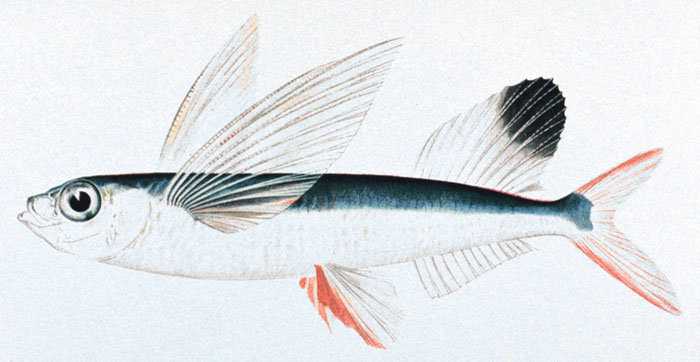
The Exocoetidae are a family of saltwater ray-finned fish in the order Beloniformes, known colloquially as flying fish or flying cod, with about 64 species in seven genera. While they do not "fly" in the same way a bird does, flying fish can make powerful leaps out of the water where their long, wing-like paired fins act as aerofoils to generate lift and enable prolonged gliding for considerable distances above the water surface. The main reason for this behavior is thought to be to escape from underwater predators, which include swordfish, mackerel, tuna, and marlin, among others, though their periods of flight expose them to attack by aerial predators such as frigatebirds.
Barbados is known as "the land of the flying fish" and the fish is one of the national symbols of the country. The French Exocet anti-ship missile is also named after them, as the missile can be launched from underwater, and take a low, sea-skimming trajectory before striking the targets.
The term Exocoetidae is both the scientific name and the general name in Latin for a flying fish. The suffix -idae, common for indicating a family, follows the root of the Latin word exocoetus, a transliteration of the Ancient Greek name ἐξώκοιτος. This means literally 'sleeping outside', from ἔξω, 'outside', and κοῖτος, 'bed', 'resting place', with the verb root κει-, 'to lie down', so named as flying fish were believed to leave the water to sleep ashore, or due to flying fish flying and thus stranding themselves in boats.
The Exocoetidae is divided into four subfamilies and seven genera:
The earliest fossil flyingfish are known from the Early Eocene of Monte Bolca, Italy. They include the genus Rhamphexocoetus Bannikov et al., 1985, which appears to be transitional between halfbeaks and flyingfishes. Also known from the same deposits is "Engraulis" evolans Agassiz, 1835, which was previously thought to be an anchovy, but is now known to represent a juvenile flyingfish.
Flying fish live in all of the oceans, particularly in tropical and warm subtropical waters. They are commonly found in the epipelagic zone, the top layer of the ocean to a depth of about 200 m (660 ft).
Numerous morphological features give flying fish the ability to leap above the surface of the ocean. One such feature is fully broadened neural arches, which act as insertion sites for connective tissues and ligaments in a fish's skeleton. Fully broadened neural arches act as more stable and sturdier sites for these connections, creating a strong link between the vertebral column and cranium. A steady glide will improve their flight duration and allow them to be above water. An unsteady glide will not impact their flight as much but will shorten their flight duration not much more than a steady flight. This also will vary based on their energy consumption. This ultimately allows a rigid and sturdy vertebral column (body) that is beneficial in flight. Having a rigid body during glided flight gives the flying fish aerodynamic advantages, increasing its speed and improving its aim. Furthermore, flying fish have developed vertebral columns and ossified caudal complexes. These features provide the majority of strength to the flying fish, allowing them to physically lift their bodies out of water and glide remarkable distances. These additions also reduce the flexibility of the flying fish, allowing them to perform powerful leaps without weakening midair. At the end of a glide, they fold their pectoral fins to re-enter the sea, or drop their tails into the water to push against the water to lift for another glide, possibly changing direction. The curved profile of the "wing" is comparable to the aerodynamic shape of a bird wing. The fish is able to increase its time in the air by flying straight into or at an angle to the direction of updrafts created by a combination of air and ocean currents.
Species of genus Exocoetus have one pair of fins and streamlined bodies to optimize for speed, while Cypselurus spp. have flattened bodies and two pairs of fins, which maximize their time in the air. From 1900 to the 1930s, flying fish were studied as possible models used to develop airplanes.
Hub AI
Flying fish AI simulator
(@Flying fish_simulator)
Flying fish
The Exocoetidae are a family of saltwater ray-finned fish in the order Beloniformes, known colloquially as flying fish or flying cod, with about 64 species in seven genera. While they do not "fly" in the same way a bird does, flying fish can make powerful leaps out of the water where their long, wing-like paired fins act as aerofoils to generate lift and enable prolonged gliding for considerable distances above the water surface. The main reason for this behavior is thought to be to escape from underwater predators, which include swordfish, mackerel, tuna, and marlin, among others, though their periods of flight expose them to attack by aerial predators such as frigatebirds.
Barbados is known as "the land of the flying fish" and the fish is one of the national symbols of the country. The French Exocet anti-ship missile is also named after them, as the missile can be launched from underwater, and take a low, sea-skimming trajectory before striking the targets.
The term Exocoetidae is both the scientific name and the general name in Latin for a flying fish. The suffix -idae, common for indicating a family, follows the root of the Latin word exocoetus, a transliteration of the Ancient Greek name ἐξώκοιτος. This means literally 'sleeping outside', from ἔξω, 'outside', and κοῖτος, 'bed', 'resting place', with the verb root κει-, 'to lie down', so named as flying fish were believed to leave the water to sleep ashore, or due to flying fish flying and thus stranding themselves in boats.
The Exocoetidae is divided into four subfamilies and seven genera:
The earliest fossil flyingfish are known from the Early Eocene of Monte Bolca, Italy. They include the genus Rhamphexocoetus Bannikov et al., 1985, which appears to be transitional between halfbeaks and flyingfishes. Also known from the same deposits is "Engraulis" evolans Agassiz, 1835, which was previously thought to be an anchovy, but is now known to represent a juvenile flyingfish.
Flying fish live in all of the oceans, particularly in tropical and warm subtropical waters. They are commonly found in the epipelagic zone, the top layer of the ocean to a depth of about 200 m (660 ft).
Numerous morphological features give flying fish the ability to leap above the surface of the ocean. One such feature is fully broadened neural arches, which act as insertion sites for connective tissues and ligaments in a fish's skeleton. Fully broadened neural arches act as more stable and sturdier sites for these connections, creating a strong link between the vertebral column and cranium. A steady glide will improve their flight duration and allow them to be above water. An unsteady glide will not impact their flight as much but will shorten their flight duration not much more than a steady flight. This also will vary based on their energy consumption. This ultimately allows a rigid and sturdy vertebral column (body) that is beneficial in flight. Having a rigid body during glided flight gives the flying fish aerodynamic advantages, increasing its speed and improving its aim. Furthermore, flying fish have developed vertebral columns and ossified caudal complexes. These features provide the majority of strength to the flying fish, allowing them to physically lift their bodies out of water and glide remarkable distances. These additions also reduce the flexibility of the flying fish, allowing them to perform powerful leaps without weakening midair. At the end of a glide, they fold their pectoral fins to re-enter the sea, or drop their tails into the water to push against the water to lift for another glide, possibly changing direction. The curved profile of the "wing" is comparable to the aerodynamic shape of a bird wing. The fish is able to increase its time in the air by flying straight into or at an angle to the direction of updrafts created by a combination of air and ocean currents.
Species of genus Exocoetus have one pair of fins and streamlined bodies to optimize for speed, while Cypselurus spp. have flattened bodies and two pairs of fins, which maximize their time in the air. From 1900 to the 1930s, flying fish were studied as possible models used to develop airplanes.
Recent media