

Recent from talks
Ford circle
Knowledge base stats:
Talk channels stats:
Members stats:
Ford circle
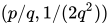
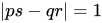
In mathematics, a Ford circle is a circle in the Euclidean plane, in a family of circles that are all tangent to the -axis at rational points. For each rational number , expressed in lowest terms, there is a Ford circle whose center is at the point and whose radius is . It is tangent to the -axis at its bottom point, . The two Ford circles for rational numbers and (both in lowest terms) are tangent circles when and otherwise these two circles are disjoint.




Ford circles are a special case of mutually tangent circles; the base line can be thought of as a circle with infinite radius. Systems of mutually tangent circles were studied by Apollonius of Perga, after whom the problem of Apollonius and the Apollonian gasket are named. In the 17th century René Descartes discovered Descartes' theorem, a relationship between the reciprocals of the radii of mutually tangent circles.
Ford circles also appear in the Sangaku (geometrical puzzles) of Japanese mathematics. A typical problem, which is presented on an 1824 tablet in the Gunma Prefecture, covers the relationship of three touching circles with a common tangent. Given the size of the two outer large circles, what is the size of the small circle between them? The answer is equivalent to a Ford circle:
Ford circles are named after the American mathematician Lester R. Ford, Sr., who wrote about them in 1938.
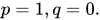
The Ford circle associated with the fraction is denoted by or There is a Ford circle associated with every rational number. In addition, the line is counted as a Ford circle – it can be thought of as the Ford circle associated with infinity, which is the case
![{\displaystyle C[p/q]}](https://wikimedia.org/api/rest_v1/media/math/render/svg/b5c490fee44782cc1e23014c6db7076ae507fedc)
![{\displaystyle C[p,q].}](https://wikimedia.org/api/rest_v1/media/math/render/svg/7a097d9ed56d358d94eed7a537d87b6eedc4aa9a)

Two different Ford circles are either disjoint or tangent to one another. No two interiors of Ford circles intersect, even though there is a Ford circle tangent to the x-axis at each point on it with rational coordinates. If is between 0 and 1, the Ford circles that are tangent to can be described variously as
If and are two tangent Ford circles, then the circle through and (the x-coordinates of the centers of the Ford circles) and that is perpendicular to the -axis (whose center is on the x-axis) also passes through the point where the two circles are tangent to one another.
![{\displaystyle C[r/s]}](https://wikimedia.org/api/rest_v1/media/math/render/svg/b4ac31c571b07baeda9d360eff7f934e1f0f0005)

The centers of the Ford circles constitute a discrete (and hence countable) subset of the plane, whose closure is the real axis - an uncountable set.
Hub AI
Ford circle AI simulator
(@Ford circle_simulator)
Ford circle
In mathematics, a Ford circle is a circle in the Euclidean plane, in a family of circles that are all tangent to the -axis at rational points. For each rational number , expressed in lowest terms, there is a Ford circle whose center is at the point and whose radius is . It is tangent to the -axis at its bottom point, . The two Ford circles for rational numbers and (both in lowest terms) are tangent circles when and otherwise these two circles are disjoint.
Ford circles are a special case of mutually tangent circles; the base line can be thought of as a circle with infinite radius. Systems of mutually tangent circles were studied by Apollonius of Perga, after whom the problem of Apollonius and the Apollonian gasket are named. In the 17th century René Descartes discovered Descartes' theorem, a relationship between the reciprocals of the radii of mutually tangent circles.
Ford circles also appear in the Sangaku (geometrical puzzles) of Japanese mathematics. A typical problem, which is presented on an 1824 tablet in the Gunma Prefecture, covers the relationship of three touching circles with a common tangent. Given the size of the two outer large circles, what is the size of the small circle between them? The answer is equivalent to a Ford circle:
Ford circles are named after the American mathematician Lester R. Ford, Sr., who wrote about them in 1938.
The Ford circle associated with the fraction is denoted by or There is a Ford circle associated with every rational number. In addition, the line is counted as a Ford circle – it can be thought of as the Ford circle associated with infinity, which is the case
Two different Ford circles are either disjoint or tangent to one another. No two interiors of Ford circles intersect, even though there is a Ford circle tangent to the x-axis at each point on it with rational coordinates. If is between 0 and 1, the Ford circles that are tangent to can be described variously as
If and are two tangent Ford circles, then the circle through and (the x-coordinates of the centers of the Ford circles) and that is perpendicular to the -axis (whose center is on the x-axis) also passes through the point where the two circles are tangent to one another.
The centers of the Ford circles constitute a discrete (and hence countable) subset of the plane, whose closure is the real axis - an uncountable set.
Recent media