Hubbry Logo
search
logo
2216671

Ford circle

logo
Community Hub0 Subscribers
Read side by side
from Wikipedia
Ford circles for p/q with q from 1 to 20. Circles with q ≤ 10 are labelled as p/q and color-coded according to q. Each circle is tangent to the base line and its neighboring circles. Irreducible fractions with the same denominator have circles of the same size.

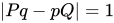
In mathematics, a Ford circle is a circle in the Euclidean plane, in a family of circles that are all tangent to the -axis at rational points. For each rational number , expressed in lowest terms, there is a Ford circle whose center is at the point and whose radius is . It is tangent to the -axis at its bottom point, . The two Ford circles for rational numbers and (both in lowest terms) are tangent circles when and otherwise these two circles are disjoint.[1]

History

[edit]

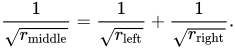
Ford circles are a special case of mutually tangent circles; the base line can be thought of as a circle with infinite radius. Systems of mutually tangent circles were studied by Apollonius of Perga, after whom the problem of Apollonius and the Apollonian gasket are named.[2] In the 17th century René Descartes discovered Descartes' theorem, a relationship between the reciprocals of the radii of mutually tangent circles.[2]

Ford circles also appear in the Sangaku (geometrical puzzles) of Japanese mathematics. A typical problem, which is presented on an 1824 tablet in the Gunma Prefecture, covers the relationship of three touching circles with a common tangent. Given the size of the two outer large circles, what is the size of the small circle between them? The answer is equivalent to a Ford circle:[3]
Ford circles are named after the American mathematician Lester R. Ford, Sr., who wrote about them in 1938.[1]

Properties

[edit]
Comparison of Ford circles and a Farey diagram with circular arcs for n from 1 to 9. Note that each arc intersects its corresponding circles at right angles. In the SVG image, hover over a circle or curve to highlight it and its terms.

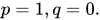
The Ford circle associated with the fraction is denoted by or There is a Ford circle associated with every rational number. In addition, the line is counted as a Ford circle – it can be thought of as the Ford circle associated with infinity, which is the case

Two different Ford circles are either disjoint or tangent to one another. No two interiors of Ford circles intersect, even though there is a Ford circle tangent to the x-axis at each point on it with rational coordinates. If is between 0 and 1, the Ford circles that are tangent to can be described variously as

  1. the circles where [1]
  2. the circles associated with the fractions that are the neighbors of in some Farey sequence,[1] or
  3. the circles where is the next larger or the next smaller ancestor to in the Stern–Brocot tree or where is the next larger or next smaller ancestor to .[1]

If and are two tangent Ford circles, then the circle through and (the x-coordinates of the centers of the Ford circles) and that is perpendicular to the -axis (whose center is on the x-axis) also passes through the point where the two circles are tangent to one another.

The centers of the Ford circles constitute a discrete (and hence countable) subset of the plane, whose closure is the real axis - an uncountable set.

Ford circles can also be thought of as curves in the complex plane. The modular group of transformations of the complex plane maps Ford circles to other Ford circles.[1]

Ford circles are a sub-set of the circles in the Apollonian gasket generated by the lines and and the circle [4]

By interpreting the upper half of the complex plane as a model of the hyperbolic plane (the Poincaré half-plane model), Ford circles can be interpreted as horocycles. In hyperbolic geometry any two horocycles are congruent. When these horocycles are circumscribed by apeirogons they tile the hyperbolic plane with an order-3 apeirogonal tiling.

Total area of Ford circles

[edit]

There is a link between the area of Ford circles, Euler's totient function the Riemann zeta function and Apéry's constant [5] As no two Ford circles intersect, it follows immediately that the total area of the Ford circles

is less than 1. In fact the total area of these Ford circles is given by a convergent sum, which can be evaluated. From the definition, the area is
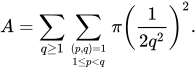
Simplifying this expression gives

where the last equality reflects the Dirichlet generating function for Euler's totient function Since this finally becomes

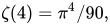
Note that as a matter of convention, the previous calculations excluded the circle of radius corresponding to the fraction . It includes the complete circle for , half of which lies outside the unit interval, hence the sum is still the fraction of the unit square covered by Ford circles.

Ford spheres (3D)

[edit]
Ford spheres above the complex domain

The concept of Ford circles can be generalized from the rational numbers to the Gaussian rationals, giving Ford spheres. In this construction, the complex numbers are embedded as a plane in a three-dimensional Euclidean space, and for each Gaussian rational point in this plane one constructs a sphere tangent to the plane at that point. For a Gaussian rational represented in lowest terms as , the diameter of this sphere should be where represents the complex conjugate of . The resulting spheres are tangent for pairs of Gaussian rationals and with , and otherwise they do not intersect each other.[6][7]

See also

[edit]

References

[edit]
[edit]
Revisions and contributorsEdit on WikipediaRead on Wikipedia
from Grokipedia
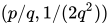
In mathematics, a Ford circle is a circle in the Euclidean plane that is tangent to the x-axis at a rational point $ \frac{p}{q} $, where $ p $ and $ q $ are coprime integers with $ q > 0 $, having its center at $ \left( \frac{p}{q}, \frac{1}{2q^2} \right) $ and radius $ \frac{1}{2q^2} $.[1] These circles form a family parameterized by the rational numbers, with each circle touching the x-axis precisely at its corresponding rational and never intersecting the interiors of others.[1] Two Ford circles are tangent to each other if and only if the absolute value of the determinant of their defining fractions—that is, $ |pk' - p'k| = 1 $—indicating adjacency in the Farey sequence of order $ \max(q, q') $.[1] Ford circles were introduced by the American mathematician Lester Randolph Ford Sr. in his 1938 paper "Fractions," where he used them to provide a geometric interpretation of continued fraction approximations to irrational numbers and the structure of rational approximations.[2][3] Ford's construction draws on earlier ideas from Farey sequences, which enumerate rationals in reduced form, but visualizes their relationships through tangency rather than linear ordering.[2] The circles above the x-axis correspond to positive rationals, while those below represent negatives, though the standard study focuses on the upper half-plane.[1] Key properties of Ford circles include their mutual non-intersection and tangency conditions, which reflect the mediant operation on fractions: the circle for the mediant $ \frac{p + p'}{q + q'} $ of two tangent circles is itself tangent to both.[1] The total area of all Ford circles (for positive rationals between 0 and 1) is finite and equals $ \frac{3 \zeta(3)}{2 \pi^2} \approx 0.872 $, reflecting that while there are infinitely many circles, their areas decrease rapidly. These circles have applications in number theory, particularly in visualizing Diophantine approximation and the geometry of the modular group, and extend to higher dimensions as Ford spheres.[1]

Definition and Construction

Formal Definition

A Ford circle is defined for each pair of coprime integers hh and kk, where k>0k > 0 and gcd(h,k)=1\gcd(h, k) = 1, as the circle in the upper half-plane centered at (hk,12k2)\left( \frac{h}{k}, \frac{1}{2k^2} \right) with radius 12k2\frac{1}{2k^2}.[4][1] This construction ensures that every such circle is tangent to the x-axis at the point (hk,0)\left( \frac{h}{k}, 0 \right), since the y-coordinate of the center equals the radius.[4] The family includes circles for negative rationals by allowing h<0h < 0, yielding symmetric configurations in the left half-plane.[1] The x-axis itself serves as the boundary case corresponding to the point at infinity, analogous to a Ford circle with infinite radius.[5]

Geometric Construction

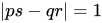
The geometric construction of Ford circles begins with the two trivial circles corresponding to the fractions 0/10/1 and 1/11/1. These are circles of radius 1/21/2, centered at (0,1/2)(0, 1/2) and (1,1/2)(1, 1/2), both tangent to the x-axis from above.[1] This initial setup forms the foundation for the Farey diagram of order 1.[6] Subsequent circles are added iteratively through the process of building higher-order Farey sequences, where new fractions are inserted as mediants between adjacent existing fractions. For two adjacent fractions p/qp/q and r/sr/s in a Farey sequence (satisfying psqr=1|ps - qr| = 1), the mediant (p+r)/(q+s)(p + r)/(q + s) is introduced, and a circle is drawn for this new fraction, tangent to both the x-axis and the circles of the parent fractions.[7] This process repeats: as the order nn of the Farey sequence increases, mediants with denominator up to nn are added between all pairs of adjacent fractions, ensuring each new circle fits precisely between tangent predecessors without overlap.[6] The construction thus proceeds level by level, mirroring the recursive generation of the Farey sequence itself.[1] The resulting packing fills the space above the x-axis densely, with circles either tangent or disjoint, creating a self-similar arrangement that becomes increasingly intricate at higher orders.[1] For illustration, consider the first few stages: In the Farey sequence of order 1, only the circles for 0/10/1 and 1/11/1 appear. Order 2 adds the mediant 1/21/2, yielding a circle centered at (1/2,1/8)(1/2, 1/8) with radius 1/81/8, tangent to both initial circles. Order 3 further inserts 1/31/3 (mediant of 0/10/1 and 1/21/2) and 2/32/3 (mediant of 1/21/2 and 1/11/1), each with radius 1/181/18, nesting smaller circles between the existing ones.[7]

Geometric Properties

Tangency and Non-Intersection

A fundamental property of Ford circles is that any two distinct circles, corresponding to reduced fractions $ h/k $ and $ h'/k' $ with $ k, k' > 0 $, are either tangent or disjoint, with no overlap of their interiors. Specifically, the circles are tangent if and only if $ |h k' - h' k| = 1 $, and disjoint otherwise.[4] This condition holds because the fractions $ h/k $ and $ h'/k' $ are assumed to be in lowest terms, ensuring $ |h k' - h' k| $ is a positive integer. To derive the tangency condition, consider the centers of the circles at $ (h/k, 1/(2k^2)) $ and $ (h'/k', 1/(2k'^2)) $, each with radius equal to its y-coordinate. The Euclidean distance $ d $ between the centers satisfies
d2=(hkhk)2+(12k212k2)2=(hkhkkk)2+(k2k22k2k2)2. d^2 = \left( \frac{h}{k} - \frac{h'}{k'} \right)^2 + \left( \frac{1}{2k^2} - \frac{1}{2k'^2} \right)^2 = \left( \frac{h k' - h' k}{k k'} \right)^2 + \left( \frac{k'^2 - k^2}{2 k^2 k'^2} \right)^2.
Let $ m = |h k' - h' k| \geq 1 $. Substituting yields
d2=m2k2k2+(k2k2)24k4k4=4m2k2k2+(k42k2k2+k4)4k4k4=(k2+k2)2+4(m21)k2k24k4k4. d^2 = \frac{m^2}{k^2 k'^2} + \frac{(k'^2 - k^2)^2}{4 k^4 k'^4} = \frac{4 m^2 k^2 k'^2 + (k^4 - 2 k^2 k'^2 + k'^4)}{4 k^4 k'^4} = \frac{(k^2 + k'^2)^2 + 4 (m^2 - 1) k^2 k'^2}{4 k^4 k'^4}.
The sum of the radii is $ r + r' = 1/(2k^2) + 1/(2k'^2) = (k^2 + k'^2)/(2 k^2 k'^2) $, so
(r+r)2=(k2+k2)24k4k4. (r + r')^2 = \frac{(k^2 + k'^2)^2}{4 k^4 k'^4}.
Thus, $ d^2 = (r + r')^2 + (m^2 - 1) \frac{1}{k^2 k'^2} \geq (r + r')^2 $, with equality if and only if $ m = 1 $. This shows the circles are tangent externally when $ |h k' - h' k| = 1 $, as the distance equals the sum of the radii.[4] When $ m > 1 $, $ d > r + r' $, ensuring the circles are separated without intersecting. Since all Ford circles for positive rationals lie above the x-axis and are tangent to it from the same side, no circle contains another, and all tangencies are external rather than internal. This geometric separation guarantees that the interiors of any two distinct Ford circles do not intersect.[4]

Symmetries and Transformations

The Ford circle packing exhibits invariance under the action of the modular group SL(2,[Z](/page/Z))\mathrm{SL}(2, \mathbb{[Z](/page/Z)}), which consists of 2×22 \times 2 integer matrices (abcd)\begin{pmatrix} a & b \\ c & d \end{pmatrix} with det=adbc=1\det = ad - bc = 1. This group acts on the rationals via fractional linear transformations h/k(ah+bk)/(ch+dk)h/k \mapsto (ah + bk)/(ch + dk), mapping the Ford circle associated with the rational h/kh/k to the circle associated with the image rational, thereby preserving the overall packing structure and tangencies between circles.[8] These transformations extend to the entire complex plane via the Poincaré extension, where Möbius maps γ(z)=(az+b)/(cz+d)\gamma(z) = (az + b)/(cz + d) send circles to circles or lines, maintaining the geometric relations in the Ford configuration. Specifically, translations corresponding to integer shifts (e.g., zz+nz \mapsto z + n for nZn \in \mathbb{Z}) reflect the periodic nature of the rationals along the real axis, while inversions like z1/zz \mapsto -1/z swap roles between finite rationals and the point at infinity, reflecting the packing across the upper half-plane. Such actions preserve or reflect the circle packing, ensuring that tangencies are mapped to tangencies.[8][9] In the context of hyperbolic geometry, Ford circles realize horocycles in the upper half-plane model of the hyperbolic plane H2\mathbb{H}^2. Each Ford circle is the image under an element of PSL(2,Z)\mathrm{PSL}(2, \mathbb{Z}) (the projective version of SL(2,Z)\mathrm{SL}(2, \mathbb{Z})) of a base horocycle, such as the horizontal line at height 1 tangent to the boundary at infinity; these images are Euclidean circles tangent to the real axis at rational points, with the modular group action generating the full set while preserving hyperbolic distances along the horocycles. Under the Cayley transform mapping the upper half-plane to the Poincaré disk model, these horocycles correspond to Euclidean circles inside the unit disk tangent to the boundary circle at the images of the rational cusps, highlighting the packing's role in the modular surface's cusp structure.[10][8] A concrete example is the transformation z1/zz \mapsto -1/z, a generator of SL(2,Z)\mathrm{SL}(2, \mathbb{Z}), which inverts the Ford circle at 0/10/1 (centered at (0,1/2)(0, 1/2) with radius 1/21/2) to a circle at infinity and maps the circle at 1/11/1 (centered at (1,1/2)(1, 1/2) with radius 1/21/2) to the circle at 1/1-1/1, while preserving tangencies between neighboring circles such as those for 1/21/2 and 1/31/3. This inversion effectively reflects the packing across the imaginary axis, demonstrating how modular symmetries reorganize the rational approximations without altering their geometric incidences.[9][8]

Connections to Number Theory

Relation to Farey Sequences

The Farey sequence of order $ n $, denoted $ F_n $, consists of all irreducible fractions between 0 and 1 (inclusive) with denominators at most $ n $, arranged in increasing order.[11] These sequences provide a systematic enumeration of the rationals in the unit interval, starting with $ F_1 = { 0/1, 1/1 } $ and building higher orders by inserting mediants of adjacent terms from previous sequences.[12] In a Farey sequence $ F_n $, two consecutive fractions $ \frac{p}{q} $ and $ \frac{r}{s} $ (in lowest terms) satisfy the adjacency condition $ |ps - qr| = 1 $.[11] This determinant condition precisely corresponds to the tangency of their associated Ford circles, where the circles for $ \frac{p}{q} $ and $ \frac{r}{s} $ touch externally without intersecting interiors.[11] Thus, the structure of Farey sequences directly encodes the tangency relations among Ford circles, with adjacent fractions in $ F_n $ mapping to mutually tangent circles in the visualization.[13] The Ford circles corresponding to the fractions in a Farey sequence $ F_n $ form a chain of tangent circles aligned above the interval [0,1] on the x-axis, illustrating the combinatorial ordering of the rationals.[11] As the order $ n $ increases to $ F_{n+1} $, new fractions are inserted between existing adjacent pairs, filling the gaps with additional circles that are tangent to their neighbors, thereby densifying the chain while preserving the overall tangency properties.[11] This iterative insertion process highlights how Farey sequences exhaust the rationals through successive refinements, mirrored geometrically by the expanding collection of Ford circles.[13]

Approximations and Continued Fractions

Ford circles offer a geometric lens for understanding Diophantine approximations of irrational numbers via continued fractions. For an irrational α\alpha, among all Ford circles Cp/qC_{p/q} with denominator qq in lowest terms, the circle corresponding to a convergent p/qp/q of α\alpha's continued fraction expansion has its center closest to the vertical line x=αx = \alpha. This closeness reflects the superior approximation quality of convergents, as measured by the minimal distance from the circle to the line, which ties directly to the error qαp|q\alpha - p|.[14] The continued fraction expansion of α\alpha manifests geometrically as a chain of tangent Ford circles Cpn/qnC_{p_n/q_n}, where successive convergents pn/qnp_n/q_n produce circles that touch each other and progressively approach the vertical line at α\alpha. These tangencies occur because consecutive convergents satisfy pnqn1pn1qn=1|p_n q_{n-1} - p_{n-1} q_n| = 1, mirroring the condition for adjacency in Farey sequences. This chained configuration visualizes how continued fractions iteratively refine rational approximations, with each new circle nestled between prior ones to better approximate α\alpha.[14][15] The packing of non-intersecting Ford circles imposes fundamental limits on approximation quality, linking to key results in Diophantine theory. In particular, the separations between non-tangent circles relate to the optimality of the √5 constant in Hurwitz's theorem, where the continued fraction chain for irrationals equivalent to the golden ratio achieves the lim inf $ q^2 |\alpha - p/q| = 1/\sqrt{5} $, demonstrating that no larger constant (better uniform approximation bound) is possible for all irrationals. This geometric constraint arises from the circle radii 1/(2q2)1/(2q^2) and their disjoint interiors, ensuring no rational can approximate α\alpha more closely without violating the packing.[15] Applications of Ford circles extend to visualizing Hurwitz's theorem, which asserts that for any irrational α\alpha, there are infinitely many p/qp/q satisfying αp/q<1/(5q2)|\alpha - p/q| < 1/(\sqrt{5} q^2), with 5\sqrt{5} the optimal constant. The theorem's sharpness is illuminated by circle separations: the "mesh triangles" formed by tangent circles and their mediants show how approximations cluster near α\alpha, with the golden ratio's chain achieving the tightest packing that precludes a larger constant. This visualization, introduced by Ford, underscores why equivalents to the golden ratio attain the theorem's bound, providing an intuitive proof of the 5\sqrt{5} factor through geometric exclusion.[15]

Historical Development

Origins and Early Work

The concept of Ford circles has roots in early 19th-century studies of rational fractions and their geometric representations, particularly through the development of Farey sequences. In 1816, British geologist John Farey Sr. introduced these sequences in a letter to The Philosophical Magazine, describing ordered lists of reduced fractions between 0 and 1 with denominators up to a given order, noting their utility in surveying and approximation.[16] Farey observed that the mediant of two adjacent fractions in such a sequence appears as the next term when the order increases, a property he conjectured without proof.[17] Augustin-Louis Cauchy provided a rigorous proof of this mediant property later in 1816, in his Exercices de mathématiques, attributing the sequences to Farey while establishing their key structural features, such as the condition for adjacency based on the determinant of fraction pairs equaling 1.[18] These sequences laid foundational groundwork for visualizing rational approximations geometrically, though without explicit circle constructions at the time.[19] Precursors to Ford circles appear in geometric studies of tangent circle packings and hyperbolic structures. In the 17th century, René Descartes described a theorem on mutually tangent circles, which later inspired Apollonian gaskets—iterative packings of tangent circles filling interstices—providing an early model for dense, non-overlapping circle arrangements similar to those in Ford's work.[20] More directly relevant were horocycles in hyperbolic geometry, introduced by Henri Poincaré in the 1880s through his development of the upper half-plane model, where such curves represent circles tangent to the boundary line, offering a framework for equidistant loci that parallels the tangency properties of Ford circles. The systematic description of Ford circles emerged in 1938 from American mathematician Lester R. Ford Sr., who constructed them as circles centered at (p/q, 1/(2q²)) with radius 1/(2q²) for reduced fractions p/q, associating each with Farey sequence terms to visualize rational approximations.[6] In his paper "Fractions," published in The American Mathematical Monthly (Vol. 45, No. 9, pp. 586–601), Ford explored their tangency and non-intersection properties, linking them to continued fraction expansions for Diophantine approximation. This work arose from Ford's broader interests in analytic number theory and geometric interpretations of fractions, predating his later roles as editor of the Monthly (1942–1946) and president of the Mathematical Association of America (1947–1948).[3]

Naming and Subsequent Studies

The Ford circles are named in honor of the American mathematician Lester R. Ford Sr. (1886–1967), who introduced the geometric construction in his 1938 paper "Fractions," published in The American Mathematical Monthly, though the paper itself refers to them simply as circles associated with rational fractions without using the eponymous term.[11] The designation "Ford circles" emerged in later literature to attribute the innovation to Ford, gaining widespread use and popularization during the 1950s and 1960s as the objects became integrated into broader discussions of geometry and Diophantine approximation; for instance, H. S. M. Coxeter highlighted their properties in the context of Farey sequences and modular transformations in his 1961 textbook Introduction to Geometry. Post-1938 studies expanded on Ford's foundational geometric observations, particularly forging deeper connections to modular forms and analytic number theory. In the 1960s and beyond, researchers like Robert A. Rankin explored how the tangency properties of Ford circles relate to the distribution of zeros for Poincaré series and Eisenstein series associated with congruence subgroups, providing high-precision approximations for these zeros within the fundamental domain of the modular group. Rankin's analysis in Modular Forms and Functions (1977) and his 1982 paper on Poincaré series zeros laid groundwork for viewing Ford circles as tools for bounding modular function behavior near the real axis, influencing subsequent work on cusp forms and quasi-modular forms. Recent developments up to 2025 have renewed interest through computational approaches and interdisciplinary links. For example, a 2015 arXiv preprint examined iterative geometric constructions generating Ford circles and their three-dimensional analogs (Ford spheres), revealing recursive patterns tied to Farey sequences and hyperbolic geometry.[21] Computational visualizations have facilitated explorations of their fractal-like structure, while applications extend to random matrix theory, where Ford circles model spacing statistics akin to eigenvalue distributions in Gaussian ensembles, as seen in high-energy physics contexts. Additionally, their role in circle packings has connected them to quantum chaos via spectral triples on fractal sets, approximating chaotic dynamics in noncommutative geometry.[22] For instance, 2025 studies have applied Ford circles to derive Rademacher-type exact formulas and higher-order Turán inequalities for modular forms, as well as to analyze one-loop four-graviton string amplitudes at finite α′.[23][24]

Analytic Properties

Total Area Calculation

The area of a single Ford circle associated with the reduced fraction $ h/k $ in lowest terms, where $ k \geq 1 $ and $ \gcd(h, k) = 1 $, is given by $ \pi r^2 $, with radius $ r = \frac{1}{2k^2} $. This yields an area of $ \frac{\pi}{4k^4} $.[1] The total area $ A $ of all Ford circles corresponding to reduced fractions in (0,1], is the sum over all such fractions. For each denominator $ k $, there are exactly $ \phi(k) $ numerators $ h $ with $ 1 \leq h \leq k $ and $ \gcd(h,k)=1 $. Thus,
A=k=11hkgcd(h,k)=1π4k4=π4k=1ϕ(k)k4, A = \sum_{k=1}^\infty \sum_{\substack{1 \leq h \leq k \\ \gcd(h,k)=1}} \frac{\pi}{4k^4} = \frac{\pi}{4} \sum_{k=1}^\infty \frac{\phi(k)}{k^4},
where $ \phi $ denotes Euler's totient function. This sum excludes the circle at 0/1, which is symmetric to the one at 1/1; the left half of the 0/1 circle lies outside the interval [0,1].[25] The series $ \sum_{k=1}^\infty \frac{\phi(k)}{k^4} $ is the Dirichlet series for $ \phi(n) $ evaluated at $ s=4 $, which equals $ \frac{\zeta(3)}{\zeta(4)} $, with $ \zeta(s) $ the Riemann zeta function. Since $ \zeta(4) = \frac{\pi^4}{90} $, this simplifies to $ \frac{90 \zeta(3)}{\pi^4} $. Substituting yields
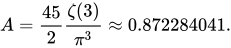
A=π490ζ(3)π4=45ζ(3)2π30.872284. A = \frac{\pi}{4} \cdot \frac{90 \zeta(3)}{\pi^4} = \frac{45 \zeta(3)}{2 \pi^3} \approx 0.872284.
Here, $ \zeta(3) \approx 1.202057 $ is Apéry's constant.[26][25] This finite total area arises despite the infinitely many circles due to the rapid decay of the terms $ 1/k^4 $. Moreover, as no two Ford circles overlap interiors—their interiors are disjoint by the tangency and non-intersection properties—the total area is simply the additive sum of individual areas.[1] The sum of the radii of all Ford circles, given by q=1ϕ(q)2q2\sum_{q=1}^\infty \frac{\phi(q)}{2q^2} where ϕ\phi denotes Euler's totient function, diverges logarithmically. This follows from the fact that ϕ(q)/q6/π2\phi(q)/q \sim 6/\pi^2 on average, so the partial sums up to XX behave asymptotically as (3/π2)logX+O(1)(3/\pi^2) \log X + O(1), reflecting the infinite extent of the packing along the x-axis as the centers of the circles spread unboundedly over the real line. In contrast to the convergent total area πr2=(3/2)ϕ(q)/q4<\sum \pi r^2 = (3/2) \sum \phi(q)/q^4 < \infty, this divergence highlights how the vertical confinement (all circles tangent to the x-axis) coexists with horizontal infinitude. Studies of moments of distances between centers of Ford circles provide further analytic measures of the packing's geometry. For consecutive circles in the Farey sequence of order YY, the kk-th moment of the Euclidean distances dd between their centers satisfies 1NdkCkY\frac{1}{N} \sum d^k \sim C_k Y for k=1k=1 and k3k \geq 3, and C2YlogY\sim C_2 Y \log Y for k=2k=2, where N3Y2/π2N \sim 3Y^2/\pi^2 is the number of terms and the constants CkC_k involve values of the Riemann zeta function (e.g., C1=ζ(3)/(4ζ(2))C_1 = \zeta(3)/(4\zeta(2))).[27] These results, analogous to those for Ford spheres derived in 2019, quantify the typical spacing, which decreases as O(1/Y)O(1/Y) on average, underscoring the increasing density of circles as finer rationals are included. Packing densities in the Ford circle configuration vary locally and asymptotically. Near rational points with small denominators, large circles (e.g., the unit circle at 0/1 and 1/1) yield high local densities close to 1, while near irrationals—particularly those poorly approximable by rationals like the golden ratio—clusters of smaller circles result in lower densities due to sparser coverage. The asymptotic radial density, defined as the limiting proportion of a horizontal line at height ϵ>0\epsilon > 0 intersected by the circles as ϵ0\epsilon \to 0, equals 3/π0.9553/\pi \approx 0.955, indicating incomplete coverage of the upper half-plane.[28] This measure incorporates zeta function values through equidistribution properties of Farey fractions, with error terms in the approximation linked to the Riemann Hypothesis.

Generalizations and Extensions

Ford Spheres in Three Dimensions

Ford spheres provide a natural three-dimensional extension of Ford circles, associating a sphere to each irreducible rational number $ p/q \in \mathbb{Q} $. The sphere corresponding to $ p/q $ (with $ q > 0 $ and $ \gcd(p, q) = 1 $) is centered at $ (p/q, 0, 1/(2q^2)) $ in Euclidean 3-space and has radius $ 1/(2q^2) $, ensuring tangency to the $ xy $-plane at $ (p/q, 0, 0) $. This geometric construction preserves key properties from the two-dimensional case while embedding the rational points along the $ x $-axis.[8] Two such spheres for fractions $ p/q $ and $ r/s $ are tangent if and only if $ |ps - qr| = 1 $, directly analogous to the tangency condition for Ford circles. In all other cases, the spheres do not intersect, as the distance between their centers exceeds the sum of their radii. This follows from the geometry of the centers and radii, where the condition holds precisely when $ |ps - qr| = 1 $, and is strictly larger otherwise.[8] The collection of Ford spheres constitutes a packing with disjoint interiors in the half-space above the $ xy $-plane. This initial packing can be extended iteratively: starting from mutually tangent triples, new spheres are added that are tangent to three existing spheres (and potentially the plane), generating a denser structure. The resulting configuration relates to three-dimensional Farey complexes, which generalize Farey sequences to higher dimensions, and to Apollonian sphere packings, which fill the available space in a fractal manner without overlaps. The total volume is finite when considering the initial set over rationals in a bounded interval such as [0,1].[8]

Higher-Dimensional and Other Analogs

In higher dimensions, Ford circles generalize to Ford hyperspheres within the upper half-space model of hyperbolic (n+1)(n+1)-space, where n2n \geq 2. These hyperspheres correspond to rational points on the boundary hyperplane Rn×{0}\mathbb{R}^n \times \{0\} and are constructed as horoballs tangent to this boundary. For a reduced rational p/qQp/q \in \mathbb{Q} (with p,qZp, q \in \mathbb{Z}, gcd(p,q)=1\gcd(p,q)=1, q>0q > 0), the associated hypersphere has its center at (p/q,0,,0,1/(2q2))(p/q, 0, \dots, 0, 1/(2q^2)) and radius 1/(2q2)1/(2q^2), ensuring tangency to the boundary hyperplane xn+1=0x_{n+1} = 0. This placement mirrors the 2D case while embedding the rational in the first coordinate, with subsequent coordinates set to zero for simplicity in bridging to multidimensional settings. Two such hyperspheres for rationals p/qp/q and a/ba/b are tangent if and only if pbqa=1|pb - qa| = 1, a condition derived from the determinant of the corresponding 2×22 \times 2 integer matrix, which extends naturally via SL(n,Z)(n,\mathbb{Z})-invariants in higher ranks.[29] More general constructions employ Clifford algebras associated with positive definite quadratic forms to define Ford hyperspheres for arbitrary dimensions. Here, the centers and radii are parameterized using reverse Hermitian matrices A=(αβγα)A = \begin{pmatrix} \alpha & \beta \\ \gamma & \alpha \end{pmatrix} over orders in rational Clifford algebras, with the center at p=β/γp = -\beta / \gamma and radius r=β2αγ/γr = \sqrt{|\beta|^2 - \alpha \gamma} / |\gamma|. Tangency occurs when the spheres are adjacent in the Farey sense, generalized through the group's action on the boundary, ensuring the packing is integral with integer curvatures (reciprocals of radii). For n=4n=4, this connects to quaternionic modular groups like PSL(2,O)(2, \mathcal{O}), where O\mathcal{O} is an order in the Hurwitz quaternions, linking the packings to cusp sections of higher-rank modular forms. These structures form connected packings invariant under the group action, providing geometric realizations of Dirichlet's approximation theorem in multiple variables.[29] Variants of these packings include integral Apollonian sphere packings, which extend the iterative construction of tangent spheres with integer curvatures and encompass Ford hyperspheres as a degenerate case tangent to a bounding hyperplane. In such packings, starting from a configuration of mutually tangent hyperspheres (analogous to Descartes' theorem in higher dimensions), new hyperspheres are inserted into curvilinear polytopes, generalizing the Farey sequence insertion process and yielding Ford-like arrangements in non-Euclidean geometries like spherical or projective spaces via stereographic projections. Connections to cusp forms in higher-rank groups, such as those arising from Bianchi or Picard modular surfaces, further tie these analogs to analytic number theory, where the packing densities relate to regulators and class numbers.[30][29] Recent developments up to 2024 have explored these analogs in broader contexts, including explicit computations of fundamental domains for Clifford-Bianchi groups and their horoball packings, revealing non-maximal subsets akin to classical Apollonian configurations. These extensions emphasize the role of quadratic forms in ensuring tangency and connectivity, with applications to Diophantine approximation in higher dimensions.[29]
User Avatar
No comments yet.