Hubbry Logo
Fort BrookeFort BrookeMain
Open search
Fort Brooke
Community hub
Fort Brooke
logo
8 pages, 0 posts
0 subscribers
Be the first to start a discussion here.
Fort Brooke
Fort Brooke
from Wikipedia

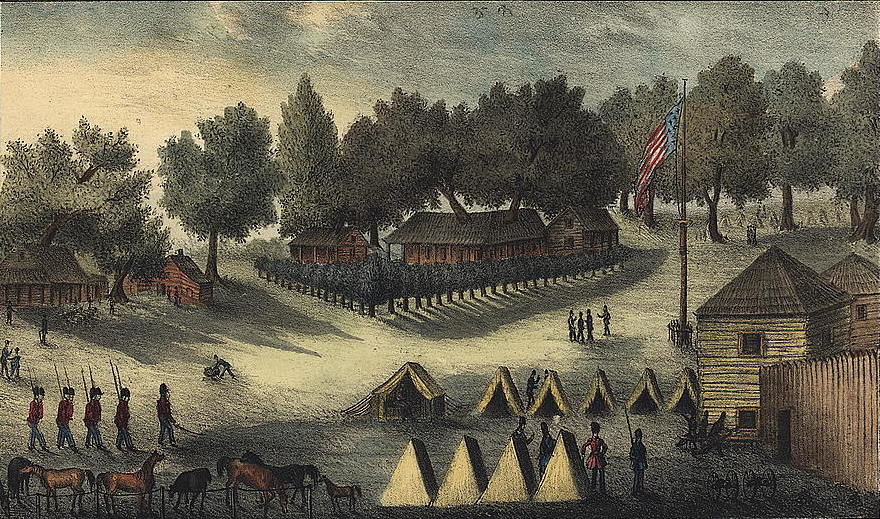
Fort Brooke around 1840

Fort Brooke was a historical military post established at the mouth of the Hillsborough River in present-day Tampa, Florida, in 1824. Its original purpose was to serve as a check on and trading post for the native Seminoles, who had been confined to an interior reservation by the Treaty of Moultrie Creek (1823), and it served as a military headquarters and port during the Second Seminole War (1835–1842). The village of Tampa developed just north of the fort during this period, and the area was the site of a minor raid and skirmish during the American Civil War. The obsolete outpost was sparsely garrisoned after the war, and it was decommissioned in 1883, just before Tampa began a period of rapid growth, opening the land for development.

Fort Brooke was located on what is now the southern end of downtown Tampa along eastern bank of the river and the Garrison Channel. Most of the fort's structures were situated at the current site of the Tampa Convention Center, with the military reserve stretching from the current location of the Tampa Bay History Center to the southeast to Curtis Hixon Waterfront Park to the northwest, with many modern buildings and public spaces (including Benchmark International Arena and much of the Tampa Riverwalk now located in its former footprint. Several unmapped army and Seminole cemeteries along with many artifacts were discovered during various construction projects. The soldiers' remains were reinterred at the Florida National Cemetery in Bushnell, the native remains were transferred to the Seminole Tribe of Florida, and the artifacts were given to the Tampa Bay History Center and other institutions for research and preservation.

Fort Brooke as a military outpost

[edit]

In 1823, Colonels George Mercer Brooke and James Gadsden of the United States Army were ordered to establish a military presence on Tampa Bay in the newly acquired Florida Territory to contain the Seminole Indians according to the Treaty of Moultrie Creek and to curtail illegal activities along the Gulf coast.[1] On 10 January 1824, Brooke and four full companies of the U.S. 4th Infantry Regiment from Pensacola established "Cantonment Brooke" at the mouth of the Hillsborough River, just about where today's Tampa Convention Center sits in downtown Tampa. The site was marked by a huge hickory tree atop an ancient Indian mound, most likely built by the Tocobaga culture centuries before. Brooke directed his troops to clear the area for the construction of a wooden log fort and support buildings, but he ordered that several ancient live oak trees inside the encampment be spared to provide shade and cheer. In 1824, the post was officially rechristened Fort Brooke.

Fort Brooke served as a major outpost on Florida's west coast during all three Seminole Indian Wars and the Civil War. The fort also played a part in the development of the village of Tampa. In October 1863, the small Civil War Battle of Fort Brooke was fought nearby. On May 6, 1864, both Fort Brooke and Tampa were captured by Union forces. As Tampa languished during the 1870s and early 1880s, so did Fort Brooke. The last roll call of soldiers occurred in 1882, and the post was decommissioned by the U.S. Army in 1883.

Closure and as incorporated town

[edit]

After the fort's closure, most of the land was open to homesteaders, and some garrison buildings remained on site.[2] Shortly after the post was decommissioned, Fort Brooke became an independent incorporated town in 1885.[3] Fort Brooke was annexed by Tampa in 1907.[2]

See also

[edit]

Tampa-Fort Brooke, a single census unit recorded by the U.S. Census Bureau in 1850.

References

[edit]

Further reading

[edit]
[edit]
Revisions and contributorsEdit on WikipediaRead on Wikipedia
from Grokipedia
Fort Brooke was a United States Army military post established in January 1824 at the mouth of the Hillsborough River where it meets Tampa Bay, in present-day Tampa, Florida. Originally designated Cantonment Brooke, the outpost was created to enforce the Treaty of Moultrie Creek signed in 1823, which required the Seminole tribes to relocate to a reservation south of the post, thereby securing American territorial control in the region following the acquisition of Florida from Spain. Reactivated in 1834, it functioned as the primary command headquarters for U.S. forces during the Second Seminole War (1835–1842), coordinating operations against Seminole resistance and facilitating troop movements and supply lines critical to the conflict. The fort's presence spurred the initial permanent settlement of Tampa Bay, evolving from a sparse military encampment amid existing Spanish fishing operations into the nucleus of civilian development that laid the foundation for Tampa's growth as a key port and urban center. Deactivated after the Seminole War, it saw limited reuse, including as a minor Confederate position during the American Civil War, before the site's lands were repurposed in the late 19th century, with remnants preserved in memorials amid modern infrastructure.

Establishment

Founding and Strategic Purpose

Fort Brooke was established on January 22, 1824, by Brevet Colonel George Mercer Brooke of the at the mouth of the Hillsborough River, where it meets in present-day . The post, initially known as Cantonment Brooke, was ordered on November 5, 1823, by the U.S. Army's commanding general as part of efforts to consolidate control over the following its acquisition from in 1821. The founding occurred in direct response to the Treaty of Moultrie Creek, signed on September 18, 1823, between the U.S. government and leaders, which confined the Seminoles to a reservation approximately 30 miles north of while ceding their northern lands to the . This treaty necessitated military outposts to enforce Seminole relocation, monitor compliance, and prevent raids or escapes from the reservation, with Fort Brooke positioned strategically outside the reserved territory to oversee Seminole movements. Strategically, Fort Brooke served as a outpost to safeguard 's deep-water harbor, which offered vital access for naval operations, supply lines, and potential settlement expansion along Florida's Gulf Coast. It protected against threats from Seminoles, pirates operating in the Gulf, and lawless elements, thereby enabling U.S. enforcement of territorial sovereignty and facilitating future civilian development in the region. The fort's location at the southern tip of a dividing from Hillsborough Bay enhanced its defensive capabilities and logistical importance for military campaigns.

Construction and Early Infrastructure

In November 1823, the U.S. ordered George Mercer Brooke of the Fourth Infantry to establish a military post at with four companies from Cantonment Clinch in Pensacola. Brooke and his troops arrived on January 22, 1824, after departing Pensacola on January 15 and facing delays from a ; they landed at Gadsden Point and marched to the selected site on the northeastern bank of the Hillsborough River's mouth, an area previously occupied by a Timucuan Indian village and Spanish fishing structures including palmetto huts and a dilapidated . Construction commenced immediately, with soldiers clearing land using primarily pine logs for buildings, initially housing in tents while officers occupied a nearby trader's structure; by mid-April 1824, officers' quarters, a quartermaster's quarters, commissary storehouse, and bakehouse were completed, alongside barracks measuring 260 feet long and 12 feet high. Early infrastructure emphasized self-sufficiency and supply lines. By September 1824, troops had cleared 15 acres and cultivated 9 acres for gardens to supplement provisions, while water—deemed poor quality onsite—was hauled from Government Spring approximately two miles inland via mule-drawn wagons. A was constructed at the river's edge to facilitate supply shipments from Pensacola and New Orleans, with soldiers tasked to clear alligators from the waterway. In 1825, a connected the fort to the spring, followed by the completion of the Military Road (or Fort King Trail) extending inland; a powder magazine was finished by January 1826 to store ordnance securely. Defensive features in the initial phase were modest, reflecting the post's role as a peaceful of about 250 men rather than an active outpost, with a serving as an early lookout point; permanent defenses, including blockhouses and artillery placements, were added later amid rising tensions.

Military Operations

Role in the Seminole Wars

Fort Brooke, established in January 1824 to enforce the Treaty of Moultrie Creek (1823) by confining Seminole Indians to a central Florida reservation, initially functioned as a military outpost and trading post to monitor and interact with Seminole populations. Its role expanded significantly during the Second Seminole War (1835–1842), when the fort was reactivated in 1834 and became the main command headquarters, supply center, and port for U.S. Army operations on Florida's west coast. Housing up to 4,000 troops at peak, it supported logistics including the embarkation of reinforcements and deportation of captured Seminoles, often in manacles, to territories beyond Florida. The war's escalation was triggered by the Dade Massacre on December 28, 1835, in which Major Francis L. Dade and about 110 soldiers marching from Fort Brooke to Fort King were ambushed by Seminole forces led by Micanopy, resulting in the deaths of all but one or two survivors. From the fort, commanders like Brevet Major General Winfield Scott coordinated a three-pronged offensive against Seminole strongholds, while Brevet Major General Edmund P. Gaines engaged in battles such as the eight-day fight at Withlacoochee Cove starting February 27, 1836. The conflict, costing over $20 million and more than 1,500 U.S. military lives, ended via negotiations on July 21, 1842, allowing limited Seminole retention in southern Florida. Fort Brooke's involvement in the Third Seminole War (1855–1858) was comparatively minor, serving auxiliary support roles while Fort Myers emerged as the primary base against Billy Bowlegs' band; operations included supply convoys, such as a 1856 mule train ambushed en route to Fort Fraser.

Involvement in Other Conflicts

During the Mexican–American War (1846–1848), Fort Brooke functioned as a key embarkation and garrison point for Florida volunteer companies preparing for deployment. Troops from the fort departed for as a staging area prior to advancing into , while other units mustered there remained stationed to suppress potential unrest in southern , thereby securing the rear for federal forces abroad. In the Third Seminole War (1855–1858), also known as the War, Fort Brooke served primarily as a logistical support base rather than a frontline outpost, supplying wagon trains and grain to forward positions like Fort Fraser. Although troops were garrisoned there, the fort's strategic role was limited compared to its prominence in earlier conflicts, with primary operations shifting southward to sites such as Fort Myers.

Civil War Era

Union Raids and the Battle of Fort Brooke

During the , Union naval forces targeted Fort Brooke and the port of , as part of broader efforts to enforce the of Confederate supply lines and disrupt blockade runners operating from the Gulf Coast. Fort Brooke, originally a U.S. Army post, had been repurposed by Confederate forces with minimal fortifications, including earthen batteries mounting a few light guns, defended by a small of and units totaling around 40-100 men at various points. Earlier Union probes in 1862 had shelled the fort and destroyed moored blockade runners, but the major raid of 1863 aimed to eliminate hidden Confederate vessels up the Hillsborough River. The Battle of Fort Brooke unfolded from October 16 to 18, 1863, under Union Lieutenant Commander Alexander Semmes, with Confederate Captain John Westcott overseeing local defenses. On October 16, the steamers USS Tahoma and USS Adela opened bombardment on Fort Brooke to create a diversion, firing dozens of shells that caused limited damage to the fort's structures but drew Confederate attention seaward. Simultaneously, a Union landing party of about 100 sailors and under Acting Master T. R. Harris disembarked at Ballast Point, approximately 5 miles south of Tampa, and marched 14 miles inland to the Hillsborough River shipyards. The raiders located and captured the blockade-running steamer Scottish Chief and sloop Kate Dale, setting both ablaze; Confederate forces scuttled the steamer A. B. Noyes to prevent its seizure. As the Union party withdrew, it encountered an ambush by elements of the 2nd Infantry Battalion and local , including the Ocklawaha Rangers, resulting in a skirmish that inflicted casualties before the sailors escaped to waiting boats. On , at Ballast Point, approximately 40 Confederate troops from Fort Brooke clashed with the re-embarking Union forces in a sharp exchange of musket fire, with both sides reporting heavy but unquantified losses in the close-quarters fight; militia, some disguised to surprise the enemy, contributed to the resistance. In retaliation and to cover the raid's completion, Union ships continued shelling Tampa and nearby salt works critical to Confederate preservation efforts, devastating the town's wooden structures and eliminating key supply infrastructure. Total Union casualties numbered 16 killed or wounded, with Confederate losses lower and unreported in detail; the engagement is classified as a Union victory for achieving the destruction of the targeted vessels, though Fort Brooke itself remained operational until later Union occupation in 1864. The raid highlighted the vulnerability of Confederate coastal outposts to amphibious operations but also demonstrated effective local improvisation in defense against superior naval power.

Post-Battle Occupation

Following the October 1863 engagement, Confederate forces briefly retained possession of Fort Brooke, though the Union raid had inflicted damage and destroyed key Confederate assets, including two blockade runners on the Hillsborough River. By early May 1864, the fort's garrison had dwindled amid broader Confederate withdrawals in , leaving it lightly defended. On May 6–7, 1864, a Union expeditionary force of approximately 250–300 men, comprising elements of the 2nd U.S. Colored Infantry, 2nd Florida Union Cavalry, and supporting naval units from USS James L. Cabell, landed near Tampa and advanced on the fort. They encountered minimal resistance from a small Confederate picket—estimated at fewer than 20 men—and quickly secured the site after a brief skirmish, with Union casualties limited to one wounded and Confederates suffering several killed or captured. Union occupation of Fort Brooke commenced immediately thereafter and persisted until 1869, extending through the Civil War's conclusion in April 1865 and into the Reconstruction period. Federal troops, primarily and detachments, used the fort's , , and earthworks as a logistical hub to enforce Union authority in west-central , monitor local Confederate sympathizers, and support anti-slavery operations, including of freedmen into Union regiments. The occupation force numbered in the low hundreds at peak, with rotations from nearby garrisons; no major engagements occurred, as Confederate resistance in the region had collapsed following defeats elsewhere in . Supplies and remaining Confederate ordnance were confiscated or destroyed, but the fort's infrastructure— including officers' quarters and a —remained operational, albeit with gradual deterioration from tropical exposure and deferred maintenance. By 1867, as Reconstruction policies emphasized civilian governance, the military footprint at Fort Brooke diminished, with troops reassigned to enforce federal laws against former Confederates and protect African American rights amid local tensions. The occupation concluded in 1869 when the last federal units departed, leaving the site in caretaker status under nominal Army oversight; this marked the end of active Union control, though sporadic use persisted until full decommissioning in 1883. During the five-year tenure, the presence stabilized Tampa's rudimentary economy by facilitating trade resumption, but it also strained relations with pro-Confederate residents, who viewed the garrison as an imposition of northern authority.

Decommissioning and Civilian Transition

Final Years and Closure

Following the departure of Union troops in 1869, Fort Brooke experienced a marked decline in military significance, with garrisons reduced to sporadic presence amid the broader diminishment of threats after War (1855–1858). By 1873, most buildings stood unoccupied, though portions such as the and were leased to civilian operators like Captain James McKay for cattle shipping to . The fort's reservation was further curtailed in 1877 to approximately 148–155 acres, reflecting reduced strategic needs and pressure from adjacent civilian settlement growth in Tampa. Troops were permanently withdrawn by 1882, with the last formal abandonment occurring on December 21 of that year. In 1883, the U.S. War Department officially decommissioned the post and relinquished title to the Department of the Interior, transferring the land to and enabling its sale to settlers; remaining cemetery interments were relocated to Barrancas National Cemetery. The site saw brief reoccupation in 1898 during the , but this did not reverse its prior closure.

Emergence of Tampa as a Settlement

The decommissioning of Fort Brooke in 1883 represented a critical transition from military outpost to hub, as the U.S. Army released its 16-square-mile reservation for and private development. Prior to this, a modest enclave, known as the Village of Tampa, had formed just north of the fort's boundaries, sustained by military trade, supply contracts, and protection amid lingering threats. This early settlement, established as early as the following reductions in the military reservation's size in 1847, consisted primarily of traders, farmers, and former soldiers drawn to the site's strategic harbor access. The fort's closure accelerated land acquisition efforts by local residents, who resolved longstanding claims rooted in Spanish-era deeds, such as those associated with the Hackley family, granting civilians precedence over the former military tract. This opened prime waterfront and inland acreage for expansion, coinciding with infrastructure advancements like the completion of Henry B. Plant's railroad line to Tampa in , which facilitated commerce and influx of settlers. Economic catalysts, including phosphate mining booms and nascent cigar manufacturing, further propelled growth, transforming the sparse village—home to roughly 700 residents in 1880—into a burgeoning port town by the late 1880s. Some original garrison structures persisted amid the civilian overlay, symbolizing the fort's foundational role, while legal battles over titles underscored the contested path to private ownership. Tampa's incorporation as a in 1855 had laid nominal groundwork, but substantive emergence as a self-sustaining settlement hinged on the post-1883 land release, enabling and investment unencumbered by federal military priorities. This shift marked the causal pivot from defensive to economic , driven by geographic advantages and opportunistic development rather than imposed narratives of progress.

Legacy

Historical Significance and Impact

Fort Brooke's establishment in 1824 represented a pivotal assertion of U.S. federal authority in newly acquired , serving as the linchpin for military operations aimed at subduing resistance and enforcing the Treaty of Moultrie Creek, which confined to interior reservations. Positioned at the Hillsborough River's mouth, the fort controlled access to Tampa Bay's deep-water harbor, enabling efficient troop deployments, supply logistics, and naval coordination during the First and (1816–1818 and 1835–1842, respectively), where it housed thousands of soldiers and facilitated the embarkation of forces that ultimately displaced populations eastward. This strategic role extended to the Third Seminole War (1855–1858), reinforcing U.S. control over peninsular Florida's west coast and contributing to the territory's stabilization for American expansion. By providing a secure base amid , Fort Brooke minimized threats to settlers and trade routes, though at the cost of prolonged conflict and significant federal expenditure—estimated in the millions for the campaigns overall. Its infrastructure, including for up to 4,000 troops during peak Second Seminole War activity, underscored the scale of commitment to . During the Civil War, the fort's brief Union occupation following raids in 1863–1864 highlighted its enduring logistical value, despite limited combat, as Confederate forces abandoned it to avoid . Decommissioned in 1882 after 58 years of service, Fort Brooke's transition to civilian hands catalyzed Tampa's ; surplus military lands and the pre-existing port infrastructure spurred settlement, commerce, and infrastructure development, transforming a frontier outpost into the nucleus of a major Gulf city with over 300,000 residents by the early . This shift exemplified how temporary military installations often seeded permanent economic hubs, with Tampa leveraging the site's harbor for exports like and cigars, though early growth was hampered by outbreaks and regional isolation until rail connections in the . The fort's legacy endures in Tampa's foundational identity, symbolizing both the coercive mechanics of 19th-century U.S. expansion and the pragmatic harnessing of military assets for civilian prosperity, as evidenced by its role in averting broader indigenous incursions that could have delayed Florida's statehood in 1845. Archaeological remnants, including sites excavated in the late , provide empirical insights into military life and War casualties, informing scholarly assessments of the era's human costs without reliance on anecdotal narratives.

Preservation Efforts and Modern Site

The site of Fort Brooke, located in present-day along the Hillsborough River, has undergone extensive urban development since the fort's decommissioning in 1882, leaving few above-ground physical remnants but prompting ongoing archaeological preservation efforts during construction projects. In 1980, excavation for the Fort Brooke Parking Garage uncovered the fort's original military , containing over 100 skeletons, some buried with Native American artifacts, which were studied and reinterred to mitigate impacts from modernization. Similar discoveries occurred in 2018 during Water Street Tampa development, where 19th-century graves were exhumed, analyzed by archaeologists, and relocated, highlighting the site's layered historical deposits including military refuse from the 1820s–1850s. Preservation initiatives emphasize archaeological mitigation and public commemoration rather than structural reconstruction, given the fort's demolition by the late 19th century. Mechanical excavations in Project Area I, part of broader urban renewal, exposed and documented early 1800s features like pier-supported house floors overlying fort-era debris, preserving artifacts for analysis while allowing development to proceed. The Tampa Bay History Center's "Replacing Fort Brooke" exhibit features recovered artifacts, digitally rectified overlays of the original layout, and early maps of the Garrison District, educating visitors on the site's evolution from military outpost to civic hub. A historical marker at the Old Fort Brooke Municipal Parking Structure designates the location of the first cemetery (1824–1882), underscoring federal military occupation. Today, the former fort grounds encompass key downtown landmarks, including the Tampa Convention Center—built over the core structures—and extend toward the Amalie Arena, with the military reserve now integrated into Tampa's waterfront riverwalk system. Fort Brooke Park, acquired in the early 2000s as the inaugural segment of the city's connected parks initiative, provides public access to the eastern riverbank, blending green space with interpretive elements on the site's founding role in Tampa's establishment in 1824. These efforts balance historical recovery with contemporary use, as ongoing development triggers mandated surveys to protect subsurface remains amid Tampa's growth.

References

Add your contribution
Related Hubs
User Avatar
No comments yet.