



Community hub
Recent from talks
Knowledge base stats:
Talk channels stats:
Members stats:
Forward head posture
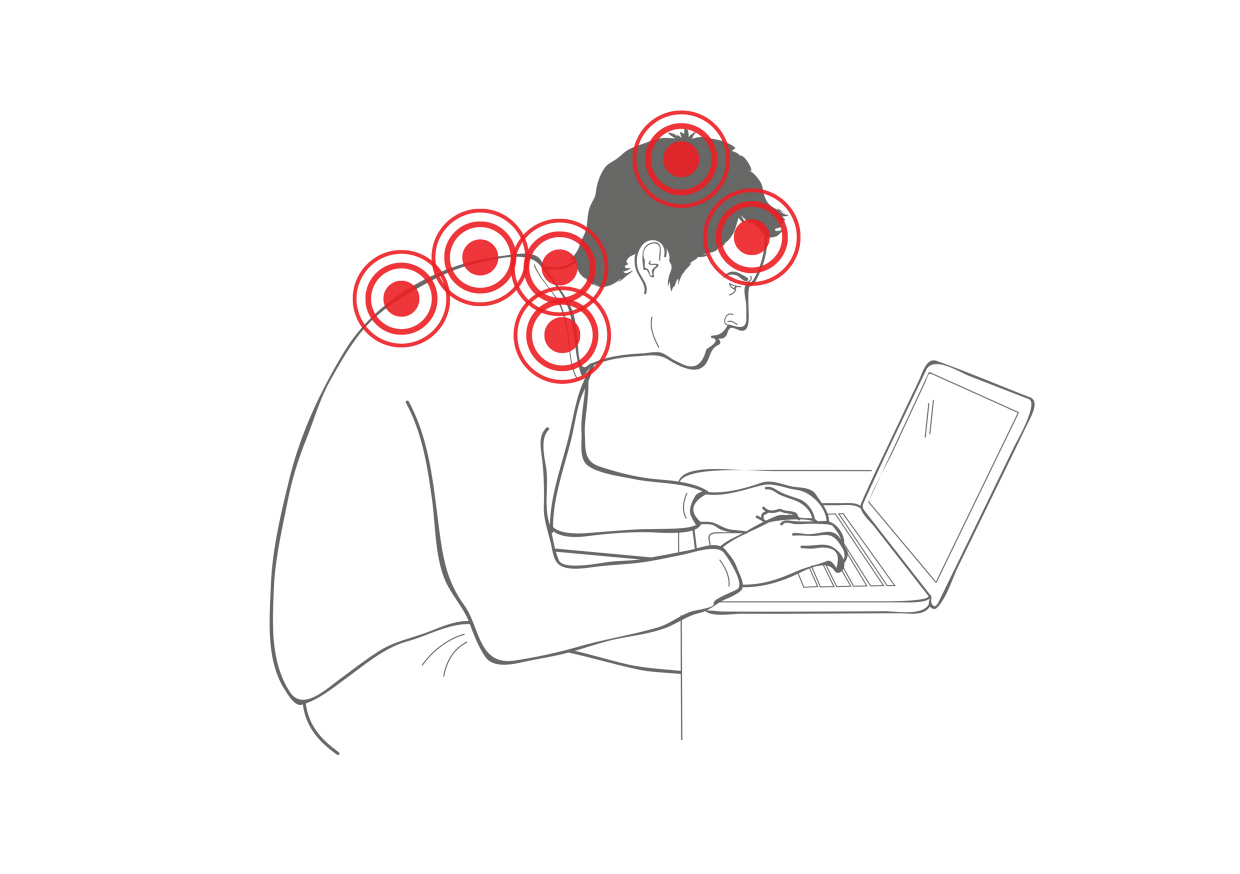
Forward head posture (FHP) is an excessively kyphotic (hunched) thoracic spine. It is clinically recognized as a form of repetitive strain injury.[citation needed] The posture can occur in dentists, surgeons, and hairdressers, or people who spend time on electronic devices. It is one of the most common postural issues. There is a correlation between forward head posture and neck pain in adults, but not adolescents.
Having both forward head posture and rounded shoulders is known as upper crossed syndrome.
Indications are that the prevalence of upper back and neck pain has increased dramatically in the decade leading up to 2016. This increase has been attributed to the corresponding widespread adoption of laptop computers, tablets, smartphones and other small portable digital devices.
Because their screens do not separate from their keyboards these small devices cannot be set up ergonomically correctly (unless an extra screen or extra keyboard is added). They are unlike personal desk top computers (PCs) in this respect. Most commonly, the user hunches to operate them, often for many hours a day.
Hunching increases the effective load on the neck up to several times more than does erect posture, due to increasing moment arm. Local pain, cervicogenic headache and referred pain extending down the arms can arise from the sustained muscle strain, cervical facet joint (or apophyseal, or zygapophyseal joint) compression and diminution of the cervical foraminal nerve exits.
Treatment may include regular breaks while using mobile devices, strengthening and stretching of the neck and upper back muscles, massage, spinal manipulation and mobilisation, posture awareness, and the use of ergonomic tools. Biomechanical analysis suggests a combination of approaches is best and gives more lasting results.
In a neck with perfect posture (as seen for instance in young children) the head is balanced above the shoulders. In this position the load on each vertebra of the cervical spine is spread evenly between the two facet (apophyseal) joints at the back and the intervertebral disc and vertebral body at the front.
The condition is characterised by a posture with vagi at the head sitting somewhat forward of the shoulders (i.e., the ear lobe is anterior to a vertical line through the point of the shoulder (acromion process)). This can be very marked, with the back of the skull positioned anterior to the breastbone (sternum). The chin is poked forward.
Hub AI
Forward head posture AI simulator
(@Forward head posture_simulator)
Forward head posture
Forward head posture (FHP) is an excessively kyphotic (hunched) thoracic spine. It is clinically recognized as a form of repetitive strain injury.[citation needed] The posture can occur in dentists, surgeons, and hairdressers, or people who spend time on electronic devices. It is one of the most common postural issues. There is a correlation between forward head posture and neck pain in adults, but not adolescents.
Having both forward head posture and rounded shoulders is known as upper crossed syndrome.
Indications are that the prevalence of upper back and neck pain has increased dramatically in the decade leading up to 2016. This increase has been attributed to the corresponding widespread adoption of laptop computers, tablets, smartphones and other small portable digital devices.
Because their screens do not separate from their keyboards these small devices cannot be set up ergonomically correctly (unless an extra screen or extra keyboard is added). They are unlike personal desk top computers (PCs) in this respect. Most commonly, the user hunches to operate them, often for many hours a day.
Hunching increases the effective load on the neck up to several times more than does erect posture, due to increasing moment arm. Local pain, cervicogenic headache and referred pain extending down the arms can arise from the sustained muscle strain, cervical facet joint (or apophyseal, or zygapophyseal joint) compression and diminution of the cervical foraminal nerve exits.
Treatment may include regular breaks while using mobile devices, strengthening and stretching of the neck and upper back muscles, massage, spinal manipulation and mobilisation, posture awareness, and the use of ergonomic tools. Biomechanical analysis suggests a combination of approaches is best and gives more lasting results.
In a neck with perfect posture (as seen for instance in young children) the head is balanced above the shoulders. In this position the load on each vertebra of the cervical spine is spread evenly between the two facet (apophyseal) joints at the back and the intervertebral disc and vertebral body at the front.
The condition is characterised by a posture with vagi at the head sitting somewhat forward of the shoulders (i.e., the ear lobe is anterior to a vertical line through the point of the shoulder (acromion process)). This can be very marked, with the back of the skull positioned anterior to the breastbone (sternum). The chin is poked forward.