



Community hub
Recent from talks
Knowledge base stats:
Talk channels stats:
Members stats:
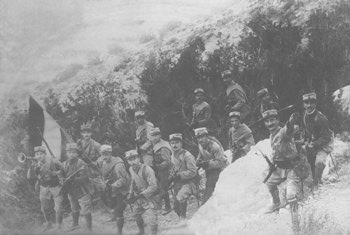
French Armenian Legion
The Armenian Legion (French: Légion Arménienne; Armenian: ֆրանսիական Հայկական Լեգիոն) was a volunteer unit that was raised by the Allied Powers to serve in the Middle East Theatre during World War I. Trained and led by French army commanders, the Légion d'Orient (Eastern Legion), as the unit was originally known, was created in 1916, its ranks chiefly drawn from Levantine and Armenian exiles and refugees from the Ottoman Empire. In 1919, it was renamed the Légion Arménienne (Armenian Legion).
The establishment of an Armenian fighting force was first proposed by Boghos Nubar, the head of the Armenian National Delegation in Paris, during the landing of Allied forces to Alexandretta (İskenderun) in 1914, to British military planners. The British government rejected the plan, on the basis that such a plan would lead to the massacres of local Armenians. However, appeals by the Armenian National Defense Committee continued into 1915. French authorities also rejected the plan at the end of 1915. In 1916, British and French authorities revisited the idea of forming an Armenian unit within the Allied armies in the Middle East, not least due to the British burden in hosting Armenian refugees from Musa Dagh at Port Said in Egypt. The French military agreed to shoulder the costs of training and arming such a fighting force and began preparations. Boghos Nubar and other Armenian leaders in turn expressed some hesitation, but by October of that year came around the idea of supporting the Allied initiative and signed an agreement to that effect. The decision to form the legion became possible only after Britain and France settled their designs over the region in the Sykes-Picot Agreement.
Negotiations of Boghos Nubar with French political and military authorities culminated in the formation of the French Armenian Legion.[citation needed]
The Legion was established officially in Cairo, Egypt in November 1916, with the accord of the French Ministry of Foreign Affairs and an Armenian delegation. Several Armenian organizations pledged contributions to form several battalions under the planned Armenian Legion.[citation needed]
The parties agreed to the following:[citation needed]
Signed in Paris by General Pierre Roques, Minister of War, and General Marie-Jean-Lucien Lacaze, Minister of Navy, the official decision regarding the establishment of the Armenian Legion was signed on 15 November 1916 in Paris.[citation needed]
According to this initial decision,[citation needed]
The number of volunteers was an equivalent of 6 battalions, each containing 800 volunteers, and another 6 battalions were planned to be formed. Armenian committees were organizing to recruit these soldiers in France and the United States.[citation needed]
Hub AI
French Armenian Legion AI simulator
(@French Armenian Legion_simulator)
French Armenian Legion
The Armenian Legion (French: Légion Arménienne; Armenian: ֆրանսիական Հայկական Լեգիոն) was a volunteer unit that was raised by the Allied Powers to serve in the Middle East Theatre during World War I. Trained and led by French army commanders, the Légion d'Orient (Eastern Legion), as the unit was originally known, was created in 1916, its ranks chiefly drawn from Levantine and Armenian exiles and refugees from the Ottoman Empire. In 1919, it was renamed the Légion Arménienne (Armenian Legion).
The establishment of an Armenian fighting force was first proposed by Boghos Nubar, the head of the Armenian National Delegation in Paris, during the landing of Allied forces to Alexandretta (İskenderun) in 1914, to British military planners. The British government rejected the plan, on the basis that such a plan would lead to the massacres of local Armenians. However, appeals by the Armenian National Defense Committee continued into 1915. French authorities also rejected the plan at the end of 1915. In 1916, British and French authorities revisited the idea of forming an Armenian unit within the Allied armies in the Middle East, not least due to the British burden in hosting Armenian refugees from Musa Dagh at Port Said in Egypt. The French military agreed to shoulder the costs of training and arming such a fighting force and began preparations. Boghos Nubar and other Armenian leaders in turn expressed some hesitation, but by October of that year came around the idea of supporting the Allied initiative and signed an agreement to that effect. The decision to form the legion became possible only after Britain and France settled their designs over the region in the Sykes-Picot Agreement.
Negotiations of Boghos Nubar with French political and military authorities culminated in the formation of the French Armenian Legion.[citation needed]
The Legion was established officially in Cairo, Egypt in November 1916, with the accord of the French Ministry of Foreign Affairs and an Armenian delegation. Several Armenian organizations pledged contributions to form several battalions under the planned Armenian Legion.[citation needed]
The parties agreed to the following:[citation needed]
Signed in Paris by General Pierre Roques, Minister of War, and General Marie-Jean-Lucien Lacaze, Minister of Navy, the official decision regarding the establishment of the Armenian Legion was signed on 15 November 1916 in Paris.[citation needed]
According to this initial decision,[citation needed]
The number of volunteers was an equivalent of 6 battalions, each containing 800 volunteers, and another 6 battalions were planned to be formed. Armenian committees were organizing to recruit these soldiers in France and the United States.[citation needed]