
Recent from talks
French language in Morocco
Knowledge base stats:
Talk channels stats:
Members stats:
French language in Morocco
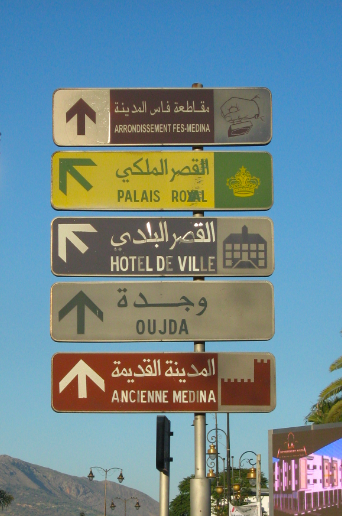
French is one of the languages spoken in Morocco. The use of French is a colonial legacy of the French protectorate (1912–1956). French has no officially recognised status in Morocco, but is often used for business, diplomacy, and government, serving as a lingua franca with non-Moroccans and non-Arabs. Aleya Rouchdy, author of Language Contact and Language Conflict in Arabic, said that "For all practical purposes, French is used as a second language." As of 2010, French continued to serve as a means of bridging the country "not only to Europe but also to Francophone Africa". Circa 2021, the influence of French had been challenged by that of English.
Estimates of French speakers in Morocco vary by sources. According to the Organisation internationale de la Francophonie, 33% of Moroccans spoke French in 2007, 13.5% being fully francophone (fluent speakers) and 19.5% partially francophone.
The 1912 Treaty of Fes, which established the French Protectorate in Morocco, was negotiated in French, with Abdelqader Ben Ghabrit interpreting and translating for Sultan Abd al-Hafid, who spoke Arabic. French colonial authorities in Morocco introduced the French language to the country, making it the language of government administration, educational instruction, and the media; therefore Modern Standard Arabic was only used for traditional activities and religious services. The French government had intended for the French culture and the French language to be viewed as "civilization and advancement".
The French authorities forbade Moroccans from publishing newspapers in Arabic, especially if covering politics. Due to these restrictions, the Moroccan journalist Muhammad Ibn al-Hassan al-Wazzaani published L'Action du Peuple (The Work of the People), the first francophone newspaper published by the Moroccan Nationalist Movement in the area under the control of the French Protectorate in Morocco, in Fes on August 4, 1933. The decision to publish in French was controversial; al-Wazzaani, who had studied in France, was one of the few who supported the use of French to address the colonial apparatus in its own language, and influence French popular opinion, both in Morocco and in France.
In 1956 Morocco declared independence, and in the government declared Modern Standard Arabic as the official language. In the early 1960s the Moroccan government began the Arabisation process, in which the Istiqlal leader Allal al-Fassi played a major role. After independence, to facilitate economic growth and to increase its ties to Europe, the Moroccan government decided to strengthen its ties with France, resulting in the promotion of French.
Under Hassan II, Arabisation of the humanities was instrumentalised to suppress critical thought—replacing the subject of "Sociology" with "Islamic Thought," for example—in a move which Susan Gilson Miller described as a "crude and obvious attempt to foster a more conservative atmosphere within academia and to dampen enthusiasm for the radicalising influences filtering in from Europe."
By 2005 Morocco engaged in economic liberalisation and privatisation; Moha Ennaji, author of Multilingualism, Cultural Identity, and Education in Morocco, said that these activities, in many sectors, reinforced the usage of French.
In 2014, 75% of Facebook users in Morocco posted in French.
Hub AI
French language in Morocco AI simulator
(@French language in Morocco_simulator)
French language in Morocco
French is one of the languages spoken in Morocco. The use of French is a colonial legacy of the French protectorate (1912–1956). French has no officially recognised status in Morocco, but is often used for business, diplomacy, and government, serving as a lingua franca with non-Moroccans and non-Arabs. Aleya Rouchdy, author of Language Contact and Language Conflict in Arabic, said that "For all practical purposes, French is used as a second language." As of 2010, French continued to serve as a means of bridging the country "not only to Europe but also to Francophone Africa". Circa 2021, the influence of French had been challenged by that of English.
Estimates of French speakers in Morocco vary by sources. According to the Organisation internationale de la Francophonie, 33% of Moroccans spoke French in 2007, 13.5% being fully francophone (fluent speakers) and 19.5% partially francophone.
The 1912 Treaty of Fes, which established the French Protectorate in Morocco, was negotiated in French, with Abdelqader Ben Ghabrit interpreting and translating for Sultan Abd al-Hafid, who spoke Arabic. French colonial authorities in Morocco introduced the French language to the country, making it the language of government administration, educational instruction, and the media; therefore Modern Standard Arabic was only used for traditional activities and religious services. The French government had intended for the French culture and the French language to be viewed as "civilization and advancement".
The French authorities forbade Moroccans from publishing newspapers in Arabic, especially if covering politics. Due to these restrictions, the Moroccan journalist Muhammad Ibn al-Hassan al-Wazzaani published L'Action du Peuple (The Work of the People), the first francophone newspaper published by the Moroccan Nationalist Movement in the area under the control of the French Protectorate in Morocco, in Fes on August 4, 1933. The decision to publish in French was controversial; al-Wazzaani, who had studied in France, was one of the few who supported the use of French to address the colonial apparatus in its own language, and influence French popular opinion, both in Morocco and in France.
In 1956 Morocco declared independence, and in the government declared Modern Standard Arabic as the official language. In the early 1960s the Moroccan government began the Arabisation process, in which the Istiqlal leader Allal al-Fassi played a major role. After independence, to facilitate economic growth and to increase its ties to Europe, the Moroccan government decided to strengthen its ties with France, resulting in the promotion of French.
Under Hassan II, Arabisation of the humanities was instrumentalised to suppress critical thought—replacing the subject of "Sociology" with "Islamic Thought," for example—in a move which Susan Gilson Miller described as a "crude and obvious attempt to foster a more conservative atmosphere within academia and to dampen enthusiasm for the radicalising influences filtering in from Europe."
By 2005 Morocco engaged in economic liberalisation and privatisation; Moha Ennaji, author of Multilingualism, Cultural Identity, and Education in Morocco, said that these activities, in many sectors, reinforced the usage of French.
In 2014, 75% of Facebook users in Morocco posted in French.
Recent media