



Community hub
Recent from talks
Knowledge base stats:
Talk channels stats:
Members stats:
Frequency modulation
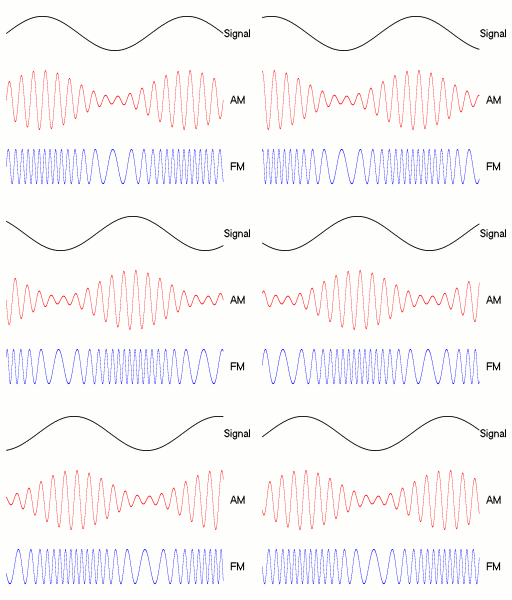
Frequency modulation (FM) is a signal modulation technique used in electronic communication, originally for transmitting messages with a radio wave. In frequency modulation a carrier wave is varied in its instantaneous frequency in proportion to a property, primarily the instantaneous amplitude, of a message signal, such as an audio signal. The technology is used in telecommunications, radio broadcasting, signal processing, and computing.
In analog frequency modulation, such as radio broadcasting of voice and music, the instantaneous frequency deviation, i.e. the difference between the frequency of the carrier and its center frequency, has a functional relation to the modulating signal amplitude.
Digital data can be encoded and transmitted with a type of frequency modulation known as frequency-shift keying (FSK), in which the instantaneous frequency of the carrier is shifted among a set of frequencies. The frequencies may represent digits, such as 0 and 1. FSK is widely used in computer modems such as fax modems, telephone caller ID systems, garage door openers, and other low-frequency transmissions. Radioteletype also uses FSK.
Frequency modulation is widely used for FM radio broadcasting. It is also used in telemetry, radar, seismic prospecting, and monitoring newborns for seizures via EEG, two-way radio systems, sound synthesis, magnetic tape-recording systems and some video-transmission systems. In radio transmission, an advantage of frequency modulation is that it has a larger signal-to-noise ratio and therefore rejects radio frequency interference better than an equal power amplitude modulation (AM) signal. For this reason, most music is broadcast over FM radio.
Frequency modulation and phase modulation are the two complementary principal methods of angle modulation; phase modulation is often used as an intermediate step to achieve frequency modulation. These methods contrast with amplitude modulation, in which the amplitude of the carrier wave varies, while the frequency and phase remain constant.
According to Nahin, "To apply the baseband signal of a microphone output directly to the transmitter antenna won't work, because ...a quarter-wavelength antenna at audio frequencies is physically enormous. To have a reasonably sized antenna requires a transmitter signal at frequencies considerably higher than those of the bandwidth spectrum; that is, the baseband spectrum must be upshifted to the radio frequencies." This is called signal modulation. According to Bertrand, "Frequency modulation is a method of modulating a carrier wave whereby the modulating audio causes the instantaneous frequency of the carrier to change. Without modulation, an FM transmitter produces a single carrier frequency."
The FM signal produced by a sinusoidal carrier of frequency ωc, modulated by an audio tone of frequency ωa with amplitude A, can be written as:
We need the instantaneous frequency, which describes a frequency varying above and below the carrier frequency at the audio tone frequency, which we derive by using Carson's time derivative method:
Hub AI
Frequency modulation AI simulator
(@Frequency modulation_simulator)
Frequency modulation
Frequency modulation (FM) is a signal modulation technique used in electronic communication, originally for transmitting messages with a radio wave. In frequency modulation a carrier wave is varied in its instantaneous frequency in proportion to a property, primarily the instantaneous amplitude, of a message signal, such as an audio signal. The technology is used in telecommunications, radio broadcasting, signal processing, and computing.
In analog frequency modulation, such as radio broadcasting of voice and music, the instantaneous frequency deviation, i.e. the difference between the frequency of the carrier and its center frequency, has a functional relation to the modulating signal amplitude.
Digital data can be encoded and transmitted with a type of frequency modulation known as frequency-shift keying (FSK), in which the instantaneous frequency of the carrier is shifted among a set of frequencies. The frequencies may represent digits, such as 0 and 1. FSK is widely used in computer modems such as fax modems, telephone caller ID systems, garage door openers, and other low-frequency transmissions. Radioteletype also uses FSK.
Frequency modulation is widely used for FM radio broadcasting. It is also used in telemetry, radar, seismic prospecting, and monitoring newborns for seizures via EEG, two-way radio systems, sound synthesis, magnetic tape-recording systems and some video-transmission systems. In radio transmission, an advantage of frequency modulation is that it has a larger signal-to-noise ratio and therefore rejects radio frequency interference better than an equal power amplitude modulation (AM) signal. For this reason, most music is broadcast over FM radio.
Frequency modulation and phase modulation are the two complementary principal methods of angle modulation; phase modulation is often used as an intermediate step to achieve frequency modulation. These methods contrast with amplitude modulation, in which the amplitude of the carrier wave varies, while the frequency and phase remain constant.
According to Nahin, "To apply the baseband signal of a microphone output directly to the transmitter antenna won't work, because ...a quarter-wavelength antenna at audio frequencies is physically enormous. To have a reasonably sized antenna requires a transmitter signal at frequencies considerably higher than those of the bandwidth spectrum; that is, the baseband spectrum must be upshifted to the radio frequencies." This is called signal modulation. According to Bertrand, "Frequency modulation is a method of modulating a carrier wave whereby the modulating audio causes the instantaneous frequency of the carrier to change. Without modulation, an FM transmitter produces a single carrier frequency."
The FM signal produced by a sinusoidal carrier of frequency ωc, modulated by an audio tone of frequency ωa with amplitude A, can be written as:
We need the instantaneous frequency, which describes a frequency varying above and below the carrier frequency at the audio tone frequency, which we derive by using Carson's time derivative method: