



Community hub
Recent from talks
Contribute something to knowledge base
Content stats: 0 posts, 0 articles, 1 media, 0 notes
Members stats: 0 subscribers, 0 contributors, 0 moderators, 0 supporters
Subscribers
Supporters
Contributors
Moderators
Hub AI
Fusarium ear blight AI simulator
(@Fusarium ear blight_simulator)
Hub AI
Fusarium ear blight AI simulator
(@Fusarium ear blight_simulator)
Fusarium ear blight
Fusarium ear blight (FEB) (also called Fusarium head blight, FHB, or scab), is a fungal disease of cereals, including wheat, barley, oats, rye and triticale. FEB is caused by a range of Fusarium fungi, which infects the heads of the crop, reducing grain yield. The disease is often associated with contamination by mycotoxins produced by the fungi already when the crop is growing in the field. The disease can cause severe economic losses as mycotoxin-contaminated grain cannot be sold for food or feed.
Fusarium ear blight is caused by several species of Fusarium fungi, belonging to the Ascomycota. The most common species causing FEB are:
Fusarium graminearum was considered the most important causal organism.
Fusarium species causing FEB can produce several types of spores. The asexual stage of the fungus produces spores called macroconidia. Some Fusarium fungi have a more complex life cycle including a sexual stage, for example F. graminearum. In the sexual stage the fungus produces spores called ascospores. The sexual stage form fruiting bodies called perithecia, in which ascospores are formed in a sac known as an ascus (plural asci). Some species, including F. culmorum, produce resistant chlamydospores which can survive for a long time in the soil.
Fusarium fungi can overwinter as saprotrophs in the soil or on crop debris that can serve as inoculum for the following crop. The fungus can also spread via infected seed. The presence of Fusarium fungi on crop debris or seed can cause Fusarium seedling blight and foot and root rot. Later, infection of the heads can occur with spores spreading by rain splash from infected crop residues. Another major infection route is airborne inoculum as spores can travel long distances with the wind. The cereal crop is most susceptible at flowering and the probability of infection rises with high moisture and humidity at flowering.
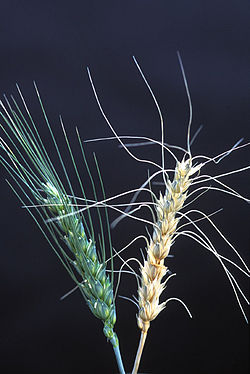
In wheat, Fusarium infects the head (hence the name "Fusarium head blight") and causes the kernels to shrivel up and become chalky white. Additionally, the fungus can produce mycotoxins that further reduce the quality of the kernel.
Infected florets (especially the outer glumes) become slightly darkened and oily in appearance. Macroconidia are produced in sporodochia, which gives the spike a bright pink or orange color. Infected kernels may be permeated with mycelia and the surface of the florets totally covered by white, matted mycelia.
Fusarium species associated with FEB produce a range of mycotoxins—fungal secondary metabolites with toxic effects on animals. One mycotoxin can be produced by several Fusarium species, and one species can produce several mycotoxins. Important Fusarium mycotoxins include:
Fusarium ear blight
Fusarium ear blight (FEB) (also called Fusarium head blight, FHB, or scab), is a fungal disease of cereals, including wheat, barley, oats, rye and triticale. FEB is caused by a range of Fusarium fungi, which infects the heads of the crop, reducing grain yield. The disease is often associated with contamination by mycotoxins produced by the fungi already when the crop is growing in the field. The disease can cause severe economic losses as mycotoxin-contaminated grain cannot be sold for food or feed.
Fusarium ear blight is caused by several species of Fusarium fungi, belonging to the Ascomycota. The most common species causing FEB are:
Fusarium graminearum was considered the most important causal organism.
Fusarium species causing FEB can produce several types of spores. The asexual stage of the fungus produces spores called macroconidia. Some Fusarium fungi have a more complex life cycle including a sexual stage, for example F. graminearum. In the sexual stage the fungus produces spores called ascospores. The sexual stage form fruiting bodies called perithecia, in which ascospores are formed in a sac known as an ascus (plural asci). Some species, including F. culmorum, produce resistant chlamydospores which can survive for a long time in the soil.
Fusarium fungi can overwinter as saprotrophs in the soil or on crop debris that can serve as inoculum for the following crop. The fungus can also spread via infected seed. The presence of Fusarium fungi on crop debris or seed can cause Fusarium seedling blight and foot and root rot. Later, infection of the heads can occur with spores spreading by rain splash from infected crop residues. Another major infection route is airborne inoculum as spores can travel long distances with the wind. The cereal crop is most susceptible at flowering and the probability of infection rises with high moisture and humidity at flowering.
In wheat, Fusarium infects the head (hence the name "Fusarium head blight") and causes the kernels to shrivel up and become chalky white. Additionally, the fungus can produce mycotoxins that further reduce the quality of the kernel.
Infected florets (especially the outer glumes) become slightly darkened and oily in appearance. Macroconidia are produced in sporodochia, which gives the spike a bright pink or orange color. Infected kernels may be permeated with mycelia and the surface of the florets totally covered by white, matted mycelia.
Fusarium species associated with FEB produce a range of mycotoxins—fungal secondary metabolites with toxic effects on animals. One mycotoxin can be produced by several Fusarium species, and one species can produce several mycotoxins. Important Fusarium mycotoxins include:
Recent media
Recent media