


Community hub
Recent from talks
Contribute something
Nothing was collected or created yet.
Gaiman Formation
View on WikipediaThe Gaiman Formation (Spanish: Formación Gaiman), in older literature also referred to as Patagonian Marine Formation (Spanish: Formación Patagonia Marino, Patagoniense), is a fossiliferous geologic formation of the Peninsula Valdés Basin in the eastern Chubut Province of northwestern Patagonia, eastern Argentina.
Key Information


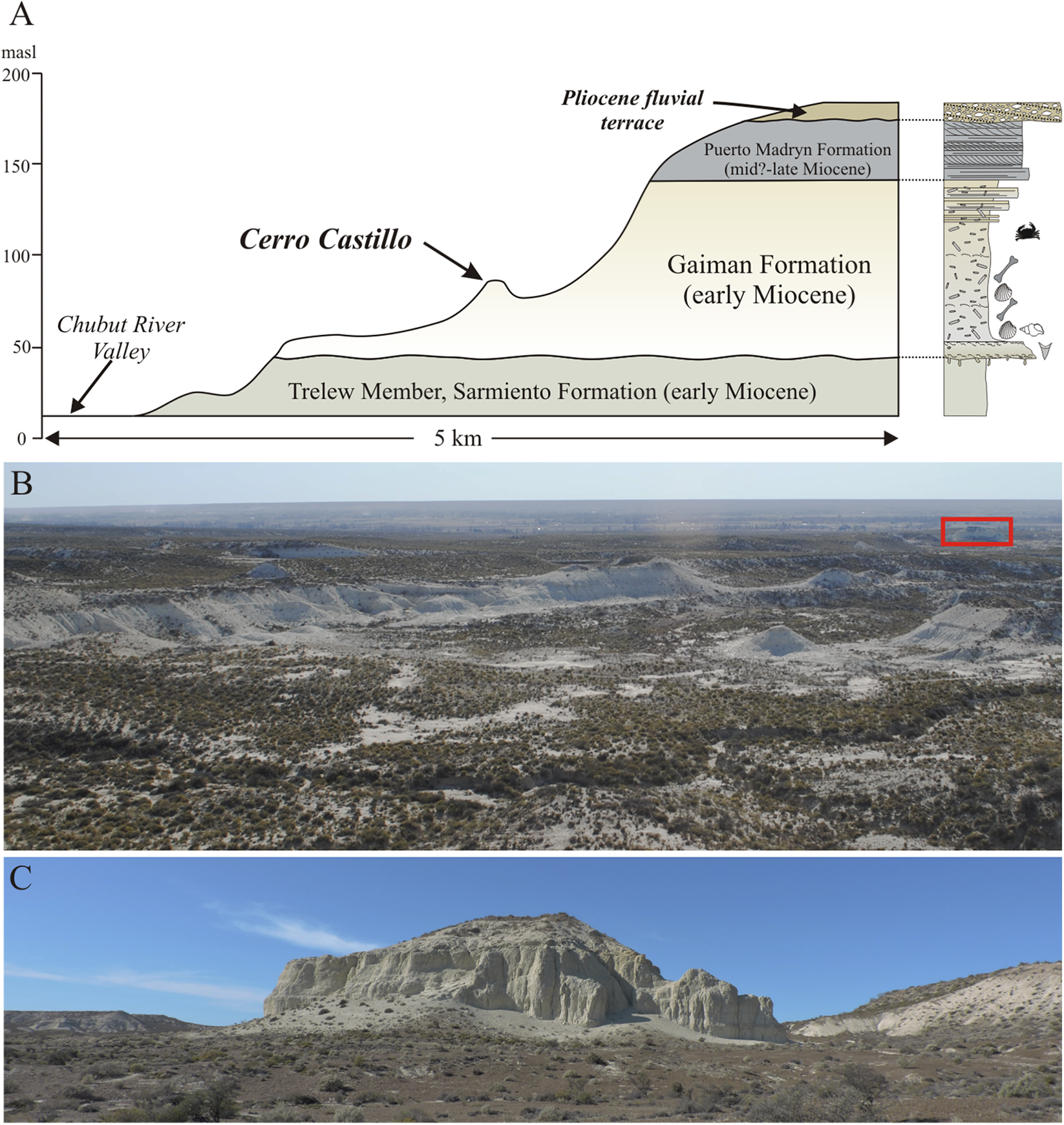
The 70 metres (230 ft) thick formation overlies the Sarmiento Formation and is overlain by the Puerto Madryn Formation and comprises grey and white tuffaceous mudstones and sandstones, deposited in a shallow marine environment.
The Gaiman Formation has provided fossils of many extinct penguins, among which five species in the genus Palaeospheniscus, as well as whales and dolphins, most notably Aondelphis talen, Prosqualodon australis, Idiorophus patagonicus and Argyrocetus patagonicus, indeterminate seal and turtle fossils, shark and other fossils. The richness of the formation, and the other formations in the area, such as the underlying Sarmiento Formation, led to the establishment of the Bryn Gwyn Paleontological Park, with a Welsh name, reflecting the number of Welsh settlers in the region.
Description
[edit]
The Gaiman Formation was first defined by Mendía & Bayarsky in 1981,[1] and further described by Mendía in 1983, taking its name from Gaiman in Chubut Province, eastern Patagonia.[2] Gaiman in the local language of the native Tehuelche people means "rocky point".[3] The formation crops out in the lower course of the Chubut River,[4] and overlies the continental Trelew Member of the Sarmiento Formation and is overlain by the Late Miocene Puerto Madryn Formation. The formation is 70 metres (230 ft) thick,[5] and comprises marine tuffs, tuffaceous mudstones, sandstones and coquinas.[1]
The Gaiman Formation is correlated with the Chenque Formation of the Golfo San Jorge Basin and the Monte León Formation of the Austral Basin to the south, the Saladar Member of the lower Gran Bajo del Gualicho Formation of the Colorado Basin to the north and the Vaca Mahuida Formation of the Neuquén Basin to the northwest.[6]
Depositional environment
[edit]The basal stratum of the Gaiman Formation is a thin transgressive lag with some gravels, bones and teeth from marine vertebrates.[5] The unit displays a concentration of phosphatic concretions, ooids, bones and teeth.[7] The marine sediments overlying this basal stratum are composed of white, tuffaceous, thoroughly bioturbated mudstones and fine sandstones with occasional mollusk molds and thin oyster horizons, deposited in a shallow shelf environment.[5]
The marine transgression leading to the deposition of the Gaiman Formation is the first of two major South Atlantic transgressions of the Miocene, the second causing the deposition of the overlying Puerto Madryn Formation.[8]
Facies analysis shows that the formation represents a transgressive-regressive stratigraphic cycle, with palaeoenvironments including coastal, storm-dominated shoreface, inner shelf embayment and open inner shelf.[9]
The age of the Gaiman Formation is established on stratigraphic correlations to other absolutely-dated sections in Patagonia and biostratigraphic data and dates to the Early Miocene (Burdigalian, or Colhuehuapian in the SALMA classification).[5]
Paleontological significance
[edit].JPG)
The Gaiman Formation has provided several fossil penguins, of which nine are assigned to specific species and include five species of the genus Palaeospheniscus. Also, shark teeth, fossils of indeterminate seals and turtles, and several dolphins, baleen and toothed whales have been found in the formation. Argentine paleontologist Florentino Ameghino described an isolated tooth from the formation first as an ichthyodectiform fish, Portheus patagonicus in 1901, however this fossil was assigned to a delphinoid cetacean of the family Kentriodontidae by Cione and Cozzuol in 1990.[10] Fish recorded from the formation are hexanchiform hexanchids, lamniform isurids, odontaspidids, cetorhinids, carcharhiniform carcharhinids, heterodontiform heterodontids, squatiniform squatinids myliobatiform myliobatids, perciform oplegnathids and labrids, and tetraodontiform molids.[11] Rays are abundant in the formation.[12] The lack of somatic remains of most molluscs, bryozoans, polychaetes and cirripeds in the formation is attributed to the high-energy and corrosive environment at time of deposition, as well as diagenesis after the formation was deposited.[13]
The bird species Eretiscus tonnii solely occurs in the Gaiman Formation.[14] Bite marks on several of the penguin bones are attributed to terrestrial mammals such as didelphid or hathliacyniid sparassodont marsupials, common in Patagonia during the Miocene.[15] Other ichnofossils found on the bones are presumably caused by dental erosion by regular echinoids,[16] and bite marks by sharks, as Galeocerdo aduncus.[17]
The paleontological richness of the formation, as well as the more fossiliferous underlying Sarmiento Formation, led to the establishment of the Bryn Gwyn Paleontological Park.[18]
Fossil content
[edit]The formation has provided the following fossils:[19][20][21][22][23]
Mammals
[edit]Cetaceans
[edit]| Taxa | Species | Locality | Material | Description | Images | Notes |
|---|---|---|---|---|---|---|
| Aglaocetus | A. moreni | Cerro del Castillo and Bahia Solano | A skull | An early baleen Whale |  |
[24] |
| Aondelphis | A. talen | Bryn Gwyn Locality | A partial skull | An early river dolphin | [25] | |
| Argyrocetus | A. patagonicus | Bryn Gwyn Locality | A skull | An early toothed whale | [12] | |
| Crisocetus | C. lydekkeri | Estancia El Crisol | A partial skull | An early toothed whale | [26] | |
| Dolgopolis | D. kinchikafiforo | Estancia El Crisol | A partial skull | An early toothed whale | [27] | |
| Eurhinodelphinidae | indet. | [20] | ||||
| Idiorophus | I. patagonicus | Bryn Gwyn Locality | A complete skull | An early toothed whale |  |
[24] |
| Kentriodon | K. sp. | Bryn Gwyn Locality | A specimen | An early toothed whale |  |
[12] |
| Morenocetus | M. parvus | Cerro del Castillo, Trelew | A partial cranium | An early baleen whale |  |
[24] |
| Phoberodon | P. arctirostris | Playa Magagna and Cerro del Castillo, Trelew | A partial skeleton with skull | An early river dolphin |  |
[12] |
| Plesiocetus | P. dyticus | Cerro del Castillo | A specimen | An early rorquals | [24] | |
| Prosqualodon | P. australis | Playa Magagna and Cerro del Castillo | A preserved skeleton | An early toothed whale |  |
[12][28] |
| Squalodontidae | indet. | [20] |
Pinnipeds
[edit]| Taxa | Species | Locality | Material | Description | Images | Notes |
|---|---|---|---|---|---|---|
| Phocidae | indet. | [22] |
Birds
[edit]| Taxa | Species | Locality | Material | Description | Images | Notes |
|---|---|---|---|---|---|---|
| Anseriformes | indet. | [20] | ||||
| Apterodytes | A. ictus | Cerro del Castillo | An early penguin | [21] | ||
| Arthrodytes | A. sp. | [20] | ||||
| Cayaoa | C. bruneti | Cerro Castillo | A specimen | An early anatid water bird | [4][29] | |
| Eretiscus | E. tonnii | An early prenguin | [30] | |||
| Palaeospheniscus | P. bergi | Cerro del Castillo, Trelew | A set of limb elements (humerus, radius, tarsometatarsus) | An early penguin | [30][19] | |
| P. bilocular | Cerro del Castillo | Two characteristic humeri (AMNH 3341 and 3346) | A early penguin, formally named Chubutodyptes biloculata | [30] | ||
| P. gracilis | Gran Bajo de San Julian and Cerro del Castillo | A specimen | An early penguin | [20] | ||
| P. patagonicus | Cerro del Castillo | An early penguin | [19][31] | |||
| P. wimani | Cerro del Castillo | An early penguin | [22] | |||
| Paraptenodytes | P. antarcticus | A partial skeleton |  |
[30] | ||
| P. robustus | [19][31] | |||||
| Sphenisciformes | indet. | [20] |
Reptiles
[edit]| Taxa | Species | Locality | Material | Description | Images | Notes |
|---|---|---|---|---|---|---|
| Dermochelyidae | indet. | [20] | ||||
| Helianthochelys | H. redondita. | Coastal creek located 5 km east of La Redonda Chica House in La Redonda Chica Farm | A near-complete carapace (secondary ossicles and nuchal bone) with a putative skull fragment (jugal) and postcranial elements. | A sea turtle belonging to the family Dermochelyidae. | [32] |
Fish
[edit]| Taxa | Species | Locality | Material | Description | Images | Notes |
|---|---|---|---|---|---|---|
| Carcharoides | C. totuserratus | A mackeral shark | [17] | |||
| Echinorhinus | E. pozzii | [12] | ||||
| Galeocerdo | G. aduncus | [17] | ||||
| Megascyliorhinus | M. trelewensis | [12] | ||||
| Heterodontus | H. sp. | [12] | ||||
| Odontaspis | O. sp. | [12] | ||||
| Pristiophorus | P. sp. | [12] | ||||
| Squalus | S. sp. | [12] | ||||
| Oplegnathidae | O. sp. | [12] | ||||
| Tetraodontiformes | T. sp. | [33] |
Mollusk
[edit]| Taxa | Species | Locality | Material | Description | Images | Notes |
|---|---|---|---|---|---|---|
| Crassostrea | C. ? hatcheri | A bivalve | [23] | |||
| Balanus | B. sp. | A bivalve | [34] | |||
| Turritella | T. sp. | A gastropod | [34] |
Ichnofossils
[edit]| Taxa | Species | Locality | Material | Description | Images | Notes |
|---|---|---|---|---|---|---|
| Chondrites | A Bioturbation | [11] [16] | ||||
| Ophiomorpha | ||||||
| Planolites | ||||||
| Skolithos | ||||||
| Gnathichnus | G. pentax | Bite marks | ||||
| Entobia | Bite marks |
Flora
[edit]| Taxa | Species | Locality | Material | Description | Images | Notes |
|---|---|---|---|---|---|---|
| Chenopodipollis | C. chenopodiaceoides | Isla Escondida | A chenopodiaceae | |||
| Cyatheacidites | C. annulatus | A dicksoniaceae | ||||
| Equisetosporites | E. claricristatus | |||||
| Margocolporites | M. vanwijhei | A fabaceae | ||||
| Nothofagidites | N. saraensis | |||||
| Peromonolites | P. vellosus | A blechnaceae | ||||
| Thalassotaenia | T. notophyllum | A hydrocharitaceae |
See also
[edit]- South American land mammal ages
- Uitpa Formation, contemporaneous fossiliferous formation of the Cocinetas Basin, Colombia
- Castillo Formation, contemporaneous fossiliferous formation of the Falcón Basin, Venezuela
- Biblián Formation, contemporaneous fossiliferous formation of Ecuador
- Bahía Inglesa Formation, contemporaneous fossiliferous formation of Chile
References
[edit]- ^ a b Cione et al., 2010, p.434
- ^ Rodríguez, 2015, p.198
- ^ (in Spanish) Significado de los nombres de los Municipios de Chubut
- ^ a b Noriega & Tambussi, 2008, p.272
- ^ a b c d Viglino et al., 2018, p.263
- ^ Reichler, 2018, p.185
- ^ Cione et al., 2011, p.424
- ^ Cuitiño, 2017, p.47
- ^ Cuitiño et al., 2019
- ^ Cione & Cozzuol, 1990, p.451
- ^ a b Cione et al., 2010, p.443
- ^ a b c d e f g h i j k l Cione et al., 2010, p.429
- ^ Cione et al., 2010, p.450
- ^ Chávez Hoffmeister, 2008, p.82
- ^ Cione et al., 2010, p.437
- ^ a b Cione et al., 2010, p.439
- ^ a b c Cione et al., 2010, p.441
- ^ (in Spanish) Parque paleontológico Bryn Gwyn
- ^ a b c d Cerro del Castillo, Trelew at Fossilworks.org
- ^ a b c d e f g h Bryn Gwyn at Fossilworks.org
- ^ a b Patagonian at Fossilworks.org
- ^ a b c Gaiman (marine vertebrates) at Fossilworks.org
- ^ a b Playa Santa Isabel, south at Fossilworks.org
- ^ a b c d Cione et al., 2011, p.428
- ^ Viglino et al., 2018, p.264
- ^ Gaetán, C. Maximiliano; Paolucci, Florencia; Buono, Mónica R. (2023-08-15). "A new squaloziphiid-like odontocete from the Early Miocene of Patagonia expands the cetacean diversity in the southwestern Atlantic Ocean". Journal of Vertebrate Paleontology. 42 (6). doi:10.1080/02724634.2023.2232425. ISSN 0272-4634. S2CID 260947656.
- ^ Viglino et al., 2020
- ^ Gaetán, 2019
- ^ Tonni, 1979, p.12
- ^ a b c d Cione et al., 2010, p.433
- ^ a b Acosta et al., 2008, p.568
- ^ Sterli, J.; Vlachos, E.; Cuitiño, J. I.; Cerda, I. A.; Buono, M. R. (2025). "Southernmost dermochelyid turtle from the Miocene". Ameghiniana.
- ^ "Tetraodontiformes (Osteichthyes, Actinopterygii) from the Miocene of Argentina: with the southernmost record of fossil Tetraodontidae". Comptes Rendus Palevol. 20 (27): 585–596. 2021.
- ^ a b Acosta et al., 2008, p.566
Bibliography
[edit]- Geology
- Cuitiño, José I.; Buono, Mónica R.; Viglino, Mariana; Farroni, Nicolás D.; Bessone, Santiago (2019), "Factors affecting the preservation and distribution of cetaceans in the lower Miocene Gaiman Formation of Patagonia, Argentina", Palaeogeography, Palaeoclimatology, Palaeoecology, 526: 110–125, Bibcode:2019PPP...526..110C, doi:10.1016/j.palaeo.2019.03.013, retrieved 2019-04-05
- Cuitiño, J.I.; Dozo, M.T; Del Río, C.J.; Buono, M.R.; Palazzesi, L.; Fuentes, S.; Scasso, R.A. (2017), Miocene marine transgressions: Paleoenvironments and paleobiodiversity in: P. Bouza and A. Bilmes (eds.), Springer Earth System Sciences, Late Cenozoic of Península Valdés, Patagonia, Argentina, Springer International Publishing AG, pp. 47–84, retrieved 2019-04-05
- Reichler, Valeria A (2010), "Estratigrafía y paleontología del Cenozoico marino del Gran Bajo y Salinas del Gualicho, Argentina, y descripción de 17 especies nuevas" (PDF), Andean Geology, 31: 177–219, retrieved 2019-04-05
- Rodríguez, Karina M (2015), Análisis de los rasgos geomorfológicos del paleovalle Simpson (Provincia de Chubut) mediante técnicas de procesamiento digital de imágenes LANDSAT7 ETM+ (PDF), VI Congreso Argentino de Cuaternário y Geomorfología, pp. 198–199, archived from the original (PDF) on 2020-02-15, retrieved 2019-04-05
- Paleontology
- Acosta Hospitaleche, C.; Castro, L.; Tambussi, C.; Scasso, R.A. (2008), "Palaeospheniscus patagonicus (Aves, Sphenisciformes): New discoveries from the early Miocene of Argentina", Journal of Paleontology, 82 (3): 565–575, Bibcode:2008JPal...82..565H, doi:10.1666/07-014.1, retrieved 2022-12-12
- Acosta Hospitaleche, Carolina (2007), "Revisión sistemática de Palaeospheniscus biloculata (Simpson) nov. comb. (Aves, Spheniscidae) de la Formación Gaiman (Mioceno Temprano), Chubut, Argentina", Ameghiniana, 44: 417–426, retrieved 2019-04-05
- Chávez Hoffmeister, Martín Felipe (2008), La ornitofauna de la Formación Bahía Inglesa, Caldera, Chile (BSc. thesis) (PDF), Universidad Austral de Chile, pp. 1–165, retrieved 2019-04-05
- Cione, Alberto Luis; Cozzuol, Mario Alberto; Dozo, María Teresa; Acosta Hospitaleche, Carolina (2011), "Marine vertebrate assemblages in the southwest Atlantic during the Miocene", Biological Journal of the Linnean Society, 103 (2): 423–440, doi:10.1111/j.1095-8312.2011.01685.x, hdl:11336/105080, retrieved 2019-04-05
- Cione, A.L.; Acosta Hospitaleche, C.; Pérez, L.; Laza, J.; César, I. (2010), "Trace fossils on penguin bones from the Miocene of Chubut, southern Argentina", Alcheringa, 34 (4): 433–454, Bibcode:2010Alch...34..433C, doi:10.1080/03115511003793470, retrieved 2019-04-05
- Cione, A.L.; Cozzuol, M.A. (1990), "Reidentification of Portheus patagonicus Ameghino, 1901, a supposed fish from the Middle Tertiary of Patagonia as a delphinoid cetacean", Journal of Paleontology, 64 (3): 451–453, Bibcode:1990JPal...64..451C, doi:10.1017/S0022336000018692, retrieved 2019-04-05
- Gaetán, Carlos M (2019), "Prosqualodon australis (Cetacea: Odontoceti) from the early Miocene of Patagonia, Argentina: redescription and phylogenetic analysis", Ameghiniana, in press, archived from the original on 2020-02-08, retrieved 2019-04-05
- Noriega, J.I.; Tambussi, C.P. (2008), "New material of Cayaoa bruneti TONNI, an Early Miocene anseriform (Aves) from Patagonia, Argentina", Neues Jahrbuch für Geologie und Paläontologie, 249 (3): 271–280, doi:10.1127/0077-7749/2008/0249-0271, hdl:11336/80912, retrieved 2019-04-05
- Tonni, Eduardo P (1979), "Un Nuevo Anseriforme de Sedimentos Marinos Terciarios de Chubut, Argentina" (PDF), Hornero, 12 (1): 11–15, doi:10.56178/eh.v12i1.1212, retrieved 2019-04-05
- Viglino, Mariana; Gaetán, C. Maximiliano; Cuitiño, José I.; Buono, Mónica R. (2021), "First Toothless Platanistoid from the Early Miocene of Patagonia: the Golden Age of Diversification of the Odontoceti", Journal of Mammalian Evolution, 28 (2): 337–358, doi:10.1007/s10914-020-09505-w
- Viglino, Mariana; Buono, Mónica R.; Gutstein, Carolina S.; Cozzuol, Mario A.; Cuitiño, José I. (2018), "A new dolphin from the early Miocene of Patagonia, Argentina: Insights into the evolution of Platanistoidea in the Southern Hemisphere" (PDF), Acta Palaeontologica Polonica, 63 (2): 261–277, doi:10.4202/app.00441.2017, retrieved 2019-04-05
Further reading
[edit]- Cabrera, Ángel (1926), "Cetaceos fósiles del Museo de La Plata", Revista del Museo de La Plata, 29: 363–411
- Lydekker, Richard (1894), "Cetacean skulls from Patagonia", Anales del Museo de la Plata, II: 1–13
- Simpson, George Gaylord (1946), "Fossil Penguins", Bulletin of the American Museum of Natural History, 87: 1–100